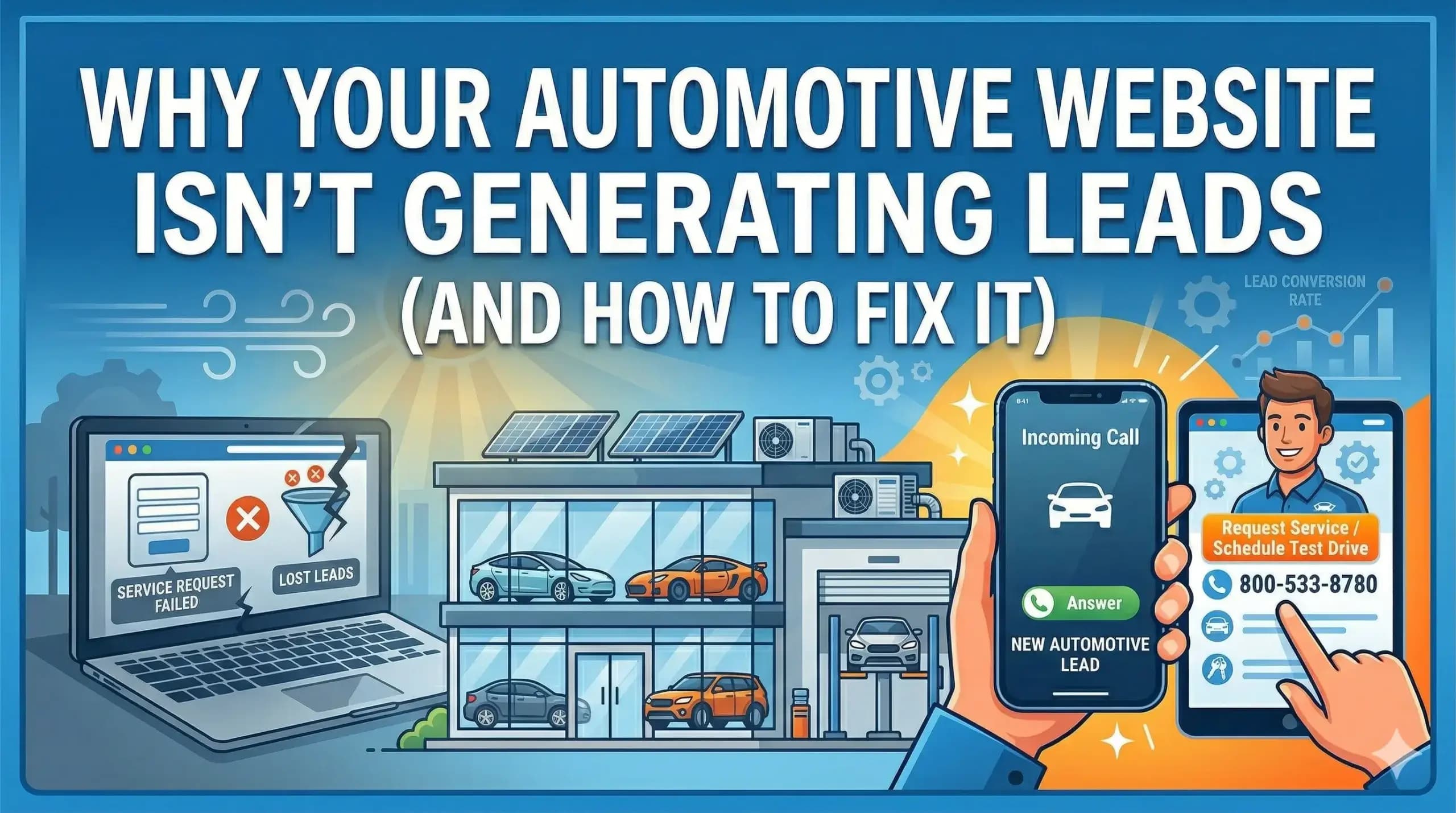
Why Your Automotive Website Isn’t Generating Leads (And How to Fix It)
You’ve got a website. It’s been live for a couple of years. Maybe someone redid it, or maybe it came with your shop management software. Either way, the phone isn’t ringing the way it should — and you’re not sure why.
Here’s the uncomfortable truth: most automotive websites look fine on the surface but are silently failing every single day. They’re not converting visitors into calls. They’re not showing up when local customers search. And they’re handing leads directly to your competitor down the street without you ever knowing.
This isn’t about needing more traffic or spending more on ads. It’s about fixing the foundational problems in your automotive website design that are costing you real customers right now. By the end of this article, you’ll know exactly what’s broken — and what a high-performance fix looks like.
Your Website Is Like a Waiting Room With No Receptionist
Think about it this way: when a customer walks into your shop, someone greets them. They see your certifications on the wall. They know where to sit, what to ask, and that they’re in the right place.
Most automotive websites do none of that. A customer lands on your site, can’t find your phone number, can’t tell what services you offer, and has no idea if you’re trustworthy. So they leave — and call the next shop in Google’s results.
That moment of confusion costs you a customer every single time. And it’s happening dozens of times a day.
Problem #1: Your Phone Number Is Hidden (Or Just Hard to Find)
This sounds too simple to be a real issue. It is absolutely a real issue.
On most automotive websites, the phone number lives in the footer, in small text, buried beneath a navigation menu. On mobile — where 70%+ of your customers are searching — that means they have to scroll past your entire homepage just to find out how to call you.
The real cost: A potential customer searching “oil change near me” at 7pm has three tabs open. Whichever shop makes it easiest to call gets the booking. If that’s not you, it’s someone else.
What a high-performance automotive website does instead: The phone number sits at the very top of every page as a clickable tap-to-call button. On mobile, it’s always visible. No scrolling. No hunting. One tap and they’re talking to you.
Problem #2: Your Site Takes Forever to Load — and Nobody Waits
Imagine a customer pulls into your parking lot, sits in your waiting area for 10 seconds, and then walks out. That’s what a slow website does, every single time.
Most automotive websites load in 6 to 10 seconds. The research is clear: most people abandon a site after 3 seconds if it hasn’t loaded. That means a significant chunk of your visitors are leaving before they’ve even seen your name.
Why it happens: Oversized images, cheap hosting, bloated code, too many plugins — all the technical stuff that gets ignored when a site is built on the cheap. None of it is visible to you. All of it is visible in your call volume.
What Digital Trace does instead: Every automotive website we build is optimized to load in under 2 seconds — tested across real mobile devices, not just desktop. Speed isn’t an afterthought; it’s built into the foundation.
Problem #3: Google Doesn’t Know Enough About Your Business to Trust It
You might wonder why your competitor — with a worse-looking website — shows up before you in Google. The answer usually isn’t about their design. It’s about signals.
Google needs specific information to confidently recommend a local business: your services, your location, your hours, your reviews, and structured data that tells Google’s systems exactly what your business does. Most automotive websites are missing most of this.
The plain-English version: Google is like a cautious customer who only refers friends to businesses they know well. If your site doesn’t give Google enough to work with, it won’t take the risk of putting you in front of searchers — even if you’re the best shop in town.
What this looks like in practice: Your site needs clear service pages (not just “Services” — think “Brake Repair in [City]”), a properly claimed and linked Google Business Profile, consistent contact information, and technical markup that tells Google’s crawlers what they’re reading.
💡 Pro Tip: One of the most common mistakes automotive shops make is having a single “Services” page that lists everything in bullet points. Google rewards specificity. A dedicated page for each service — oil changes, brake repair, tire installation, AC service — not only helps Google understand your business, it also gives you a page that can rank for each individual search. It’s one of the fastest fixes that directly impacts how often you show up locally.
Not Sure If Your Site Has These Problems?
Digital Trace offers a free website audit for automotive businesses — no obligation, just a clear picture of what’s costing you leads. We’ll look at your speed, your mobile experience, your local SEO setup, and your conversion path, then show you exactly what’s working and what’s not.
Problem #4: Your Website Doesn’t Build Trust Fast Enough
When someone’s choosing a shop to trust with their car, they’re making a judgment call in about 8 seconds. Your website either builds that trust or it doesn’t.
Most automotive websites skip the basics: no visible reviews, no certifications displayed prominently, no photos of the actual team or shop, no guarantees. They look like a placeholder — not a professional operation.
The real cost: Customers assume the worst. If your site looks like it hasn’t been updated since 2016, they assume your service might match.
What builds trust fast:
- Google and Yelp review counts displayed prominently (not buried)
- ASE certifications or brand partnerships shown near the top
- Real photos of your shop and team — not stock images
- A clear service guarantee or warranty statement
- Before/after or “what to expect” content that reduces anxiety
These aren’t design extras. They’re conversion elements. Every one of them directly affects whether someone calls or clicks away.
Problem #5: Your Site Wasn’t Built for the Customer Who’s Ready to Book Right Now
There’s a big difference between someone browsing automotive content and someone who’s ready to book a service today. High-intent customers — the ones searching “brake repair near me” or “check engine light diagnosis [city]” — need a direct, frictionless path to contact.
Most automotive websites treat every visitor the same: they show the same homepage, the same generic copy, the same buried contact form. There’s no urgency, no clear next step, no reason to act now instead of later.
What a conversion-focused automotive website design looks like:
- Service-specific landing pages with clear calls to action
- Tap-to-call and online booking options visible immediately
- Location-specific content that confirms “yes, we serve your area”
- Trust signals (reviews, certifications) reinforced on every page, not just the homepage
When a high-intent customer lands on a page built for them, conversion rates jump dramatically. That’s not marketing theory — that’s the practical difference between 3 calls a week and 15.
The Real Numbers: Typical vs. High-Performance Automotive Website
| Factor | Typical Automotive Website | High-Performance Automotive Website |
|---|---|---|
| Calls per month | 3–6 (inconsistent) | 15–35+ (predictable) |
| Page load speed | 6–10 seconds | Under 2 seconds |
| Mobile experience | Buried phone number, hard to navigate | Tap-to-call, clean layout, fast booking |
| Google visibility | Page 2–3, no map pack | Page 1, local map pack |
| Trust signals | Missing or outdated | Reviews, certifications, guarantees visible |
| Service pages | One generic “Services” page | Individual pages per service, locally optimized |
| Bounce rate | 70–85% | 35–50% |
The difference between these two columns isn’t a bigger marketing budget. It’s better automotive website design decisions made upfront.
Real-World Before/After: Midwest Auto & Tire
The situation: A family-owned tire and repair shop in Ohio had been operating for 11 years. They had a website — professionally designed three years earlier — and were running a modest Google Ads campaign. Calls were flat at 8–12 per week. The owner assumed the market was just slow.
What the audit found: The site loaded in 8.4 seconds on mobile. The phone number was only in the footer. There were no individual service pages — just one page listing 14 services in paragraph form. Their Google Business Profile was incomplete and linked to a domain they no longer used. Reviews existed on Google but weren’t referenced anywhere on the site.
What changed: Digital Trace rebuilt the site with speed as a priority (under 1.8 seconds load time), added tap-to-call functionality at the top of every page, created individual optimized pages for their eight core services, fixed the Google Business Profile link, and added a review widget pulling live Google ratings to the homepage.
The result: Within 90 days, inbound calls increased from an average of 10 per week to 28 per week. The Google Ads budget stayed the same. The only difference was where those visitors landed — and what happened when they got there.
Your Path to More Leads: 5 Steps to Start Now
You don’t need to overhaul everything overnight. Start here:
1. Check your site on your phone right now. Open your own website on your smartphone as if you’re a customer. Can you find the phone number in under 3 seconds? Can you tap to call? If not, that’s costing you bookings today.
2. Google your own business. Search “[your service] near [your city].” Are you on page one? Are you in the map pack? If not, your customers aren’t finding you — they’re finding someone else.
3. Count your service pages. If your entire service offering lives on one page, you’re invisible for most of the searches that matter. Each service deserves its own page.
4. Check your site speed. Go to Google PageSpeed Insights and run your site. A score below 50 on mobile means you’re losing a significant percentage of visitors before they even see your content.
5. Get a professional audit. Most of the problems listed in this article are invisible to the naked eye. They live in your site’s code, its structure, and its relationship with Google. A proper audit finds them in hours — not months.
Ready to Find Out What’s Costing You Calls?
Digital Trace works specifically with small business owners in the automotive industry to build websites that don’t just look good — they generate consistent, qualified inbound calls.
The free audit covers your load speed, mobile usability, local SEO setup, conversion path, and trust signals. You’ll get a plain-English breakdown of exactly what’s working and what’s actively costing you leads.
There’s no pitch, no pressure, and no obligation. Just a clear picture of where your website stands — and what it would take to fix it.