How to Get More HVAC Leads Without Paying for Ads
Your HVAC truck is wrapped. You show up on time. Your reviews are solid. But your phone isn’t ringing the way it should — and the jobs you are getting feel random, not consistent.
Most HVAC business owners assume the answer is running more ads. Spend money, get leads. But here’s what rarely gets said: if your website isn’t built to convert, you’re pouring fuel into a leaking tank. Ads drive people to your site — and a weak site sends them straight to your competitor.
The businesses dominating HVAC searches in your area aren’t outspending you on ads. They’ve built a website that works like a 24/7 salesperson — one that shows up on Google, earns trust in seconds, and makes it easy to call. This post breaks down exactly what separates those websites from the rest, and what you can do about it.
Your Website Is Like Your HVAC System — If It Isn’t Running Right, Nothing Works
Think about it this way: a homeowner calls you because their AC stopped working. You show up and find the unit is running — but it’s undersized, the ducts are leaking, and the thermostat is miscalibrated. The whole system is working against itself.
That’s what most HVAC websites look like under the hood.
The design might look fine on the surface. But if the site loads slowly, doesn’t show up in local searches, or buries your phone number three scrolls deep — it’s leaking leads every single day.
The fix isn’t a full rebuild in most cases. It’s knowing where the problems are.
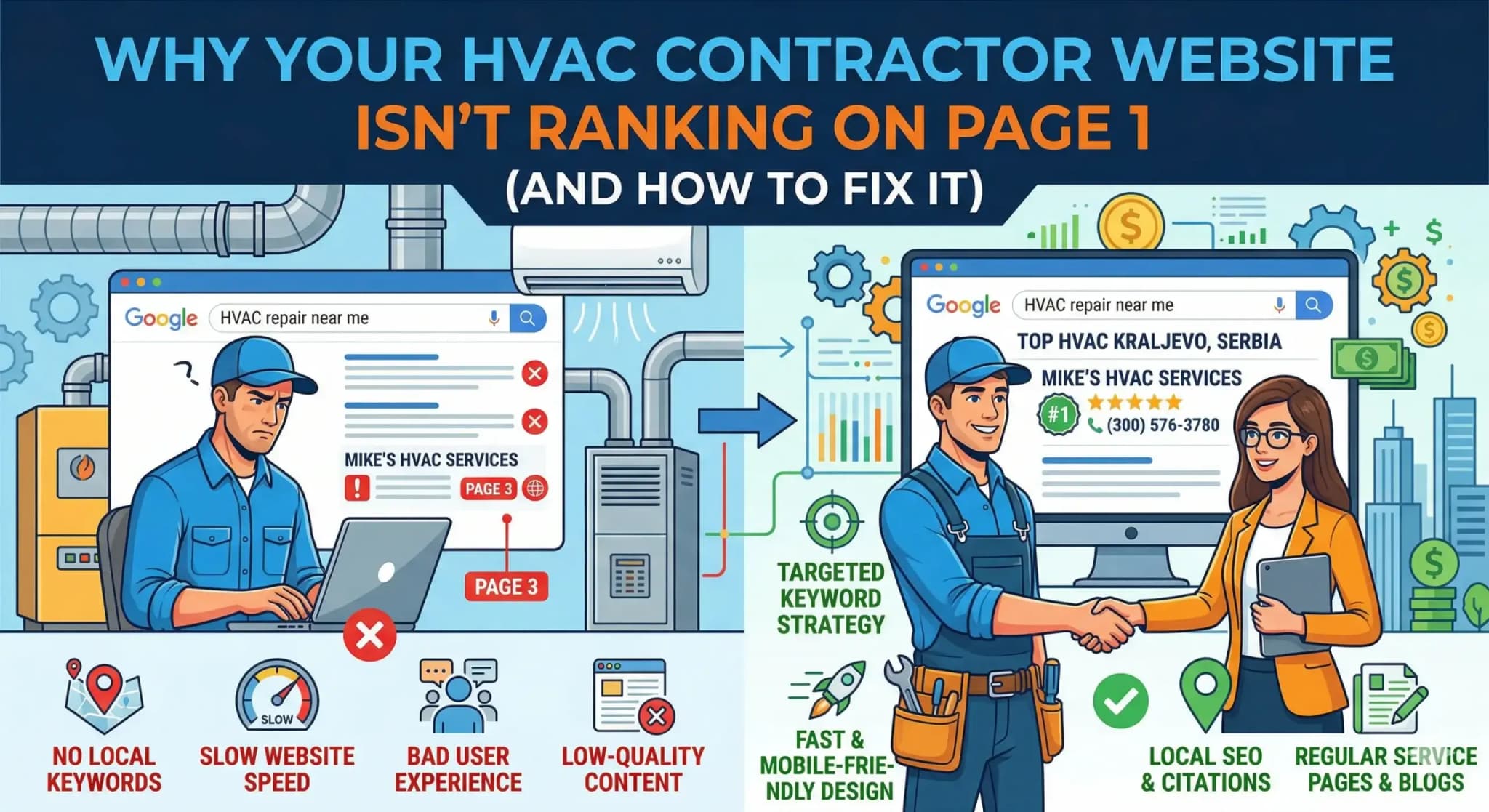
Why Your HVAC Website Isn’t Showing Up on Google
When someone searches “AC repair near me” or “HVAC company in [your city],” Google decides in milliseconds who shows up on page one. That decision comes down to a few factors — and most HVAC websites fail at almost all of them.
Here’s what Google is looking for:
- A fast-loading site — if your pages take more than 3 seconds to load, Google ranks you lower. More importantly, the customer already left.
- Location relevance — Google needs clear signals that your business serves specific cities and neighborhoods. Generic content doesn’t cut it.
- Consistent business information — your name, address, and phone number need to match exactly across your website, Google Business Profile, and every directory you’re listed on.
- Real content about your services — thin pages with five sentences about “AC repair” give Google almost nothing to work with.
The HVAC businesses showing up in the local map pack aren’t lucky. Their websites are telling Google exactly who they are, where they work, and what they do — repeatedly and clearly.
Why Visitors Leave Without Calling You
Getting people to your website is only half the battle. What happens in the next 10 seconds determines whether they call — or hit the back button.
Most HVAC websites make the same mistakes:
- The phone number isn’t visible immediately. On mobile, a visitor shouldn’t have to scroll or search. It should be one tap, at the top of the screen, always.
- The page is cluttered. Too many options, too much text, no clear “next step.” Visitors freeze and leave.
- There’s no trust built in the first seconds. No reviews visible. No “licensed and insured” badge. No sense of who you are. A homeowner making a decision about who to let into their house needs to feel confident — fast.
The best HVAC websites understand this. They’re built around one goal: get the visitor to call or submit a form. Everything else is noise.
💡 Pro Tip: One of the most common mistakes on HVAC websites is using a generic contact form as the only conversion option. Most homeowners with an urgent problem — a broken AC in August, a furnace out in February — aren’t filling out a form and waiting. They want to call right now. Your website should have a prominent tap-to-call button visible on every page, especially on mobile. If a visitor has to work to find your number, most won’t bother.
The Hidden Cost of a Slow Website
Most HVAC business owners don’t know their site’s load speed — and they don’t realize what it’s costing them.
Here’s the reality: studies across industries consistently show that more than half of mobile visitors leave a site that takes longer than 3 seconds to load. For HVAC, where most searches happen on a phone during an emergency, that number matters enormously.
A slow site doesn’t just frustrate visitors. Google sees that people are bouncing quickly and interprets it as a signal that your site isn’t useful — which pushes your rankings down further.
The culprit is usually oversized images, cheap hosting, or a bloated website theme. These aren’t hard to fix, but they have to be identified first.
A properly built HVAC website loads in under 2 seconds. That’s not a luxury — it’s the baseline for competing.
Not Sure If Your Website Has These Problems?
Digital Trace offers a free website audit — no obligation, just a clear picture of what’s costing you leads. They’ll look at your site’s speed, local SEO signals, mobile experience, and conversion setup, and show you exactly what’s working and what isn’t.
Get Your Free HVAC Website Audit →
What a High-Performance HVAC Website Actually Looks Like
The difference between a website that generates consistent leads and one that sits there doing nothing isn’t about having a flashy design. It’s about getting the fundamentals right.
| Factor | Typical HVAC Website | High-Performance HVAC Website |
|---|---|---|
| Leads per month | 2–5 (inconsistent) | 15–30+ (predictable) |
| Load speed | 6–10 seconds | Under 2 seconds |
| Mobile experience | Buried CTA, hard to navigate | Tap-to-call, clean layout |
| Google visibility | Page 2–3, no map pack | Page 1, local map pack |
| Trust signals | Missing or outdated | Reviews, licenses, guarantees visible |
| Service pages | One generic “Services” page | Individual pages per service and city |
| Contact options | Form only | Tap-to-call + form + live chat option |
The businesses generating 20+ leads per month from their website aren’t doing anything magical. They’ve built a site that loads fast, shows up for the right searches, and makes it easy — and obvious — to call.
A Real-World Example: What Changes When You Get This Right
Take an HVAC company serving a mid-sized metro area — let’s call them Metro Comfort Heating & Air. They’d been in business for 11 years, had solid reviews, and a decent reputation locally. But their website was built by a nephew six years ago and hadn’t been touched since.
The problems:
- The site loaded in 8 seconds on mobile
- They had one page covering all their services with about 200 words of text
- Their phone number was in the footer only
- They weren’t showing up in the local map pack for their main service areas
- Google Business Profile and website had different phone numbers listed
What changed:
After a full rebuild focused on HVAC website design best practices, they had dedicated pages for each service (AC repair, furnace installation, tune-ups, etc.), individual city pages for the five areas they served, a prominently placed tap-to-call button, and a site that loaded in under 1.8 seconds.
The result:
Within 90 days, they were ranking on page one for their primary keywords. Monthly website leads went from an average of 4–6 to consistently 22–28. More importantly, those leads were from people actively searching for HVAC help in their area — not tire-kickers from a broad ad campaign.
That kind of shift doesn’t require a massive marketing budget. It requires fixing the right things.
Your Path to More Leads: What to Do Next
You don’t need to overhaul everything at once. Start by fixing the biggest leaks first.
Step 1: Test your site speed. Go to Google’s PageSpeed Insights (free tool) and enter your website URL. If you’re scoring below 70 on mobile, that’s a priority fix.
Step 2: Check your phone number placement. Pull up your website on your phone. Is your number visible without scrolling? Is it a tap-to-call link? If not, that’s one of the fastest fixes available.
Step 3: Look at your service pages. Do you have individual pages for each service you offer? Do you have pages targeting the specific cities you work in? If everything is crammed onto one page, Google can’t rank you for specific searches.
Step 4: Audit your Google Business Profile. Make sure your name, address, and phone number exactly match what’s on your website. Upload recent photos. Respond to reviews. This directly affects your map pack ranking.
Step 5: Get a professional set of eyes on it. The issues that cost HVAC businesses the most leads are usually the ones they can’t see. A proper audit will surface problems you didn’t know existed — and show you exactly what fixing them is worth.
Ready to Stop Losing Leads You’ve Already Earned?
Every day your website isn’t performing, potential customers are finding your competitors instead. They’re not better at HVAC than you — they just have a website that works.
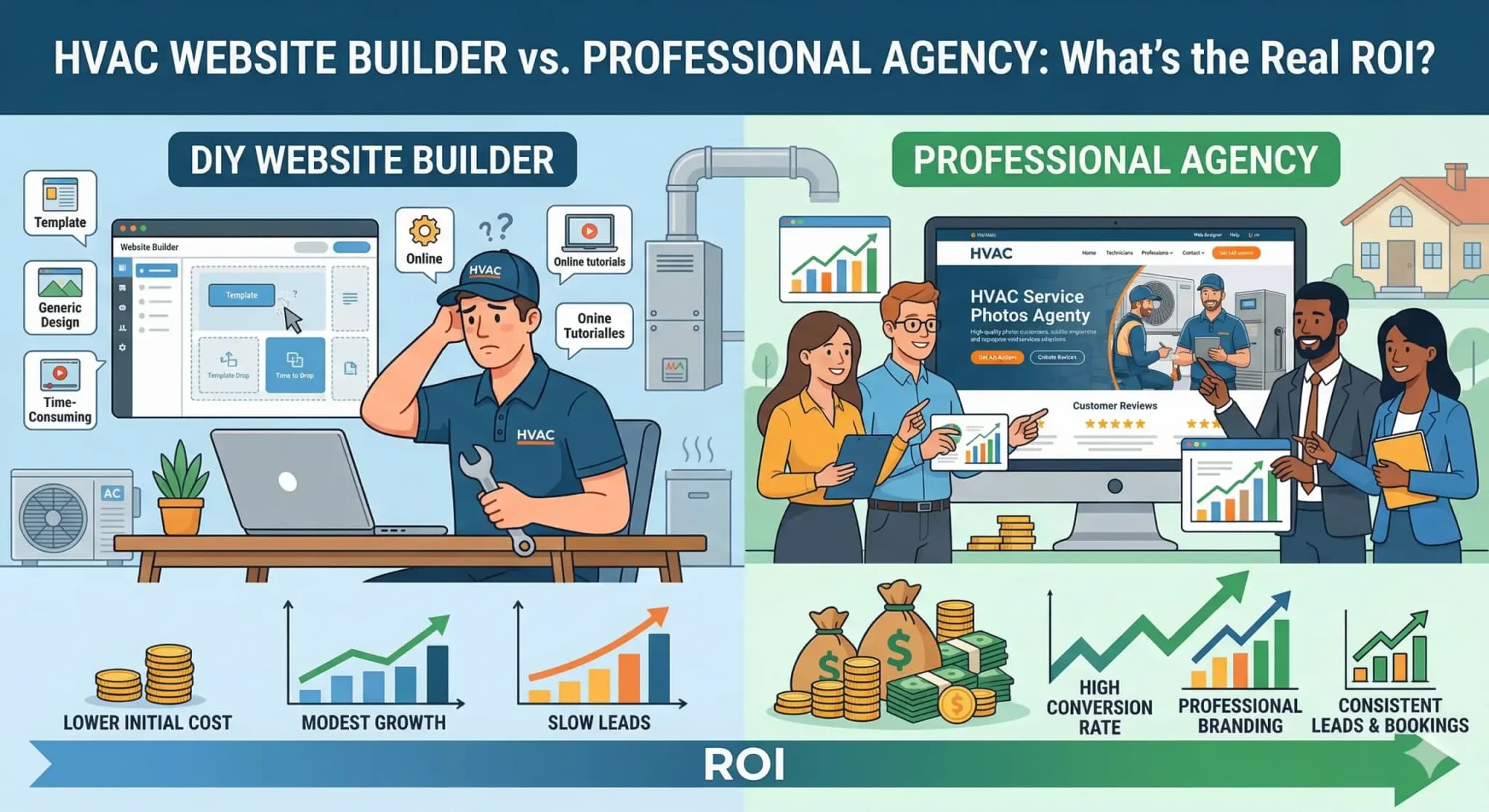
Digital Trace specializes in HVAC web design services built specifically for heating and cooling businesses. They don’t do generic websites. They build sites engineered to rank, convert, and generate leads consistently — without relying on a paid ad budget to do it.
The free audit takes about 15 minutes and costs you nothing. You’ll walk away knowing exactly what’s holding your website back and what it would take to fix it.
Claim Your Free HVAC Website Audit from Digital Trace →
No pressure, no pitch. Just a clear look at what your website is doing — and what it could be doing instead.