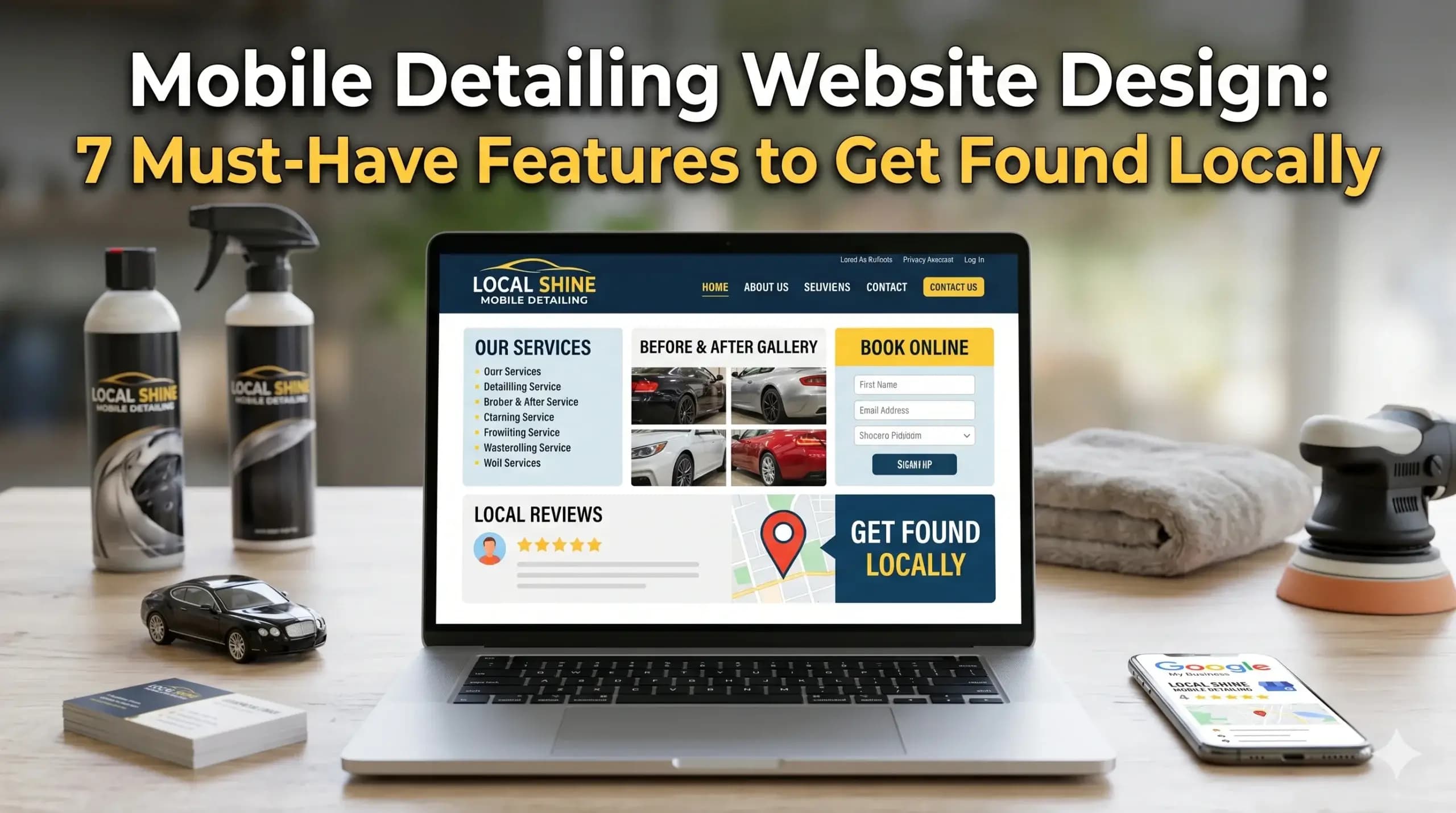
Mobile Detailing Website Design: 7 Must-Have Features to Get Found Locally
You’re out in the field five days a week, doing flawless work — paint correction, ceramic coatings, full interior details. Your customers love you. But your phone? It’s quiet. And somewhere across town, a competitor with a half-decent website is picking up the jobs that should be yours.
That’s not a luck problem. That’s a website problem.
Most mobile detailing businesses in the US built their website once, posted it, and never thought about it again. The result is a site that looks fine on a desktop, loads like it’s running on a 2009 laptop, and gives Google zero reason to show it to anyone searching “mobile detailer near me.”
The good news: most of these issues are fixable. Here are the 7 features your mobile detailing website design absolutely needs if you want to get found, get calls, and grow your business — without spending every evening trying to figure out marketing.
1. A Homepage That Tells Google (and Customers) Exactly What You Do
Your homepage has about 3 seconds to communicate three things: what you do, where you do it, and why someone should call you. Most auto detailing websites fail all three.
A generic headline like “Professional Auto Detailing Services” tells Google almost nothing. It doesn’t mention your city, your specialty, or who you serve. You might as well be invisible.
What you lose: Google needs location signals to rank you for local searches. Without them, your site won’t show up when someone in your city types “mobile detailer near me” — even if you’ve been in business for years.
The fix: Your H1 headline should say something like “Mobile Auto Detailing in [Your City] — We Come to You.” Then your first paragraph should name your service area, your core service, and your phone number. That’s what the websites built for auto detailing businesses at Digital Trace are structured around from the very first line of code.
2. Mobile-First Design That Works for People Searching From a Parking Lot
Think about who’s looking for a mobile detailer. It’s someone sitting in their car, glancing at their phone, trying to find someone fast. If your site takes more than 3 seconds to load or forces them to pinch and zoom to read your prices, they’re gone — and calling the next result.
More than 70% of local service searches happen on mobile devices. If your site was built for a desktop and “adjusted” for phones, that’s not the same thing as being designed mobile-first.
The real cost: Every visitor who lands on a slow or clunky mobile site and bounces back to Google is a lost lead. You didn’t even get a chance to impress them.
What a proper mobile detailing website looks like:
- One-tap call button visible above the fold
- Services and pricing readable without zooming
- Photos that load fast (under 1MB each)
- A contact or booking form that works without pinching
Think of your website like your detail van showing up to a job. If it arrives late, dirty, and disorganized, the customer questions everything before you’ve even opened the door. Your site is your first impression — and on mobile, it needs to show up sharp.
3. Local SEO Built Into Every Page — Not Bolted On After
Here’s why your competitor shows up in Google and you don’t: their site is structured in a way that tells Google exactly what city they serve, what services they offer, and that real customers have confirmed this. Yours probably isn’t.
Local SEO for a mobile detailing website isn’t about stuffing your city name into every sentence. It’s about building a site with the right technical structure, consistent service area pages, and business signals Google trusts.
What’s likely missing from your site right now:
- No dedicated page for each major service (paint correction, ceramic coating, interior detailing)
- No Google Business Profile connected and optimized
- No consistent NAP (Name, Address, Phone) across the web
- No service area pages targeting surrounding cities
Google is trying to match searchers with the most relevant local business. If your site doesn’t give Google clear signals, it won’t take the risk of showing you. That’s not personal — it’s algorithmic.
4. A Fast-Loading Site (Because Slow Sites Are Invisible Sites)
Your site could look incredible. Full-page hero images, smooth transitions, a video background. And it could still be completely tanking your leads — because it loads in 8 seconds.
Speed is not just a “nice to have.” Google uses page speed as a direct ranking factor for mobile searches. A site that loads slowly gets pushed down in results, often below competitors whose services aren’t even as good as yours.
Plain English translation: A slow site is like a detail van that takes 45 minutes to show up for a “mobile” service. No matter how good the work is, you’ve already lost the customer’s trust.
💡 Pro Tip: Your Images Are Probably Killing Your Load Time
The single most common issue on auto detailing websites is uncompressed images. You upload a beautiful high-res photo of a ceramic-coated hood — straight from your iPhone at 6MB — and your site’s load time doubles. The fix is simple: compress every image before uploading (tools like TinyPNG work), and use modern formats like WebP instead of JPEG or PNG where possible. This one change alone can cut your load time in half.
5. Clear Service Pages With Pricing Signals (Not Just a Services List)
Most auto detailing websites have a “Services” page that lists: Basic Wash, Interior Detail, Full Detail, Ceramic Coating. That’s it. No descriptions, no photos, no pricing guidance.
Here’s the problem: your customer is comparison shopping. They’re looking at your site and two competitors’. If your site doesn’t give them enough information to feel confident, they’ll call the site that does — even if your work is better.
What a high-converting service page includes:
- Clear description of what’s included (and what’s not)
- A pricing range or starting price (even “from $X” helps)
- Before/after photos specific to that service
- A call-to-action after every service description, not just at the bottom
You’re not giving away the farm by sharing this information. You’re qualifying the customer before they even call — and that means better calls, fewer tire-kickers, and more booked jobs.
6. Social Proof That Shows Up Where People Are Looking
Reviews matter. But where those reviews appear — and how your website uses them — is what separates a site that converts from one that doesn’t.
A wall of five-star stars on your homepage feels generic. What converts is specific, named, photo-verified testimonials placed near the decision points on your page. Right next to your “Book Now” button. Right below your pricing section.
What actually builds trust with skeptical customers:
- Google reviews embedded on your site (not just linked to)
- Before/after photo galleries organized by service type
- Named testimonials with the customer’s city (e.g., “— James R., Tampa”)
- A visible review count and average rating in your header or hero section
Your work is visible in every parking lot you’ve ever detailed a car in. Make sure your website shows that same proof, in the places where it matters most.
7. A Lead Capture System That Works Even When You’re on the Job
Here’s a scenario you’ve probably lived: someone visits your site at 7pm while you’re finishing a job, fills out your contact form, and you don’t see it until the next morning. By then, they’ve already booked with someone else.
Your website needs a lead system that captures inquiries, sends you an immediate notification, and gives the customer an instant confirmation — even when you can’t pick up the phone.
What a proper lead capture system includes:
- A short, mobile-friendly booking or quote request form (name, vehicle, service, preferred date — that’s it)
- Instant email/SMS notification sent to you
- An auto-reply to the customer confirming their request and setting expectations
- A clear phone number displayed at the top of every page, click-to-call on mobile
If your current contact form is a generic “Name / Email / Message” box with no auto-reply, you’re leaving leads in limbo — and in local service businesses, speed of response is often the whole game.
Before & After: What Happens When You Fix the Foundation
Meet Marcus, who runs a solo mobile detailing operation in the Phoenix metro area. He’d been in business for four years, had solid reviews on Google, and did great work. But his website — something he’d built himself on a free platform — was getting fewer than 40 visitors a month, and maybe 2–3 contact form submissions. He was relying entirely on word of mouth and a Facebook page.
After a complete rebuild focused on mobile detailing website design — local SEO structure, fast-loading pages, service-specific landing pages, and a proper lead form — his site traffic climbed to over 300 organic visitors per month within 90 days. More importantly, his inbound lead volume went from 2–3 per month to 18–22 qualified inquiries. He booked out his schedule three weeks in advance for the first time in his business’s history.
His work didn’t change. His prices didn’t change. His website finally started doing its job.
Not sure if your auto detailing website has these issues? Get a free website audit — no obligation, just a clear picture of what’s costing you leads.
Your Path to More Leads: 5 Steps That Actually Work
You don’t need to become a web designer or SEO expert. You just need a site that’s built right from the start. Here’s what that process looks like:
- Audit what you have. Before changing anything, understand what’s broken. A free audit will show you exactly where your site is leaking leads.
- Fix your mobile experience first. If your site doesn’t work flawlessly on a phone, nothing else matters — that’s where your customers are.
- Build location-specific pages. Create a page for every city or neighborhood you serve. This is how you show up in more local searches without paid ads.
- Add real social proof. Get your Google reviews onto your site. Add before/after photos organized by service. Make your work visible.
- Set up a lead capture that works while you’re working. A form, an auto-reply, and an SMS alert to your phone. Simple, effective, and it pays for itself with the first job it captures.
Frequently Asked Questions
Why am I not getting calls from my website?
The most common reasons are slow load speed, missing local SEO signals, and a homepage that doesn’t clearly state what you do and where you do it. If Google doesn’t understand your site, it won’t show it — and if visitors land on it and can’t find your number in two seconds, they’re gone. A free website audit will show you exactly which of these issues is affecting your site.
How do I know if my auto detailing website is actually working?
If you can’t answer “how many people visited my site last month” and “how many of them contacted me,” your site isn’t being tracked properly. A working website should generate measurable leads — not just look good. At minimum, you should have Google Analytics installed and a way to track form submissions or call clicks.
How long does it take to see results from a new website?
For local SEO, most auto detailing businesses start seeing meaningful traffic improvements within 60–90 days of a properly built site going live. Paid traffic can start immediately. The key is that the site has to be built right — a fast, locally optimized site will outperform a slow, generic one within a few months and keep compounding over time.
What makes an auto detailing website different from a regular business website?
Auto detailing is a visual, trust-based, location-dependent service. Your website needs to show your work with high-quality photos, establish local credibility through reviews and service area pages, and convert mobile visitors quickly — because most people searching for a detailer are on their phone and ready to book. A generic business website template won’t do any of those things well.
Do I really need a fast website if my customers are local?
Yes — especially because they’re local. Local customers are searching on mobile, often in the moment. Google penalizes slow sites in mobile search rankings, which means a slow site doesn’t just frustrate visitors; it doesn’t even show up for them. Speed isn’t a luxury feature for mobile detailing websites — it’s the entry point.
I’ve had a website for years and it’s never brought in leads. Is it worth fixing or should I start over?
That depends on the specific issues. Sometimes a structural rebuild is faster and cheaper than trying to retrofit a broken foundation. Other times, targeted fixes to speed, content, and local SEO can turn an underperforming site around. The only way to know is an honest audit — which is exactly what Digital Trace offers at no cost.
Ready to Find Out What Your Website Is Really Costing You?
Every week your site isn’t performing is a week your competitors are picking up the calls that should be yours. The jobs are out there — people in your city are searching for a mobile detailer right now.
The question is whether your website gives them a reason to call you.
Book a free website audit and find out exactly what’s holding your site back. No jargon, no pressure — just a clear look at what’s working, what isn’t, and what it would take to fix it.
Your detail van is ready. Let’s make sure your website is too.