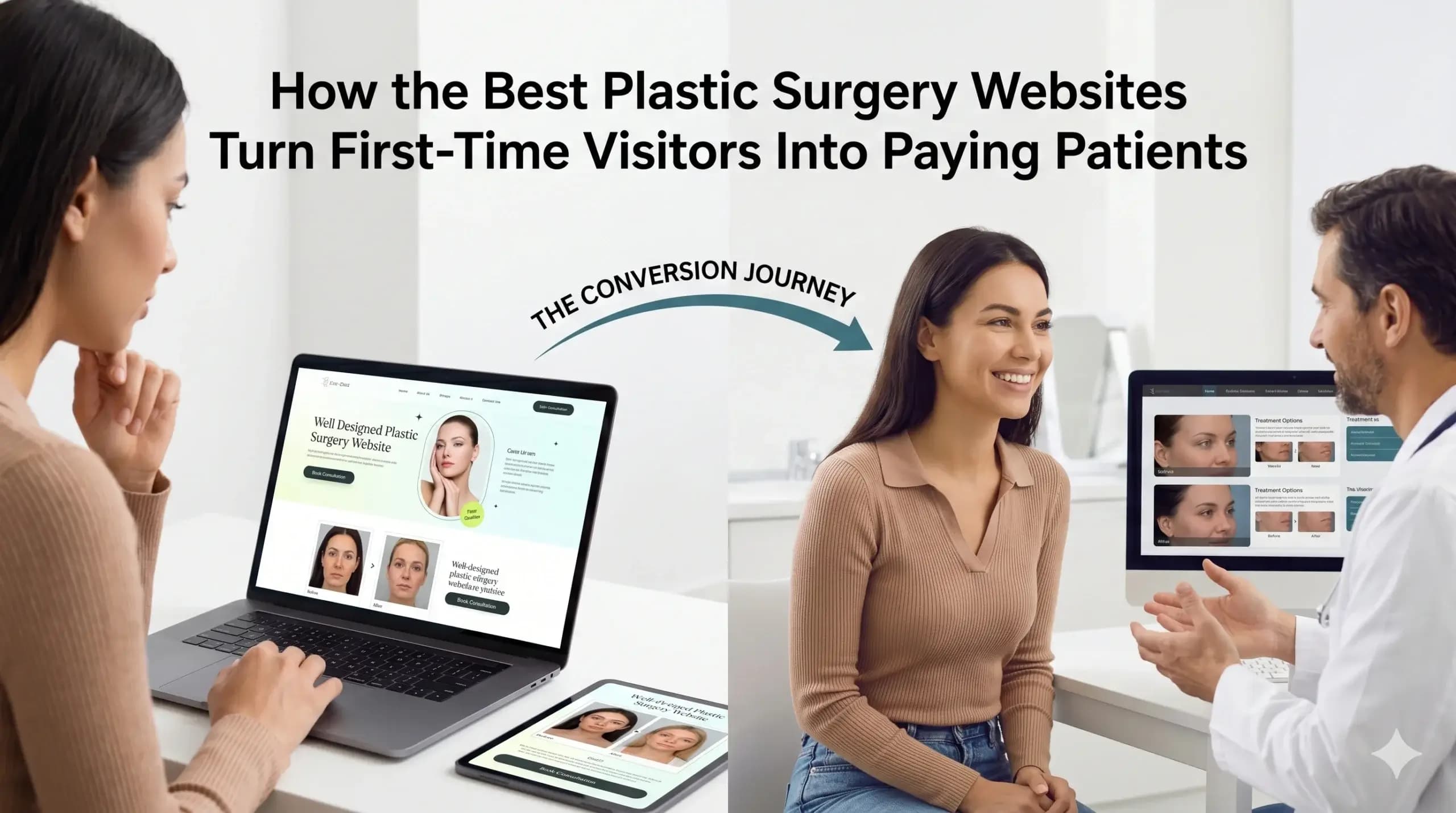
How the Best Plastic Surgery Websites Turn First-Time Visitors Into Paying Patients
Your consultations are booked through referrals. Your work speaks for itself. So why does your website feel like it’s just sitting there — looking fine but not actually doing anything?
Most plastic surgeons assume their website is “good enough” because it looks professional. But looking professional and performing professionally are two completely different things. A lot of practices are quietly losing 10, 15, even 20 prospective patients a month — and they have no idea, because their site never tells them.
The best plastic surgery websites aren’t just pretty galleries of before-and-after photos. They’re built like a skilled consultation: they earn trust fast, answer the right questions in the right order, and make it effortless for someone to take the next step. This post breaks down exactly what separates those high-performing sites from the ones that just look good on a desktop monitor.
Your Website Has About 4 Seconds to Make or Break the Consultation
Think about the experience you create in your consultation room — calm, clean, professional, with everything in the right place. Your website needs to do that same job before a patient ever picks up the phone.
Here’s what actually happens when someone lands on a slow or cluttered plastic surgery site: they leave. Not because they weren’t interested, but because the experience felt off — and for someone considering a procedure, “off” is disqualifying.
Why it happens: Sites overloaded with large before-and-after image files, outdated code, or cheap hosting load slowly. Most visitors will abandon a page that takes longer than 3–4 seconds to load, and mobile users are even less forgiving.
What it costs you: Every visitor who bounces before your page loads is a potential consultation you never got the chance to earn. That’s not a traffic problem — that’s a revenue leak.
What the fix looks like: At Digital Trace, every plastic surgery website we build is engineered for speed from the ground up — optimized images, fast hosting, clean code. Because the first second of your site is already part of the patient experience.
First-Time Visitors Don’t Know You Yet — Your Site Has to Do the Convincing
Choosing a plastic surgeon is one of the most personal decisions a patient makes. When someone lands on your site for the first time, they’re not ready to book — they’re evaluating whether they can trust you.
Most plastic surgery websites fail at this stage because they lead with the practice, not the patient. Pages full of credentials, award logos, and procedure lists miss the real question every visitor is silently asking: “Is this the right surgeon for me?”
The trust signals that actually work:
- Authentic before-and-after photo galleries (not stock imagery)
- Surgeon biography that feels human, not just a CV
- Video introductions — even a short 60-second clip builds more trust than three paragraphs of text
- Real patient testimonials placed near conversion points (not buried on a separate page)
- Clear, specific information about what a consultation actually looks like
The insight behind it: Patients researching elective procedures spend more time on a website before converting than almost any other healthcare category. They’re reading carefully. If your site doesn’t answer “who is this surgeon and why should I trust them,” they’ll find one that does.
Your Navigation Is Probably Sending Patients to a Dead End
Here’s a common scenario: someone searches for “rhinoplasty consultation [city],” lands on your homepage, scrolls for 30 seconds, can’t quickly find what they need, and clicks back to Google. Your competitor — with an arguably less impressive practice — gets the call instead.
Website navigation for plastic surgery isn’t just about organization. It’s about guiding someone who is curious, slightly anxious, and comparing you against multiple other options — all at the same time.
What broken navigation looks like:
- A single long “Procedures” dropdown with 20+ items and no hierarchy
- No clear path from a procedure page to a consultation booking
- Contact information buried in the footer
- Mobile menus that are hard to tap or navigate
What good navigation does: It anticipates the patient journey. Someone interested in a mommy makeover should be able to find the procedure page, see relevant before-and-afters, read about recovery, and get to a contact form — without having to think about where to click next.
💡 Pro Tip: One of the most common mistakes plastic surgery practices make is having a beautiful homepage but procedure pages that feel like afterthoughts — thin content, no photos, no FAQs, no CTA. Google actually ranks individual procedure pages in search results, not just your homepage. If your rhinoplasty page has two paragraphs and a contact form, it’s likely invisible in search. Each procedure page should be built like a mini landing page: informative, visually rich, and conversion-ready.
Google Can’t Recommend What It Doesn’t Understand
When a prospective patient in your city searches “best plastic surgeon for breast augmentation” or “natural rhinoplasty results near me,” Google has to decide which websites to show. The practices that show up consistently aren’t always the most talented surgeons — they’re the ones whose websites speak Google’s language.
Plain-English version of why this matters: Google reads your website to figure out what your practice does, where you’re located, and whether you’re a credible expert. If your site is missing key signals — proper page structure, location information, procedure-specific content — Google won’t be confident showing you to people who are actively searching for exactly what you offer.
The business cost: Patients are searching right now. If your site isn’t structured to be found, those searches are converting your competitors, not you. This isn’t about chasing rankings for their own sake — it’s about making sure the people who are ready to book a consultation can actually find you.
What Digital Trace builds instead: Our web design for plastic surgeons includes proper technical structure, location signals, and procedure-specific page architecture — the foundational layer that makes everything else work.
What Happens When You Get This Right: A Real-World Scenario
Consider a plastic surgery practice in a mid-sized US city. The surgeon had been in practice for 11 years, had excellent patient outcomes, and received consistent referrals. But the website — built six years ago — was slow, wasn’t mobile-friendly, and had one generic “Procedures” page listing everything from liposuction to eyelid surgery with a few sentences each.
New patient consultations had plateaued. The front desk was fielding fewer calls from the website. The surgeon assumed it was market saturation.
After a full redesign focused on speed, mobile experience, trust-building content, and individual procedure pages built to rank and convert:
- Website load time dropped from 6.8 seconds to under 2 seconds
- Mobile traffic — which had been bouncing at over 75% — dropped to under 40%
- Organic search visibility for procedure-specific searches increased substantially within 90 days
- New consultation inquiries from the website increased by roughly 60% within the first quarter
The practice didn’t change. The surgeon’s skill didn’t change. What changed was whether the website was actually doing its job.
Not sure if your plastic surgery website has these problems? Get a free website audit — no obligation, just a clear picture of what’s costing you consultations.
Your Path to More Leads: What This Actually Looks Like in Practice
Getting your website to consistently generate consultations isn’t about a single magic fix. It’s about getting the fundamentals right in the right order.
Step 1: Find out what’s actually broken. Most practices don’t know what their site is doing wrong — because a site can look fine and still be invisible in search or leaking conversions. A free audit is the starting point.
Step 2: Fix the speed and mobile experience first. Before anything else, the site needs to load fast and work perfectly on a phone. Most plastic surgery patients research on mobile. If the experience is frustrating, nothing else matters.
Step 3: Build procedure pages that rank and convert. Each service you offer deserves its own page — with real content, real images, and a clear path to booking a consultation.
Step 4: Make trust-building visual and immediate. Before-and-afters, surgeon bio, patient testimonials, and a video introduction should be prominent — not an afterthought.
Step 5: Make it effortless to reach you. Contact forms, phone numbers, and booking links should appear naturally throughout the site — not just on the Contact page.
Frequently Asked Questions
Why am I not getting calls from my plastic surgery website?
The most common reasons are that the site loads too slowly, isn’t structured in a way Google can understand, or doesn’t build enough trust for a first-time visitor to take action. You might be getting traffic but losing visitors before they ever reach your phone number. A website audit can pinpoint exactly where the drop-off is happening.
How do I know if my plastic surgery website is actually working?
If you can’t answer how many consultation requests came directly from your website last month — that’s a red flag. A well-performing plastic surgery site should be a measurable source of new patients, not just a digital placeholder. Book a free audit and we’ll show you exactly what your site is and isn’t doing.
What makes a plastic surgery website different from a regular business website?
Patients choosing a plastic surgeon are making a deeply personal, high-consideration decision. That means trust-building has to happen faster and more effectively than on most other sites. Procedure-specific content, authentic imagery, surgeon credibility signals, and a clearly guided patient journey are all non-negotiable — none of which applies to, say, a plumber’s website.
How long does it take to see results from a new plastic surgery website?
Technical improvements — speed, mobile experience, basic visibility fixes — show impact quickly, often within the first 30–60 days. SEO results from new content and page structure typically take 60–120 days to build momentum. Most practices we work with see meaningful increases in consultation inquiries within the first quarter.
Do I really need a fast website if my patients are mostly local?
Yes — especially if they’re local. Local patients are almost always searching on their phones, often while comparing multiple practices side by side. If your site takes 6 seconds to load and a competitor’s loads in 2, you’ve already lost before they’ve seen a single photo of your work.
I’ve worked with web agencies before and didn’t see results. Why would this be different?
Most general web agencies build sites that look good — but they don’t understand the plastic surgery patient journey, how procedure pages should be structured to rank, or what actually makes someone in your market pick up the phone. Digital Trace specializes in medical aesthetic practices, and every decision is tied to one outcome: more qualified consultations.
Stop Guessing. Find Out Exactly What Your Website Is Costing You.
Your website should be your most consistent source of new patients — working every hour, on every device, for every person who’s searching for exactly what you offer.
If it’s not doing that, there are specific, fixable reasons why.
Digital Trace offers a free website audit for plastic surgery practices across the US. We’ll look at your speed, your search visibility, your conversion path, and your trust signals — and give you a plain-English picture of where you’re losing leads and what it would take to fix it.
No pitch. No pressure. Just a clear answer.