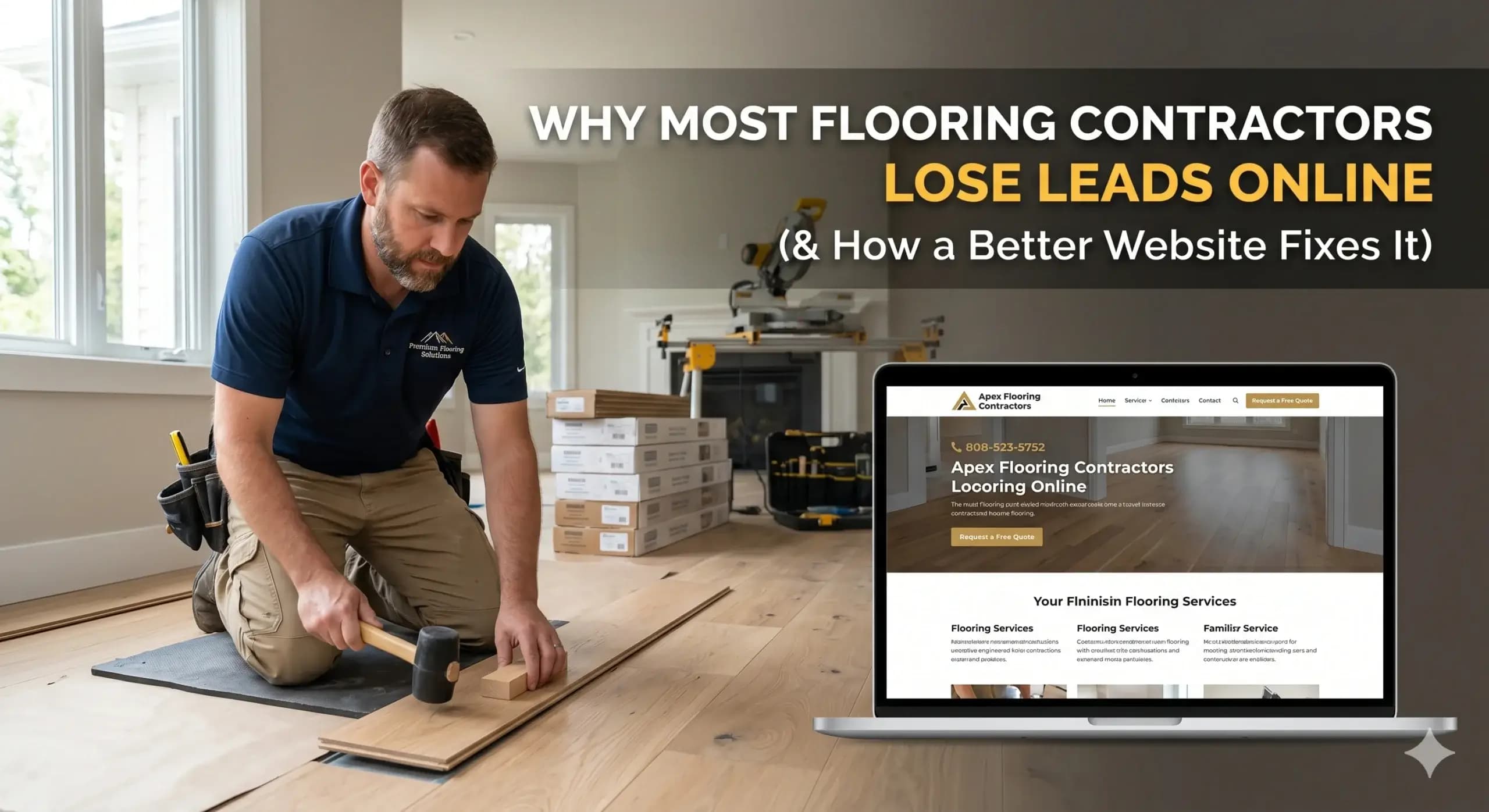
Why Most Flooring Contractors Lose Leads Online (And How a Better Website Fixes It)
You do great work. You show up on time, your installs look clean, and your customers are happy — yet your phone isn’t ringing the way it should be. Meanwhile, another flooring company in your market somehow keeps popping up everywhere online, landing jobs you should be getting.
The frustrating part? It’s probably not your pricing, your reputation, or even your service area. For most flooring contractors, the real problem is hiding in plain sight: their website.
Most flooring business owners think of their website as a digital business card — something to point customers to when they ask. But your competitors who are winning online treat their website like their best salesperson — one that works 24/7, answers questions, earns trust, and turns visitors into phone calls before they click to the next result.
This post breaks down exactly why flooring websites fail to generate leads, what the hidden causes are (in plain English), and what a properly built flooring website design actually looks like when it’s built to convert.
Your Website Loads Slowly — And Customers Leave Before They See Your Number
Think about how a homeowner shops for flooring. They pull out their phone, type something like “hardwood flooring installer near me,” and tap through a few results. If your site takes more than three seconds to load, they’re already gone — back to Google, clicking your competitor.
The average mobile user won’t wait for a slow site. They’ve got options, and they know it. What most contractors don’t realize is that site speed is one of the top factors Google uses to decide which websites rank high in the first place. A slow site gets pushed down before a customer even has the chance to leave.
This happens because most flooring websites are built on generic templates crammed with oversized images, bloated code, and add-ons that drag load times down. The site looks fine when you’re sitting at a desktop — but on mobile, in the field, on a 4G connection? It’s a different story.
What a better approach looks like:
- Images compressed and optimized for mobile without losing quality
- Streamlined code that loads the most important content — like your phone number and call-to-action — first
- Speed scores that meet Google’s performance standards so your site ranks and loads fast
Google Doesn’t Know Enough About Your Business to Show It
You might have a website up. You might even have some photos of your work, a services list, and a contact form. But if Google can’t clearly understand what you do, where you do it, and who you serve — it won’t confidently show your business to people searching in your area.
There’s a simple technical layer that helps Google understand your business. Without it, your site is speaking a language Google partially ignores. Competitors who have it set up correctly get preference in local search results — those map listings and top results that appear when someone types “flooring company near me.”
For flooring businesses, this means making sure your website tells Google: what type of flooring you install, what cities and counties you serve, how long you’ve been in business, and how customers have rated you. When Google has that information in a format it can read clearly, it trusts your site enough to show it.
Your Site Looks Fine — But It Doesn’t Do Anything
Here’s a question worth asking: when someone lands on your flooring website for the first time, what are they supposed to do next?
If the answer is “look around, I guess,” that’s a problem. Most flooring websites are built to inform — not to convert. There’s no clear reason for the visitor to call right now, no urgency, no path that naturally leads them toward picking up the phone or filling out a form.
Think of it this way: a great showroom isn’t just organized — it guides customers through a specific experience. The lighting hits the samples just right, a salesperson is there to answer questions at the perfect moment, and by the time the customer is ready to buy, they already trust you. Your website should do the same thing online.
A high-converting flooring website leads visitors through a deliberate journey:
- A headline that immediately tells them they’re in the right place (“Hardwood & LVP Installation in [City] — Free Estimates”)
- Social proof up front — reviews, years in business, number of installs completed
- A single, clear next step: call, text, or fill out a quick form
- Photos of your actual work — not stock images — that build trust fast
When a site is built this way, visitors don’t have to figure out what to do. They’re already dialing.
You’re Not Showing Up for the Right Searches
Most flooring contractors think about SEO in broad terms: “I want to rank for flooring.” But the people who are actually ready to hire someone aren’t searching “flooring.” They’re searching:
- “LVP installation cost [city]”
- “hardwood floor refinishing near me”
- “tile installer [neighborhood]”
- “flooring company free estimate”
These are high-intent searches — people with credit cards ready, measuring tape in hand. If your website doesn’t have pages that specifically address these searches, you’re invisible to exactly the customers most likely to hire you.
A properly built flooring company website creates dedicated content for each service and each location you serve. That means a page for hardwood installation, a page for tile, a page for LVP — and ideally, versions of those for each city in your service area. It sounds like a lot, but this is how flooring businesses consistently show up when the right people are searching.
💡 Pro Tip: Your Contact Form Might Be Killing Your Lead Flow
Many flooring websites have a contact form — but it asks for too much information up front. Name, email, phone, project type, square footage, preferred install date… by the time a homeowner hits question four, they’ve moved on.
The fix is simple: reduce your form to three fields maximum (name, phone, and a one-line project description). The goal of the form isn’t to gather all the information — it’s to get the conversation started. You can ask the rest on the call. Shorter forms consistently produce more submissions, and in the flooring business, more submissions mean more booked estimates.
Before & After: What a Real Flooring Business Transformation Looks Like
The situation: A family-owned flooring company operating in a mid-sized metro area had been in business for over a decade. Word of mouth was strong, but new leads from online were nearly nonexistent. Their website was five years old, loaded in over seven seconds on mobile, had no local SEO structure, and sent visitors to a homepage with no clear call-to-action.
What changed: The site was rebuilt from the ground up with performance as a priority — load times dropped to under two seconds. Separate service pages were created for hardwood, LVP, tile, and carpet, each targeting specific search terms. A streamlined quote request form replaced the old contact page. Local SEO structure was added so Google could clearly identify the company’s service areas.
The result: Within 90 days, organic search traffic more than doubled. Monthly quote requests went from 2–3 to 15–20. The owner reported booking out three weeks in advance for the first time in years — with zero additional ad spend.
That’s what a properly built flooring web design can do when every element is working together.
Not sure if your flooring website has these problems? Get a free website audit — no obligation, just a clear picture of what’s costing you leads.
Your Path to More Leads: 5 Steps That Actually Move the Needle
If you’re reading this and nodding at more than a couple of these problems, here’s where to start:
- Test your site speed on mobile. Pull out your phone, go to your website, and time how long it takes to fully load. If it’s more than three seconds, you’re losing leads every single day.
- Ask yourself: what do I want visitors to do? If your site doesn’t have one clear, obvious next step — a call button, a “Get My Free Estimate” button — that needs to change before anything else.
- Count your pages. If your website is basically a homepage, an about page, and a contact page, Google has almost nothing to show in search results. You need service-specific and location-specific pages.
- Look at your reviews. Are they visible on your website? Google review counts and ratings should be right on your homepage — not buried, not missing.
- Get a professional audit. Most flooring business owners don’t know what they don’t know when it comes to their website. A proper audit will surface the exact issues costing you leads, ranked by impact.
Digital Trace builds websites built for flooring businesses that are fast, optimized for local search, and designed to turn visitors into calls. Every site we build is built around one goal: more leads for your business.
Frequently Asked Questions
Why am I not getting calls from my website?
The most common reasons are slow load speed, no clear call-to-action, and missing local SEO structure. If your site loads slowly on mobile, visitors leave before they see your phone number. If there’s no obvious “call now” or “get a quote” button, people don’t know what to do next. And if Google can’t figure out exactly what you do and where you do it, it simply won’t show your site to the right people.
How do I know if my flooring website is actually working?
A working website produces leads consistently — not occasionally. If you’re not getting at least a few quote requests or calls per week purely from your website, something’s broken. You can also check Google Search Console for free to see if your site is showing up for any searches at all. If it’s not, the site isn’t working.
How long does it take to see results from a new website?
Most flooring businesses start seeing measurable improvements in lead volume within 60–90 days of launching a properly optimized site. SEO is not instant, but a faster, better-structured site starts earning better Google placement relatively quickly — especially in local search where competition is often less intense than you’d expect.
What makes a flooring website different from a regular business website?
Flooring customers are highly visual — they want to see your work before they call. A flooring website needs to showcase high-quality project photos, be organized by service type (hardwood, LVP, tile, carpet), and speak directly to the concerns homeowners have: cost, disruption, timeline, and reliability. A generic business website template doesn’t address any of that. It’s built for no one in particular, which means it converts no one in particular.
Do I really need a fast website if my customers are local?
Yes — especially because your customers are local. Most local searches happen on mobile, often while someone is in their car or standing in a home improvement store. Mobile connections are slower than Wi-Fi, which means a slow website hits local customers the hardest. Google also ranks faster sites higher in local search results, so your speed directly affects whether you appear before your competitors.
How do I find out what’s actually wrong with my website?
The fastest way is a professional audit that looks at your site’s speed, SEO structure, mobile performance, conversion elements, and local search visibility — all together. Book a free website audit with Digital Trace and we’ll show you exactly what’s costing you leads, with no pressure and no sales pitch attached.
Ready to Find Out What Your Website Is Costing You?
Every week your flooring website isn’t performing, you’re handing jobs to competitors. Not because they’re better at what they do — but because their website is doing a better job of convincing customers to call.
A free audit from Digital Trace will show you exactly where your site is losing leads, what’s fixable fast, and what a properly built flooring website could mean for your business in real numbers.
Get your free flooring website audit →
No contracts. No pressure. Just a clear picture of where you stand and what’s possible.