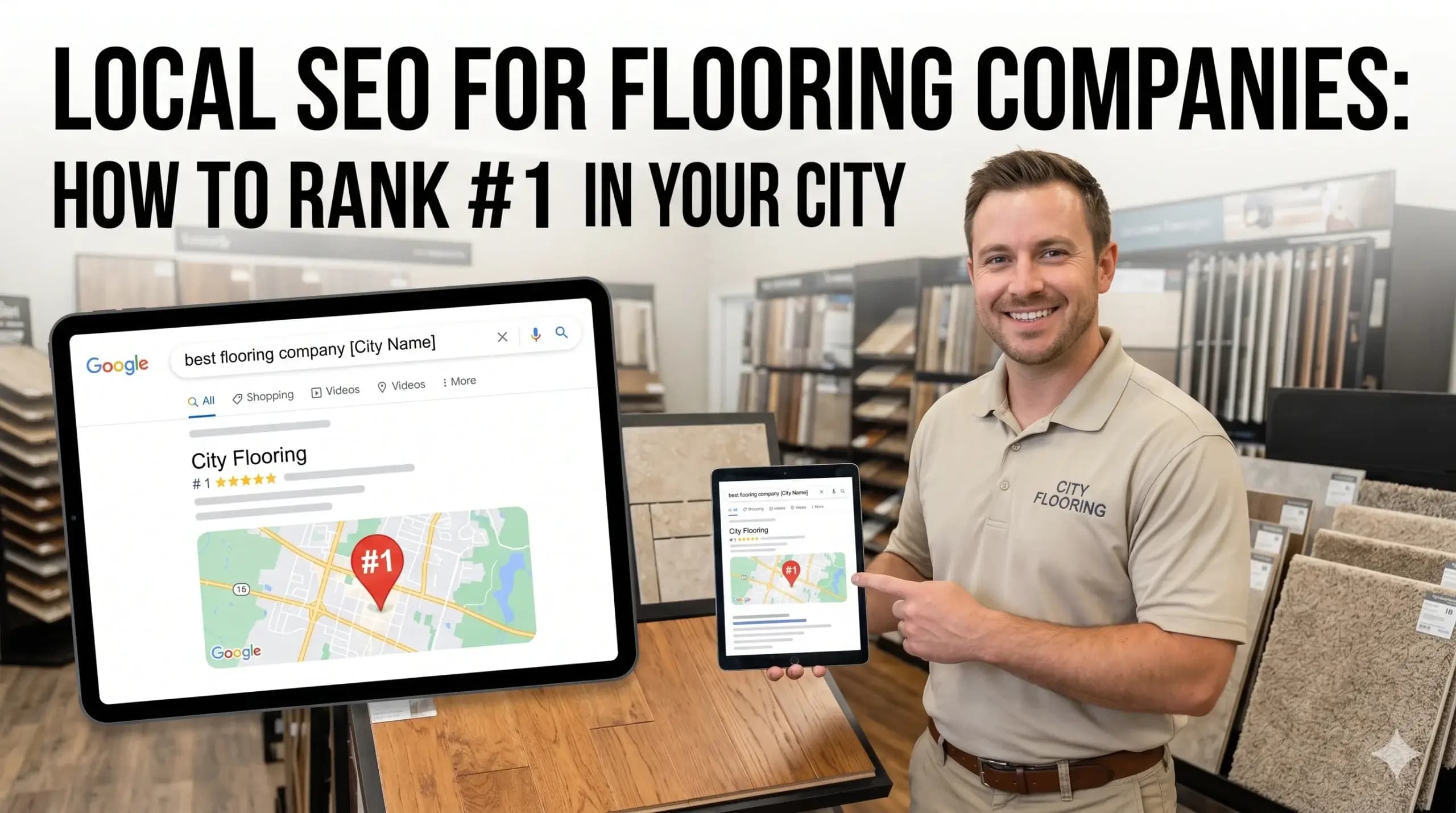
Local SEO for Flooring Companies: How to Rank #1 in Your City
You’ve been in the flooring business long enough to know good work sells itself — but lately, it feels like the phone isn’t ringing the way it used to. You’ve got years of installs under your belt, happy customers, and a website someone told you looked “professional.” So why is the competitor down the street showing up on Google and you’re not?
The hard truth is that most flooring companies have a website that looks decent but doesn’t actually work. It doesn’t rank. It doesn’t convert visitors into callers. It just sits there. And every day it sits there, leads you should be getting are going somewhere else.
This guide breaks down exactly why that happens — and what a real fix looks like. No jargon. No empty promises. Just the specific reasons flooring businesses lose leads online and what it takes to get your phone ringing again.
Why Your Flooring Website Isn’t Showing Up When It Matters Most
Here’s the scenario: A homeowner in your city just cracked a tile in their kitchen. They grab their phone, type “flooring company near me,” and three names pop up. Yours isn’t one of them.
That’s not a coincidence — it’s a technical problem with a fixable solution.
Google ranks local businesses based on three main signals: relevance (does your site say what you do and where?), proximity (are you geographically close to the searcher?), and authority (does Google trust your site?). Most flooring websites fail on at least two of those three.
The fix starts with your flooring website design — specifically, how your site is built, what it communicates to Google, and how fast it loads. These aren’t cosmetic choices. They directly determine whether your business shows up when someone nearby is ready to spend money.
Your Site Loads Too Slowly — And It’s Costing You Real Jobs
Think of your website like a showroom. If someone walks up to your door, tries to open it, and it takes eight seconds to unlock — they’re gone. They walked next door.
That’s what slow websites do. Most visitors leave within three seconds if a page doesn’t load. On a mobile phone (where most of your potential customers are searching), a sluggish site might as well not exist.
The technical culprit is usually one of three things:
- Unoptimized images that are 10x bigger than they need to be
- Cheap, shared hosting that can’t handle traffic spikes
- Bloated website templates loaded with features you’ll never use
Every one of those is fixable. At Digital Trace, sites are built for speed from the ground up — not retrofitted after the fact. That means faster load times, better rankings, and more visitors who actually stick around long enough to call you.
Google Doesn’t Know Enough About Your Business to Trust It
This one surprises a lot of flooring business owners. You’ve been in business for years, you have reviews, you have a Google Business Profile — and you’re still not showing up. Why?
Because Google needs to see consistent, specific signals across your website, your listings, and your online presence before it’ll confidently push you to the top.
When your website doesn’t clearly state what you install (hardwood? LVP? carpet? tile?), where you serve (which cities, which counties?), and what makes you different — Google treats you as a generic, lower-priority result. It’s not that Google dislikes you. It just doesn’t know enough about you.
The fix involves making sure your website and your Google Business Profile are speaking the same language — same business name, same address, same phone number, same service areas — and that your site content gives Google the context it needs to match you with the right searches.
💡 Pro Tip: Your Business Name, Address, and Phone Number Are Probably Wrong Somewhere
One of the most common and damaging mistakes flooring companies make is having inconsistent contact information scattered across the web. Your website says one phone number. Yelp has an old address. Google Business Profile has a slightly different business name. To Google, these look like three different businesses — and none of them rank well. Run a quick audit of every place your business is listed online and make sure the name, address, and phone number are exactly the same everywhere. This single fix can move the needle faster than almost anything else.
Your Homepage Talks About You — But Customers Are Searching for Themselves
Read your homepage right now. Does it start with something like “Family-owned flooring company with 20 years of experience”? That’s about you. Customers searching Google aren’t looking for your backstory — they’re looking for a solution to their problem.
“My hardwood floors are scratched and I need someone to replace them this week.”
“I’m renovating my basement and need LVP that can handle moisture.”
“I want to know how much flooring installation costs before I call anyone.”
Your website should answer those questions immediately and specifically. A homepage that leads with your services, your service area, and a clear way to contact you — not buried at the bottom — converts dramatically better than one that starts with a company history.
This is where flooring website design done right makes a measurable difference. A well-structured site tells visitors exactly what you do, where you do it, and how to reach you — within seconds of landing on the page.
A Real Example: What Happens When the Website Finally Works
The Situation: A flooring contractor in suburban Ohio had been in business for 14 years. Mostly word-of-mouth, a few Houzz leads, and a website his nephew built in 2018. It looked fine on desktop, loaded slowly on mobile, had no location-specific pages, and his Google Business Profile was barely filled out. He was averaging maybe two to three web leads per month — and half of those were low-budget tire-kickers.
What Changed: A new site was built with mobile-first design, fast loading, and dedicated service pages for each city in his area (Columbus, Westerville, Dublin, Grove City). His Google Business Profile was fully optimized — photos, services, FAQs, weekly posts. His name, address, and phone number were corrected and made consistent across 40+ directories.
The Result: Within 90 days, he was ranking in the top three on Google Maps for “flooring installation Columbus” and two surrounding cities. Monthly web leads went from two to three per month to 18 to 22 per month. Better yet, those leads were qualified — homeowners with real projects, not price-shoppers. His close rate stayed the same, but his revenue for the year was up significantly simply because more of the right people were finding him first.
Not sure if your flooring website has these issues? Get a free website audit — no obligation, just a clear picture of what’s costing you leads.
Your Path to More Leads: 5 Steps That Actually Move the Needle
You don’t need to become an SEO expert. You just need to make sure the right things are in place. Here’s what a working local presence actually looks like for a flooring company:
- A fast, mobile-first website — Most of your customers are on their phones. If your site doesn’t load cleanly and quickly on mobile, you’re invisible to the majority of your potential market.
- Service pages built around what people actually search — Not one page that says “Our Services,” but dedicated pages for hardwood installation, LVP, carpet, tile — and ideally, separate pages for your key service cities.
- A fully optimized Google Business Profile — Complete with photos of your work, accurate hours, all services listed, and consistent contact info that matches your website exactly.
- Consistent business information everywhere — Your name, address, and phone number should be identical on every directory, social platform, and listing site where your business appears.
- A clear way to contact you on every page — Phone number in the header. A contact form that’s easy to use. A call-to-action that tells visitors what to do next.
None of these are complicated in isolation. The challenge is doing all of them correctly, consistently, and in a way that works together — which is exactly what Digital Trace does for flooring businesses across the US.
FAQ: Questions Flooring Business Owners Actually Ask Before Hiring a Web Agency
Why am I not getting calls from my website even though I get visitors?
Traffic without calls usually means one of two things: the wrong people are finding your site, or the right people are finding it but leaving before they act. Common causes include slow load times, no visible phone number above the fold, confusing navigation, or pages that don’t answer the visitor’s actual question. An audit usually reveals the exact drop-off point within minutes.
How do I know if my flooring website is actually working for me?
If you can’t point to specific leads that came from your website in the last 30 days, it’s probably not working. A site that works shows up in Google for local searches, loads fast on phones, and has a measurable number of visitors who call or fill out a form. If you don’t have that data — or you do and it’s flat — something needs to change.
How long does it take to see results from a new flooring website?
For a brand-new site with proper SEO from day one, most flooring businesses start seeing meaningful movement in local rankings within 60 to 90 days. Some faster, depending on competition in your area. The key is that a well-built site compounds over time — results don’t plateau the way paid ads do.
What makes a flooring website different from a regular business website?
Flooring customers make high-consideration purchases — they want to see your work before they call. That means your site needs strong project photo galleries, clear service breakdowns (hardwood vs. LVP vs. tile vs. carpet), and specific coverage of your service area. A generic “small business website” template doesn’t account for any of that. Get a free audit to see how your current site stacks up.
Do I really need a fast website if my customers are local anyway?
Yes — more so, actually. Local searchers are almost always on mobile, often in the middle of a task (comparing contractors, getting quotes, planning a renovation). They have no patience for slow pages. Google also factors page speed into local rankings, which means a slow site doesn’t just lose visitors — it loses visibility before those visitors even find you.
I’ve paid for a website before and didn’t see results. Why would this be different?
The most common reason websites don’t perform is that they were designed to look good, not to rank or convert. Design and SEO are two different disciplines. A site that wins awards for looks but isn’t built with local search in mind will never rank. At Digital Trace, every flooring website is built with both in mind from the first line of code — not treated as an afterthought.
Stop Losing Leads You Should Already Be Getting
Every day your flooring website isn’t ranking, a homeowner in your service area is calling your competitor instead of you. That’s not a hypothetical — it’s what’s happening right now.
The good news is that the fix is usually more straightforward than most flooring business owners expect. The problems are real but solvable. The leads are out there. You just need a website and a local presence that are actually built to capture them.
Digital Trace specializes in websites and local SEO for flooring companies across the US. We find what’s costing you leads, fix it, and build a foundation that keeps working for years — not just until the next algorithm update.
Get your free website audit — we’ll show you exactly what’s holding your site back, what it’s costing you in lost revenue, and what a realistic fix looks like. No sales pressure. No obligation. Just a clear, honest picture of where you stand.
See how Digital Trace builds websites for flooring businesses →