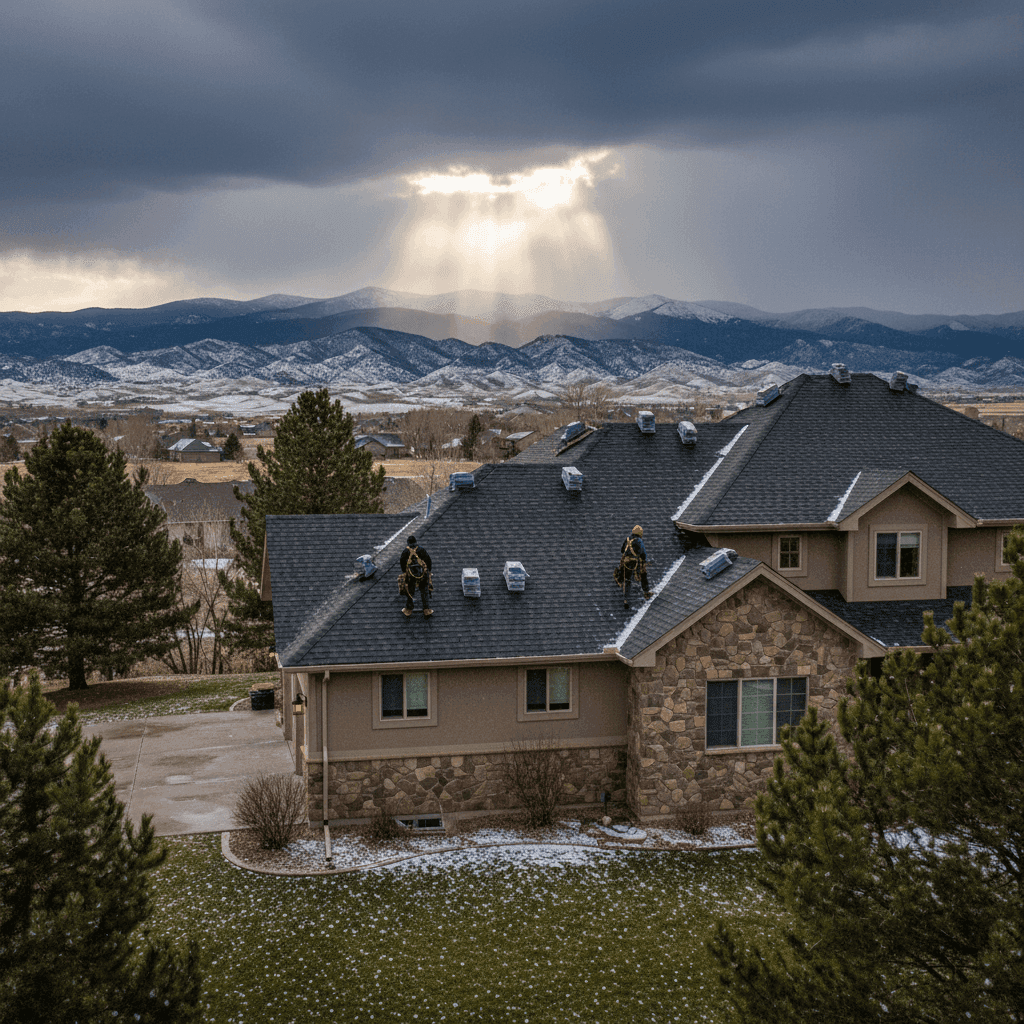
Roofing SEO in Colorado: What Actually Ranks in 2026
Roofing SEO in Colorado is won on storm intent. To rank in Denver, Colorado Springs, and the Front Range in 2026, you need a fast city-specific website, an optimized Google Business Profile with steady reviews, and content that answers hail and insurance-restoration questions the way homeowners and AI search actually ask them.
Why roofing SEO in Colorado is its own game
Colorado sits in the middle of “Hail Alley.” The Front Range — Denver, Aurora, Colorado Springs, Boulder, Fort Collins — takes some of the most frequent damaging hail in North America, and a single May-to-August season can strip thousands of roofs down to the decking. That’s the demand. The problem is that the demand is seasonal and violent, and every out-of-state storm chaser knows your ZIP codes as well as you do.
When a supercell drops golf-ball hail on Highlands Ranch, homeowners don’t canvass their neighbors first. They grab their phone and search “roof replacement,” “hail damage roof,” or “roofer near me” — and a wave of national restoration crews with big ad budgets floods in behind them. If you’re a local, licensed, GAF- or Owens Corning-certified contractor and you’re on page two, you lose that job to someone who’ll be gone by October.
The question isn’t whether SEO matters in Colorado. It’s whether your online presence is built for a market where a full replacement runs $10,000–$30,000, insurance restoration drives the volume, and the searcher decides in under a minute.
What actually ranks Colorado roofers in 2026
Four things do the heavy lifting. Get these right and you show up when the hail hits; get them wrong and you’re invisible during the only weeks that pay for your year.
1. The Google Business Profile and map pack
For “roofer near me” and “hail damage repair [city],” the three-result map pack sits above everything. Ranking there in Colorado comes down to proximity, a fully completed profile, correct categories (Roofing Contractor plus Roof Repair), photos of real Front Range jobs, and — the lever most roofers ignore — review velocity. A steady drip of fresh, keyword-natural reviews beats a pile of old five-stars that stopped in 2023.
2. City and service-area pages that aren’t doorway spam
You can’t rank in Parker, Castle Rock, and Longmont off one “service areas” page. You need genuine, distinct pages per city with local proof — jobs completed, neighborhoods served, permit and HOA notes that only a local would know. Thin, find-and-replace city pages trip Google’s doorway filter and rank for nothing.
3. Reviews, citations, and NAP consistency
Colorado’s map is crowded with post-storm LLCs, so trust signals decide ties. Consistent Name-Address-Phone data across Google, the BBB, and the big directories tells Google you’re a real, permanent local business — not a chaser with a magnetic truck sign. If your citations are a mess, start with local citations and NAP consistency before anything else.
4. AI search visibility
More Colorado homeowners are asking ChatGPT, Gemini, and Google’s AI Overviews “who’s the best roofer in Denver for hail damage?” before they ever click a blue link. Those answers are assembled from your reviews, your schema, and answer-first content. If your site doesn’t spell out what you do, where, and how insurance restoration works, the AI has nothing to cite — and it cites your competitor instead.
Losing the storm-season window is the expensive part. If your rankings only wake up after the hail — when it takes 6–12 weeks to move — you spend the whole restoration cycle watching chasers book the roofs that should have been yours. Our roofing SEO service for contractors is built to have you ranking before the first storm, not scrambling after it.
The Colorado-specific content that wins
Generic “why choose us” copy ranks nowhere. The pages that pull Colorado leads answer the questions homeowners actually type after a storm:
- Insurance restoration. How the claim works, what an adjuster looks for, how to read an EagleView report, and what a supplement is. Restoration is most of the Front Range market — own that language.
- The deductible law. Under Colorado’s Senate Bill 12-038, a roofer cannot pay, waive, or rebate a homeowner’s insurance deductible, must hold any payment in trust until materials are delivered or the majority of work is done, and must give the homeowner the right to rescind within 72 hours of signing — or within 72 hours of an insurer denying the claim. Explaining this honestly on your site marks you as the local pro, not the chaser offering to “eat the deductible.”
- Hail and materials. Impact-resistant Class 4 shingles, what they do to insurance premiums, tear-off vs. overlay, and cost per square for a Front Range replacement.
- Licensing reality. Colorado has no statewide roofing license, so requirements vary by city and county. A page that explains local permitting builds trust fast.
That’s also the content AI search engines lift word for word. The same answer-first pages that rank in Google are what get you quoted in AI Overviews.
Where to put your effort first
Not every lever moves at the same speed. Here’s how to sequence a Colorado roofing SEO push so you’re not waiting on the slowest play while storm season passes.
| Ranking lever | Why it matters in Colorado | Realistic time to impact |
|---|---|---|
| Google Business Profile + reviews | Wins the map pack for “roofer near me” during storm spikes | 2–6 weeks |
| Site speed & mobile fixes | Post-storm searchers bounce from any page over ~3 seconds | 1–3 weeks |
| City / service-area pages | Ranks you in every Front Range suburb, not just your HQ city | 2–4 months |
| Insurance & hail content + schema | Captures claim-stage searches and feeds AI Overviews | 2–5 months |
| Citations & NAP cleanup | Separates you from post-storm LLCs on trust signals | 4–8 weeks |
The fast wins — profile, reviews, speed — come first on purpose: they capture the storm already on the radar, while content and city pages compound for the seasons after.
The Colorado roofing SEO checklist
Run your own site against this before you hire anyone. Every “no” is a lead going to a competitor.
- Does your homepage load in under 3 seconds on a phone on cell data?
- Is your Google Business Profile 100% complete, with the right categories and photos from the last 90 days?
- Are you generating at least a few fresh reviews every month — not a stale wall from two years ago?
- Do you have a real, distinct page for each city you actually serve?
- Does your site clearly explain the insurance-restoration process and the Colorado deductible rules?
- Is your Name, Address, and Phone identical across Google, the BBB, and major directories?
- When you search your own service in an AI tool, does your company come up at all?
- Is there a click-to-call button visible without scrolling on every mobile page?
Miss three or more and you don’t have a ranking problem — you have a whole storm season leaking out of a website that looks fine but doesn’t work. Weeks before the season, the storm-season SEO checklist walks through the timing in detail.
What Colorado roofing SEO costs — and how fast it pays
Real roofing SEO in a competitive Front Range market runs roughly $1,500–$5,000 a month, depending on how many cities you’re targeting and how buried you’re starting. That sounds steep until you weigh it against one number: a single hail-restoration roof is worth $10,000–$30,000. Rank for one extra job a month and the campaign has paid for itself several times over. You can see how we structure it on our roofing SEO pricing page.
The reason SEO beats renting leads is durability. Local Services Ads and shared-lead services stop the day you stop paying, and you’re bidding against the same chasers. Rankings you own keep booking jobs between storms. If a rebuild is on the table too, pair the SEO with roofing website design in Colorado so the traffic lands on a site built to convert.
For context on why this is non-negotiable: BrightLocal’s 2025 Local Consumer Review Survey found 84% of consumers use Google to find or evaluate local businesses, up from 81% the year before. Your next Colorado customer is on Google. The only question is whose name they see.
Frequently asked questions
How long does roofing SEO take to work in Colorado?
Map-pack and Google Business Profile gains can show in 2–6 weeks. Ranking across multiple Front Range cities for competitive terms like “roof replacement Denver” usually takes 3–6 months of consistent work. The goal is to be ranking before hail season, so the smart time to start is winter, not the week after the first storm.
Do I need a separate page for every city I serve?
Yes, if you want to rank in them. One “service areas” list won’t put you in the map pack for Parker or Castle Rock. Each city needs a genuine page with local jobs, permitting notes, and specifics. Thin, copied city pages get filtered by Google as doorway pages and rank for nothing, so quality matters more than quantity here.
Can SEO help me win insurance-restoration jobs?
That’s exactly where it pays in Colorado. Content that explains the claim process, deductible rules, and hail inspections ranks for claim-stage searches and gets cited in AI answers. Homeowners mid-claim are high-intent, high-value leads, and most local roofers publish nothing that speaks to them — leaving that traffic to national chasers.
Is SEO better than buying roofing leads?
They solve different problems. Bought leads and Local Services Ads turn on fast but stop the moment you stop paying, and you’re sharing them with competitors. SEO takes longer to build but keeps producing jobs you don’t pay per-lead for — including in the off-season. Most Colorado roofers who scale run SEO as the foundation and use ads to spike volume after a storm.
What makes Colorado roofing SEO different from other states?
Two things: hail-driven, insurance-restoration demand, and a heavy influx of out-of-state storm chasers competing for the same searches. Colorado’s deductible law (SB 12-038) also shapes how you should talk about claims on your site. Winning here means ranking fast for storm intent and using trust signals to stand out from temporary post-storm crews.
Rank before the next storm, not after it
Colorado hands you the demand for free — the hail sees to that. What it doesn’t hand you is the ranking, and the roofers who win the restoration season are the ones whose SEO was already in place when the sky turned green.
Want to know where you actually stand? We’ll run a free roofing SEO audit of your site and show you three things: whether your pages load fast enough to hold a post-storm searcher, whether your Google Business Profile is set up to win the Front Range map pack, and whether your company shows up when homeowners ask AI tools for a roofer in your city. Request your free audit and we’ll tell you exactly what’s costing you jobs.