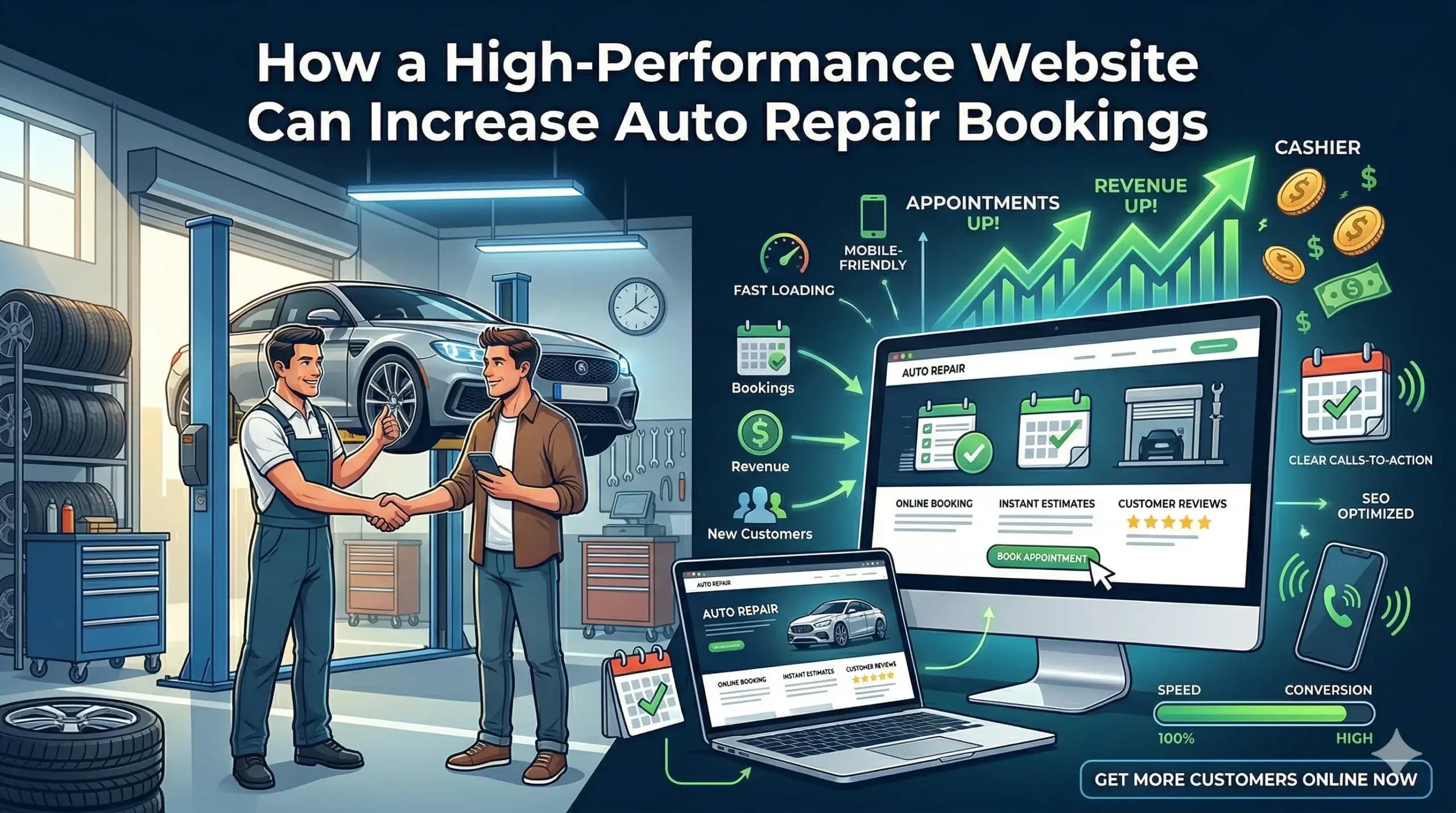
How a High-Performance Website Can Increase Auto Repair Bookings
Your bays are ready. Your techs are skilled. But your phone isn’t ringing the way it should — and your gut tells you something is off with your website.
Here’s the truth most auto shop owners don’t hear until it’s too late: your website isn’t just a digital business card. It’s either your best salesperson or your worst front-desk employee. And right now, if customers are landing on your site and leaving without calling, booking, or even reading past the first line — you’re losing revenue every single day without a trace.
This post breaks down exactly what a high-performance automotive website design actually looks like, what’s most likely killing your bookings right now, and what a purpose-built shop site should do instead. No tech jargon. No fluff. Just what matters for getting more cars in your bays.
Your Website Loads Slowly — And Your Customers Are Already Gone
Think about how a customer finds you. They’re sitting in a parking lot, their check engine light just came on, and they’re on their phone searching for a nearby shop. They tap your link. They wait. They wait a little longer. And then they tap the back button and call your competitor.
That’s not a hypothetical. That’s what happens when a website takes more than three seconds to load on mobile — and most auto shop websites load in six, eight, even ten seconds.
The technical reason comes down to how the site was built: oversized images, bloated code, cheap hosting, no performance optimization. But the business reason is simpler: slow sites don’t get calls.
What a properly built automotive website does instead:
- Loads in under 2 seconds on any phone
- Shows your phone number and “Book Now” button immediately — no scrolling required
- Works flawlessly on every screen size (most auto repair searches happen on mobile)
Digital Trace builds websites for automotive businesses that pass Google’s Core Web Vitals benchmarks — because a fast site isn’t just good UX, it’s a ranking signal that puts you above slower competitors in search results.
Google Doesn’t Know Enough About Your Shop to Show It Confidently
You might assume that having a website means Google knows you exist. It does — but “existing” and “ranking” are completely different things.
Here’s a plain-English way to think about it: Google is like a new service writer at a dealership who needs to write up a customer’s car. If the file is incomplete — no VIN, no service history, no notes — they can’t do their job confidently. Your website works the same way. If Google can’t quickly understand what you do, where you are, and why you’re credible, it won’t confidently show your shop to someone searching nearby.
The things most auto shop websites are missing:
- Location signals: Your city and service area clearly named throughout the site — not just buried in a contact page
- Structured data: Behind-the-scenes code that tells Google “this is an auto repair shop, here are their hours, here’s their rating” — without it, Google guesses
- Service-specific pages: One catch-all “Services” page doesn’t rank. A dedicated page for “brake repair in [city]” does.
This is exactly the kind of gap that a specialized automotive design agency addresses during a proper build — not as an afterthought, but baked into the foundation.
Visitors Land On Your Site But Leave Without Calling
Getting someone to your website is only half the battle. What happens when they get there?
Most auto shop websites fail the same way a waiting room with no front desk would: customers show up, look around, don’t see anyone to help them, and walk out. Your website visitor does the same thing — if they can’t immediately find your phone number, your location, and a clear reason to trust you, they’re gone.
This is called “conversion” — turning a visitor into a caller or booking. And it’s where most auto shop websites completely fall apart.
The most common conversion killers:
- Phone number hidden in the footer or on a separate contact page
- No clear call-to-action above the fold (what you see before scrolling)
- Generic stock photos instead of real shop photos that build trust
- No reviews, ratings, or trust signals visible on the homepage
- A contact form as the only booking option (customers want to call or book online instantly)
A high-performing automotive website puts your phone number and “Schedule Service” button in the header — visible on every page, on every device, always. That one change alone can meaningfully increase inbound calls.
💡 Pro Tip
The #1 mistake auto shops make: one generic homepage trying to do everything.
If someone searches “oil change near me” and lands on a homepage that talks about everything from tires to transmissions, they don’t see what they need fast enough — and they leave. The fix is creating targeted landing pages for your highest-value services (brake repair, transmission service, AC recharge) that speak directly to what the customer was searching for. Each page should have its own headline, its own local keywords, and its own call-to-action. It’s more pages to maintain — but each one works harder for you.
What Happens When You Fix the Foundation: A Real-World Scenario
The Shop: A family-owned auto repair business in the Southwest with three bays, five years in business, strong word-of-mouth — but a website built by a nephew in 2019 that hadn’t been touched since.
The Problem: The site loaded in over eight seconds on mobile. There was no booking option — just a contact form that went to an inbox nobody checked daily. The homepage had no reviews, no service-specific pages, and the phone number was only in the footer. They were showing up on page three for their main local search terms.
What Changed: A full rebuild focused on speed, mobile-first design, and local SEO structure. Dedicated pages for their top five services. Real shop photos. A prominent click-to-call button on every page. A simple online booking widget connected to their scheduling software.
The Result: Within 90 days, inbound calls from the website increased by over 60%. They moved to page one for three of their core local search terms. The owner estimated they were recovering at least 8–10 lost leads per week that had previously found their site and left.
That’s not a marketing miracle — it’s what happens when a website is actually built to convert.
Not sure if your shop’s website has these same issues? Get a free website audit — no obligation, just a clear picture of what’s costing you leads right now.
Your Competitor Is Showing Up — And You’re Not. Here’s Why.
If you’ve Googled your own services and noticed a competitor ranking above you — especially one you know isn’t better than you — this section is for you.
Local search rankings aren’t random. Google ranks sites based on dozens of signals, and most of them come down to three things: relevance (does this site clearly match what the searcher wants?), proximity (is the business actually local?), and authority (does Google trust this site?).
The shop outranking you has probably done a few things you haven’t:
- More reviews, more often: Businesses with a steady stream of recent Google reviews rank higher. Not just more reviews — recent ones, because Google treats review recency as a freshness signal.
- Consistent business information everywhere: Name, address, and phone number matching exactly across Google Business Profile, Yelp, your website, and every directory. Even small inconsistencies hurt rankings.
- A faster, better-structured website: Google uses site performance as a ranking factor. The competitor with the faster site has an edge — even if your service is better.
None of these are impossible to fix. But they take intentional effort — and usually a partner who understands how local search actually works for automotive businesses specifically.
Your Path to More Bookings
Here are five things that move the needle — in plain English:
- Fix your site speed. If your site takes more than three seconds to load on a phone, you’re losing customers before they ever see your number. This is fixable with the right rebuild.
- Make your phone number impossible to miss. It should be in your header, clickable on mobile, and visible without scrolling on every single page.
- Create service-specific pages. Stop trying to rank for everything on one page. Build individual pages for your top services, each targeting a local keyword.
- Get your Google Business Profile dialed in. Make sure your hours, photos, services, and responses to reviews are complete and current. This directly affects your map pack ranking.
- Add an online booking option. A lot of customers — especially younger ones — won’t call. They want to book online. Give them that option and you’ll capture leads you’re currently losing.
Frequently Asked Questions
Why am I not getting calls from my website even though I have one?
Having a website and having a working website are two different things. If your site is slow, hard to navigate on mobile, or doesn’t have a visible phone number and clear call-to-action, visitors will leave before they ever contact you. The site exists — but it’s not doing its job.
How do I know if my auto shop website is actually working or costing me leads?
The honest answer: most shop owners have no idea, because nobody’s told them what to look for. A basic check is this — Google your own top service plus your city, see where you rank, then open your site on your phone and time how long it takes to load. If you rank below page one or the site takes more than three seconds, you’re losing leads. A free website audit gives you a full picture without any guesswork.
How long does it take to see results from a new website?
For traffic and rankings, most shops start seeing meaningful movement within 60–90 days of launching a properly optimized site. Conversion improvements — more calls and bookings from existing traffic — can happen almost immediately after a rebuild, because you’re making it easier for people who already find you to actually contact you.
What makes an automotive website different from a regular business website?
Auto repair customers search differently than almost any other service business. They’re often in a stressful situation, searching on mobile, and making a decision fast. Your website needs to load instantly, show trust signals (reviews, credentials, real photos) at a glance, and make it dead simple to call or book. Generic website templates aren’t designed for that specific moment — automotive-specific design is.
Do I really need a fast website if all my customers are local?
Yes — especially because they’re local. Local customers are almost always searching on their phones, often while they’re already out. Mobile connections are slower than WiFi, which makes site speed even more critical. And Google uses site speed as a ranking factor for local search results, so a slow site directly hurts how often you show up when someone nearby searches for what you offer.
I’ve paid for a website before and it didn’t help. Why would this be different?
Most shop owners who’ve been burned before paid for a site that looked fine but was never built to rank or convert. Design and performance are different disciplines. A site can look professional and still load slowly, miss local SEO signals, and bury your phone number. The difference is a build process that starts with “how do we get this shop more calls” — not “how do we make this look nice.”
Ready to See What Your Website Is Actually Costing You?
Every week you have a slow, underperforming website, you’re handing leads to the shop down the street. Not because they’re better — because their website works and yours doesn’t.
Digital Trace specializes in building high-performance websites for auto repair businesses across the US — sites that load fast, rank locally, and turn visitors into booked appointments.
There’s no pitch, no pressure, and no obligation. Just a clear, honest look at what’s working, what isn’t, and what it would take to fix it.