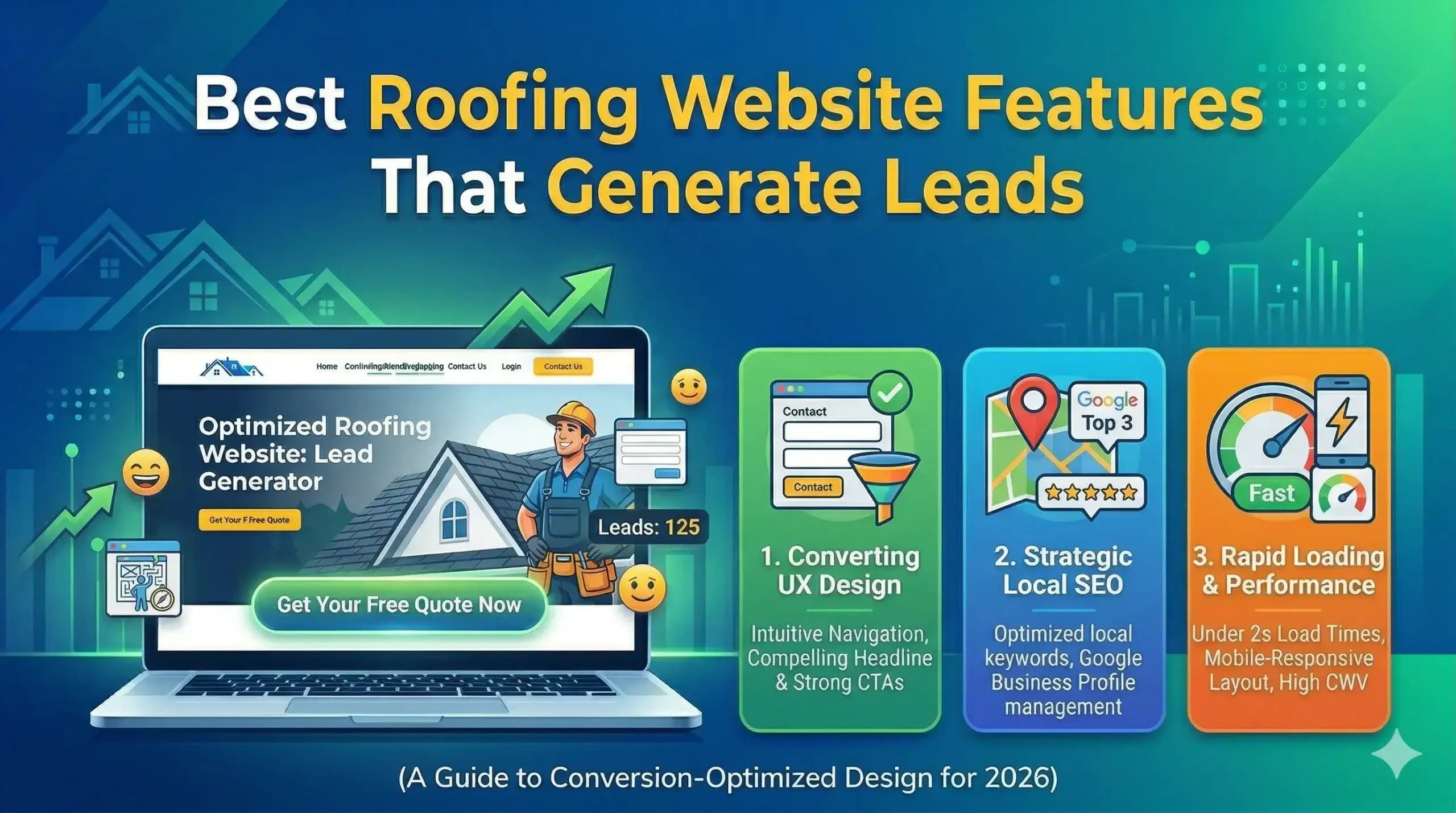
Best Roofing Website Features That Generate Leads
You’re getting traffic to your roofing website. People are finding you. But the phone isn’t ringing the way it should be — and you can’t figure out why.
Most roofing contractors assume the problem is marketing. They run more ads, post more on Facebook, or bump up their Google budget. But the real leak isn’t in your marketing. It’s in your website.
A poorly built roofing website is like showing up to a job with a rusted-out truck and no ladder. You might get there, but you’re not closing anything. Homeowners visit your site, make a split-second decision, and either call — or click away to your competitor.
This post breaks down the specific website features that actually generate roofing leads. Not generic design tips. The real stuff that determines whether a homeowner picks up the phone or moves on.
Why Your Roofing Website Isn’t Generating Calls
Here’s the honest truth most agencies won’t say: most roofing websites are built to look good in a presentation — not to win jobs.
They have nice photos, a logo, maybe a contact form buried on page three. What they don’t have is a clear path that takes a stressed-out homeowner (who just discovered a leak after last night’s storm) and turns that urgency into a phone call or booked estimate.
Every hour a panicked homeowner spends confused on your site is an hour they spend on a competitor’s site instead.
Feature #1: A Phone Number That’s Always in Sight
When a homeowner needs a roofer, they’re not browsing leisurely. They want a number. Fast.
If your phone number isn’t visible at the top of every single page — especially on mobile — you’re losing calls before the conversation even starts. This isn’t a design opinion. It’s the single highest-impact change most roofing websites can make.
What a strong roofing company website does instead:
- Pins a clickable phone number to the top of the screen on mobile so it scrolls with the user
- Uses a high-contrast color (orange, red, or bright green) so the number pops
- Includes a “Call Now” button that one tap connects directly — no copying, no memorizing
The goal is zero friction between “I need a roofer” and “I’m talking to one.”
Feature #2: A Site That Loads Before They Get Impatient
Most people give a slow website about three seconds before they leave. On mobile — which is where most of your traffic comes from — that window is even shorter.
Think about that. You could be spending money on Google Ads, showing up in search results, and losing every single visitor because your site takes six seconds to load an image gallery from 2019.
The business impact isn’t just annoying users. Google’s ranking algorithm now factors in speed directly. A slow site ranks lower AND converts worse — a double loss.
What this looks like in practice:
- Images that are properly compressed (big photos are the #1 speed killer on roofing sites)
- A hosting plan that can actually handle traffic
- Code that’s clean and doesn’t load unnecessary bloat
Digital Trace builds every roofing contractor website with performance baked in from the start — not bolted on as an afterthought.
Feature #3: A Homepage That Speaks to Stressed Homeowners — Not Search Engines
Walk into any roofing website and you’ll see the same thing: “Quality Roofing You Can Trust.” “Serving [City] for 20 Years.” A stock photo of someone in a hard hat.
That copy doesn’t make anyone pick up the phone. It doesn’t address what the homeowner is actually feeling: Is this company reliable? Will they show up? Are they going to rip me off?
Your homepage needs to answer those questions in the first 10 seconds. That means:
- A headline that names the specific problem you solve (“Storm damage? We respond same-day.”)
- Social proof immediately visible — reviews, years in business, number of jobs completed
- A clear, single call to action above the fold (“Get a Free Estimate” — not four different buttons)
Every word on your homepage is either earning a call or costing you one.
Feature #4: Reviews That Show Up Where Homeowners Are Looking
You probably have great Google reviews. But if they’re not showing up in the right places — or not showing up at all — you’re leaving money on the table.
Google uses review signals to decide how prominently to show your business in local search. More importantly, homeowners use reviews to decide whether to trust you before they’ve ever spoken to you.
A high-performing roofing website pulls in live Google reviews so homeowners see them on your site — not just on your Google Business profile where competitors are also listed. It also uses structured data (the technical term is “schema markup”) so Google understands your business is a local roofing contractor with real customer feedback. In plain terms: it helps Google confidently recommend you over someone with no reviews or a thin profile.
💡 Pro Tip: Your Contact Form Might Be Killing Conversions
Most roofing websites have a contact form with six or more fields: name, email, phone, address, type of roof, message, preferred callback time… By field three, most homeowners have already closed the tab.
The fix is simple: reduce your form to three fields maximum — name, phone number, and one line about their issue. Fewer fields = more submissions. A shorter form feels less like a commitment and more like a quick conversation starter. The roofing companies that make this one change alone often see a dramatic jump in form completions.
Feature #5: Local SEO Built Into Every Page — Not Just the Homepage
Here’s where most roofing websites fall completely flat. They optimize the homepage for “[City] Roofing” and call it done. But homeowners search for roofers in their specific neighborhood, zip code, or suburb — not just the city.
If your site doesn’t have dedicated pages for the specific areas you serve, you’re invisible to a huge portion of your potential customers.
Effective roofing web design services build out location-specific pages for every major service area. Each page targets the real search phrases homeowners use — “roof repair in [Neighborhood],” “emergency roofer near [Zip Code]” — and gives Google enough local context to rank you confidently.
This is one of the biggest separators between roofing websites that generate a steady stream of leads and ones that just sit there.
Before & After: What Happens When a Roofing Website Actually Works
The Situation: A roofing contractor in the Midwest — 12 years in business, strong reputation, solid reviews — was getting roughly 400 website visitors a month but averaging only 6–8 contact form submissions. Their site was built by a nephew in 2017, loaded slowly on mobile, and had a contact form with nine fields.
What Changed: A new site was built with a pinned mobile call button, fast load times, a three-field contact form, and location pages for the eight towns they actively served. Reviews were pulled in live from Google. The homepage headline was rewritten to address storm damage response directly.
The Result: Within 90 days, form submissions jumped from 6–8 per month to over 35. Phone calls from the website more than doubled. Their cost-per-lead from Google Ads dropped because the site was converting the traffic they were already paying for.
The leads didn’t change. The traffic didn’t change. The website changed — and the phone started ringing.
Not sure if your roofing website has these problems? Get a free website audit — no obligation, just a clear picture of what’s costing you leads.
Your Path to More Leads: 5 Steps to a Roofing Website That Works
Step 1: Audit what you have. Look at your site the way a panicked homeowner would — on your phone, in 10 seconds. Can you find the phone number immediately? Is there a clear reason to call you over anyone else?
Step 2: Fix the speed. Run your site through Google’s free PageSpeed Insights tool. If you’re scoring below 70 on mobile, your site is losing visitors before they see anything.
Step 3: Simplify the conversion path. One headline. One call to action. One phone number. One short form. Complexity kills conversions.
Step 4: Build out your local presence. Create dedicated pages for every area you serve. This is where the long-term lead flow comes from.
Step 5: Let an expert handle the heavy lifting. The websites Digital Trace builds for roofing businesses are engineered from day one to generate calls — not just look professional. Speed, local SEO, conversion structure, and review integration are all built in, not added as extras.
FAQ: Real Questions Roofing Contractors Ask Before Hiring a Web Agency
Why am I not getting calls from my website even though people are visiting it?
Traffic without calls almost always means a conversion problem, not a visibility problem. Your site might load slowly, have an unclear headline, bury the phone number, or make it hard to take the next step. The good news is these are fixable — usually without rebuilding the entire site.
How do I know if my roofing website is actually working?
If your website is working, you should be able to trace a clear percentage of your monthly calls and form submissions back to it. If you can’t — or if that number is near zero — your site is a placeholder, not a business asset. A free audit can show you exactly where visitors are dropping off.
How long does it take to see results from a new roofing website?
Conversion improvements (more calls from existing traffic) can show results within the first 30–60 days. Local SEO and organic ranking improvements typically build over 3–6 months. Most roofing contractors see meaningful lead increases within the first quarter after launch.
What makes a roofing website different from a regular business website?
Roofing customers are often in a stressful situation — they’ve just had storm damage, a leak, or a roof failure. They need to move fast and trust quickly. A roofing website has to communicate speed, credibility, and local expertise within seconds. Generic business website templates don’t account for any of that urgency.
Do I really need a fast website if my customers are mostly local?
Especially if they’re local. Local homeowners are searching on their phones, often while standing in a wet room or looking at a damaged roof. If your site takes more than three seconds to load on mobile, they’re already calling the next roofer. Site speed is also a direct Google ranking factor — a slow site ranks lower in local search results, which means fewer people even find you.
I’ve been burned by agencies before. How is this different?
That’s a fair concern — and it’s one Digital Trace hears often. The difference is accountability and specificity. A free audit shows you exactly what’s broken and what it’s costing you in concrete terms — before any money changes hands. There’s no pressure and no vague promises. Just a clear picture of where your website stands and what fixing it would actually mean for your business.
Ready to Find Out What Your Roofing Website Is Costing You?
Most roofing contractors don’t realize how much revenue is slipping through the cracks of a slow, confusing, or outdated website. The leads are out there — homeowners in your area searching for exactly what you do. The question is whether your website is capturing them or sending them to your competitor.
A free website audit from Digital Trace takes a close look at your site’s speed, structure, local SEO, and conversion flow — and gives you a plain-English breakdown of what’s working, what isn’t, and what it would take to fix it.
No hard sell. No long contracts. Just a clear, honest look at what you’re working with.