Why Your Lawn Care Business Is Losing Clients to Competitors Online
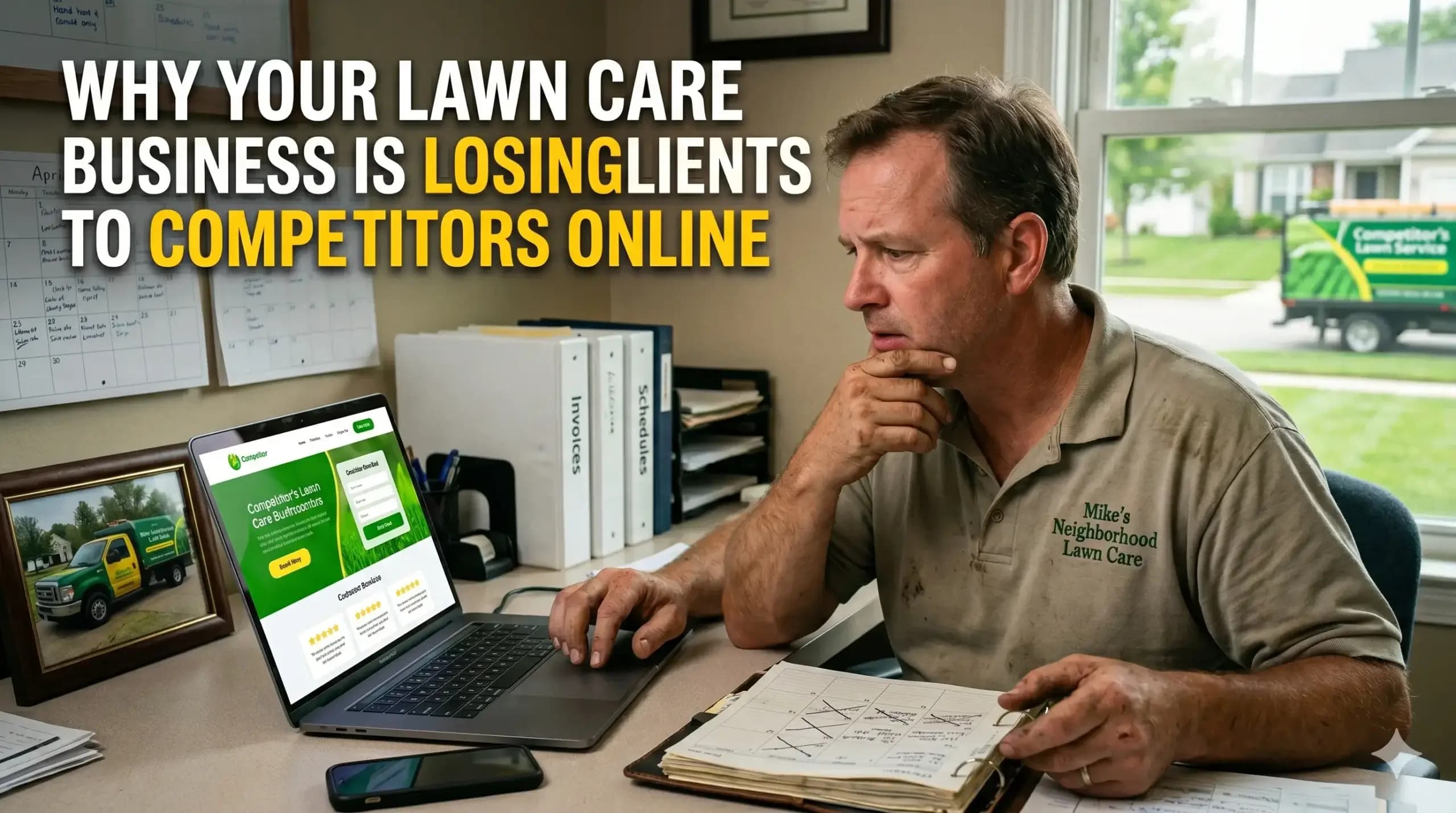
You do great work. Your crews show up on time, your lawns look clean, and your customers are happy — at least, the ones you have. But somewhere between a homeowner typing “lawn care near me” and actually picking up the phone, you’re losing them to a competitor. And that competitor might not even do better work than you.
The difference isn’t skill. It’s their website.
Most lawn care business owners assume that if they have a website, they’re covered. But having a website and having one that actually wins you clients are two completely different things. This article breaks down exactly where that gap is — and what you can do about it before another busy season slips by.
Your Website Loads Too Slowly — And Most Visitors Leave Before Your Phone Number Even Appears
Picture this: a homeowner pulls out their phone while their neighbor’s lawn is being mowed. They Google “lawn care service” and tap the first result. If your site takes more than three seconds to load, they’ve already hit the back button before they’ve read a single word.
That’s not an exaggeration. Most mobile users won’t wait. They’ll just go to the next result — which is often your competitor.
The technical reason is usually oversized images, bloated code, or cheap web hosting that can’t handle traffic spikes. None of that is obvious to you when you’re looking at your own site. But Google sees it, and more importantly, your potential customers feel it.
What this costs you: If your site is slow and you’re getting even modest traffic, you’re likely losing multiple leads every single week without ever knowing those people existed.
Websites built for lawn care businesses are engineered to load fast from the first tap — especially on the phones that most of your customers are using.
Google Doesn’t Trust Your Site Enough to Show It
Think of Google like a new homeowner in your area asking a neighbor for a lawn care recommendation. If your name barely rings a bell — no reviews, no details, no presence — they’re going to recommend someone else. Someone Google knows and trusts.
Your website needs to give Google the information it needs to confidently recommend you. That means clear signals: what services you offer, what areas you serve, how to contact you, and proof that real customers have worked with you.
When those signals are missing or muddled, Google hedges. It might show you for one search and not another. It might rank you on page two for searches where you should be on page one.
The fix isn’t complicated, but it’s specific. It involves making sure your service pages are written clearly for both Google and homeowners, that your location information is consistent everywhere online, and that your site’s structure tells Google exactly who you are and what you do.
Your Site Looks Fine to You — But It’s Losing Visitors in the First Few Seconds
Here’s an uncomfortable truth: you’ve seen your website so many times that you can’t see it the way a stranger does. A first-time visitor to your site makes a judgment in about five seconds. If the design looks dated, the photos are blurry, or it’s hard to find how to get a quote — they leave.
This isn’t about having a flashy website. It’s about trust. A homeowner is about to let you onto their property, around their kids, their dogs, their landscaping. They want to feel confident before they call. Your website either gives them that confidence or it doesn’t.
Ask yourself honestly:
- Does my homepage make it obvious, within five seconds, what I do and where I serve?
- Is there a clear, easy way to request a quote or call — visible without scrolling?
- Do I have real photos of my actual work, or just stock images anyone could have?
- Are there reviews or testimonials on the site?
If you answered “no” to any of these, you’re losing clients who would have hired you if the first impression had been better.
💡 Pro Tip
One of the most common mistakes lawn care websites make: burying the phone number or “Get a Quote” button at the bottom of the page or in a tiny font at the top corner.
Your phone number should be impossible to miss — ideally in a large, tappable format at the top of every page, especially on mobile. When someone’s ready to call, make it effortless. Every extra second they spend looking for your number is a second they might just close the tab instead.
You’re Invisible for the Searches That Actually Matter
Ranking for “lawn care” is nearly impossible — it’s too broad and too competitive. But ranking for “lawn mowing service in [your city]” or “lawn care company near [your neighborhood]”? That’s a real, winnable opportunity that many small lawn care businesses are leaving on the table.
Most lawn care websites have one page that says “we provide lawn care services” and calls it a day. That’s like having a yard sign with no phone number. You’re present, but you’re not useful.
Google wants to match searches with pages that actually answer the question. If someone searches “lawn fertilization service in Dallas,” they want a page about fertilization services in Dallas — not your general homepage.
What works instead:
- Dedicated pages for each core service (mowing, fertilization, aeration, overseeding, etc.)
- Pages that mention the specific cities and neighborhoods you serve
- Content that answers the questions your customers actually ask
This is how how Digital Trace builds lawn care websites — with a structure designed to rank for the specific, local searches your customers are already making.
Real Results: What Happens When a Lawn Care Website Actually Works
Before: A mid-sized lawn care company operating across three suburbs had a website they’d built themselves five years ago. It looked okay on a desktop but was nearly unusable on a phone. Their contact form was buried two clicks deep, their Google Business profile pointed to an old address, and they had no dedicated pages for any specific service. They were getting maybe two or three web leads per month and couldn’t figure out why referrals were their only real source of new business.
After: After rebuilding with a mobile-first design, fast load times, separate service pages for each offering, and a prominent click-to-call button on every page, the results changed significantly. Within four months, web leads increased to 15–20 per month. Their Google ranking for local lawn care searches moved from page three to page one for multiple service terms. The owner reported that they stopped relying almost entirely on referrals and started being selective about which new clients they took on.
The work didn’t change. The crews were the same. The only thing that changed was what happened when a stranger searched for lawn care and landed on their website.
Not sure if your lawn care website has these issues? Get a free website audit — no obligation, just a clear picture of what’s costing you leads.
Your Path to More Leads: Where to Start
Getting more leads from your website doesn’t require a massive overhaul overnight. Here’s what actually moves the needle:
- Fix your mobile experience first. Pull out your phone and visit your own website. Is the phone number easy to tap? Can you find a quote button without scrolling? If not, that’s the first thing to fix.
- Speed up your site. Run your site through Google PageSpeed Insights (free tool). If it scores below 70 on mobile, your slow load time is actively costing you leads.
- Create pages for each service you offer. If you do mowing, fertilization, aeration, and cleanups — each one deserves its own page, not a single paragraph on your homepage.
- Make sure your contact info is consistent everywhere. Your name, address, and phone number should be identical on your website, Google Business Profile, Yelp, and any directory listings. Inconsistencies quietly hurt your rankings.
- Add real photos and real reviews. Actual before/after shots of your work and genuine customer testimonials build the kind of trust that makes someone pick up the phone.
Frequently Asked Questions
Why am I not getting calls from my website?
Usually, it’s one of three things: your site isn’t showing up in the searches your customers are making, it loads too slowly for people to stick around, or it doesn’t make it easy enough to take the next step. All three are fixable — but you need to know which one is actually happening before you can fix it.
How do I know if my lawn care website is actually working?
If you don’t know how many people visit your site each month, how long they stay, or how many fill out a form or call from it — you’re flying blind. A basic setup with Google Analytics takes about 30 minutes and gives you real data on what’s working. If your site has no tracking at all, that’s a gap worth closing immediately.
What makes a lawn care website different from a regular business website?
Lawn care is a hyper-local, high-trust service. People want to see your actual work, confirm you serve their neighborhood, and be able to reach you in one tap. A generic website template doesn’t account for any of that. A well-built lawn care site is structured around local service areas, specific services, and a frictionless path to contact — not just a nice design.
Do I really need a fast website if my customers are local?
Yes — more so, actually. Most local service searches happen on mobile phones, often in the middle of something else. A homeowner who just noticed their lawn needs attention is not going to wait five seconds for your page to load. They’ll go to the next result. Speed matters more for mobile, local searches than almost any other category.
How long does it take to see results from a new website?
A faster, better-structured site can start converting more visitors immediately. Ranking improvements from SEO changes typically take two to four months to fully show. That said, most lawn care businesses see a meaningful uptick in leads within the first season after a proper rebuild — especially if the previous site had significant problems.
What if I’ve worked with agencies before and been burned?
That’s fair — and common. The difference is accountability. Before working with anyone, ask them to show you actual examples of lawn care websites they’ve built and what results those businesses saw. Ask how they’ll measure success and what you’ll actually be able to track. A free audit is a good starting point — it shows you exactly what’s wrong with your current site before you commit to anything.
Stop Losing Leads You’ve Already Paid For
Every person who searches for lawn care in your area and lands on your website is a warm lead. You didn’t have to knock on a door or run an ad to get them there — they came looking for exactly what you offer. Losing them because of a slow load time, a missing service page, or a hard-to-find phone number is one of the most expensive and invisible problems in this business.
You don’t need to guess whether your website is costing you clients. A free audit will show you exactly where the problems are — no jargon, no sales pressure, just a clear look at what’s working and what isn’t.
Find out what your lawn care website is costing you — get your free audit today.