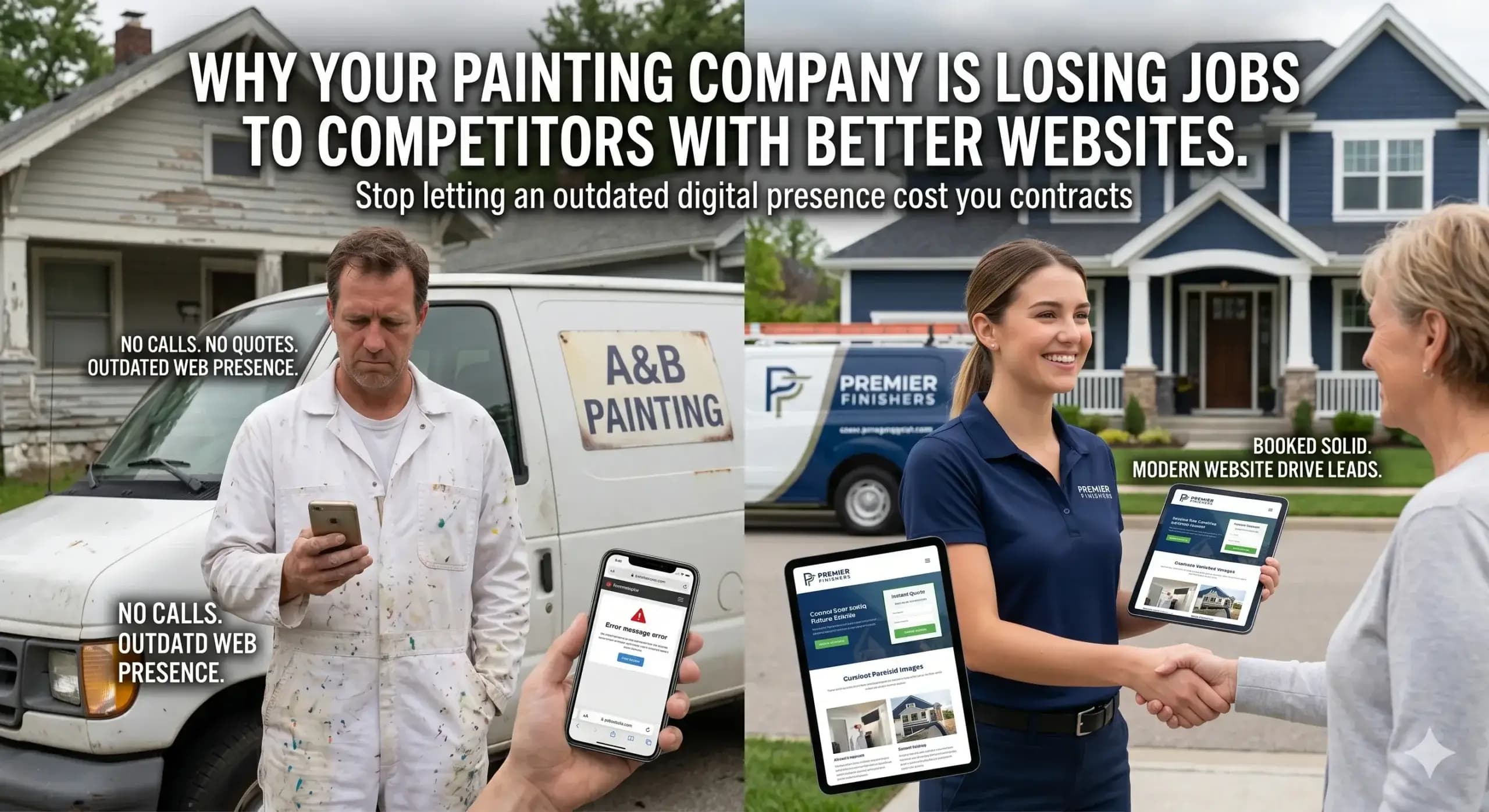
Why Your Painting Company Is Losing Jobs to Competitors With Better Websites
You did the estimate. You showed up on time. Your work is solid. So why did the homeowner hire the other guy?
Nine times out of ten, the decision was made before you ever picked up the phone — the moment they typed “painters near me” and started clicking through websites. If yours didn’t look the part, load fast enough, or make it easy to reach you, they moved on. Simple as that.
Most painting business owners assume they’re losing work because of price. Sometimes that’s true. But more often, there’s a silent leak draining leads every single week — and it’s sitting on your screen right now. This post breaks down exactly what’s happening, why it happens, and what you can do about it. No jargon, no fluff — just real answers a painting business owner can use.
Your Website Is Like a Job Site Walkthrough — First Impressions Are Everything
Think about it this way: when a homeowner lets a painter walk through their house for an estimate, they’re already judging — are you professional? Do you seem trustworthy? Did you wipe your boots?
Your website does that same walkthrough for every person who searches for a painter online. It happens before you ever speak to them.
If your site looks outdated, loads slowly, or is hard to navigate on a phone, the homeowner’s gut says: this company isn’t careful enough. They close the tab. They call your competitor.
What this looks like in real life:
- Blurry before-and-after photos that look like they were taken in 2011
- Text that’s too small to read on a phone screen
- No clear “Call Now” button visible without scrolling
- A contact form that feels like filing taxes
The fix isn’t about being flashy. It’s about looking like you run a tight, professional operation — because you do. A website built for painting businesses should show that from the very first second.
If Your Site Takes More Than 3 Seconds to Load, You’re Already Losing
Here’s something most painting business owners don’t realize: people don’t wait for slow websites. Studies consistently show that most visitors abandon a page if it doesn’t load within a few seconds. On mobile — where most of your potential customers are searching — that window gets even shorter.
Why it happens: Many websites are built with oversized images, bloated code, or cheap hosting that wasn’t designed to handle real traffic. Your site looks fine when you check it because your browser cached it. For someone new? They’re staring at a loading spinner.
What it costs you: If even 2–3 people a week leave because your site is slow, and each job is worth $1,500–$5,000, you’re leaving serious money on the table every single month.
What good painting website design actually does:
- Compresses images without losing quality
- Uses fast, reliable hosting built for business
- Loads fully on mobile in under 2 seconds
- Puts your phone number front and center — immediately
Speed isn’t a tech luxury. It’s a sales tool.
Google Doesn’t Know Enough About Your Business to Show It
You might have a website. But if Google can’t figure out what you do, where you do it, and why you’re credible, it won’t show your site to people searching for painters in your area.
The plain-English version: Google reads your website the same way a new customer might skim it. If it doesn’t clearly say “residential painting contractor serving [City]” — with real service pages, location signals, and structured information — Google hedges its bets and sends traffic to the competitors who made it obvious.
What’s usually missing from painting websites:
- Individual service pages (interior painting, exterior painting, cabinet painting — not one page that mentions all three)
- Location-specific content (“serving homeowners in [City] and surrounding areas”)
- A Google Business Profile that matches the website’s information
- Basic technical signals that help Google categorize the site correctly
💡 Pro Tip: One of the most common mistakes painting business owners make is having a single “Services” page that lists everything in a few sentences. Google treats each service as a separate search. If you want to show up for “exterior house painting near me,” that phrase needs its own dedicated page with real detail behind it — not a bullet point buried under five others. This single change can meaningfully improve how often Google shows your site for high-intent searches.
Your Phone Number Shouldn’t Be a Treasure Hunt
Pull up your website on your phone right now. How many times do you have to scroll or tap before you can call your own business?
If the answer is more than zero, you have a problem.
Most painting customers are deciding quickly. They might be standing in their driveway looking at peeling trim, or sitting at their kitchen table comparing three painters at once. The easier you make it to contact you — the more calls you get. Full stop.
What a high-converting painting website does differently:
- Shows a clickable phone number in the top bar on every page
- Has a simple, short contact form (name, phone, what do you need — done)
- Includes a clear, direct call-to-action on every section: “Get a Free Estimate”, “Call Now”, “Schedule Today”
- Makes the next step feel obvious, not optional
If your competitor’s site has a “Call Now” button visible the moment the page loads and yours doesn’t — they’re getting the call. Every time.
Real-World Scenario: Before and After
The business: A residential painting company based in the Midwest. Two crews, solid reputation, mostly word-of-mouth referrals. Owner had a website built years ago by a friend — functional, but bare-bones.
The problem: They were getting roughly 3–5 website inquiries a month. The site had no individual service pages, loaded slowly on mobile, and the only way to contact them was a form buried at the bottom of the homepage.
What changed: A new painting website design was built with dedicated pages for interior, exterior, and cabinet painting. The site loaded in under 2 seconds. A click-to-call button was added to the top of every page. Local SEO signals were built in from the ground up.
The result: Within 90 days, website inquiries went from 3–5 per month to 18–22 per month. The owner didn’t change his prices or add crew — the website just started doing its job.
Not sure if your painting website has these issues? Get a free website audit — no obligation, just a clear picture of what’s costing you leads.
Your Path to More Leads: 5 Steps That Actually Work
You don’t need to become a web designer. You just need a website that does its job. Here’s the straightforward path:
- Audit what you have. Look at your site on your phone. Is it fast? Is your number easy to find? Does it explain exactly what you do and where you work? If you’re unsure, a professional audit will tell you fast.
- Build dedicated service pages. Interior painting, exterior painting, cabinet refinishing — each one deserves its own page with real descriptions, photos, and a call-to-action.
- Fix your speed. Compress your images. Move to reliable hosting. This alone can improve both your Google rankings and the number of people who actually stay on your site.
- Make contact frictionless. Click-to-call at the top. Short form. Clear ask. The simpler you make it, the more people follow through.
- Work with someone who knows the painting industry. Generic web designers build generic websites. A painting website design agency understands what painting customers are looking for — and builds toward that specifically.
FAQ: Real Questions From Painting Business Owners
Why am I not getting calls from my website even though I have one?
Having a website and having a website that works are two different things. Most painting websites fail on one of three things: they’re hard to find on Google, they load too slowly for people to stick around, or they don’t make it obvious how to contact you. Usually it’s a combination of all three.
How do I know if my painting website is actually working?
If you don’t know how many people visit your site each month, how they found you, and how many of them contacted you — you have no visibility. At minimum, you should have Google Analytics installed and be tracking form submissions and phone clicks. If that sounds foreign, it means no one set it up properly.
How long does it take to see results from a new website?
A well-built site can start showing results within 60–90 days for local search. Depending on competition in your area, some results come faster. The key is that a properly built website compounds over time — it gets stronger the longer it’s live, not weaker.
What makes a painting website different from a regular business website?
Painting customers make decisions based on trust and visuals. They need to see real work, real reviews, and a clear sense that you’re a legitimate, established business. They’re also almost always searching on mobile. A painting website needs to be built around those specific behaviors — not copied from a generic template.
Do I really need a fast website if my customers are local?
Yes — especially because your customers are local. They’re searching on their phones, often outdoors or on the go, sometimes on slower connections. If your site doesn’t load fast, they’re gone before they see your work. Local doesn’t mean slow is acceptable. It means speed matters even more.
How do I know if Digital Trace is the right fit for my painting business?
The easiest way is to see what they find. Book a free website audit and get a specific breakdown of what’s working, what’s broken, and what it’s costing you in lost leads. No pitch, no obligation — just real information you can use.
Stop Leaving Jobs on the Table
Your reputation is solid. Your work speaks for itself. The only thing working against you is a website that isn’t pulling its weight.
Every week that passes with a slow, hard-to-find, hard-to-use website is another week your competitor is getting calls that should be yours.
The good news: this is fixable. And it starts with knowing exactly what’s broken.
Digital Trace will review your painting website, show you exactly what’s costing you leads, and give you a clear picture of what a high-performing site could do for your business — no strings attached.
Your next job shouldn’t go to the painter with the better-looking truck. It should go to you — because you have the better website.