7 Must-Have Features Every Painting Company Website Needs to Get More Leads
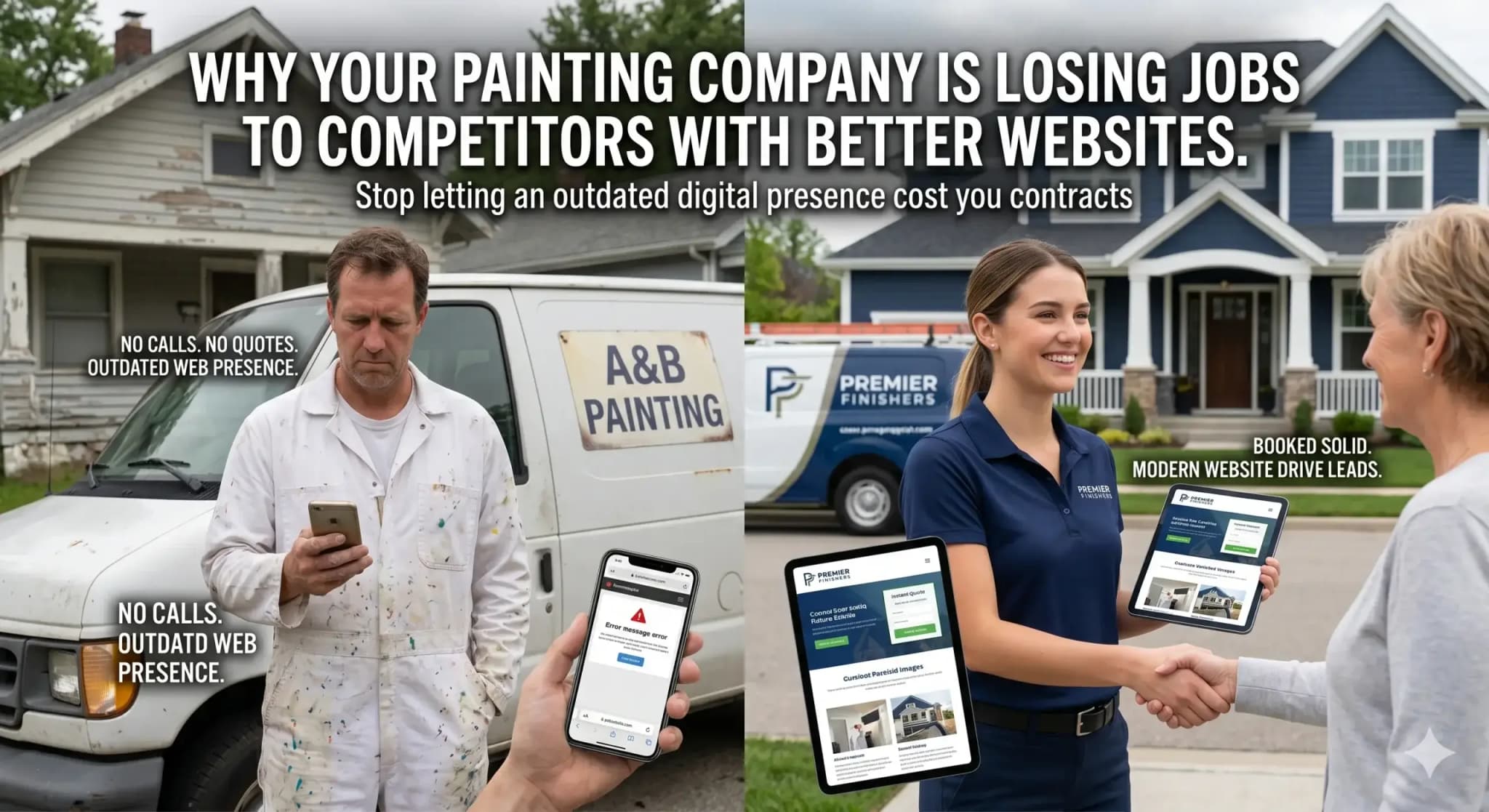
You do great work. Your jobs look immaculate. Past clients rave about you. So why is the phone not ringing from your website?
Most painting business owners assume the answer is more advertising — more Facebook posts, maybe a Google ad here and there. But the real problem is almost always the website itself. It’s not designed to convert visitors into leads. It’s just sitting there, looking decent, doing nothing.
Here’s the hard truth: a painting website that doesn’t actively work for you is like sending an estimator to a job site with no tools. The opportunity is there, but nothing gets done.
This post breaks down the 7 features that separate painting company websites that generate real leads from the ones that silently bleed money every single day. If your site is missing even a few of these, you’re handing jobs to competitors — and you probably don’t even realize it.
1. A Clear, Specific Headline That Tells Visitors Exactly What You Do
The problem: Most painting websites open with something like “Welcome to ABC Painting” or “Quality Painting Services.” That tells a visitor almost nothing.
Why it matters: When someone lands on your site, they make a decision in about 3 seconds: Does this look like what I need? If your headline doesn’t immediately say who you serve, where you work, and why you’re the right choice — they leave.
The real cost: You’re paying (in time, in SEO, in ad spend) to get people to your site, and they bounce before they even scroll.
What to do instead: Lead with a specific, benefit-driven headline. Something like: “Professional Interior & Exterior Painting in [City] — Done Right, On Time, Every Time.” That headline answers three questions immediately: what you do, where you do it, and why they should trust you.
At Digital Trace, every painting website design starts with a headline audit — because the first 10 words on your homepage can make or break everything that follows.
2. A Phone Number That’s Always Visible (Especially on Mobile)
The problem: A surprising number of painting websites bury the phone number in the footer — or worse, only have it on a contact form.
Why it matters: The majority of people searching for painting services are on their phones. They want to tap and call, not fill out a form, wait 24 hours, and play phone tag. If your number isn’t visible at the top of every page on mobile — as a tappable link — you’re losing calls before they ever happen.
The real cost: Every person who had to hunt for your number and gave up is a job you didn’t get. These are warm leads who already liked what they saw — they just couldn’t reach you fast enough.
What to do instead: Pin your phone number to the top of every page with a click-to-call button on mobile. Make it big. Make it obvious. Don’t make them work for it.
3. Before-and-After Project Photos That Prove Your Work
The problem: Generic stock photos of paint brushes and rollers don’t sell jobs. Real photos of your actual work do.
Why it matters: Painting is a visual trade. Your potential customer is standing in their living room, imagining what it could look like. They need to see your work — specifically work that looks like theirs. A gallery of real before-and-after photos from jobs you’ve done in your area is one of the most powerful trust signals a painting website can have.
The real cost: If your site has no photos — or has only after shots without the before — visitors have no emotional reference point. They don’t connect. They move on to someone whose site shows the transformation clearly.
What to do instead:
- Group photos by project type (interior, exterior, cabinets, commercial)
- Always show before AND after shots together
- Add a one-line caption: what room, what finish, what city
- Feature your best work prominently on the homepage — not buried in a gallery tab
4. Fast Loading Speed — Especially on Mobile
The problem: If your site takes more than 3 seconds to load, most people leave — and they don’t come back.
Why it matters: Most painting websites are overloaded with large, uncompressed images and slow hosting. On a mobile connection, that’s a disaster. Visitors don’t wait. They hit the back button and call the next painter in the search results — who is almost certainly your competitor.
The real cost: You can have the best photos, the best headline, and the best reviews — but none of it matters if your site doesn’t load in time for anyone to see it.
What to do instead: Your images need to be compressed and properly sized for web. Your hosting needs to be fast. Your code needs to be clean. This is exactly why how Digital Trace builds painting websites prioritizes performance from the ground up — not as an afterthought.
💡 Pro Tip
One of the most common mistakes painting websites make: uploading photos straight from a phone or camera without resizing them. A single uncompressed photo can be 5–10 MB. Multiply that by a gallery of 20 photos and your site is essentially loading a massive file dump every time someone visits. The fix is straightforward — compress and resize every image before uploading — but most painters (and a lot of cheap web developers) skip this step entirely. The result is a site that feels slow, even when the design looks fine.
5. Genuine Reviews — Front and Center, Not Hidden
The problem: Most painting sites have a reviews page buried in the navigation. Or they link to Google and hope people click through.
Why it matters: Reviews aren’t just nice to have — they’re what converts a curious visitor into someone who actually calls. People hiring a painter are letting a stranger into their home. They need social proof, and they need it immediately, without hunting for it.
The real cost: If your reviews are hard to find, they’re basically invisible. Visitors assume you either don’t have many, or you’re hiding something.
What to do instead:
- Embed 3–5 of your best Google reviews directly on your homepage
- Include the reviewer’s name, star rating, and a specific detail (not just “great job!”)
- Add a total review count: “★★★★★ 87 Reviews on Google” builds immediate credibility
- Update them regularly — a site with reviews from 4 years ago feels stale
6. A Contact Form That Actually Works (And a Response That’s Fast)
The problem: Many painting websites have broken contact forms — or forms that send to an email no one checks regularly.
Why it matters: Someone who fills out your form is a warm lead. They’ve already decided they want a quote. If they don’t hear back within a few hours, they move on. Studies across service businesses show that leads contacted within the first hour are far more likely to convert than those contacted a day later.
The real cost: Every unanswered form submission is a job that went to a competitor who responded faster.
What to do instead:
- Test your contact form every few weeks — forms break more often than you’d think
- Set up an automatic email confirmation so the customer knows their message was received
- Route form submissions to your phone via text, not just email
- Keep the form short: name, phone, service type, and preferred callback time is enough
7. Local SEO Built Into Every Page
The problem: You show up when people Google your business name — but not when they Google “house painter near me” or “exterior painting [your city].”
Why it matters: Most painting jobs come from local search. If your site doesn’t clearly signal to Google where you work and what you do, Google simply won’t show you to people searching in your area. This isn’t about tricks or hacks — it’s about giving Google enough information to confidently recommend your business.
The real cost: Your competitor down the street — who may do worse work than you — shows up first in search results because their site has the right local signals. You’re invisible to everyone who doesn’t already know your name.
What to do instead:
- Each service area should have its own page (not just a list of cities in a footer)
- Use your city and service type naturally in your headings and page titles
- Keep your Google Business Profile linked to and consistent with your website
- Make sure your address, phone number, and service areas are clearly listed on your site
A Real-World Example: How One Painting Business Turned Their Website Around
Consider a residential painting company based in the suburbs of Columbus, Ohio. Good reviews on Google. Five years in business. Word-of-mouth was solid — but their website was generating almost zero calls.
Here’s what was wrong: the homepage loaded slowly because of large uncompressed photos, the phone number wasn’t visible on mobile, and there were no before-and-after project photos — just a stock image of someone painting a wall. Their service pages had no mention of the specific neighborhoods they covered.
After a full redesign focused on speed, mobile usability, real project photos, and local SEO structure:
- Their site load time dropped from 8 seconds to under 2 seconds
- Calls from the website went from near zero to a consistent 10–15 per month within 90 days
- Three of their core service pages started ranking on the first page of Google for local search terms
None of that required paid ads. It was all the website doing its job.
Not sure if your painting website has these issues? Get a free website audit — no obligation, just a clear picture of what’s costing you leads.
Your Path to More Leads: What to Do Next
Here’s a simple sequence that works for most painting businesses:
- Test your site on your phone. Pull it up the way a customer would. Does the phone number show up immediately? Does it load fast? Is it easy to read?
- Check your contact form. Fill it out yourself and make sure you receive the submission. If it’s broken, fix it today.
- Audit your photos. Do you have real before-and-after shots from actual jobs? If not, bring your phone to your next three projects and document the transformation.
- Search for yourself the way a customer would. Google “house painting [your city]” — are you showing up? If not, your local SEO needs work.
- Get a professional eye on it. A free website audit from Digital Trace will tell you exactly where your site is losing leads and what it would take to fix it.
Frequently Asked Questions
Why am I not getting calls from my website even though I have one?
Having a website isn’t the same as having one that works. Most painting websites look fine but are missing key conversion signals — a visible phone number, fast loading, local SEO, and real project photos. If visitors can’t quickly find what they need, they leave without calling.
How do I know if my painting website is actually working?
A working website generates regular contact form submissions and phone calls from people who found you through Google — not just from people who already knew your name. If all your website traffic comes from existing clients or people who Googled your business name directly, your site isn’t pulling in new customers.
What makes a painting website different from a regular business website?
Painting is a visual, trust-heavy, local service. Your site needs to show real project photos (not stock images), display local service areas clearly, make phone contact dead simple, and load fast on mobile — because most of your potential customers are searching from their phones while standing in a room they want painted. Generic templates don’t account for any of that.
How long does it take to see results from a new website?
Most painting businesses start seeing a meaningful uptick in leads within 60–90 days of launching a properly optimized site. Local SEO takes time to build, but fast load speeds and better conversion elements (like visible phone numbers and real photos) can generate results almost immediately. Get a free website audit to understand where you stand right now.
Do I really need a fast website if my customers are local?
Yes — especially if they’re local. Local customers are mostly searching on mobile data connections, which are slower than home WiFi. A slow-loading site on a mobile connection loses visitors fast. Google also factors site speed into local search rankings, so a slow site makes you less visible AND less likely to convert anyone who does find you.
I’ve been burned by web agencies before. How is this different?
That’s a fair concern, and it’s the most common thing painting business owners tell us. The difference is accountability. A good painting website agency shows you exactly what they’re building, why each decision was made, and what results to expect — in plain English, not marketing fluff. Start with a no-obligation audit and see if the conversation feels different.
Your Painting Business Deserves a Website That Actually Works
Every week your website sits underperforming, you’re handing leads to competitors. The jobs are out there — people in your area are actively searching for a painter right now. The question is whether your site is visible, fast, and trustworthy enough to make them call you instead of someone else.
Digital Trace specializes in building high-converting websites for painting businesses across the US. No templates. No guesswork. Just websites built specifically for how painting customers search, decide, and reach out.
Book your free website audit today — we’ll show you exactly what your site is missing and what it’s costing you. No pitch, no pressure. Just answers.