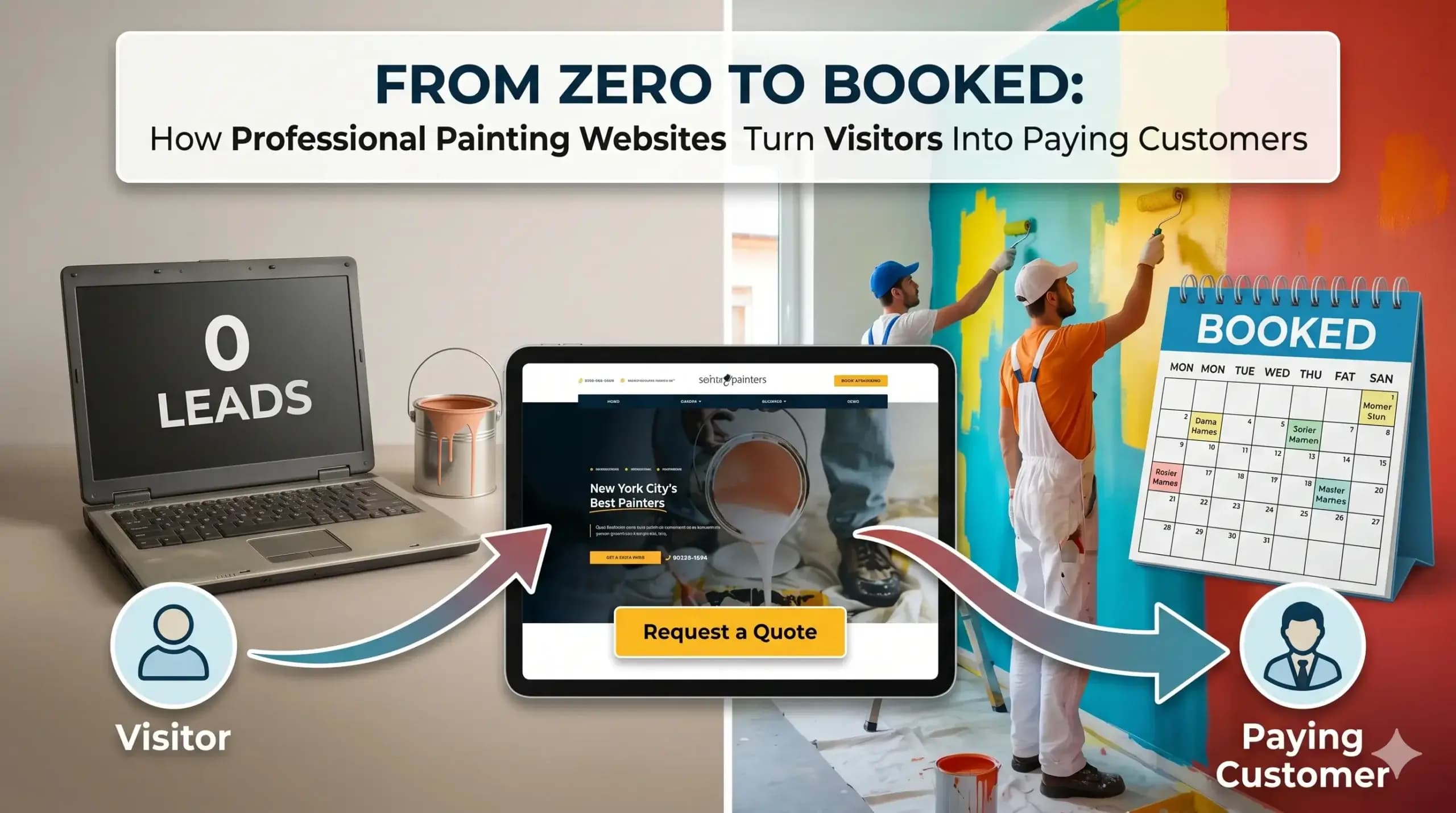
From Zero to Booked: How Professional Painting Websites Turn Visitors Into Paying Customers
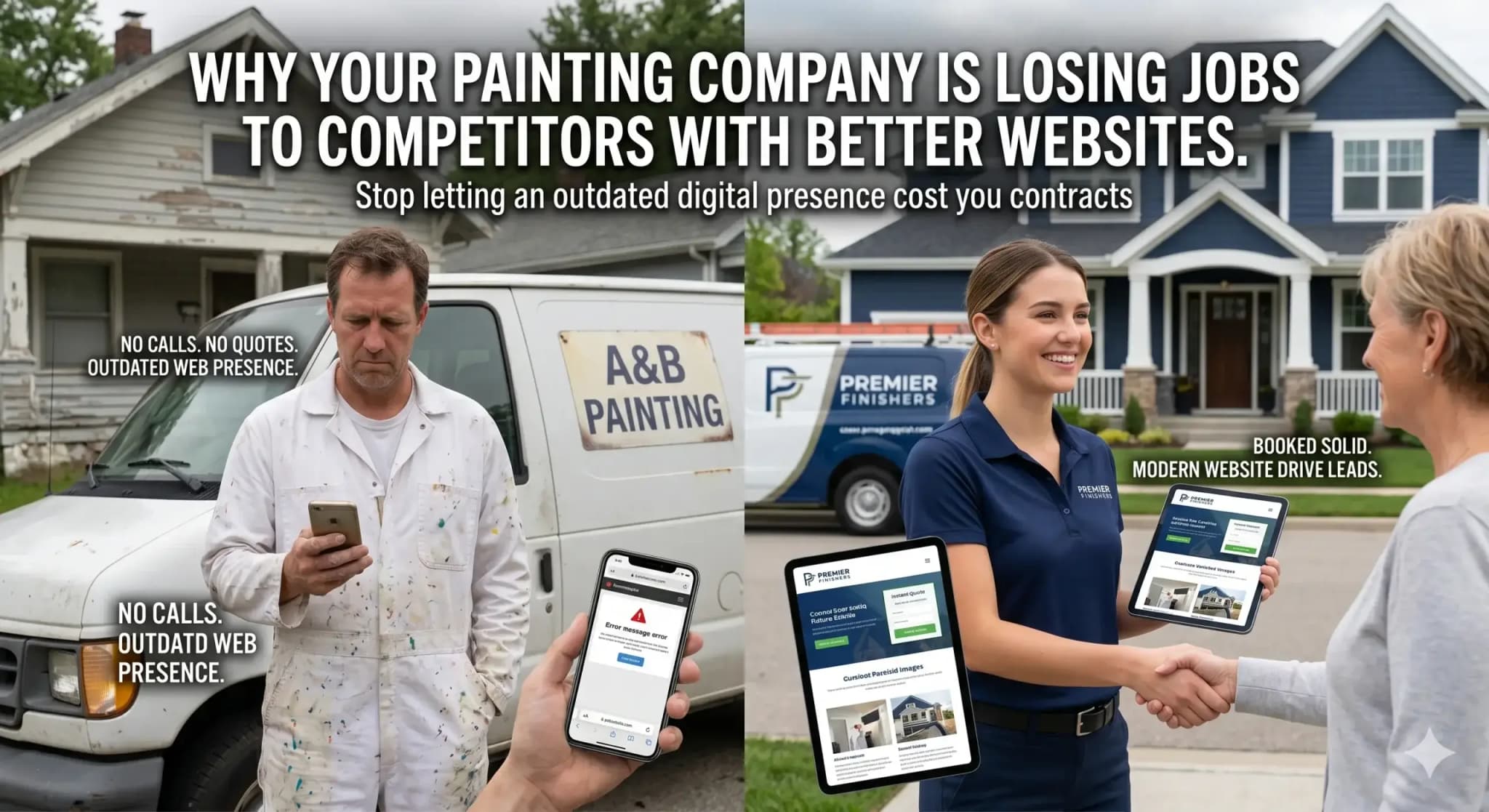
You finished a beautiful exterior repaint last week. The homeowner was thrilled. You took photos, shook hands, and moved on to the next job. But when that homeowner’s neighbor searched “exterior house painter near me” two days later — your name never showed up.
That’s not a lead generation problem. That’s a website problem.
Most painting business owners think their website is just a place to list their services and phone number. But a professional painting website is actually your hardest-working salesperson — one that either earns you jobs around the clock or quietly loses them to a competitor while you’re on a ladder.
This guide breaks down exactly what separates a painting website that sits there looking pretty from one that actually fills your schedule.
Why Your Website Looks Fine but Your Phone Stays Silent
Here’s a frustration that’s more common than you’d think: you spent money on a website, it looks decent enough, but it’s not producing calls.
The problem usually isn’t how it looks — it’s how it performs behind the scenes.
Think of your website like the outside of a freshly painted house. If the prep work underneath was skipped — bare wood, cracks unfilled, primer missed — the paint won’t stick no matter how good it looks on day one. A website with poor technical foundations is the same story. It might look fine, but Google won’t trust it, and visitors won’t stay long enough to contact you.
What actually kills your call volume:
- Pages that take more than 3 seconds to load (most visitors leave before they ever see your phone number)
- No clear call-to-action above the fold — visitors don’t know what step to take next
- A site that looks broken on phones (where most of your potential customers are searching)
- Generic service descriptions that could apply to any contractor — nothing that says why you specifically
These aren’t cosmetic issues. Each one is a paying customer who clicked away.
The Mobile Problem That’s Costing You Jobs Right Now
When a homeowner sees peeling paint on a Saturday afternoon and pulls out their phone to search for a painter, your site has about 8 seconds to convince them to call you.
Most painting websites fail this test completely.
A site that isn’t built for mobile makes everything harder: tiny text, buttons that don’t tap correctly, images that push the layout sideways, and a phone number buried at the bottom. The homeowner taps back and calls whoever came up next.
What a mobile-ready painting website actually includes:
- A tap-to-call button that works the instant someone lands on the page
- Fast-loading photos of your actual work (compressed without losing quality)
- A short, clear sentence at the top that answers: What do you do, who do you serve, where are you located?
- A simple contact form that works on any screen size
This is where websites built for painting businesses are fundamentally different from generic templates. A contractor-specific build puts the call button first, not as an afterthought.
Google Doesn’t Know Enough About Your Business to Show It
You might have a perfectly nice website — and still never appear when someone in your area searches for a painter.
The reason is simple: Google needs specific signals to confidently show your business in search results. Without them, it doesn’t know where you work, what you specialize in, or whether you’re a legitimate, active business.
This isn’t a traffic problem. It’s a trust problem — and it’s fixable.
What Google needs to trust your painting website:
- Your service area clearly named in your content (not just in your footer)
- Separate pages or sections for each core service — interior painting, exterior painting, cabinet refinishing, etc.
- Your business name, address, and phone number formatted consistently everywhere
- Structured data (a piece of code that tells Google: “This is a local painting business, here are their hours, here’s their service area”) — this one change alone can meaningfully improve how often you show up
💡 Pro Tip: One of the most common mistakes painting businesses make is having a single “Services” page that lists everything in one block of text. Google prefers individual pages for each service — one for interior painting, one for exterior, one for commercial painting. This isn’t about stuffing your site with content. It’s about giving Google a clear, organized picture of exactly what you offer so it can match you to the right searches. This one structural change is often the difference between appearing on page one and never appearing at all.
What Visitors Are Judging Before They Ever Call You
When someone lands on your painting website, they’re not just reading your services. They’re deciding whether to trust you with their home.
That decision takes about 5 seconds — and it’s mostly visual and emotional, not logical.
What builds instant trust on a painting website:
- Real photos of your finished work (not stock images of paint cans or brushes)
- A short section about you — your name, how long you’ve been in the business, what makes your work different
- Visible reviews with real names and specific details (“Mike repainted our entire first floor in two days — impeccable trim work”)
- A simple guarantee or clear statement of how you protect the homeowner’s property during a project
Missing any of these, and a visitor’s instinct is to keep searching. Not because your work isn’t good — but because they can’t tell.
Before & After: From a Slow Site to a Full Schedule
The Situation: A residential painting company in the Southeast had been in business for nine years. Their work was excellent — steady word-of-mouth kept them running — but they’d hit a ceiling. Their website hadn’t been touched in four years, loaded slowly on phones, had no individual service pages, and their contact form wasn’t even working correctly.
The Problems: They were invisible in local searches. Competitors with newer sites were capturing the homeowners actively searching online — the exact customers most likely to book quickly. The owner estimated he was missing 8–12 inquiries a month based on what he heard from neighbors and referrals who said they “couldn’t find” his site.
What Changed: Their site was rebuilt with mobile performance as the priority. Each core service got its own dedicated page optimized for local searches. A tap-to-call button went front and center. Real project photos replaced the stock imagery. Customer reviews were pulled in prominently. The contact form was rebuilt and tested across devices.
The Result: Within 60 days, inbound calls from the website more than doubled. By month three, they were booking two to three weeks out consistently — without spending a dollar on ads. The owner described it simply: “The phone just started ringing from people I’d never met.”
Not sure if your painting website has these issues? Get a free website audit — no obligation, just a clear picture of what’s costing you leads.
Your Path to More Leads: 5 Steps That Actually Work
You don’t need to become a web expert. You just need the right foundation. Here’s what the path forward looks like:
1. Audit what you have now. Find out what’s actually broken — load speed, mobile layout, missing local signals, dead contact forms. You can’t fix what you haven’t measured.
2. Build service-specific pages. Each major service you offer deserves its own page. Interior painting. Exterior. Commercial. Deck staining. Each one is a separate chance to show up in search.
3. Load real proof. Add project photos, customer reviews with names, and a short paragraph about who you are. Trust is built before someone calls — your site needs to do that work.
4. Make contact effortless. One visible phone number. One tap-to-call button. One short form. The easier it is to reach you, the more people will.
5. Work with someone who knows contractor businesses. Generic web agencies build generic websites. A team that understands how Digital Trace builds painting websites knows what local homeowners are looking for — and how to position you as the clear choice.
Frequently Asked Questions
Why am I not getting calls from my painting website?
The most common reasons are a slow load time (people leave before the page finishes), no clear call-to-action visible immediately, or your site simply isn’t appearing in searches because Google doesn’t have enough local signals to trust it. Usually it’s a combination of all three, not just one.
How do I actually know if my painting website is working?
If your website is working, you should be able to trace inbound calls and contact form submissions directly to it. If you’re not tracking that, you have no idea what’s working. A quick audit will tell you within minutes whether your site is attracting traffic, keeping visitors, and prompting them to reach out — book a free review here.
How long does it take to see results from a new painting website?
Most painting businesses see meaningful changes within 30–60 days after a proper rebuild — not years. The initial improvement usually comes from fixing mobile performance and contact paths (faster calls). SEO improvements that drive more search traffic typically build over 60–90 days as Google re-indexes the updated pages.
What makes a painting website different from a regular business website?
Homeowners hiring a painter are making a trust decision about someone entering their home. Your site needs to work harder on credibility — real project photos, specific reviews, a clear explanation of your process, and visible local roots. A generic business site template doesn’t account for any of that.
Do I really need a fast website if my customers are local?
Especially if your customers are local. Local homeowners search on their phones, often in the moment — standing in their backyard noticing their fence needs repainting, or walking through a house they just bought. If your site takes five seconds to load on a phone, they’ve already moved on to the next result. Speed isn’t a luxury — it’s the price of entry.
I’ve paid for a website before and got nothing. Why would this be different?
Most painting business owners who’ve been burned hired a general-purpose designer who built them a site that looked fine but wasn’t built to convert or rank locally. The difference is in the strategy behind the build — not just the visuals. A site built specifically around how local homeowners search and decide is a different product entirely.
Ready to See What Your Website Is Actually Costing You?
Every week your website isn’t performing, jobs are going to competitors. Not because they’re better painters — because their site shows up and yours doesn’t.
Digital Trace offers a free, no-pressure audit that shows you exactly where your painting website is losing leads — and what it would take to fix it. No jargon, no sales pitch. Just a clear, honest look at what’s holding you back.
There’s no risk. Just answers — and a roadmap to a phone that rings.