Roofing Video Marketing: Videos That Book Jobs
Roofing video marketing uses short job-site, drone, and customer-review clips to build trust and book more jobs. It works because a homeowner about to spend $8,000–$25,000 on a new roof wants proof you’re real and skilled before they call — and 40 seconds of video delivers that proof faster than any brochure page or stock photo ever will.
Right now a homeowner two neighborhoods over is comparing three roofers after a hailstorm. Two of them have a drone flyover and a real crew on camera. If you’ve got a logo and a stock photo of somebody else’s roof, you look like the fly-by-night storm chaser — even if you’ve been running clean tear-offs for 20 years. Every silent website visit and every scrolled-past post is a job going to the roofer who showed up on screen.
The good news: you already own the hardest part. Your crew is on roofs every day doing footage-worthy work. Here’s how to turn that into video that actually converts.
Why roofing video marketing beats a brochure page
Homeowners don’t read roofing websites — they skim them, nervous, on a phone, usually right after a leak or a storm. Text asks them to trust you. Video shows them. They watch your crew snap a chalk line, tear off three layers down to the decking, and walk a finished ridge, and the fear of hiring the wrong guy drops.
The behavior is well documented. Wyzowl’s 2026 report found that 85% of people say they’ve been convinced to buy a product or service after watching a video. A roof is one of the most expensive, most anxiety-loaded purchases a homeowner ever makes — exactly the kind of decision video is built to unlock.
Video also earns you real estate a text page can’t. Clips keep visitors on your pages longer, they show up in the Google Business Profile map pack, and how-to videos on YouTube get pulled into search results and AI answers. Done right, one afternoon of filming feeds your website, your GBP, and every social channel for a month.
The 6 roofing videos that actually book jobs
You don’t need a studio or a script. You need these six, filmed on the jobs you’re already running.
1. The drone flyover
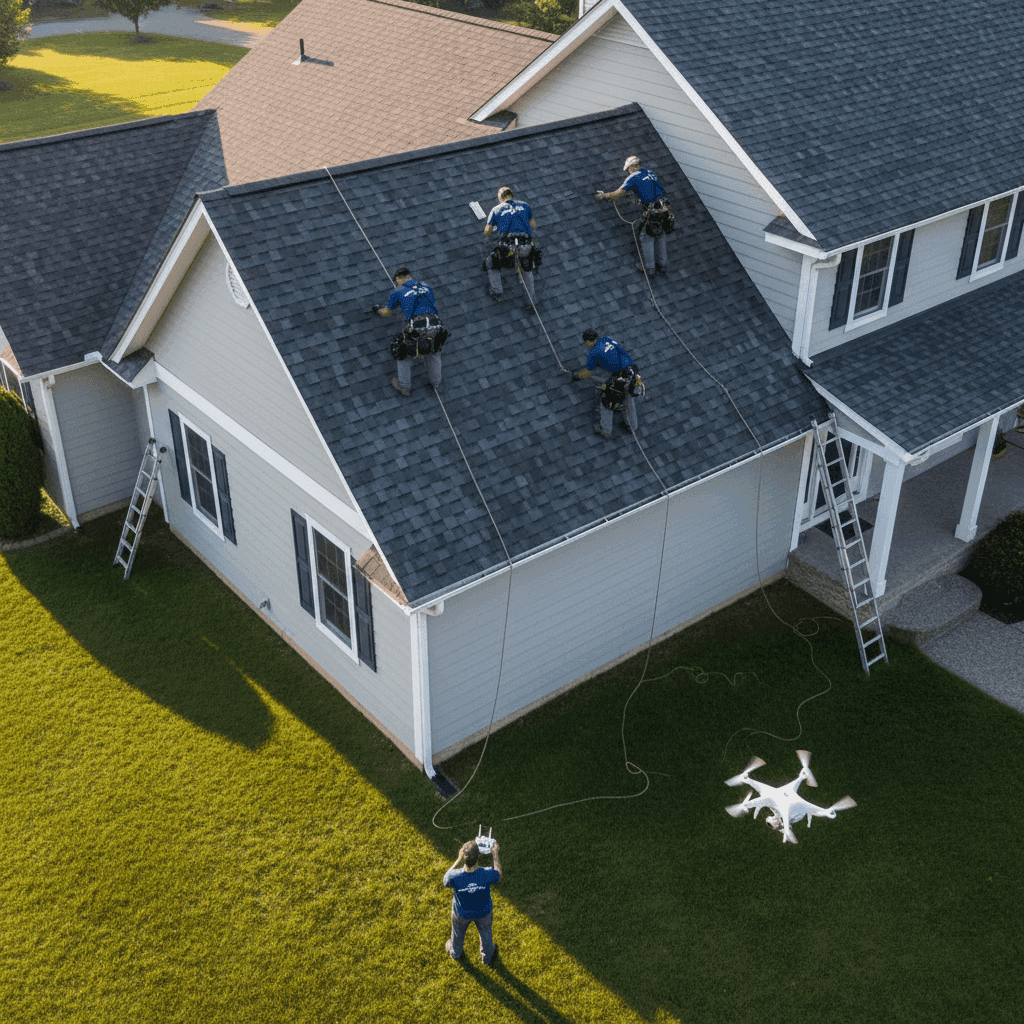
A 30–60 second aerial pass over a finished roof. It shows scale, clean lines, and straight courses no ground photo captures. Use it as the hero video on your homepage and service pages. If you already fly a drone for EagleView-style measurements or insurance documentation, you’re one export away from marketing gold.
2. The tear-off time-lapse
Set a phone on a tripod across the street and let it run through a full tear-off and re-deck. Compress a 6-hour day into 45 seconds. Nothing sells competence like watching a crew strip a roof to the sheathing, dry it in, and lay a clean field of shingles — it proves you do it right instead of shingling over rot.
3. The homeowner review video
Right after the final walk-through, while the customer is happy, ask for 20 seconds on camera: what was wrong, why they picked you, how it went. A neighbor’s face and voice outperform a dozen written testimonials. These are your highest-converting trust signals — put them next to your quote form.
4. The owner or crew intro
One 60-second clip of you on a roof, saying who you are, how long you’ve been at it, and what certifications you carry (GAF Master Elite, Owens Corning Preferred). Homeowners hiring a stranger want a face. This single video quietly separates you from the anonymous storm chasers.
5. The inspection and insurance explainer
Walk a roof and explain what you’re looking for — bruised shingles, granule loss, lifted flashing — and how the insurance restoration claim process works. This is the video that ranks and gets cited by AI, because it answers the exact questions homeowners type after a storm.
6. The storm-response clip
After a hail or wind event, a quick phone video of you on-site in the affected area, offering free inspections, books calls while competitors are still printing door hangers. Fast, timely, and human beats polished-but-late every time.
Getting video views but no calls? A flyover only converts if it loads fast and sits next to a real offer — see how a custom roofing website turns footage into booked estimates.
Where to put your roofing videos
The same clip performs differently depending on where it lives. Spread your six videos across these channels instead of dumping them all in one place.
| Platform | Best video for it | What it does for you | Effort |
|---|---|---|---|
| Your website | Drone flyover + review clips | Turns visitors into calls; keeps them on the page | Once, embedded |
| Google Business Profile | Short job clips, review videos | Feeds the local map pack; shows in nearby results | ~5 min/week |
| YouTube | Inspection & insurance explainers | Ranks in search and AI answers; evergreen | 1–2 hrs/video |
| Facebook / Instagram | Time-lapses, before/afters, Reels | Neighborhood reach right after storms | ~10 min/post |
| TikTok | Satisfying tear-off & repair clips | Reaches younger homeowners; storm content travels | ~10 min/post |
One rule: your website is the destination, not the afterthought. Social and YouTube build reach, but the flyover and review videos have to live on a fast, well-built site or you’re renting an audience you can’t convert. If your pages crawl, video makes it worse — heavy files punish a slow site, so read up on roofing website speed before you embed anything.
The gear and budget: what you actually need
Roofing video is cheap to start and easy to overthink. Here’s the honest tier list.
- Starter ($0–$50): The phone in your pocket, a $30 tripod, and a free editing app like CapCut. This is enough to shoot all six video types.
- Better ($100–$400): Add a handheld gimbal for smooth walking shots and a $50 lav mic so on-camera talking is actually audible over wind and traffic.
- Drone ($500–$1,500): A consumer drone (the DJI Mini class) pays for itself fast if you also use it for measurements and claim documentation.
Keep clips short — 30 to 90 seconds for social, up to two or three minutes for a YouTube explainer. Shoot vertical for social and Reels, horizontal for your website and YouTube. Film more than you think you need; you can always cut, you can’t re-shoot a finished roof.
Your 7-point roofing video checklist
Screenshot this. Do one thing off it per week and you’ll have a full library inside two months.
- Assign a “camera guy” on every crew — one person responsible for 3 clips per job.
- Film every tear-off as a time-lapse from a fixed spot across the street.
- Capture one drone flyover of each finished roof before you pull the ladders.
- Ask for a review video at the final walk-through, while the customer is thrilled.
- Post to Google Business Profile weekly — even a raw 20-second clip.
- Embed your best flyover and review video on your homepage and top service pages.
- Add captions to everything — most homeowners watch on mute.
Mistakes that kill roofing videos
A few habits waste good footage. Long and polished: a two-minute cinematic intro loses people who wanted to see a roof in the first five seconds. No call to action: every video should end with “call for a free inspection” and your number on screen. Locked in one place: a great clip buried on Facebook that never touches your website or GBP is doing a fraction of its job. No captions: silent autoplay is the default now, so un-captioned video is invisible video.
And remember what video can’t fix. It drives the click, but the click lands on your website. If that page is slow, confusing, or missing an obvious way to call, the footage just delivered a warm lead to a dead end — which is why your roofing website conversion rate matters as much as the video itself. For proof of what a video-ready site looks like, study the best roofing websites and copy how they use motion above the fold.
FAQ
Do I really need video to market my roofing company?
You don’t legally need it, but you’re competing against roofers who have it. When a nervous homeowner is choosing between you and two others, the company that shows real crews and real finished roofs on camera wins the trust battle. Video isn’t optional anymore — it’s the fastest way to prove you’re legitimate.
What’s the best type of roofing video to start with?
Start with drone flyovers of finished roofs and short homeowner review clips. Flyovers show off your workmanship instantly, and review videos borrow a happy customer’s credibility. Together they cover the two questions every homeowner has: can this crew do the work, and can I trust them? Everything else builds on those two.
How much does roofing video marketing cost?
You can start for under $50 with the phone you already own, a cheap tripod, and a free editing app. A gimbal and a clip-on mic run $100–$400, and a consumer drone is $500–$1,500. The real cost isn’t gear — it’s the discipline to film consistently on the jobs you’re already running.
Can I just film roofing videos on my phone?
Yes. Modern phones shoot excellent 4K video, and homeowners trust raw, real footage over glossy production. Keep the phone steady, get close to the detail, add captions, and keep clips short. The only shot a phone can’t get is the aerial flyover — that’s the one job for a drone.
Where should I post my roofing videos?
Everywhere, but start with your website and Google Business Profile because those convert nearby searchers directly into calls. Then repurpose the same clips to Facebook, Instagram, YouTube, and TikTok for reach. Pair the video work with your roofing SEO so the pages holding your videos actually rank.
Turn your footage into booked jobs
Your crew already does work worth filming. The gap is a website and search setup that puts that footage in front of homeowners at the exact moment they’re choosing a roofer — fast-loading, video-ready pages that rank in Google and get cited in AI answers for your city.
That’s what we build. Get a free quote on a custom roofing website and SEO/AIO setup designed to turn your videos into booked jobs.