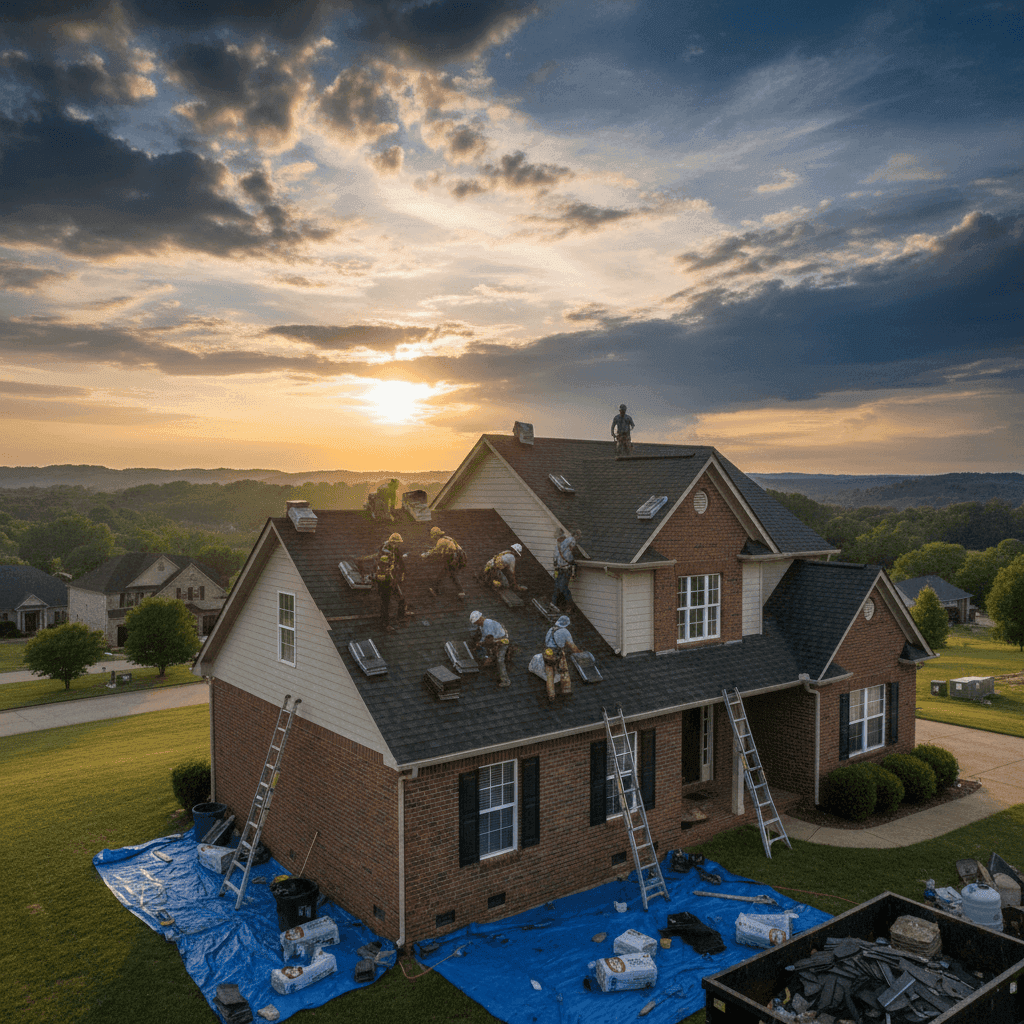
Missouri Roofing Website Design That Books Jobs
Good Missouri roofing website design loads in under three seconds on a phone, puts your local contractor license and live reviews up top, and makes requesting an estimate one tap away. Built custom for St. Louis and Kansas City storm demand, it turns hail-season searches into booked tear-offs, not bounces.
Here’s what a quiet phone actually costs you. A full roof replacement in the St. Louis or Kansas City metro runs $8,000 to $16,000. If your site sends three storm-season visitors a week to a faster competitor because it loads slow or buries your phone number, that’s six figures in lost tear-offs over a single hail season. In Missouri’s hail belt, your website is either catching that demand or leaking it to the next truck in town.
Why Missouri roofing website design is its own problem
Missouri is not a “nice-to-have website” market. St. Louis and Kansas City sit squarely in the nation’s hail belt, and every spring the metros get worked over by supercells, large hail, and the straight-line wind of a derecho. When a storm rolls through Chesterfield or Lee’s Summit, three things happen at once:
- Homeowners search in a panic — “roof repair near me,” “hail damage roofer St. Louis,” “storm damage inspection Kansas City” — almost always from a phone, usually within hours.
- Out-of-state storm chasers flood in. Trucks with plates from three states away canvass the damaged neighborhoods and stand up pop-up websites overnight.
- Insurance restoration becomes the whole game. Most of these jobs are claims, not cash, so your site has to speak the language of adjusters, supplements, and ACV vs. RCV.
Here’s the Missouri-specific wrinkle most markets don’t have: there is no statewide roofing contractor license. Licensing is handled city by city — St. Louis requires a Construction Industry Contractor license, while Kansas City requires a Residential Building Contractor license and a passed ICC exam. That gap is exactly what out-of-state chasers exploit, because a homeowner has no single state number to check them against. A local roofer who displays the right city license, bond, and insurance front and center instantly separates themselves from the chaser who can’t — and a generic template built for a florist does none of it.
What a Missouri roofing website needs to book jobs
Strip away the fluff and a roofing site has one job: turn a worried homeowner into a booked inspection before they call the next name on Google. Five things make that happen.
1. Mobile speed under three seconds
Storm searches happen on phones in driveways, not on desktops. Every extra second your site takes to load gives that homeowner another chance to hit back and tap the competitor below you. Target a sub-three-second mobile load — compressed images, no bloated page builders, real hosting, not a $6/month shared plan.
2. Lead capture that works in one tap
A click-to-call button that follows the thumb. A short “request free inspection” form — name, address, phone, and “storm or wear?” — nothing more. A visible number in the header on every page. If a homeowner has to pinch, zoom, or hunt, you’ve already lost them to the next truck in town.
3. Trust signals, Missouri-specific
Because Missouri has no statewide license to point to, trust has to be built on your site: your St. Louis or Kansas City contractor license, your bond and liability coverage, GAF or Owens Corning certification, and Google reviews pulled in live, not screenshots. It matters more than most roofers think — BrightLocal’s 2025 survey found only 4% of consumers never read online reviews for local businesses, so nearly everyone comparing you to a chaser is reading them. Real before-and-after photos of tear-offs close the gap.
4. Local SEO built for your metro
City and suburb pages (St. Charles, O’Fallon, Chesterfield, Independence, Lee’s Summit, Springfield, Columbia), a tuned Google Business Profile, and schema that tells Google exactly where you work. This is where our roofing SEO work and your site have to move together — a beautiful site nobody finds books zero jobs.
5. AI search visibility (AIO)
A growing share of homeowners now ask ChatGPT, Google AI Overviews, or Perplexity “who’s a good roofer in St. Louis?” before they ever scroll a results page. If your site isn’t structured so those tools can read and quote it, you’re invisible in the fastest-growing search channel. Answer-first content and clean schema are how you get cited.
Custom vs. template vs. DIY builder: what it costs in Missouri
There are three honest ways to put a roofing site online. They are not equal, and the cheapest one is almost always the most expensive per booked job.
| Option | Typical cost | Mobile speed | Local SEO for STL/KC | AI search ready | Best for |
|---|---|---|---|---|---|
| DIY builder (Wix, GoDaddy) | $15–$50/mo + your nights | Usually slow, bloated | Minimal, manual | No | A brand-new roofer with zero budget testing the water |
| Template / freelancer | $500–$2,500 one-time | Depends on the template | Basic, rarely maintained | Rarely | A roofer who needs “something decent” fast and will chase leads another way |
| Custom roofing agency | $5,000–$15,000+ built, often with a monthly care plan | Engineered sub-3s | Built in from day one | Yes | An established STL/KC roofer who wants the site to be a lead engine |
A $500 template that books one extra job a year “pays for itself,” but it leaves most of your storm-season demand on the table. A custom build that captures three claims jobs in one hail season returns 2–4x its cost. For the full numbers, see what a roofing website actually costs in 2026, and weigh the trade-offs in our custom vs. template roofing website guide. Build and care-plan pricing is on our pricing page.
If your current site misses even two of the five must-haves above, you’re funding your competitors’ phones. See what our custom roofing website design service builds in instead.
The storm-season math most Missouri roofers miss
You can’t control when the next hailstorm rolls through St. Charles County or the Northland. You can control whether your site is ready when it does. Here’s the math operators forget: your most expensive lead window lasts about 72 hours after a storm. In that window, homeowners aren’t comparing craftsmanship — they’re comparing the first three sites that load fast, look legitimate, and let them book in one tap.
Speed to lead compounds it. The roofer whose site captures the number and fires an instant text-back books the inspection while the chaser is still knocking doors. Lose that window and you’re competing on price three weeks later with every out-of-state truck still in town.
How to hire a Missouri roofing web design team
Use this checklist before you sign anything. Screenshot it and make the agency answer every line.
- Do they build custom, or drop you into a template? Ask to see three live roofing sites they built — then load them on your phone and time them.
- Is local SEO for your metro included, or sold separately later? City pages, GBP, and schema belong in the build, not a surprise upsell.
- Will the site be structured for AI search (AIO)? If they look confused when you say “Google AI Overviews,” keep looking.
- Do they handle hosting and maintenance, or hand you a file and vanish? Storm-season uptime matters.
- Can they wire in an AI sales agent or instant text-back so after-hours storm traffic still books?
- Do they build in your city license and insurance display — the trust signals that matter most in a no-statewide-license state?
- Who owns the site and the domain when you’re done? The answer must be you.
An agency that answers those cleanly is worth paying for. One that dodges them costs you more in missed jobs than it ever charges.
Where Digital Trace fits
We build custom roofing sites — never templates — engineered for sub-three-second mobile loads, with lead capture, St. Louis and Kansas City local SEO, and AI-search structure built in from the first page. We wire in an AI sales agent so after-hours and storm-season traffic still books estimates, and we keep the site fast and secure with managed hosting and maintenance included. You own everything. That’s the whole model: a site that works like your best salesperson during the only 72 hours that matter. Read how we approach it on our roofing website design page, or pair it with roofing SEO in Missouri to own the map pack.
Frequently asked questions
How much does a roofing website cost in Missouri?
Expect $15–$50 a month for a DIY builder, $500–$2,500 for a template or freelancer, and $5,000–$15,000+ for a custom agency build, often with a monthly care plan. The real question isn’t the sticker price — it’s how many storm-season claims jobs the site captures, because one full St. Louis or Kansas City replacement often covers a custom build on its own.
Do I need a license to roof in Missouri?
Missouri has no statewide roofing license. Licensing is local: St. Louis requires a Construction Industry Contractor license from the Office of the License Collector, and Kansas City requires a Residential Building Contractor license plus a passed ICC exam. Check the rules for every city and county you work in — and display that local license, your bond, and insurance on your website, because there’s no state number for homeowners to look you up by.
Why isn’t my current roofing website getting calls?
Usually one of four leaks: it loads too slowly on a phone, the call button is buried, it shows no real trust signals, or Google and AI tools can’t find it for St. Louis and Kansas City searches. Fix mobile speed and one-tap lead capture first — that’s where most storm-season traffic silently bounces to a faster competitor.
Custom or template for a Missouri roofing site?
A template is fine if you only need “something decent” and plan to get leads another way. If you want the site itself to catch storm demand — fast mobile load, built-in local SEO, insurance-restoration pages, AI visibility — go custom. In a hail market, the gap between the two is measured in booked jobs, not looks.
How long does it take to build a roofing website?
A focused custom roofing site typically takes four to eight weeks — discovery, design, content, local SEO setup, and testing. Starting a build in winter and having it ranking and converting before the spring hail season is far better than rushing it mid-storm or missing the season entirely.
Get your Missouri roofing site ready before the next storm
If you’re not sure where your current site is leaking jobs, start with a free website audit. We’ll show you exactly three things: whether your mobile conversion path actually lets a homeowner book in one tap, how fast your pages load against the sub-three-second bar, and whether you show up in AI answers when someone asks for a roofer in your city. No pitch, just the leaks. Request your free roofing website audit.