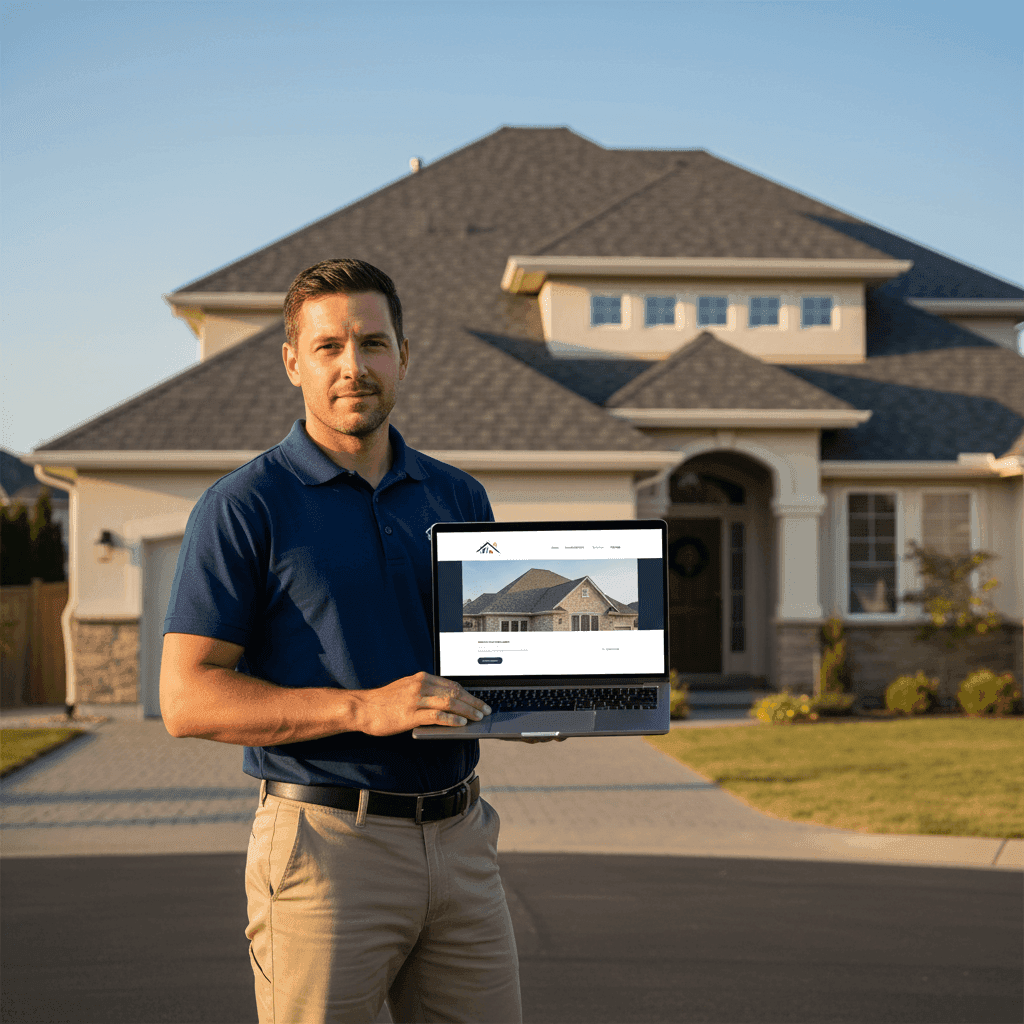
Roofing Contractor Website: Custom vs Template in 2026
For most roofing contractors, a custom website books more jobs than a template. A template gets you online cheaply, but a custom roofing contractor website is built around your services, your metro, and a fast mobile path to “call now” — the things that turn searchers into booked tear-offs. Choose a template only when speed to launch matters more than lead volume.
Here is what a template quietly costs you. A homeowner two suburbs over searches “roof replacement near me,” lands on your site, waits four seconds for a stock-photo hero to load on their phone, and hits back. That was an $18,000 full tear-off, and it went to the roofer whose site loaded in under two seconds and put a phone number under their thumb. Multiply that by the dozen searches you never see each week.
Nearly every roofing website falls into one of two camps: a template you bought or a nephew assembled, or a custom site an agency built for your business. The gap between them is not how they look on launch day — plenty of templates look sharp. It is what they do for you twelve months later, when you need to rank, load fast, and convert. Here is how the two actually compare, and how to decide.
What “custom” and “template” actually mean
A template roofing website starts from a pre-built theme — Wix, Squarespace, GoDaddy, or an off-the-shelf WordPress theme — where you drop in your logo, a few photos, and your services. The structure was designed for everyone, so it fits no one exactly. You are renting a layout thousands of other contractors also use.
A custom roofing contractor website is built from your business outward. The pages, the load speed, the lead-capture flow, and the code are shaped around how roofing customers actually search and decide. You own it, and it is engineered to do one job: turn a storm-season search into a booked estimate.
That difference sounds abstract until it shows up in your call volume. Break it into the things that decide whether a website makes you money.
Where template roofing websites win
Templates are not useless. For the right contractor, at the right stage, they are a reasonable start.
- Cost and speed to launch. A template runs roughly $0 to $50 a month and can be live in a weekend. If you have zero web presence and need something before the next hailstorm, that is real.
- You control small edits. Swapping a phone number or adding a photo of yesterday’s job is easy without calling anyone.
- Low upfront risk. You are not writing a four-figure check to find out whether a site helps.
If you are a brand-new, one-truck operation still testing whether you will stick with the business, a template is a defensible starting point. The trouble starts when leads become the goal.
Where the template ceiling hits
Every template has a ceiling, and roofing contractors hit it fast because roofing is a speed-and-trust sale.
Page speed. Templates load heavy, one-size-fits-all code and stock sliders. On a phone — where most roofing searches happen — that is the difference between a call and a bounce. Google’s research on mobile pages found that the probability of a bounce rises 90% as load time goes from one second to five seconds. A slow template leaks leads before your hero image even finishes loading.
SEO control. To rank in your market you need real, indexable pages per service and per city — tile, tear-off, storm repair, and each town you cover. Templates tend to produce thin, near-duplicate pages that Google ignores or buries. Ranking city by city is exactly where the jobs are.
Conversion design. A template drops your “Contact” link in the menu and calls it done. A site built to convert stacks trust signals — license number, GAF or Owens Corning certification, real reviews, financing — and keeps a one-tap call button following the homeowner down the page.
Automation and follow-up. Speed to lead wins roofing jobs. Templates cannot text a homeowner back the second they miss your call or route a form straight into your CRM. Custom builds can wire in an AI sales agent and missed-call text-back so no lead sits cold while you are on a roof.
If your current site is a template and the phone has gone quiet, a custom roofing website design is usually where the fix starts.
Custom vs template roofing websites, side by side
| Criteria | Template site | Custom roofing website |
|---|---|---|
| Upfront cost | $0–$500 | $3,500–$10,000+ |
| Monthly cost | $16–$50 builder plan | Hosting & maintenance, often bundled |
| Time to launch | Days | 3–6 weeks |
| Mobile page speed | Often 4s or slower | Under 2.5s when built right |
| City & service pages that rank | Thin, templated | Built per market |
| Conversion design | Generic | Engineered for roofing leads |
| Automation (AI agent, text-back) | No | Yes |
| Ownership | You rent the platform | You own the site |
| Best for | Brand-new, testing the waters | Contractors who want steady leads |
The cost line is where owners flinch, but read it against a single job. If a full tear-off nets you $6,000 to $20,000, a custom site that books two extra jobs a month has paid for itself and the year’s hosting by week three. For a full breakdown, see what a roofing website actually costs and our transparent website pricing.
What books jobs no matter which you choose
Platform aside, a handful of things decide whether any roofing site converts. Nail these on a template and it will outperform a lazy custom build.
- Mobile-first speed. Under 2.5 seconds on a phone, or you are bleeding calls.
- A phone number that is always reachable. Sticky call button, top of every page.
- Trust up front. License, certifications, insurance, and real reviews above the fold.
- Proof. Before-and-after photos of actual tear-offs and EagleView-measured jobs, not stock houses.
- One clear next step. A free inspection or quote, repeated, with a short form.
Want to see this done well? Study the best roofing websites and note how fast they load and how quickly they push you toward “call.”
How to choose your roofing contractor website: a 7-point framework
Run your situation through these seven questions. Answer “custom” to four or more, and it is time to stop renting a template.
- Do you depend on inbound leads, or mostly referrals and canvassing? Lead-dependent points to custom.
- Do you want to rank in more than one city? Multi-metro coverage needs custom page architecture.
- Is your current site slower than three seconds on your own phone? Test it right now, standing where a customer would.
- Are competitors outranking you for “roofer near me” in your town?
- Do you want missed-call text-back or an AI agent catching leads after hours and during storms?
- Is a booked job worth more than $5,000? Then one extra job pays for the build.
- Do you plan to run this business for years? Owning an asset beats renting a layout.
Still weighing DIY tools against hiring out? We break that decision down further in roofing website builder vs. hiring an agency.
Frequently asked questions
Is a custom website really worth it for a small roofing company?
For most, yes. If you rely on the phone ringing from online searches, a custom site pays back fast — a single booked tear-off usually covers the build. If you are brand new and living entirely on referrals, a template can hold you over. The deciding factor is whether you need leads or just an online business card.
How much more does a custom roofing website cost than a template?
A template runs roughly $0 to $500 upfront plus $16 to $50 a month. A custom roofing website typically starts around $3,500 and climbs with the number of pages, cities, and automations. It is a bigger number, but you own the asset and it is engineered to book jobs, not just exist.
Can I just make my template site faster?
Somewhat. You can compress images, cut plugins, and drop heavy sliders, and that helps. But you are still stuck on shared, one-size-fits-all code and rigid page structures, so there is a hard ceiling. A purpose-built site starts fast and stays fast because speed was designed in, not patched on afterward.
How long does a custom roofing website take to build?
Most custom roofing sites take three to six weeks, depending on how many service and city pages you need and how quickly you supply photos and reviews. That is longer than a weekend template, but the pages are built to rank and convert from day one instead of needing a rescue six months later.
Will a template hurt my Google ranking?
Not automatically, but it makes ranking harder. Templates often ship slow, bloated code and encourage thin, duplicate city pages — both of which Google discounts. You can rank on a well-tuned template, but you are fighting the platform. A custom build gives you the speed and page control that local roofing SEO rewards.
The bottom line
A template gets you online; a custom roofing contractor website gets you booked. If leads are the goal and roofing is your living, the math almost always favors custom — one extra job a month usually covers it.
Not sure which camp your current site is in? Get a free website audit and we will show you three things: your real mobile load speed, whether you show up in Google AI answers for your city, and where your conversion path loses the homeowner between “search” and “call.”