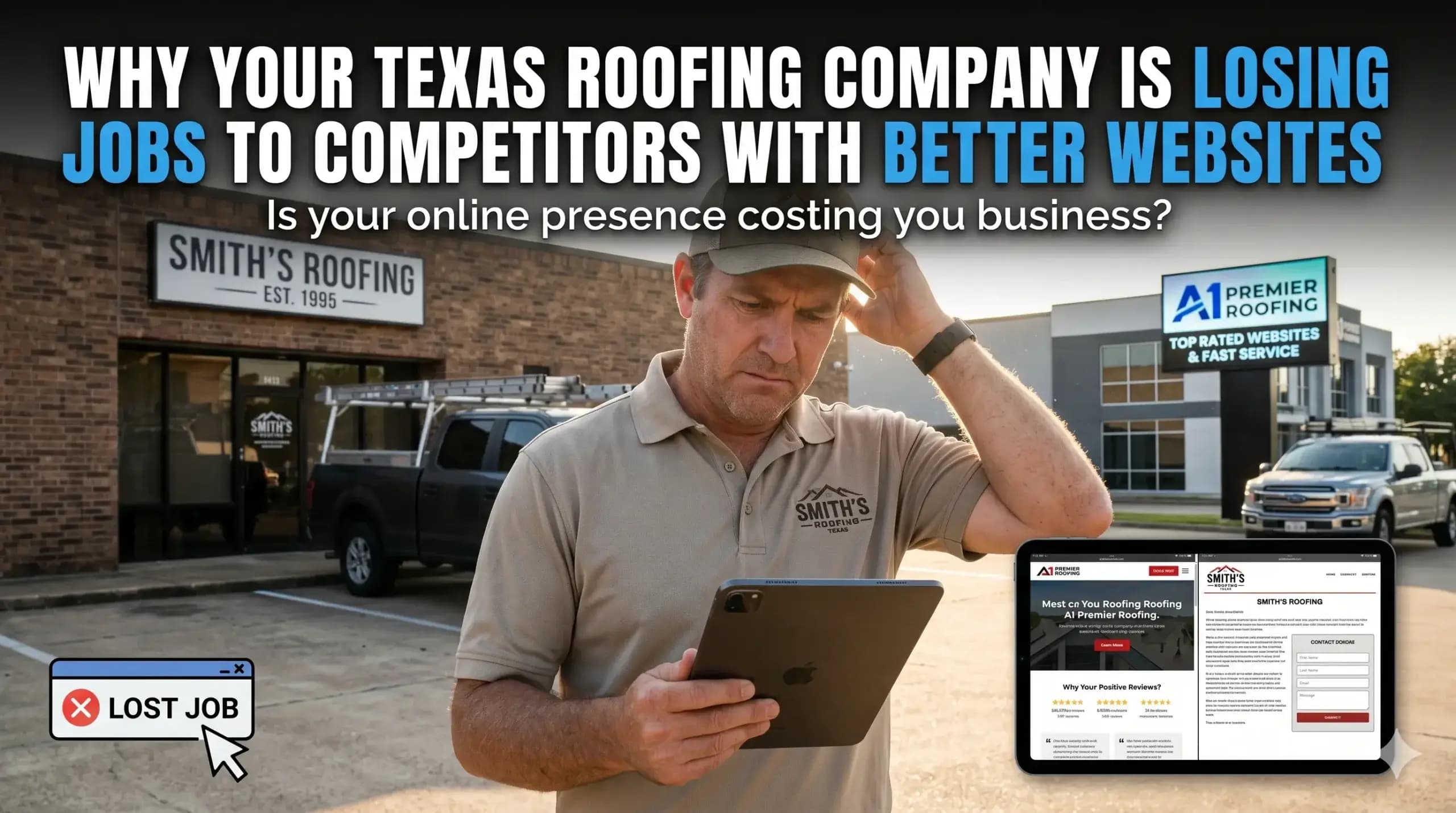
Why Your Texas Roofing Company Is Losing Jobs to Competitors With Better Websites
You just finished a five-star job — clean install, happy homeowner, crew out before noon. But when that homeowner’s neighbor searches for a roofer the next day, your company doesn’t come up. Someone else does. And that someone else gets the call, the estimate, and the check.
That’s not bad luck. That’s a website problem.
Most Texas roofing companies assume their website is “fine.” It loads, it has a phone number, it lists their services. But fine doesn’t win jobs anymore. The roofing market has gotten competitive enough that the contractor with the best-performing website is capturing leads that should be yours — every single day — while you have no idea it’s happening.
This post will show you exactly what’s going wrong, what your competitors are doing differently, and what it actually takes to turn your website into your best salesperson.
Your Website Is Working Against You — And You Can’t See It Happening
Think of your website like your service truck. If the engine is misfiring, the truck still moves — but it’s burning fuel, losing power, and eventually going to leave you stranded on the side of the road.
That’s most roofing websites. They look functional on the outside, but underneath, they’re hemorrhaging leads every hour.
Here’s what’s usually going wrong:
- The site loads slowly on mobile, and 70%+ of homeowners searching for roofers are on their phones
- The contact form doesn’t work properly on certain devices
- There’s no clear, visible phone number above the fold
- The pages aren’t structured in a way Google recognizes as relevant for roofing searches in your area
None of these show up when you look at the site yourself. But they show up in your phone not ringing.
Speed Isn’t a “Tech Thing” — It’s a Revenue Thing
Here’s something that surprises most roofers: a website that takes more than 3 seconds to load loses more than half its visitors before they ever see your phone number.
A homeowner’s shingles are missing after last week’s storm. They Google “roofing company near me,” click your site, and stare at a loading screen. They hit the back button and click your competitor. Done. You never had a chance to pitch them — your website ended the conversation before it started.
The technical reason this happens is usually a combination of oversized images, a bloated website theme, or cheap hosting that can’t handle traffic spikes. But the business reality is simple: slow sites don’t get calls.
At Digital Trace, every roofing website is built with speed as a foundation — not an afterthought. Pages load fast on every device, especially the phones your potential customers are using from their driveway after a hailstorm.
Google Doesn’t Know Your Business Well Enough to Recommend It
When someone types “roofing company in Dallas” or “roof replacement McKinney TX,” Google makes a split-second decision about which businesses are most relevant and trustworthy. If your website doesn’t give Google the right signals, you simply don’t appear — no matter how good your work is.
This isn’t about stuffing your site with keywords. It’s about structure. Google needs to clearly understand:
- What services you offer (and in which cities)
- That you’re a legitimate, established roofing business
- That your site matches what the searcher is actually looking for
Many roofing sites have one generic “Services” page. The contractors showing up on the first page of Google have individual pages for roof replacement, roof repair, storm damage, commercial roofing, and each service area they cover. That’s not an accident — it’s a deliberate strategy built around roofing website design that targets how homeowners actually search.
Your Competitor Isn’t Better Than You — Their Website Just Says They Are
This one stings a little, but it’s true: a homeowner comparing two roofing companies they’ve never heard of is making their decision based almost entirely on first impressions. Your website is that first impression.
If a competitor’s site shows:
- Professional photos of completed jobs
- Real reviews with specific details (“replaced our entire roof in one day, cleaned up everything”)
- Clear pricing information or a straightforward estimate process
- A phone number that’s impossible to miss
…and your site shows a stock photo of a house and a contact form buried at the bottom of the page — they win the job. Not because they’re better roofers. Because their website does a better job of building trust in 30 seconds.
Homeowners aren’t roofing experts. They can’t evaluate your flashing technique or underlayment choices. They’re evaluating how professional you look, how easy you are to contact, and whether other people seem to trust you. Your website either makes that case or it doesn’t.
💡 Pro Tip: Your “Contact Us” Page Is Probably Killing Your Conversions
Most roofing websites send every visitor to a basic contact form and call it a day. But a homeowner who needs an emergency repair and a homeowner pricing out a new roof have completely different needs — and the same generic form doesn’t serve either of them well.
The fix: create separate entry points. A “Request Emergency Inspection” button for storm damage leads. A “Get a Free Estimate” form for planned replacements. Even small changes like this — matched with a visible phone number that auto-dials on mobile — can dramatically increase how many visitors actually reach out.
Before & After: What a Better Website Actually Does for a Roofing Business
The Situation: A family-owned roofing company in the Dallas-Fort Worth area had been in business for 11 years. Strong reputation, consistent referrals, good reviews on Google — but their website was built in 2017 and hadn’t been touched since. They were running Google Ads but paying for clicks that weren’t converting. They assumed the ads were the problem.
What the Audit Found: The site took 8+ seconds to load on mobile. There was no dedicated page for storm damage repair — their biggest revenue driver — just a mention of it buried in a paragraph. The phone number wasn’t clickable on phones. And their Google Business Profile wasn’t connected properly to the site, so local search rankings were weak.
What Changed: A new site built specifically around roofing web design best practices — fast load times, individual pages for each service and service area, a prominent call-to-action above the fold, and properly structured local SEO signals. No new ad spend.
The Result: Within 90 days, organic calls increased noticeably. Their storm damage page started ranking in the top 3 for several area searches. The cost-per-lead from Google Ads dropped significantly because the same ad budget was now sending traffic to a site that actually converted. They stopped losing jobs to companies they knew were less experienced — because their website finally reflected the business they’d spent 11 years building.
Not sure if your roofing website has these issues? Get a free website audit — no obligation, just a clear picture of what’s costing you leads.
Your Path to More Leads: What Actually Needs to Happen
You don’t need to understand web development to fix this. Here’s what the process looks like in plain terms:
- Find out what’s broken. A proper audit tells you exactly where your site is losing visitors — speed issues, missing pages, weak local SEO signals. You can’t fix what you haven’t identified.
- Build pages that match how homeowners search. Each service you offer and each city you work in should have its own page. That’s how you show up when people search for exactly what you do.
- Make it dead simple to contact you. Visible phone number. Fast-loading pages. A form that works on every phone. Remove every barrier between a visitor and a conversation.
- Show proof you’re the right choice. Real photos of your work, real reviews with real specifics, and a clear explanation of your process. Trust is earned fast or lost fast online.
- Let it run while you work. A properly built roofing website generates leads around the clock — while you’re on a job, while you’re sleeping, while your competitors are scrambling for referrals.
Frequently Asked Questions
Why am I not getting calls from my website even though I’m getting traffic?
Traffic and leads are two completely different things. Visitors land on your site and leave without calling for a reason — usually a slow load time, a confusing layout, or no obvious way to reach you on mobile. If your phone number isn’t visible the second someone lands on your page, most people won’t hunt for it. They’ll just go back to Google and call whoever is next.
How do I know if my roofing website is actually working?
The honest answer: if you don’t know, it probably isn’t. A working roofing website produces a steady stream of inbound calls and form submissions from people you didn’t already know. If most of your leads still come from referrals or word of mouth, your website is a placeholder — not a sales tool. Get a free audit to see exactly how your site is performing and where it’s falling short.
How long does it take to see results from a new website?
A faster, better-structured site can start showing improvements within 30–60 days as Google recrawls and re-ranks your pages. More competitive search terms in larger metros typically take 90–120 days to move significantly. Paid traffic (Google Ads) converts better immediately because the landing page improves right away. SEO results build over time and compound — a well-built site keeps getting stronger month after month.
What makes a roofing website different from a regular business website?
Roofing is a high-trust, high-urgency purchase. Homeowners aren’t browsing casually — they have a problem and they need to feel confident, fast. That means your site needs to immediately communicate credibility (reviews, photos, years in business), serve people searching from their phones after a storm, and have clear pathways for different types of jobs (emergency repairs vs. full replacements vs. insurance claims). A generic business website template doesn’t account for any of that.
Do I really need a fast website if all my customers are local?
Yes — especially because your customers are local. Local homeowners are searching on their phones, often right after a weather event when cell service is already stressed. If your site loads slowly, they’re gone before they see your name. Google also uses site speed as a ranking factor for local search results, so a slow site doesn’t just lose visitors — it loses ranking positions, which means fewer visitors in the first place.
I’ve hired marketing companies before and got burned. Why would this be different?
That’s a fair concern, and it’s one we hear constantly from roofing contractors. The difference usually comes down to whether the agency actually understands your industry and is accountable to real business outcomes — not just traffic reports. A good starting point is a free audit that shows you exactly what’s wrong before you spend a dollar. If the problems are real and the fixes are clear, the conversation is worth having. If not, you’ve lost nothing.
Stop Leaving Jobs on the Table
Every day your website underperforms, a competitor is getting the call that should have been yours. The homeowner two streets over who needed a new roof. The property manager who Googled “commercial roofer” and clicked the first site that loaded fast and looked professional. The storm damage job that went to someone with a contact button that actually worked on mobile.
You’ve built a real roofing business. Your website should reflect that — and work as hard as you do.
Book a free website audit with Digital Trace. We’ll show you exactly what’s costing you leads, what it takes to fix it, and what a roofing website designed to actually convert looks like. No pressure, no jargon — just a straight answer about where your business stands online.