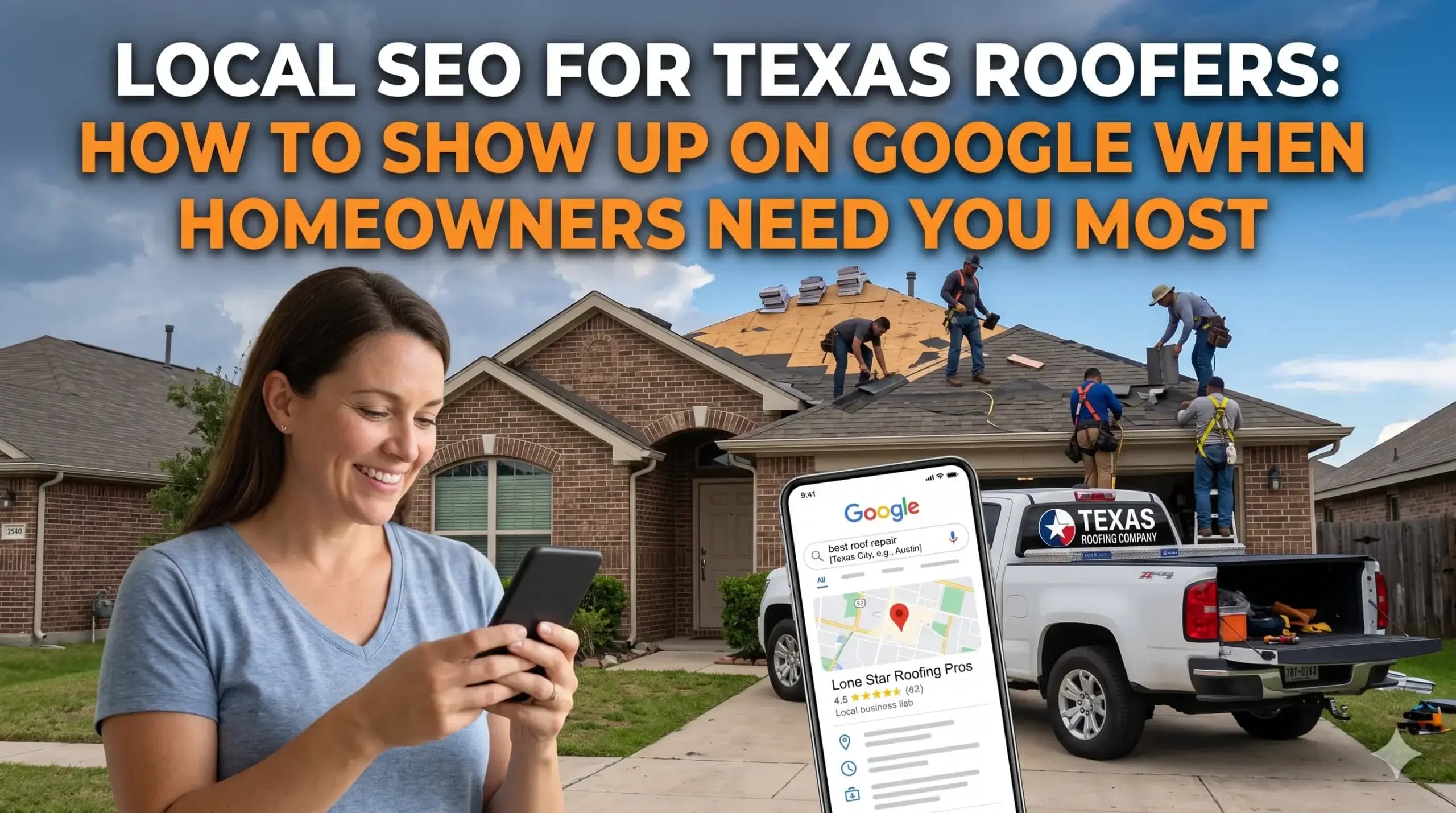
Local SEO for Texas Roofers: How to Show Up on Google When Homeowners Need You Most
A storm rolls through the Dallas suburbs. Shingles are scattered across lawns. Homeowners are grabbing their phones — not to call a neighbor, not to flip through the Yellow Pages — they’re typing “emergency roofer near me” into Google. Three names pop up. Yours isn’t one of them.
That’s the moment your roofing business either wins or loses a job worth $8,000–$15,000. And it happens dozens of times a week, all across Texas.
Most roofing contractors assume they’re invisible on Google because they haven’t “done enough SEO.” The truth is messier: it’s usually a combination of a slow website, a neglected Google Business Profile, and pages Google simply doesn’t trust enough to show. None of these problems are obvious — you’d never know they’re bleeding you leads unless someone looked.
This guide breaks down exactly what’s holding most Texas roofers back, what good local SEO actually looks like, and how to fix the leaks in your digital roof.
Why Your Roofing Website Isn’t Bringing in Calls
Your website is your best salesperson — or it should be. But most roofing websites have a problem: they’re built to look good, not to perform.
Here’s what actually happens when a homeowner clicks on your site:
- The page takes more than 3 seconds to load
- They see a wall of text or a cluttered layout
- There’s no clear phone number above the fold
- They hit the back button and call your competitor
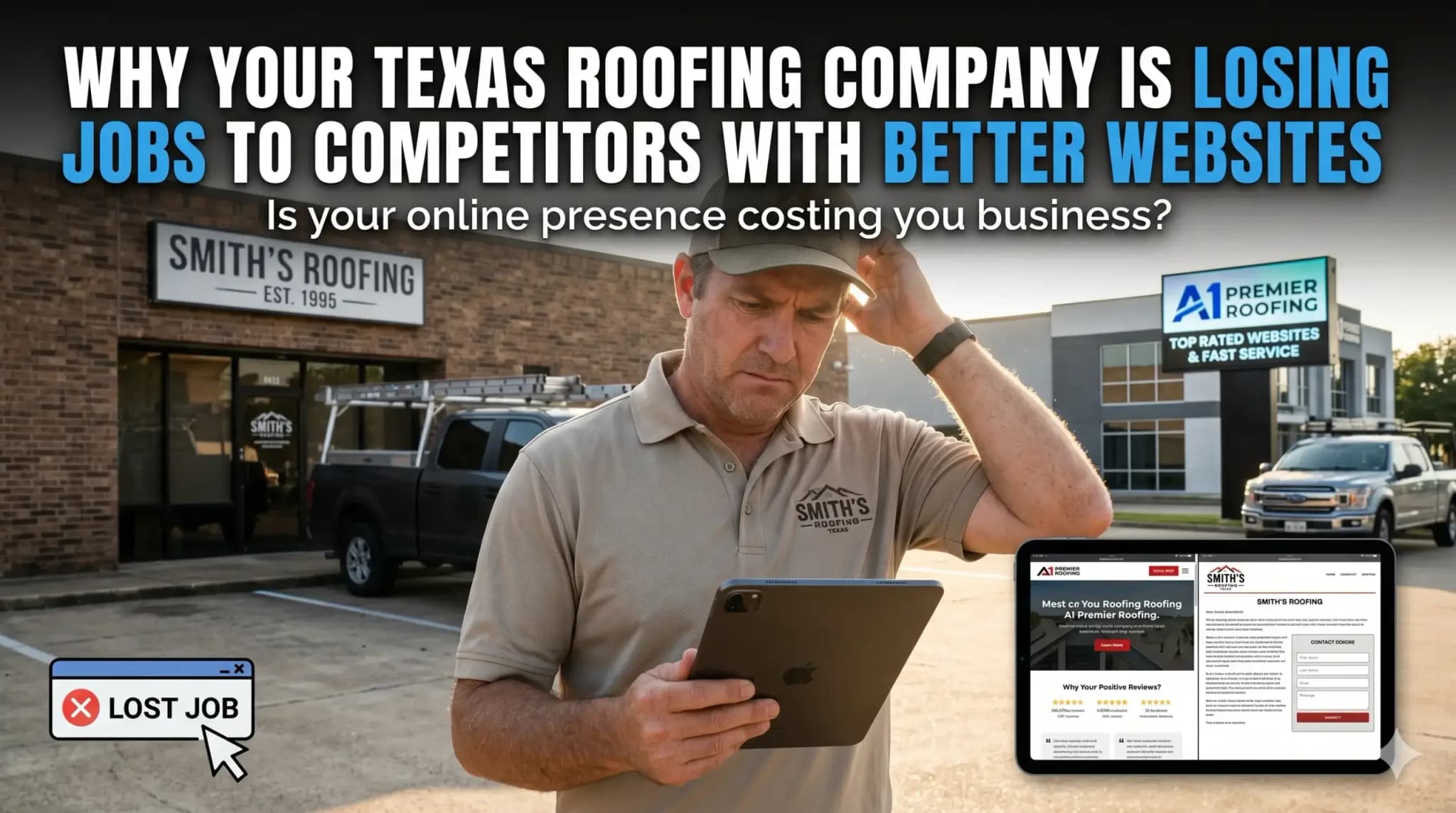
Google notices this behavior. When people leave your site fast, Google interprets it as a signal that your page isn’t useful — and it quietly pushes you further down the results. Your site might look fine to you, but it’s silently costing you jobs.
The fix isn’t just speed (though that matters enormously). It’s building a site that’s designed for one thing: turning a stressed-out homeowner into a phone call within 30 seconds of landing on your page.
That’s exactly what websites built for roofing businesses are designed to do.
The Google Map Pack: The 3 Spots That Control Your Local Market
When someone searches “roofing contractor Austin” or “roof repair near me,” they don’t usually scroll down to the blue links. They look at the map — specifically the three businesses that appear in the Google Map Pack at the top of the results.
Those three spots capture the majority of clicks. If you’re not in them, you’re fighting for scraps.
Getting into the Map Pack comes down to three things:
- A fully optimized Google Business Profile — photos, service areas, hours, and a consistent business name/address/phone number across every listing
- Reviews — not just how many you have, but how recently they were posted and how well you respond to them
- Local relevance signals — does your website mention the specific cities and neighborhoods you serve? Does Google understand your geographic footprint?
Most roofers have a Google Business Profile that was set up once and forgotten. No updates, no new photos, outdated hours, unanswered reviews. To Google, a neglected profile looks like a neglected business.
Why Your Competitor Shows Up and You Don’t
It’s a specific kind of frustration — you know you do better work, but the guy down the road keeps getting the calls. Here’s why it’s probably happening.
Think of Google like a building inspector reviewing a new construction project. Before they approve the build, they want to see proper permits, documented materials, and verified contractors. If the paperwork’s incomplete or inconsistent, the project gets flagged — or ignored entirely.
Your website is the same. Google needs consistent, verifiable signals that say: “This is a real, trustworthy roofing company that serves this specific area.”
Those signals include:
- Citations — your business name, address, and phone number listed identically across Yelp, Angi, BBB, and other directories
- Structured data — technical code on your website that tells Google exactly who you are, what you do, and where you operate
- Location-specific pages — not one generic “Service Area” page, but dedicated pages for Dallas, Fort Worth, Plano, or wherever you actually work
- Backlinks — other credible local websites linking to yours
When your competitor has these and you don’t, Google sends them the traffic. It’s not personal — it’s signals.
💡 Pro Tip: Your City Pages Are Probably Wrong (or Missing)
Many roofers have one page that lists ten cities they serve. That’s not a local SEO strategy — it’s a list. Google needs each city to have its own dedicated page with original content, local context, and a clear service focus. A single “Service Areas” page with bullet points tells Google almost nothing. Ten separate, well-written city pages tell Google everything. If you’re targeting Dallas, Fort Worth, and San Antonio, each one deserves its own page built around what homeowners in that area actually search for — hail damage, wind damage, flat roofs, tile roofs, and so on. This single change has moved roofing companies from page 3 to page 1 in specific markets.
What Good Roofing SEO Actually Looks Like: A Real-World Example
Consider a mid-size roofing company in the Dallas–Fort Worth area. They’d been in business for eleven years, had solid reviews from happy customers, and did reliable work. But their website was built in 2018, loaded slowly on mobile, had no dedicated city pages, and their Google Business Profile hadn’t been touched in two years.
Before: They were getting 3–5 inbound calls a month from Google. Most of their work came from referrals and door-knocking after storms.
After a focused local SEO overhaul — new mobile-first website, optimized GBP, five city-specific service pages, citation cleanup, and a review generation system — they began ranking in the Map Pack for their top three target cities within four months.
The result: Inbound calls from Google climbed to 25–35 per month. Their close rate stayed the same — they just had far more qualified leads to work with. They stopped door-knocking entirely within six months.
The work was the same. The visibility was completely different.
Not sure if your roofing website has these problems? Get a free website audit — no obligation, just a clear picture of what’s costing you leads.
Mobile Speed Is Not Optional — It’s Your First Impression
More than 70% of homeowners searching for a roofer are doing it on their phone — often in the driveway, looking up at damaged shingles. If your site takes five seconds to load on a phone, they’re gone before they ever see your phone number.
Google also uses mobile loading speed as a ranking factor. A slow mobile site gets pushed down in results, meaning you’re invisible at the exact moment someone needs you most.
Most roofing websites are slow because they’re loaded with oversized images, outdated code, or cheap hosting that can’t handle traffic spikes after a major storm — which is precisely when you need it most.
A properly built roofing contractor website loads in under two seconds on mobile, keeps the phone number front and center, and makes it dead simple for a homeowner to request an estimate with one tap.
Your Path to More Roofing Leads from Google
Here’s what a focused local SEO effort looks like for a Texas roofing company:
- Fix your website foundation first. Speed, mobile usability, and clear calls-to-action come before anything else. A slow site that ranks will still fail to convert.
- Claim and fully optimize your Google Business Profile. Add photos, respond to every review, list your exact service areas, and keep your hours accurate.
- Build city-specific pages for every market you serve. Each page should speak directly to what homeowners in that city search for — storm damage, insurance claims, specific roofing materials.
- Clean up your citations. Your business name, address, and phone number need to be consistent across every directory online. Inconsistencies confuse Google and erode trust.
- Build a review system. A steady flow of recent reviews is one of the strongest local ranking signals available. Make requesting reviews part of every completed job.
Frequently Asked Questions
Why am I not getting calls from my website even though I’m getting traffic?
Traffic without calls usually means one of three things: your site loads too slowly and people leave before they act, your contact information isn’t obvious enough on mobile, or the visitors landing on your site aren’t the right ones — you’re attracting general browsers instead of homeowners actively ready to hire. A proper audit will show you exactly where the drop-off is happening.
How do I know if my roofing website is actually working for me?
If you can’t tell you how many calls and form submissions came from your website last month, your website isn’t working for you — it’s just sitting there. A functioning roofing website has call tracking, form submission tracking, and clear data showing which pages drive real leads. Get a free website audit to see where yours stands.
How long does it take to see results after fixing my website or doing SEO?
For local SEO, most roofing businesses start seeing meaningful movement in the Google Map Pack within 60–120 days of a focused effort. A new website with proper optimization typically shows results faster than trying to fix an old, slow one. SEO is not instant, but the leads it generates are significantly cheaper — and more consistent — than paid ads over time.
What makes a roofing website different from a regular business website?
A roofing website needs to convert under pressure — when a homeowner just dealt with storm damage, they’re emotional and they want answers fast. That means a visible phone number the moment the page loads, clear proof of local credibility (reviews, service areas, years in business), and pages designed around what Texas homeowners actually search for — not what looks good in a design portfolio. Generic web designers build websites. Specialists build tools that bring in roofing jobs.
Do I really need a fast website if my customers are mostly local and find me by word of mouth?
Referrals are great, but they have a ceiling. The customers who find you on Google are often higher-intent and ready to hire — they’re not comparing you to three cousins’ recommendations, they need a roofer now. And even referral customers will Google you before they call. A slow, outdated site can kill a warm referral just as fast as it kills a cold lead. Your website is your reputation online. It needs to hold up.
I’ve worked with marketing agencies before and got nothing. Why would this be different?
That’s a fair concern, and an honest one. Most agencies sell roofing companies generic SEO packages that treat every industry the same. Roofing has specific seasonality, storm-driven demand cycles, insurance claim processes, and local market dynamics that a generalist agency simply doesn’t account for. The right partner understands the roofing business — not just the marketing tactics.
Stop Leaving Roofing Jobs on the Table
Every week your website isn’t optimized, you’re handing calls to a competitor. The homeowners searching for roofers in your area right now will call someone — the only question is whether it’s you.
A free website audit from Digital Trace will show you exactly what’s costing you leads: your site speed, your Google Business Profile gaps, your missing city pages, and the quick wins that could move the needle fastest.
There’s no pitch, no pressure, and no obligation — just a clear look at what’s working and what isn’t.
See what’s costing you leads — get your free website audit today.