Web Design for Roofers: What Actually Books Jobs
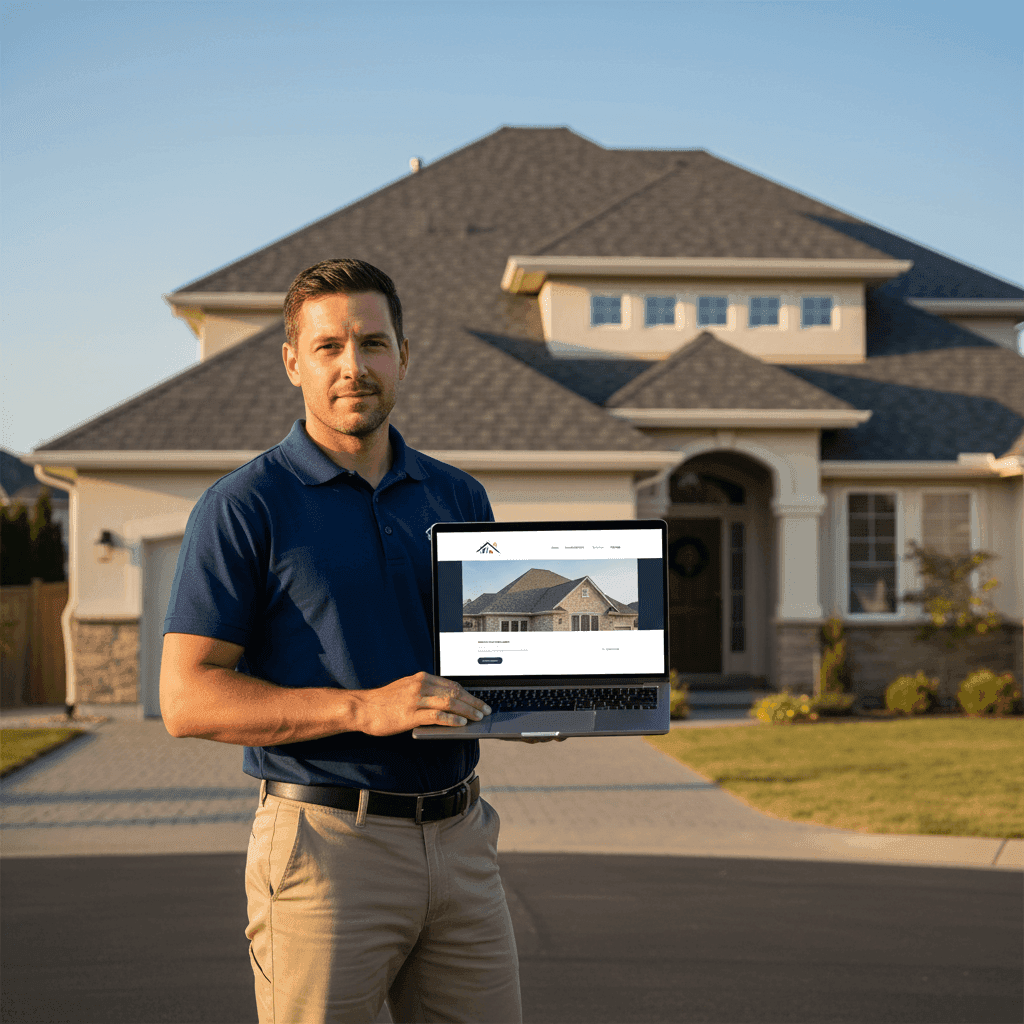
Web design for roofers is website design built around how homeowners actually hire a roofer: fast mobile pages, a visible phone number and quote form, storm and insurance-restoration messaging, service-area pages, and local SEO. Done right, it turns searches into booked estimates instead of just looking professional.
A roof replacement runs $8,000–$25,000. If your site loads slow, buries your phone number, or doesn’t rank in your service area, three homeowners a week find it, bounce, and call the next roofer on the list. That’s not a traffic problem — it’s a design problem, and it’s handing signed jobs to competitors who spent money on a site built to convert.
Why web design for roofers isn’t generic web design
Most web designers build the same brochure for a roofer that they’d build for a bakery: a logo, a gallery, an “About” page, a contact form nobody fills out. It looks fine. It books nothing.
Roofing is a different buying situation. Your customer is usually in a hurry — a leak after a storm, shingles in the yard, an adjuster coming Thursday. They’re on a phone, they’re comparing three roofers in five minutes, and they’re deciding in seconds whether you look legitimate enough to call. Web design for roofers has to win that moment, not just photograph well.
It also has to handle things a generic designer has never heard of: insurance restoration versus retail jobs, financing options, EagleView measurements, GAF or Owens Corning certification as a trust signal, and ranking across every city and suburb you drive to. Miss those, and you’ve paid for a digital business card.
Speed is the clearest example. Every extra second your page takes to load gives the homeowner another chance to hit the back button and call someone else. Google’s own mobile benchmarks found the probability of a visitor bouncing jumps 32% as load time goes from one second to three. A slow roofing site loses the job before your work ever enters the conversation.
What a roofing website that books jobs includes
Strip away the design opinions and a roofing site that actually books work comes down to a short list of parts. If your current site is missing these, that’s where the leaks are.
- Speed. Under ~2.5 seconds on mobile, with clean Core Web Vitals. This is the single biggest lever and the one most agencies skip.
- A hero that closes. Your service area, a tap-to-call phone number, and a short quote form above the fold — no scrolling to find out whether you serve their town.
- Insurance-restoration and financing messaging. Say plainly that you handle insurance claims and offer financing. Half your callers need to hear it before they’ll dial.
- Real proof. Actual job photos — tear-offs, completed squares, before-and-afters — plus GAF/Owens Corning certifications and live reviews, not stock images.
- Service-area pages. A real page for each city you serve so you can rank in all of them, not just your home town.
- Local SEO wiring. The site has to feed your Google Business Profile and the map pack, which is where most roofing calls start.
- AI search visibility. Schema and answer-first content so ChatGPT, Perplexity, and Google’s AI Overviews name you when a homeowner asks for a roofer in your city.
- Fast lead handling. Forms that route straight to text or a CRM, plus missed-call text-back, so a lead gets a reply in minutes instead of hours.
Not sure how many of these your current site has? A good team can walk your site with you and point to the gaps in ten minutes — that’s the whole idea behind our custom roofing website design.
Generic designer vs roofing specialist vs DIY builder
There are really three ways to get a roofing site built. None is “wrong” — they just fit different situations. Here’s the honest trade-off.
| Option | Typical market cost | Roofing SEO & service-area pages | Lead capture built for roofing | Speed & upkeep | Best for |
|---|---|---|---|---|---|
| DIY website builder | $0–$50/mo | Minimal — you do it all yourself | Generic form; no roofing logic | Often slow; you maintain it | Brand-new roofers testing the water on no budget |
| Freelancer / generic web designer | $1,500–$5,000 one-time | Usually none unless you ask and pay extra | Depends entirely on the individual | Fast at launch, then drifts; upkeep is on you | Owners who just need a clean brochure site |
| Roofing-specialist agency | $5,000–$12,000+ or monthly | Built in — service-area pages and local SEO from day one | Insurance, financing, and quote flow built for roofers | Tuned for speed; hosting and maintenance handled | Roofers who want the site to generate jobs, not sit there |
The pattern is simple: a DIY builder is cheapest up front and caps your leads; a roofing-specialist agency costs more but is the only option where lead generation is the point of the build, not an add-on.
What web design for roofers costs
Across the market, roofing websites range from a few hundred dollars for a DIY template to $10,000 and up for a custom agency build, with plenty of serious options in the $4,000–$8,000 range. What moves the number is scope — number of pages, how much SEO and service-area work is included, whether automation and hosting come with it, and whether it’s custom or a dressed-up template.
Don’t price a roofing site like a logo. Price it like a salesperson: if a single roof is worth $8,000–$25,000, a site that books even one extra job a month has paid for itself many times over. For a full breakdown, see our guide on what a roofing website costs, and our transparent roofing website pricing.
7 questions to ask before you hire anyone
Whether you’re talking to a freelancer or an agency, these seven questions separate a site that books jobs from one that just looks nice. Screenshot this and take it into the sales call.
- Can you show me roofing sites you’ve built — and their load speed? Ask them to run one through PageSpeed Insights on the call.
- Will I get a real page for each city I serve? If the answer is one “service area” paragraph, you won’t rank beyond your home town.
- How does the site capture insurance-restoration and financing leads? If they look blank, they don’t build for roofers.
- What happens to a lead the moment it comes in? You want instant text or CRM routing, not an email nobody checks.
- Is this custom, or a template? Templates cap your SEO ceiling and every roofer using them looks the same.
- Will I show up in Google’s map pack and AI answers? Ranking and AI visibility should be built in, not sold later.
- Who hosts and maintains it, and what does that cost? A site nobody updates gets slow and insecure within a year.
How Digital Trace approaches web design for roofers
We build roofing sites the way an operator would, because the point is booked jobs, not a design award. Here’s what’s included by default:
- Custom builds, never templates — so your site can rank and doesn’t look like every other roofer’s.
- Roofing SEO and AIO built in — service-area pages, local SEO, and roofing SEO structured so AI search engines cite you, not just Google.
- An AI sales agent and automation — to answer, qualify, and book leads 24/7 so a storm-night inquiry doesn’t sit until morning.
- Managed hosting and maintenance — speed, security, and updates handled, so the site stays fast instead of decaying.
Those are capability claims — what we build and include. The right way to judge any agency, us included, is to put your current site through the questions above and see what’s missing.
Frequently asked questions
How much does web design for roofers cost?
Expect a few hundred dollars a year for a DIY builder, $1,500–$5,000 for a freelancer, and roughly $5,000–$12,000 or a monthly plan for a custom roofing-specialist agency. What drives the price is scope: page count, how much SEO and service-area work is included, automation, and whether it’s a true custom build or a template with your logo dropped in.
What’s the difference between a roofing website and a generic one?
A generic site is a brochure. A roofing site is built for how homeowners hire after a storm: fast mobile pages, tap-to-call, insurance-restoration and financing messaging, service-area pages for local ranking, and lead routing that replies in minutes. The parts look similar; what they’re engineered to do — book estimates — is completely different.
How long does it take to build a roofing website?
A straightforward custom roofing site usually takes four to eight weeks, depending on how many service-area pages you need and how fast you get photos and content approved. A DIY builder can be live in a weekend, but you trade that speed for weak SEO and lead capture. The slow part is almost always content, not code.
Do I need SEO too, or just a website?
A website without SEO is a billboard in the desert — real, but nobody sees it. Most roofing calls start in Google’s map pack or an AI answer, so the site and its SEO have to be built together. A good roofing build wires in service-area pages, local SEO, and schema from day one instead of bolting it on later.
Will a new website actually get me more roofing leads?
Only if it fixes the reason you’re losing them — usually speed, a hidden phone number, no local ranking, or slow lead response. A faster site that ranks in your service area and replies to leads in minutes gives you more booked estimates. A prettier site that still loads slow and doesn’t rank will not. Design for the job, not the look.
The bottom line
Web design for roofers is the difference between a site that looks professional and a site that fills your calendar. If homeowners in your area are searching and you’re not getting the calls, the gap is almost always speed, local ranking, lead capture, or response time — all fixable.
Want to know exactly where your current site is leaking jobs? Get a free website audit and we’ll show you three things: whether your mobile conversion path actually leads to a booked estimate, how fast your pages load against your competitors, and whether you show up in AI answers when someone asks for a roofer in your city. For the shopping checklist, see our guide on how to choose a roofing web design company and examples of the best roofing websites and why they convert.