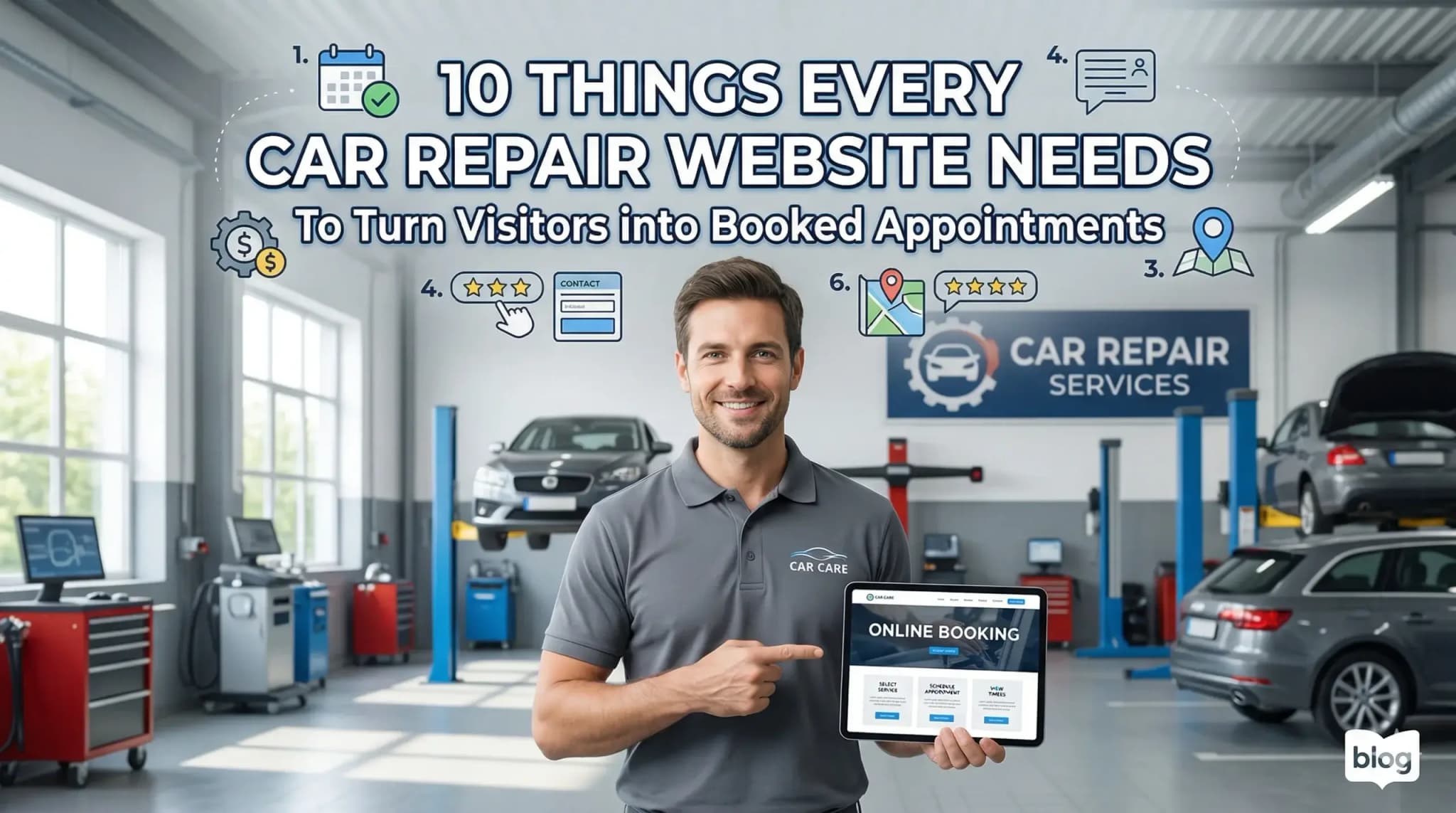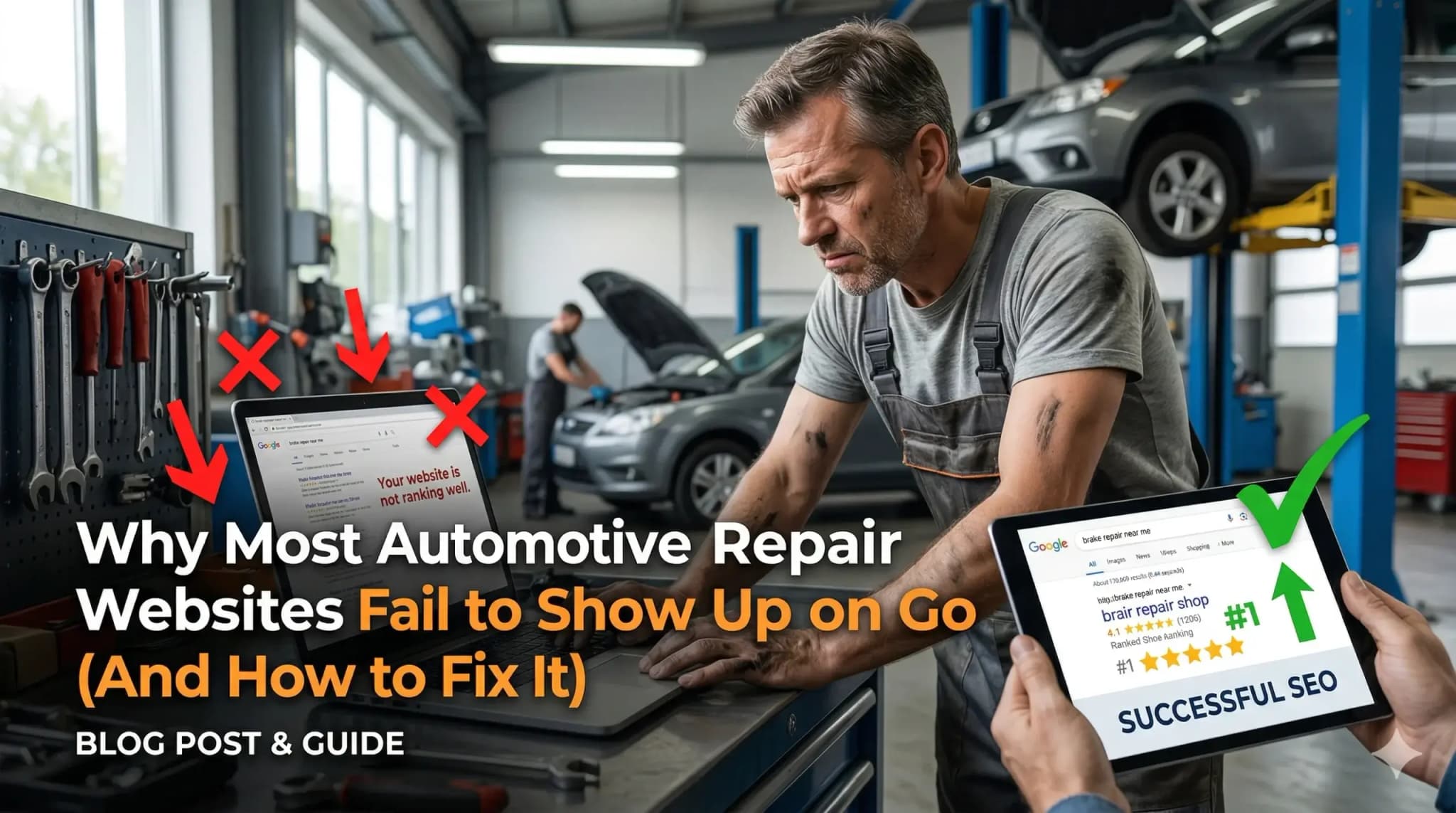
How to Get a Professional Auto Repair Shop Website That Actually Brings in Customers
Your bays are ready. Your techs are skilled. Your prices are fair. But your phone isn’t ringing the way it should — and you can’t figure out why.
Most auto repair shop owners blame slow seasons or word-of-mouth drying up. The real culprit is usually sitting right on their phone: a website that looks fine on the surface but is quietly turning away customers every single day.
The hard truth is that the majority of people searching for auto repair in your area are choosing a shop before they ever pick up the phone. They go to Google, compare the first few results, scan a few websites in about 10 seconds, and call the one that feels trustworthy. If your site isn’t built to win that 10-second judgment, you’re not losing to better mechanics — you’re losing to better websites.
This guide breaks down exactly what separates an auto repair shop website that generates real business from one that just exists on the internet. By the end, you’ll know what to fix, what to look for, and how to stop leaving customers on the table.
Why Most Auto Repair Websites Don’t Generate Calls
Think of your website like your shop’s front lot. If a customer drives by and the lot looks cluttered, the signage is hard to read, and they can’t tell what services you offer or how to pull in — they keep driving. They don’t call to ask. They just go somewhere else.
That’s exactly what happens online when your website is slow to load, hard to navigate on a phone, or buried on page two of Google. Most visitors make a decision in under 10 seconds. If your name, location, services, and phone number aren’t immediately obvious, they’re gone.
The most common problems that kill calls from auto repair websites:
- The site loads slowly on mobile (most customers are searching from their phones while their car acts up)
- The phone number isn’t clickable or visible above the fold
- There’s no clear list of services — customers aren’t sure if you handle their specific repair
- The site looks outdated, making them wonder if the shop is still open or trustworthy
- There are no reviews or trust signals visible without scrolling down
Any one of these problems costs you calls. Several of them together can nearly silence your phone.
The Speed Problem Nobody Tells You About
Here’s the most overlooked issue in auto repair website design: your site is probably too slow, and it’s costing you customers before they even see what you offer.
When someone’s car starts making a noise, they pull out their phone and search “auto repair near me.” Google loads a list of results. They tap on your site. If it takes more than 3 seconds to load — and many shop websites take 6, 8, even 12 seconds — a large portion of those visitors leave immediately. They don’t wait. They go back and tap the next result.
The technical reason is usually bloated images, cheap hosting, or a website built on a platform that wasn’t designed for performance. The business reason is that you’re paying for a website that’s actively pushing customers toward your competitors.
At Digital Trace, every auto repair website is built for speed first — because a fast site isn’t a luxury, it’s the cost of staying competitive. Fast load times also directly impact how high Google ranks your site, so fixing speed does double duty: it keeps visitors on your page and it helps more people find you in the first place.
💡 Pro Tip: Your Contact Info Shouldn’t Require Scrolling
One of the most common and costly mistakes on auto repair websites: the phone number is buried at the bottom of the page or hidden in the top navigation bar in tiny text.
On mobile — where most of your customers are searching — people expect to tap a phone number and call instantly. If they have to scroll to find it, most won’t bother. Make sure your phone number is large, visible, and clickable at the very top of every page. On mobile, that button should practically jump off the screen. The same goes for your address and a “Get Directions” link. These aren’t design choices — they’re revenue decisions.
Google Doesn’t Know Enough About Your Shop to Recommend It
You might have a great reputation in your area. But if Google can’t clearly understand what your shop does, where it’s located, and who it serves — Google won’t show it confidently in search results.
This isn’t about tricking the algorithm. It’s about giving Google the clear, structured information it needs to match your shop with the right searches. A shop in Denver that offers transmission repair, brake service, and oil changes needs pages (or at minimum, sections) dedicated to each of those services — with the city name naturally included. Without that, Google sees a vague “auto repair” website and doesn’t know when to show it.
The fix involves building out your site with service-specific content and location context. It also means making sure your Google Business Profile connects properly with your website, so the two reinforce each other. When this is done right, shops that were invisible on page two start showing up in the map pack — the three listings that appear at the top of local search results and capture the majority of clicks.
This is exactly what websites built for auto repair businesses by Digital Trace are designed to accomplish: combining the right structure, the right content, and the right technical foundation so Google knows exactly what your shop offers and who to send your way.
Trust Is Decided in Seconds — Your Website Either Builds It or Kills It
When a customer lands on your site, they’re not just looking for your services. They’re asking themselves: Can I trust these people with my car?
An outdated website design — even if it has all the right information — creates doubt. Stock photos that look nothing like your actual shop, a wall of text with no photos of your team, no reviews visible, no clear indication of how long you’ve been in business — these all quietly signal “maybe don’t call them.”
The best auto repair shop websites lead with trust:
- Real photos of the shop, the team, and actual repair work in progress
- Google and Facebook reviews pulled in automatically so customers see social proof immediately
- Clear experience signals — years in business, certifications, brands you service
- A simple, confident design that says “we’re professional and we know what we’re doing”
None of this needs to be fancy. It just needs to be intentional. A clean, fast website with real photos and visible reviews will consistently outperform a flashy site with none of those elements.
Before & After: What a Better Website Actually Does for a Shop
The situation: A family-owned auto repair shop in the Dallas–Fort Worth area had been in business for 14 years. They had loyal repeat customers, strong word-of-mouth, and good reviews on Google. But their website was built in 2016, wasn’t mobile-friendly, and had no service-specific pages — just a homepage with a general description and a contact form.
They were showing up on the second page of Google for most local searches, getting only a handful of website inquiries per month, and watching newer shops with shinier online presences pull in customers who would have been a natural fit.
What changed: A new website was built with a fast, mobile-first design. Service pages were created for their top offerings — brake repair, oil changes, transmission service, and AC repair — each with local keywords naturally woven in. Real shop photos replaced generic stock images. Their Google reviews were integrated directly on the homepage. Their phone number became a one-tap button on mobile.
The result: Within three months, the shop was ranking in the local map pack for their top service keywords. Website-generated phone calls went from a handful per month to over 60. One of their service pages alone was bringing in an average of 20+ new customer inquiries monthly. Their slow season barely felt slow.
Not sure if your auto repair website has these issues? Get a free website audit — no obligation, just a clear picture of what’s costing you leads.
Your Path to More Leads: 5 Steps That Actually Move the Needle
Getting more calls from your website doesn’t require a full marketing overhaul. It requires fixing the right things in the right order.
Step 1: Fix how your site loads on mobile. If your site takes more than 3 seconds to load on a phone, you’re losing customers before they see anything. Speed is the foundation everything else is built on.
Step 2: Make your phone number impossible to miss. Every page on your site should have a large, tappable phone number at the top. Don’t make people hunt for it.
Step 3: Create a dedicated page for each of your main services. One general “services” page isn’t enough. Google — and customers — respond better to specific pages for brake repair, oil changes, transmission work, and so on.
Step 4: Get your reviews on your homepage. If you have 50 great Google reviews and none of them are visible on your website, you’re leaving your best marketing tool unused. Integrate them prominently.
Step 5: Make sure Google understands your location and services. Your website and your Google Business Profile should tell the same story, clearly and consistently. When they do, local rankings improve.
Frequently Asked Questions
Why am I not getting calls from my website even though it shows up on Google?
Showing up on Google and converting visitors into calls are two different problems. Your site might rank on page one for your shop name but rank nowhere for “auto repair near me” or specific services. Or your site loads too slowly on mobile, customers leave before they see your phone number, or there’s nothing on the page that builds enough trust to make them call. A quick audit usually reveals which of these is the issue.
How do I actually know if my auto repair website is working or just sitting there?
If you don’t know how many calls or form submissions your website generates each month, you have no way to measure whether it’s working. Basic analytics — easy to set up — show you how many people visit, where they come from, and what they do when they get there. If visits are happening but calls aren’t, that points to a conversion problem. If visits are low, that’s a visibility problem. Both are fixable. Book a free review and we’ll show you exactly what the numbers look like for your site.
How long does it take to see results from a new website?
Most shops start seeing meaningful changes within 60–90 days of launching a properly built website — faster if the Google Business Profile is also optimized at the same time. Some improvements, like more calls from mobile visitors or a better click-through rate from search, can show up within the first few weeks. SEO results that target competitive search terms take a little longer, but the foundation gets laid immediately.
What makes an auto repair website different from a regular small business website?
Auto repair customers are often in a stressful situation — something’s wrong with their car and they need help fast. Your website needs to eliminate friction instantly: clear phone number, quick summary of services, trust signals like reviews and certifications, and a simple path to call or get a quote. It also needs to rank for service-specific and location-specific searches that are unique to the auto repair industry. A generic website template built for a boutique or a consultant won’t check those boxes.
Do I really need a fast website if most of my customers are just locals who already know me?
Repeat customers might already have your number. But new customers — the ones who just moved to the area, whose usual shop closed, or who had a breakdown away from home — are finding you (or not finding you) through Google. That audience is entirely dependent on how your website performs. A slow, hard-to-navigate site doesn’t just lose you leads today; it pushes those customers toward competitors who may now become their go-to shop for years.
I tried a web agency before and saw no results. Why would this be different?
Most agencies build websites that look good in screenshots but aren’t built around how people actually find and choose local service businesses. The difference is in the details: how fast it loads, how it’s structured for local search, how clearly it communicates trust, and whether it’s actually optimized for the way your customers search. Results come from getting all of those pieces right together — not from a template with your logo dropped in.
Ready to Find Out What Your Website Is Costing You?
Every week your auto repair website has speed problems, missing service pages, or weak trust signals is another week of potential customers choosing the shop down the street — not because they’re better, but because their website made a stronger first impression.
A free audit from Digital Trace will show you exactly where your site is losing leads, what it would take to fix it, and what kind of results you can realistically expect. There’s no pitch, no pressure, and no obligation — just a clear, honest look at what’s working and what isn’t.
Get your free website audit today — and find out what’s standing between your shop and the phone ringing more consistently.