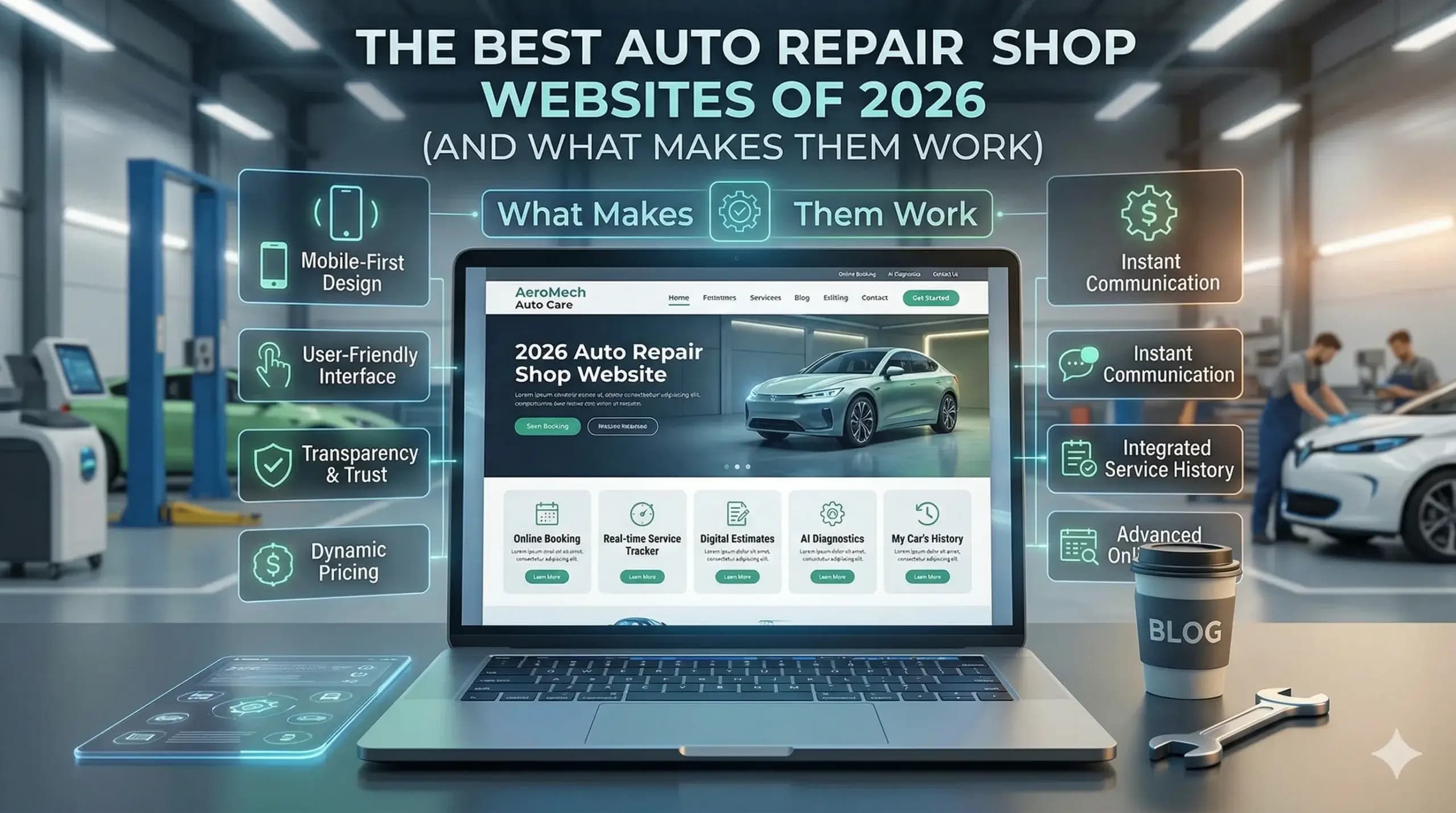
The Best Auto Repair Shop Websites of 2026 (And What Makes Them Work)
Your shop does great work. Your lifts are full, your techs are skilled, and your customers leave happy. So why does it feel like your website is the one part of your business that never pulls its weight?
Most auto repair shop owners think their website just needs to “look better.” But the shops that are consistently pulling in new customers from Google aren’t winning on looks — they’re winning because their site is built to convert. Speed, trust signals, local search presence, and a clear path to booking: these are the things separating the shops with packed appointment books from the ones waiting for the phone to ring.
This guide breaks down exactly what the best auto repair shop websites have in common — and what the average shop is quietly getting wrong every single day.
Your Website Has 3 Seconds to Make Someone Call You
Think about what happens when a car breaks down and the driver pulls over to search for a repair shop. They’re not browsing — they’re choosing fast. They tap the first result that looks trustworthy, and if that page takes more than a few seconds to load, they hit the back button and call your competitor.
This happens constantly, and most shop owners have no idea.
A slow site doesn’t just frustrate visitors — it actively pushes them away before they ever see your phone number, your services, or your years in business. And Google knows this. A site that loads slowly gets ranked lower, so not only are you losing visitors who find you, fewer people are finding you in the first place.
The best auto repair websites load in under two seconds on a phone. If yours doesn’t, you’re paying for a website that’s turning away customers.
Here’s what a fast, converting auto repair site does right:
- Loads on mobile in under 2 seconds
- Shows your phone number prominently at the top — clickable on mobile
- States your location and core services immediately (no scrolling required)
- Has a clear, single call-to-action: “Call Now,” “Book an Appointment,” or “Get a Quote”
Most Mechanic Websites Look Fine But Don’t Actually Rank
Here’s the frustrating part: your site might look decent and still be invisible on Google. That’s because looking good and being found are two completely different things.
Google needs specific information to confidently show your business in local search results. If your site doesn’t have that information structured the right way, Google essentially guesses — and usually guesses wrong, showing competitors instead.
Think of it like a diagnosis. Your car might look clean sitting in the lot, but if there’s a fault code buried in the ECU, the engine warning light’s going to come on. Your website can look clean on the surface and still have underlying issues costing you search visibility every day.
The common gaps that kill local rankings:
- Your Google Business Profile and website have slightly different addresses or business names
- Your site doesn’t have location-specific content (just “Auto Repair” with no city or region)
- Google doesn’t have structured data telling it what services you offer, your hours, or your service area
- You have no reviews connected to your site or no review strategy at all
The best auto repair websites built for US shops address all of these from day one — because ranking locally is the whole point.
The Trust Problem Nobody Talks About
A potential customer lands on your site at 7pm on a Tuesday. They need to know: Is this shop legit? Will they rip me off? Do real people use them?
They’re making that decision in about 8 seconds. And if your site doesn’t answer those questions fast — with real reviews, real photos, real credentials — they’re gone.
This isn’t about design. It’s about what’s on the page and how quickly it communicates trust. Stock photos of random cars don’t cut it. A wall of text about your “commitment to quality” doesn’t either.
What actually builds trust on an auto repair website:
- Real photos of your shop, your team, and your actual work
- Google Reviews displayed directly on the site (or a widget pulling them in)
- Certifications visible above the fold (ASE, AAA-approved, etc.)
- A short “About Us” that sounds like a real person — not a press release
- Clear pricing signals, even if just a starting price range for common services
When Digital Trace builds auto repair websites, trust signals are treated as core structure, not an afterthought. They’re baked into the page layout from the first wireframe.
💡 Pro Tip
The #1 mistake auto repair shops make: no mobile call button.
More than 70% of local service searches happen on a phone. If your phone number isn’t a tappable “Call Now” button at the top of your mobile site, you’re forcing people to copy-paste a number — and most won’t bother. They’ll just call the next shop. This is one of the fastest, highest-impact fixes any mechanic website can make, and it takes about 10 minutes to implement correctly.
Before & After: What a Real Rebuild Looks Like
The Shop: A family-owned auto repair shop in suburban Ohio — three bays, two full-time techs, been in business for 14 years. Their website was built in 2019 by a nephew and hadn’t been touched since.
The Problem: The site took over 6 seconds to load on mobile. The phone number was buried in the footer. There were no reviews visible anywhere. Their Google Business Profile listed a slightly different address than the website, which was quietly tanking their local ranking. They were showing up on page 2 for “[city] auto repair” — essentially invisible.
What Changed: The site was rebuilt from scratch with mobile-first design, a clickable call button at the top, a services page optimized for local search terms, Google Reviews pulled in automatically, and proper structured data added so Google could confidently rank them. The Google Business Profile was synced and optimized.
The Result: Within 90 days, they moved from page 2 to the top 3 results for their core local search terms. Phone calls from the website went up significantly — the owner estimated roughly 12–15 new appointment calls per month that weren’t coming in before. Two of those were transmission jobs. One call alone more than covered the cost of the new site.
Not sure if your auto repair website has these issues? Get a free website audit — no obligation, just a clear picture of what’s costing you leads.
What the Best Auto Repair Websites Have That Yours Probably Doesn’t
After reviewing hundreds of mechanic and auto repair websites across the US, the pattern is clear. The ones that consistently win in local search and convert visitors into calls share a handful of traits that most shops overlook.
They’re built for the customer’s first question, not the shop owner’s ego.
The best sites don’t lead with “Welcome to Smith’s Auto.” They lead with “Fast, Honest Auto Repair in [City] — Call for Same-Day Service.” The visitor’s first thought is answered before they scroll.
They have service pages that actually rank.
One generic “Services” page listing oil changes, brakes, and transmission work won’t cut it. The shops ranking well have individual pages — or at least dedicated sections — for their most searched services. “Brake Repair in [City]” and “Check Engine Light Diagnosis in [City]” are searches people make. A generic services list doesn’t capture them.
They make booking stupidly easy.
Phone number at the top. “Book Online” button visible on mobile. A simple contact form that doesn’t ask for 15 pieces of information. The fewer clicks between a visitor and an appointment confirmation, the more appointments you book.
They earn Google’s trust through consistency.
Same name, address, and phone number everywhere — on the site, Google Business Profile, Yelp, and any directory listing. Google rewards consistency and penalizes confusion.
Your Path to More Leads: 5 Steps to a Website That Works
You don’t have to overhaul everything at once. Here’s a clear, practical starting point:
- Check your mobile load speed. Go to Google’s PageSpeed Insights and enter your URL. If your mobile score is below 70, your site is actively losing you leads.
- Add a tap-to-call button. Your phone number should be a tappable button at the very top of your mobile site — not just text, not buried in a footer.
- Sync your information everywhere. Make sure your business name, address, and phone number are identical on your website, Google Business Profile, and any directory listings.
- Add visible reviews. If your Google Reviews aren’t showing up on your site, you’re hiding your best sales tool. Add a widget or embed them directly.
- Get a professional audit. Before spending money rebuilding anything, find out exactly what’s broken and what it’s costing you. A good audit pays for itself.
Frequently Asked Questions
Why am I not getting calls from my website even though it looks fine?
Looking fine and performing well are two different things. Your site might have a slow load time, a phone number that isn’t clickable on mobile, or poor local SEO — any of which can quietly kill your incoming calls. The only way to know for sure is to audit the site’s actual performance, not just how it looks on screen.
How do I know if my auto repair website is actually working?
If you can’t tell you exactly how many calls or contact form submissions came from your website last month, your site isn’t set up to measure results. A properly built site has call tracking and analytics in place so you can see what’s working. Without that, you’re flying blind.
How long does it take to see results from a new or rebuilt website?
For local SEO improvements, most shops start seeing meaningful movement in Google rankings within 60–90 days. Design and conversion changes — like a better call button or a cleaner mobile layout — can produce results almost immediately. It’s not overnight, but it’s also not years. Book a free review and Digital Trace can give you a realistic timeline based on your current situation.
What makes an auto repair website different from a regular business website?
Auto repair customers are local, they’re often in a hurry, and they’re making a trust decision fast. That means local SEO, mobile speed, and trust signals (reviews, certifications, real photos) matter far more than fancy design. A website built for an e-commerce brand won’t serve a repair shop well — the goals and user behavior are completely different.
Do I really need a fast website if my customers are local?
Especially if your customers are local. Local searchers are usually on their phones, often in urgent situations, and comparing multiple shops in seconds. A slow site means they’ve already moved on before your page finishes loading. Google also uses page speed as a ranking factor — a slow site ranks lower, which means fewer locals even find you.
I’ve paid for web design before and got nothing. Why would this be different?
Most web design agencies build pretty sites and move on. They don’t specialize in auto repair, they don’t think about local search from the ground up, and they don’t track whether the site actually produces calls. The difference is working with someone who understands how auto repair customers search, what makes them call, and how to build a site that does both.
Stop Leaving Leads on the Table
Every day your website underperforms, there’s a real cost — calls that didn’t happen, appointments that went to the shop down the street, customers who found you on Google and left before they ever saw your phone number.
The good news: these are fixable problems. And finding them doesn’t have to cost you anything.
Digital Trace offers a free website audit for auto repair shops across the US. No pitch, no pressure — just an honest look at what your site is doing well, what’s broken, and what it’s likely costing you in missed leads every month.
There’s no obligation. Just a clear picture of where you stand — and what’s possible.