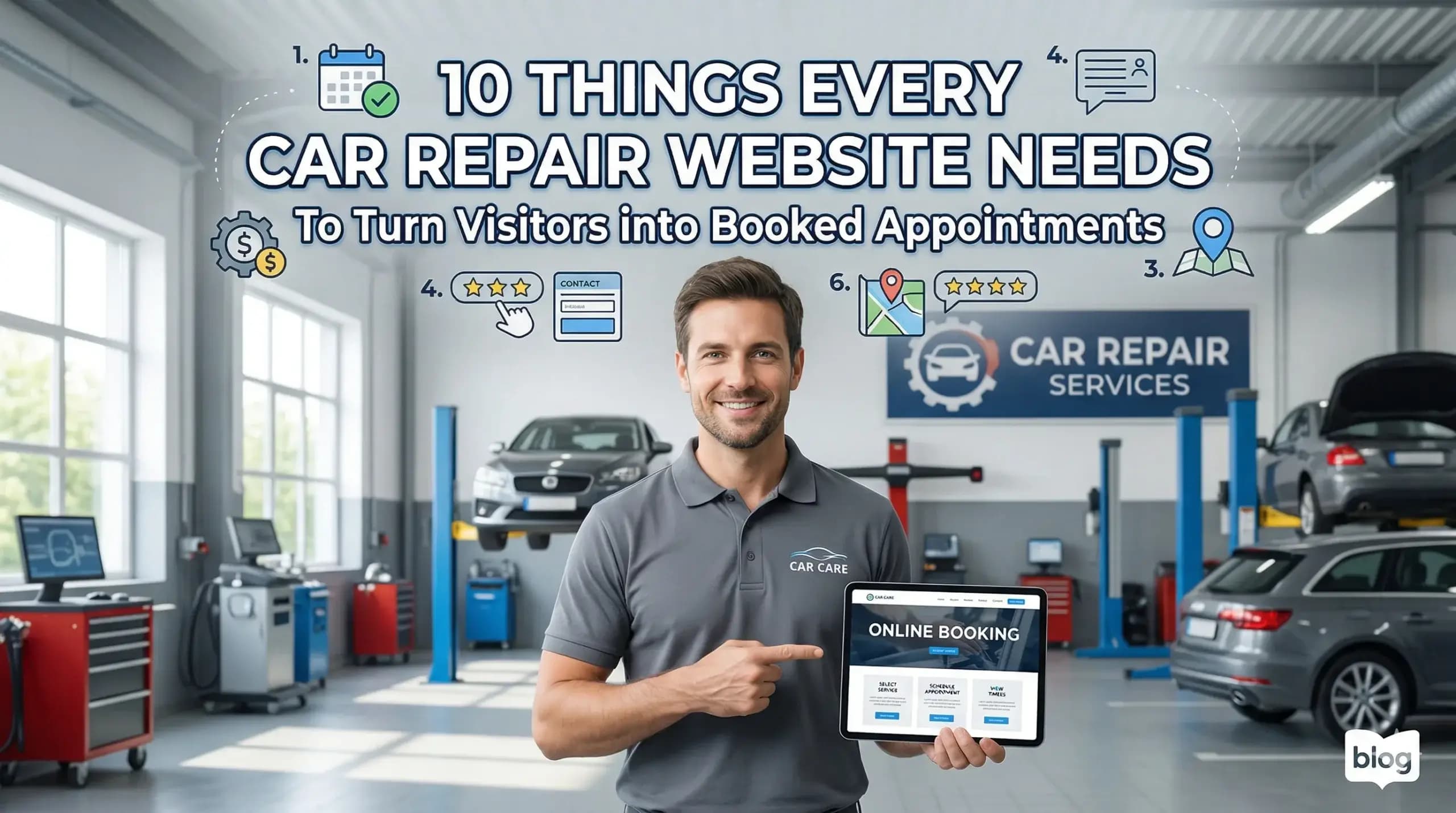
10 Things Every Car Repair Website Needs to Turn Visitors into Booked Appointments
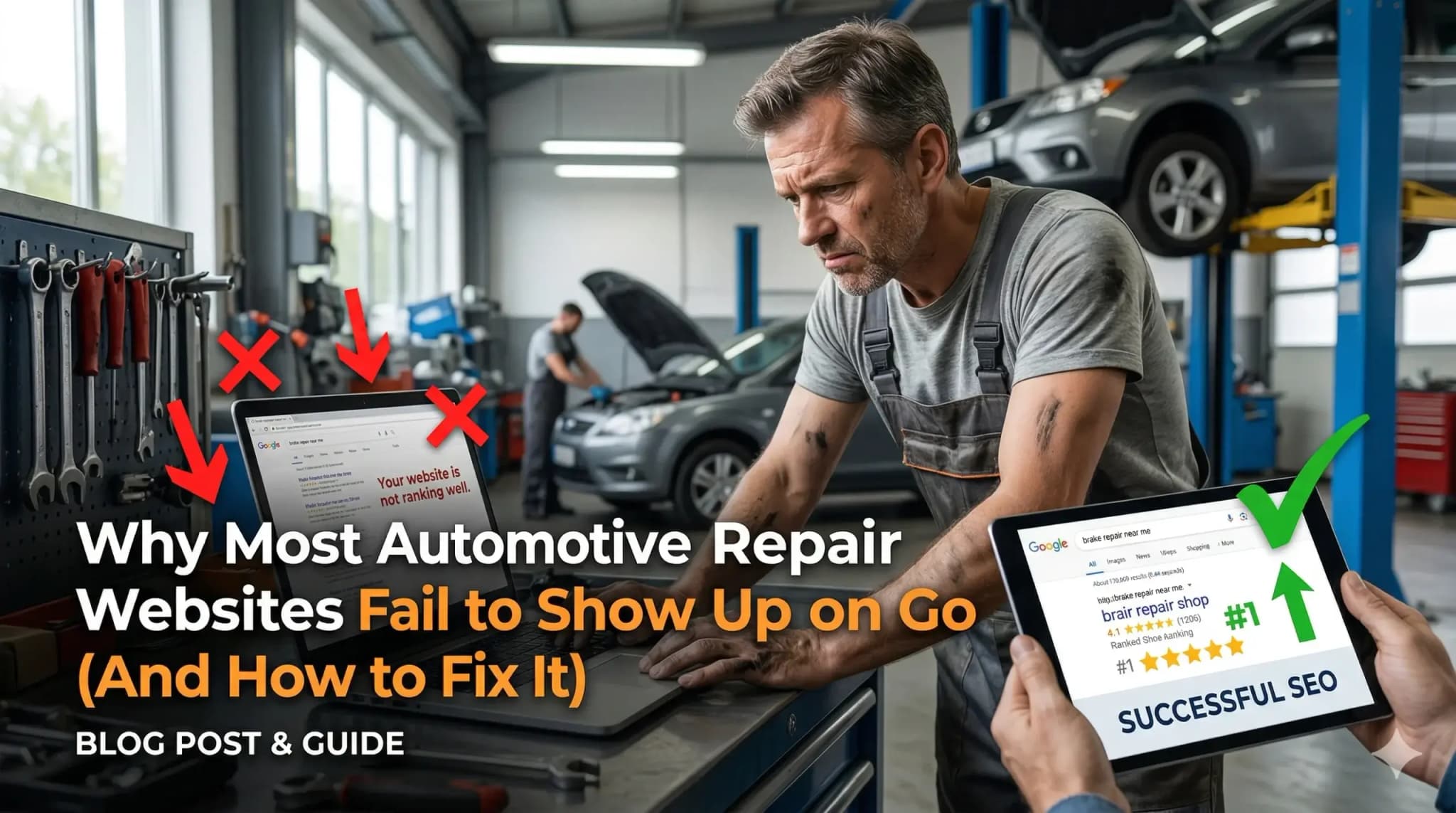
You built a reputation as a great mechanic — word of mouth has kept your bays busy for years. But lately, you’ve noticed something: people are searching for auto repair near them online, and your phone isn’t ringing the way it should. Your website is up. Your business is listed. So why aren’t they calling?
The honest answer most shop owners don’t want to hear: your website might be sending customers straight to your competitor down the street — without you even knowing it.
Most auto repair websites were built to look professional, not to work professionally. There’s a big difference. A good-looking site that loads slowly, buries your phone number, or doesn’t show up in search results is as useless as a shop with no sign on the door.
This article breaks down the 10 things your auto repair website actually needs to turn visitors into booked appointments — written for shop owners, not web developers.
1. A Phone Number That’s Impossible to Miss
The problem: A customer pulls over, searches “brake repair near me,” clicks your site — and has to hunt for your phone number. They give up in 10 seconds and call the next result.
Why it happens: Most website templates bury contact info in a footer or “Contact” page. Designers think it looks cleaner. It costs you calls.
What to do instead: Your phone number should be clickable (tap-to-call), large, and visible at the very top of every single page — not just the homepage. On mobile, this is non-negotiable.
The best auto repair websites put the phone number in the header so it’s always visible, no matter where on the site a visitor lands.
2. A Site That Loads in Under 3 Seconds
The problem: Your site takes 6–8 seconds to fully load. By second 4, more than half your visitors are already gone — and they never saw your phone number.
Why it happens: Old websites often have oversized images, outdated code, or cheap hosting that can’t handle traffic. Every extra second of load time costs you real customers.
The real cost: Think of it this way — if your shop door took 7 seconds to open every time a customer walked up, most people would just walk to the next shop. That’s exactly what a slow website does.
Digital Trace builds websites for auto repair businesses on fast, optimized infrastructure — because speed isn’t a feature, it’s the foundation.
3. A Mobile-First Design (Not Just “Mobile Friendly”)
The problem: More than 60% of local searches happen on a phone. If your site is hard to navigate on mobile — tiny buttons, text that requires pinching to read, menus that don’t work — those visitors leave without calling.
Why it happens: Older websites were built for desktop screens and then shrunk down to fit phones. That’s not the same as being designed for mobile.
What the difference looks like:
- Large tap-friendly buttons (especially “Call Now” and “Book Appointment”)
- Text that’s readable without zooming
- Services listed in a way that’s easy to scroll through on a small screen
- No pop-ups that block the entire screen
4. A Clear List of Your Services (With Real Detail)
The problem: Your website says “Auto Repair” and lists: oil changes, brakes, tires. That’s it. Google doesn’t know enough about you to show your site when someone searches “radiator flush near me” or “transmission repair [your city].”
Why it happens: Most shop owners think a general services list is enough. It’s not — for Google or for customers.
What to do instead: Create a dedicated page (or at minimum a detailed section) for each major service. Describe what the service includes, why it matters, and what signs mean a car needs it. This is what helps you show up for specific searches — and it builds trust with customers who are already nervous about repair costs.
5. Reviews That Show Up Where It Counts
The problem: You have 80 five-star Google reviews. A potential customer visits your website and sees… nothing. No reviews, no trust signals, no reason to choose you over the shop a mile away.
Why it happens: Reviews live on Google or Yelp, but most websites don’t pull them in or display them prominently.
What to do instead: Embed your best reviews directly on your homepage and service pages. Better yet, add a review count badge and a direct link to your Google listing. Customers making repair decisions — often when stressed and pressed for time — want immediate reassurance that you’re trustworthy.
💡 Pro Tip: One of the most common mistakes auto repair shops make is hiding their Google rating from their website visitors. If someone lands on your site after searching online, they haven’t seen your Google listing yet — they don’t know you have 4.9 stars unless you tell them. Display your star rating prominently above the fold on your homepage. The technical fix is simple: embed a live Google review widget or use a review schema that shows your rating in search results directly.
6. A Google Business Profile That Matches Your Website
The problem: A customer searches for you, finds your Google listing, clicks through to your website — and the phone number, address, or hours don’t match what’s on the site. Instantly, trust is broken. Some customers think it’s a scam. Others just get confused and leave.
Why it happens: Hours change, phones get updated, someone edits one place but not the other. It happens constantly.
What to do instead: Your Name, Address, and Phone number (NAP) must be identical across your website, Google Business Profile, Yelp, and any other directory. This also helps Google understand your business is real and established — which directly affects how often you show up in local search results.
7. A “Book an Appointment” Option That Actually Works
The problem: A customer is ready to book at 9 PM. Your website has no way to do that. They’re not going to call and leave a voicemail. They move on.
Why it happens: Many shop owners skip online booking because it seems complicated to set up, or they worry about no-shows.
The real cost: You’re losing every customer who researches shops outside business hours — and that’s a bigger slice of your market than you might think. A simple booking form or integration with a tool like Appointy or Google’s booking feature can capture those leads automatically.
8. A Website That Google Can Actually Read
The problem: Your competitor’s website shows up right at the top of Google when someone searches “oil change [your city].” Yours is on page three. You both offer the same services. Why?
Why it happens: Google reads websites differently than humans do. If your site isn’t structured correctly — with proper page titles, header tags, and location information — Google doesn’t know where to rank you or for what searches.
In plain terms: Imagine sending a car to a diagnostic test with all the sensors disconnected. The technician can’t get any reading. That’s what your website is like to Google if it’s not set up right — Google can’t get a clear signal about who you are, where you are, or what you do.
Mechanic website design done right means Google gets a clear, consistent signal — which is what gets you ranked above your competitors.
9. Real Photos of Your Shop and Team
The problem: Your website uses stock photos — generic cars on lifts, smiling people who’ve never held a wrench. Customers notice. It makes your business feel impersonal and harder to trust.
Why it happens: Stock photos are easy. Real photos take effort.
Why real photos convert better:
- They show customers what to expect when they walk in
- They build a personal connection before the first phone call
- They reassure customers that your shop is clean, professional, and real
- They differentiate you from every other shop using the same Shutterstock images
Even a handful of good smartphone photos of your team, your bays, and your equipment will outperform any stock image library.
10. A Website That’s Set Up to Convert — Not Just Inform
The problem: Someone visits your site, reads your services, looks at your location — and then just… leaves. No call, no form, no booking. They weren’t pushed to do anything.
Why it happens: Most auto repair websites are built like brochures. They share information but never tell the visitor what to do next.
What the best auto repair websites do differently:
- Every page has a clear, single call to action (“Call Now,” “Book Your Appointment,” “Get a Free Estimate”)
- CTAs are visible without scrolling
- The site makes it feel easy and low-risk to reach out
- There’s a sense of urgency without being pushy (limited same-day slots, fast turnaround messaging, etc.)
A website that doesn’t guide visitors toward action is like a service advisor who walks a customer to the car, explains everything that’s wrong — and then says nothing when the customer starts heading for the door.
Real-World Example: From Ghost Town to Fully Booked
Consider a transmission and general repair shop in the Phoenix metro area. They’d been in business for 11 years, had strong word of mouth, and a decent Google rating. But their website was built in 2017, loaded slowly on mobile, had no online booking, and didn’t rank for a single local search term beyond their own business name.
After a full website redesign — optimized for speed, built with service-specific pages for their top 8 repair categories, and integrated with a simple online booking form — the results shifted quickly. Within 90 days, the site ranked on the first page for five local search terms. Organic phone calls from the website more than doubled. And for the first time, they were getting appointment requests submitted overnight that were ready to confirm first thing in the morning.
The shop didn’t change what it did. They just stopped being invisible.
Not sure if your auto repair website has these issues? Get a free website audit — no obligation, just a clear picture of what’s costing you leads.
Your Path to More Leads: 5 Steps to Get Started
- Check your site on your phone right now. Is your number easy to tap? Does it load fast? If not, that’s your first problem to fix.
- Google your own business. Search “auto repair [your city]” and see where you appear — or don’t.
- Count your calls from the website. If you don’t know how many calls or form submissions your site generates each month, you have no way to know if it’s working.
- List every service you offer. Make sure each one has its own section or page on your site with real detail.
- Talk to a team that knows the auto repair industry. A generic web agency will build you a generic site. You need someone who understands how your customers think and what makes them pick up the phone.
Frequently Asked Questions
Why am I not getting calls from my website even though I have one?
Having a website and having a website that works are two very different things. If your site is slow, not showing up in search results, or doesn’t clearly direct visitors to call or book — you’ll get traffic that goes nowhere. The fix usually starts with understanding exactly where in that process you’re losing people.
How do I know if my auto repair website is actually working?
If you can’t answer “how many phone calls or form submissions did my website generate last month” — it’s probably not working as hard as it should be. A properly set up site tracks calls, form fills, and appointment requests so you know exactly what’s coming from your web presence.
How long does it take to see results from a new website?
Most auto repair shops start seeing measurable improvements in local search visibility within 60–90 days of launching a properly optimized site. That said, some quick wins — like mobile usability, tap-to-call buttons, and faster load times — can start converting better visitors almost immediately.
What makes an auto repair website different from a regular business website?
Your customers are usually stressed, in a hurry, and making a decision they don’t fully understand. That means your site needs to do three things fast: build trust, answer their immediate question (do you fix what I need?), and make it dead simple to reach you. A generic website template doesn’t account for any of that.
Do I really need a fast website if all my customers are local?
Especially local. When someone’s car is making a noise and they’re searching on their phone from a parking lot, they’re not going to wait for a slow site. They’ll tap back and call your competitor. Speed matters more for local businesses because the decision to call happens in seconds.
How do I know if my website is costing me leads right now?
The easiest starting point is a professional audit. Book a free website audit with Digital Trace and you’ll get a clear, plain-English breakdown of exactly what’s working, what isn’t, and what it’s costing you in missed calls and bookings.
Stop Leaving Appointments on the Table
Your reputation as a mechanic is built one honest job at a time. Your website should work just as hard.
If your site isn’t fast, easy to navigate, showing up in local search, and designed to turn visitors into calls — it’s not just underperforming. It’s actively losing you revenue every single day.
A proper auto repair website isn’t a luxury. It’s the difference between a full schedule and empty bays.
Get your free website audit today — no jargon, no pressure, just a clear look at exactly what your website is doing (and what it’s costing you). Auto repair shop owners across the US are surprised by what a 30-minute review uncovers.
You’ve already built a shop worth recommending. Let’s make sure your website reflects that.