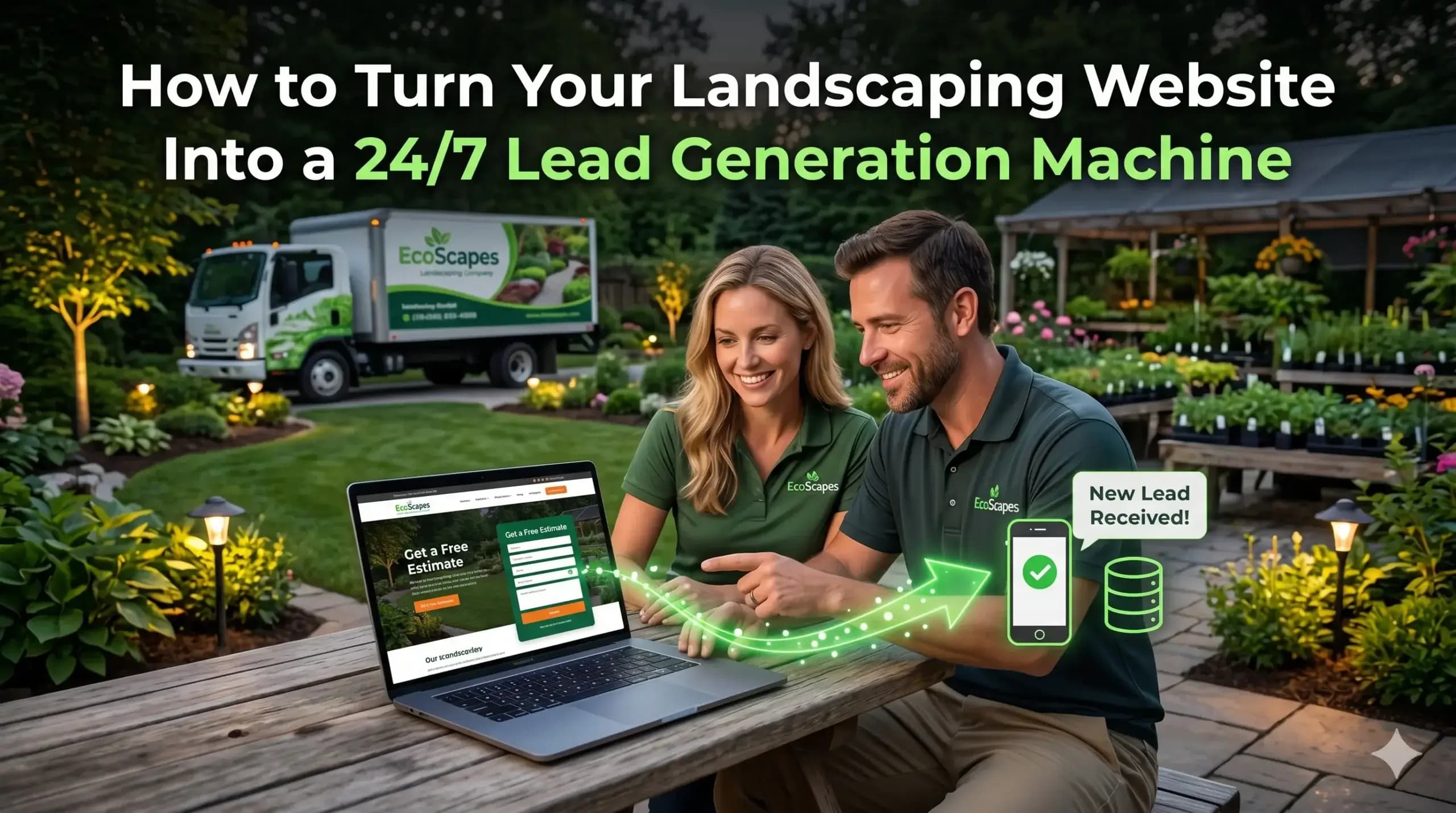
How to Turn Your Landscaping Website Into a 24/7 Lead Generation Machine
You finished a job today. The lawn looks immaculate. The client is thrilled. And somewhere across town, a homeowner searched “landscaping company near me” — found your competitor — and booked a consultation.
Your phone never rang.
That’s the quiet problem most landscaping business owners don’t see coming. They assume their website is “fine.” It loads. It has photos. It has a phone number somewhere. But fine doesn’t fill your schedule — and fine definitely doesn’t close jobs while you’re on the mower.
Most landscaping websites aren’t broken. They’re just passive. They sit there and wait, instead of actively capturing every person who lands on them.
This guide walks you through exactly what separates a landscaping website that generates calls every week from one that just exists on the internet — and what you can do about it.
Your Website Is Your Best Salesperson (But Yours Might Be Calling in Sick)
Think about your best crew member. They know the services, they know how to talk to customers, they show up on time, and they close the job. Now imagine that person showed up to a consultation looking disheveled, speaking in circles, and handing out a business card from 2018.
That’s what a slow, outdated, poorly designed landscaping website does every time someone visits it.
The average homeowner looking for a landscaping company makes their decision fast — sometimes within 30 seconds of landing on a site. If your site doesn’t immediately communicate what you do, where you work, and why you’re trustworthy, they leave. Quietly. Without calling.
Digital Trace builds websites for landscaping businesses that are designed from the ground up to do one thing: turn visitors into leads. Not just look good — convert.
Why Your Phone Isn’t Ringing (Even If You’re Getting Traffic)
Traffic without conversions is the most common — and most frustrating — problem landscaping business owners face online.
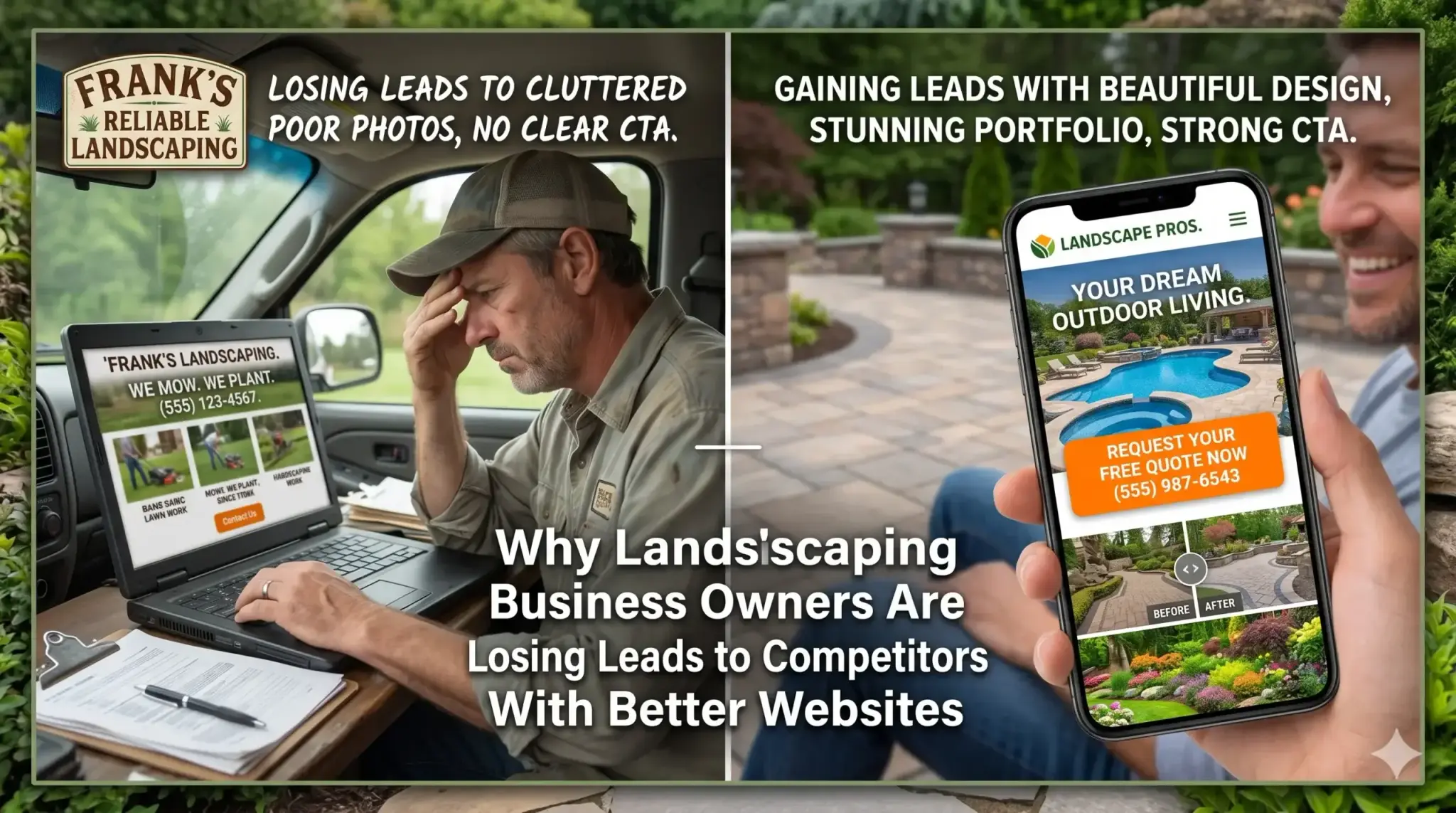
Here’s what’s actually happening: someone finds your site, clicks through, and then… nothing clicks. No urgency. No clear next step. No reason to call you instead of the three other companies they’re browsing.
The most common reasons visitors leave without contacting you:
- No clear call-to-action above the fold. Your phone number is buried. The visitor has to scroll to find it.
- Generic service descriptions. “We offer lawn care, landscaping, and more” tells a homeowner nothing. They want to know you serve their area, understand their specific needs, and have done work like theirs.
- No social proof up front. Reviews, photos of real jobs, and recognizable service areas build trust instantly — but most landscaping websites hide them at the bottom.
- A contact form that feels like paperwork. Long forms kill momentum. Most people will close the tab before filling out eight fields.
Every one of these issues is fixable. But you can’t fix what you can’t see.
The Speed Problem: You’re Losing Customers in 3 Seconds
Here’s something most people don’t realize: your website’s loading speed directly affects how many calls you get.
Not in a vague “user experience” way. In a very real, measurable way.
If your landscaping website takes more than 3 seconds to load on a phone, most visitors leave before they ever see your services, your photos, or your phone number. They don’t wait. They just hit the back button and call your competitor.
And here’s the kicker — a slow site also hurts where you show up in Google. Google measures load speed as part of how it ranks websites. So a slow site doesn’t just lose the visitors it gets — it gets fewer visitors to begin with.
The fix isn’t complicated, but it requires someone who knows what they’re doing: optimized images, clean code, fast hosting, and proper technical setup. These aren’t things a DIY website builder handles automatically.
Google Can’t Recommend You If It Doesn’t Know Who You Are
Imagine a local real estate agent who never hands out business cards, doesn’t list their name with the MLS, and operates entirely by word of mouth. They’d get some business — but they’d miss the vast majority of people looking to buy or sell.
Your landscaping website has the same problem if it’s missing what’s called local SEO signals.
Google is essentially a matchmaker. It’s trying to connect homeowners who need landscaping services with businesses that can help them. But if your website doesn’t clearly tell Google what you do, where you do it, and that you’re a legitimate, active business — Google won’t confidently send people your way.
What this looks like in practice:
- Your service areas aren’t clearly listed on your site (not just in your footer — in your content).
- Your Google Business Profile isn’t connected or optimized to work alongside your website.
- Your site has no structured data — a behind-the-scenes signal that helps Google understand your business type, services, and location without guessing.
This is one of the most common places landscaping companies lose leads without ever knowing it. Fixing it means more visibility in local searches — without running a single ad.
💡 Pro Tip
One of the most overlooked mistakes in lawn care web design is having a beautiful site that’s completely invisible in local searches. This usually happens because the website was built without service area pages. If you serve five towns but only mention your main city once, Google treats you as a one-town operation. The fix is simple: create a dedicated page for each major area you serve, with real content about the services you offer there — not copy-paste filler. This alone can significantly expand where your site shows up in local results.
What a Landscaping Website That Actually Works Looks Like
The best landscaping websites aren’t necessarily the flashiest. They’re the ones that are built around how a homeowner actually decides who to hire.
Here’s what a high-converting landscaping business website does:
- Loads fast on mobile. Most searches happen on phones. If your site isn’t mobile-first, you’re losing more than half your potential leads.
- Shows the work, not just the words. Real photos of real jobs. Before and afters. Specifics. Homeowners buy with their eyes.
- Makes contacting you frictionless. One tap to call. A short, simple form. A clear offer (free estimate, free consultation) right at the top.
- Builds trust immediately. Reviews, years in business, service areas, certifications — all visible without scrolling.
- Ranks in your target cities. Service area pages, locally-optimized content, and proper Google Business integration all work together.
Real Scenario: From Invisible to Booked Out
A landscaping company in the Midwest had been in business for nine years. Solid reputation. Mostly repeat clients and referrals. But new customer growth had stalled. They had a website — had for years — but it was built on a free template, loaded slowly on mobile, and hadn’t been updated since they added two new services.
The core problems: their site wasn’t showing up for searches in two of their most profitable service areas, they had no online reviews displayed anywhere on the site, and their contact form had seven required fields. Most mobile visitors bounced in under 15 seconds.
After rebuilding the site with proper local SEO structure, fast mobile performance, streamlined contact options, and dedicated pages for each of their five service areas — the results were tangible within 90 days. Inbound calls from new customers more than doubled. Their average monthly new leads went from 4–5 to 18–22. Their busiest season became their most profitable ever — not because they advertised more, but because their website finally did the work it was supposed to.
Not sure if your landscaping website has these issues? Get a free website audit — no obligation, just a clear picture of what’s costing you leads.
Your Path to More Leads: 5 Steps That Actually Move the Needle
You don’t need to overhaul everything overnight. Start here:
- Test your site on your phone. Pull it up on your personal smartphone, not your desktop. Does it load quickly? Is your phone number easy to tap? If you’re wincing, your customers are leaving.
- Check where you show up in Google. Search “landscaping company [your city]” from an incognito window. If you’re not on the first page, most people will never find you organically.
- Count your conversion points. How many places on your homepage can someone contact you? If it’s fewer than three, you’re making people work too hard to hire you.
- Look at your photos. Stock images and old project photos won’t win anyone over. Real, high-quality photos of your actual work are one of the highest-converting elements on any landscaping website.
- Get an expert set of eyes on it. Most landscaping business owners can’t see the technical issues killing their lead flow — because those issues are invisible to the naked eye. A professional audit surfaces them fast.
Frequently Asked Questions
Why am I not getting calls even though I have a website?
Having a website and having a website that generates leads are two very different things. Most landscaping websites are built to look good — not to convert visitors into callers. Issues like slow load times, buried contact info, no local SEO, and weak calls-to-action silently cost you leads every single day without showing any obvious symptoms.
How do I know if my landscaping website is actually working?
If you can’t point to specific calls or form submissions that came directly from your website each month, it’s probably not working as hard as it should be. A proper website audit will show you exactly how many people are visiting, where they’re dropping off, and what’s preventing them from contacting you. Book a free review here.
How long does it take to see results from a new landscaping website?
A well-built website can start generating leads within weeks for people already searching for landscaping services. Local SEO results — ranking for searches in your service areas — typically build over 60–120 days. The businesses that see results fastest are the ones that get both the technical foundation and the local content strategy right from the start.
What makes a landscaping website different from a regular business website?
A landscaping business lives and dies by local trust and visual proof. Your website needs to show homeowners that you work in their neighborhood, that your work looks great, and that booking you is easy. That’s a very specific combination of local SEO, project photography, service area structure, and conversion design that a generic website builder simply doesn’t account for.
Do I really need a fast website if my customers are local?
Especially if your customers are local. Most homeowners search on their phones — often in the moment, between errands, or when they’re standing in their yard frustrated with their lawn. If your site doesn’t load in 2–3 seconds on a phone, they’re already calling someone else. Speed is one of the most direct links between your website and your phone ringing.
I’ve worked with agencies before and didn’t see results. Why would this be different?
That’s a fair concern — and it’s one Digital Trace hears often. The difference is in the specificity. Most agencies build websites. Digital Trace builds websites specifically for landscaping businesses, with a focus on local lead generation from day one. The audit process also means you’ll know exactly what the problems are before any work begins — no vague promises.
Ready to Stop Losing Leads You Should Be Getting?
Every week your current website sits there underperforming, it’s handing jobs to your competitors. Not because they’re better at landscaping — but because their website does a better job of converting visitors into customers.
A free website audit from Digital Trace will show you exactly where your landscaping website is losing leads, why it’s not ranking where it should, and what a high-converting site would look like for your specific business.
No pressure. No sales pitch. Just a clear, honest look at what’s costing you.