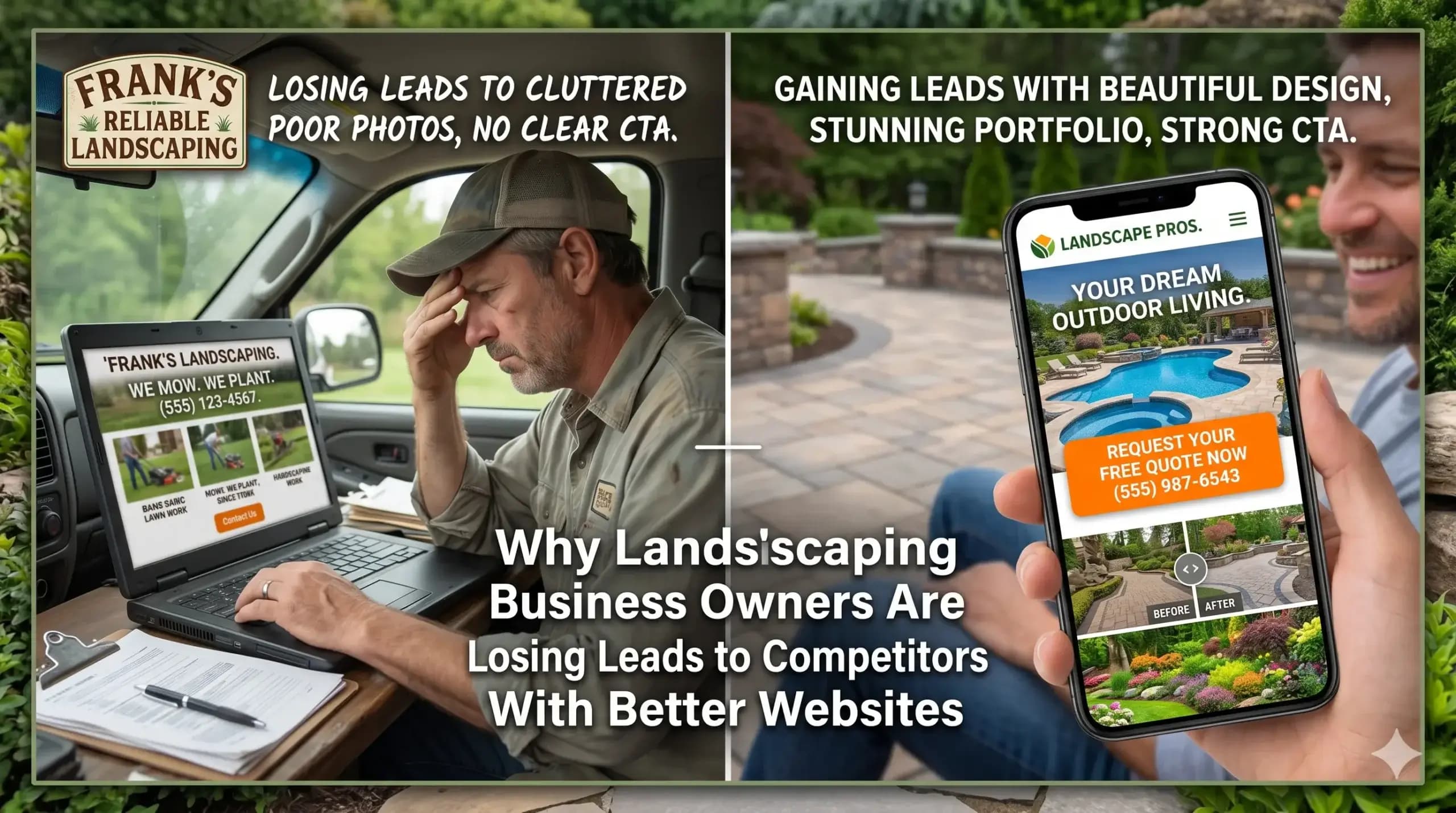
Why Landscaping Business Owners Are Losing Leads to Competitors With Better Websites
You’ve built a real business. You show up on time, your crews do clean work, and your customers refer you to their neighbors. But your phone isn’t ringing the way it should be — and somewhere across town, a competitor with half your experience is booked out six weeks.
The difference isn’t their crew. It’s their website.
Most landscaping business owners assume leads come from word of mouth and Google Maps. And they do — but only if your website does its job when someone actually clicks on you. A weak website quietly filters out potential customers before they ever call. They land on your page, look around for three seconds, and leave. No call. No form fill. Just gone.
Here are 7 signs your landscaping website is costing you jobs — and what to do about each one before your competition gets further ahead.
Sign #1: Your Website Loads Like It’s Running on Dial-Up
Picture this: a homeowner is sitting in their car after work, phone in hand, searching for a landscaping company to redo their backyard before summer. They tap your link. It spins. And spins. They close it and tap the next result.
That’s not a hypothetical. It happens to slow websites hundreds of times a day.
Most people will abandon a site that takes more than 3 seconds to load — and on mobile, that window is even shorter. Your site might look fine to you because you’ve seen it before and it’s cached on your device. First-time visitors get the full slow experience.
What’s usually causing it:
- Uncompressed photos (landscaping sites are image-heavy — this is the #1 culprit)
- Cheap hosting that can’t handle traffic
- Bloated page builders loaded with code your site doesn’t need
What Digital Trace does instead: Every landscaping company website they build is optimized for speed from the ground up — compressed images, fast hosting, and clean code that doesn’t drag.
Sign #2: Your Site Looks Wrong on a Phone
More than 60% of local service searches happen on mobile. If your website looks fine on a desktop but breaks apart on an iPhone — buttons that are too small to tap, text that runs off the screen, photos that stack weirdly — you’re losing the majority of people who find you.
This isn’t about aesthetics. It’s about whether someone can actually read your services and find your phone number without pinching and zooming.
Ask yourself: Can someone visiting your site on their phone call you in under 10 seconds without scrolling?
If the answer is no, you’re losing calls every single day.
Sign #3: You Don’t Show Up When People Search for What You Do
A homeowner in your area types “lawn care company near me” or “landscaping services in [your city].” Your competitor shows up. You don’t.
This isn’t random. Google makes a judgment call about which sites to show based on how your website is built, what it says, and whether it’s set up to signal what your business does and where you serve.
Most landscaping websites are missing the basics:
- No location-specific service pages (one generic “Services” page doesn’t cut it)
- No Google Business Profile connected to a properly optimized site
- Missing behind-the-scenes signals that tell Google what your business does
Think of it like this: if your equipment shows up to a job site with no signage, no uniforms, and no clear indication of who you are — the homeowner’s neighbors won’t know who to call. Your website works the same way. Google needs clear signals to confidently put you in front of people searching for what you do.
Sign #4: Visitors Land on Your Site and Have No Idea What to Do Next
Someone finds your website. They look at it. They leave.
Not because they didn’t need landscaping. Not because your prices were wrong. Because your site gave them no clear next step.
The best landscaping websites are built around one goal: getting the visitor to contact you. Everything on the page — the layout, the buttons, the images — guides them toward that action.
A weak landscaping website has:
- No visible phone number above the fold (you have to scroll to find it)
- A contact form buried at the bottom
- Generic calls-to-action like “Learn More” instead of “Get a Free Estimate”
- A homepage that talks about your company history instead of the customer’s problem
What works instead: A clear headline that speaks to what the homeowner wants (“Transform Your Yard — Without the Hassle”), a visible phone number at the top, and a single strong call-to-action they can’t miss.
Sign #5: Your Photos Don’t Show What You’re Actually Capable Of
Landscaping is a visual business. A homeowner deciding between you and three competitors is going to make that call partly based on what they see. If your website has blurry before/after photos, generic stock images of yards that aren’t yours, or no project gallery at all — you’re leaving trust on the table.
Your work is your portfolio. If it’s not front and center on your site, you’re asking people to take your word for it — and most won’t.
What strong landscaping websites do: They lead with real project photos, organized by service type (lawn care, hardscaping, irrigation, seasonal cleanups). Visitors can see exactly what they’d be getting.
💡 Pro Tip: Your Contact Form May Be Broken and You Don’t Know It
One of the most common — and costly — mistakes on landscaping websites is a contact form that silently fails. Submissions go nowhere. The homeowner thinks they reached out. You never got the message. Both of you move on.
Test your own form right now. Submit a message and see if it arrives. Also check that form submissions send to an email you actually monitor — not an old address you forgot to update. Digital Trace tests every contact point on every site they build, because a form that doesn’t work is worse than no form at all.
Sign #6: Google Doesn’t Know Enough About Your Business to Recommend It
There’s a hidden layer on every website that Google reads — information that tells it what your business does, where you serve, what services you offer, and whether you’re a legitimate local company worth recommending.
Most landscaping websites are missing this entirely. It’s not visible to your customers, but it matters to Google.
Without it, Google treats your site like an unknown: it exists, but there’s not enough context to confidently put it in front of someone searching for landscaping in your area.
The fix isn’t complicated — it’s about making sure your site is set up with the right structure so Google has what it needs. The websites Digital Trace builds for landscaping companies include this from day one, so Google can understand and rank them without months of guesswork.
Sign #7: Your Site Looks Like It Was Built in 2014
Design trends in web aren’t about aesthetics for the sake of it. An outdated site signals to a visitor — consciously or not — that your business might be similarly behind. If your homepage has small cluttered text, a dated color scheme, rotating banner slideshows, or a layout that looks like a template from a decade ago, visitors make a snap judgment.
You have about 3–5 seconds to create a first impression. An outdated landscaping website wastes that window.
The best landscaping websites today are clean, fast, modern, and built around what customers actually care about: seeing your work, understanding your services, and knowing how to reach you.
Before and After: What a Better Website Actually Does
A mid-size landscaping company in the Southeast — a two-crew operation focused on residential lawn care and seasonal cleanups — was getting steady referrals but almost no leads from their website. They had a site, but it was slow, looked cramped on mobile, and had no location-specific pages for the three cities they served.
After rebuilding their site with a focus on speed, mobile usability, local SEO structure, and clear calls-to-action:
- Their site went from taking 7+ seconds to load to under 2 seconds
- Contact form submissions increased within the first 60 days
- They started appearing in searches for multiple nearby cities, not just their home base
- By month three, they had booked enough new clients from the website alone to justify adding a third crew earlier than planned
The work didn’t change. The crews didn’t change. The website did.
Not sure if your landscaping website has these issues? Get a free website audit — no obligation, just a clear picture of what’s costing you leads.
Your Path to More Leads: 5 Steps That Actually Move the Needle
You don’t need to understand web development to fix what’s broken. Here’s what the process looks like:
- Find out what’s actually wrong. A free audit identifies the specific problems on your current site — speed, mobile issues, SEO gaps, conversion problems. You can’t fix what you don’t know about.
- Prioritize the biggest revenue leaks first. Not everything needs to be rebuilt at once. Start with the issues costing you the most leads right now — usually speed and mobile usability.
- Build (or rebuild) around your customer, not your company. The goal of your website is to get a visitor to contact you. Every element should serve that goal.
- Make Google your business development partner. With the right structure, your site works around the clock — putting you in front of homeowners actively searching for landscaping help in your area.
- Track what’s working. A properly set-up site tells you where visitors come from, what they look at, and where they drop off. That data helps you improve over time instead of guessing.
Frequently Asked Questions
Why am I not getting calls from my website even though I have one?
Having a website and having a website that generates leads are two different things. Most landscaping sites exist but aren’t built to convert visitors into callers. Common culprits: slow load times, no clear call-to-action, hard-to-find contact info, and no local SEO setup. Get a free audit to see exactly what’s blocking calls on your site.
How do I know if my landscaping website is actually working?
If you can’t tell you where your website visitors are coming from, how many people visit each month, or how many of them contact you — your site isn’t set up to track that. A working landscaping website has analytics, clear conversion paths, and ideally shows up in Google searches for your service areas. If none of that sounds familiar, it’s worth getting a professional eye on it.
How long does it take to see results from a new landscaping website?
Some improvements — like a better mobile layout and faster load time — show results almost immediately in terms of user experience and form submissions. SEO results, where your site ranks in Google searches, typically start showing meaningful movement within 60–120 days. It’s not instant, but it compounds over time. A well-built site keeps working for you long after the initial investment.
What makes a landscaping website different from a regular business website?
Landscaping is a high-visual, locally-driven, and seasonally urgent business. Your website needs to lead with stunning project photos, speak to local homeowners by service area, and make it effortless to request an estimate. It also needs to rank for the specific services you offer — lawn care, hardscaping, irrigation, cleanups — not just “landscaping” in general. Generic websites built for “any small business” miss all of that.
Do I really need a fast website if most of my customers are local and find me through referrals?
Referrals are great — but they check your website before they call. Even a customer referred by a neighbor will often Google you first to see your work and confirm you’re legit. If they land on a slow, outdated site, some of them will quietly move on. A fast, professional site closes the referral loop instead of breaking it.
My competitor seems to get more jobs even though I do better work. Could their website really be the reason?
Probably yes — at least in part. If their site loads faster, shows up higher in search results, and makes it easier to request a quote, they’re capturing people who never even got a chance to find out how good your work is. Quality of work matters enormously once someone hires you. But a better website gets them in the door first.
Stop Leaving Jobs on the Table
Your website should be working as hard as your crew — finding potential customers, building trust before anyone picks up the phone, and making it easy for a homeowner to choose you over the competition.
Most landscaping websites aren’t doing that. They’re sitting there passively while better-built competitors take the calls.
The good news: these problems are fixable. You don’t need to start from scratch necessarily — but you do need to know exactly what’s broken before you can fix it.
Book a free website audit with Digital Trace — we’ll look at your landscaping website, identify exactly what’s costing you leads, and give you a clear picture of what a better site could mean for your business. No obligation. No jargon. Just real answers.