How Top-Performing MedSpas Use Their Website to Book More Consultations
You invested in your space, your equipment, your staff. Clients who walk through your door almost always book again. So why does your website feel like a waiting room that nobody visits?
Most MedSpa owners assume the problem is advertising — that they just need to run more Google ads or post more on Instagram. But the real issue is usually the website itself. It’s not converting. Visitors land on it, look around for a few seconds, and leave without calling, without booking, without doing anything.
This guide breaks down exactly what separates a MedSpa website that books consultations from one that just exists. You’ll see the specific mistakes that quietly kill your lead flow, what top-performing MedSpas do instead, and how a smarter approach to med spa website design can turn your site into your best-performing front desk rep.
Your Website Is Open 24/7 — But Is It Actually Working?
Think of your website like a new front desk employee you hired and never trained. She shows up every day, greets every visitor, but has no idea how to answer questions, explain your services, or close a booking. Visitors get confused, feel uncertain, and walk out.
That’s what a poorly designed MedSpa website does. Visitors arrive from Google, a social post, or a friend’s referral — but the site gives them no clear reason to act. No obvious next step. No sense of trust or expertise. So they close the tab and call your competitor instead.
The fix isn’t more traffic. It’s making sure the traffic you already have actually turns into consultations.
The 5 Reasons Your MedSpa Website Isn’t Booking Consultations
1. Visitors Can’t Figure Out What to Do Next
The problem: A visitor lands on your site, scrolls through some photos, reads a few lines about your services — and then stares at the screen wondering what happens next. There’s no clear path to booking.
Why it happens: Most MedSpa websites are built around the owner’s vision of what looks good, not around what a potential client needs to feel confident enough to take action. The result is a beautiful-looking site with no real direction.
What it costs you: Every confused visitor is a lost consultation. If someone has to hunt for your phone number, your booking link, or even just confirmation that you offer the treatment they’re looking for, they won’t wait around.
What top-performing MedSpas do instead: Their sites are built with one job in mind — move the visitor from curious to booked. Every page has a single, clear call-to-action. The phone number is visible at the top of every page. A “Book a Consultation” button appears before the visitor even scrolls. Digital Trace designs medspa websites around this conversion path from day one.
2. Your Site Loads Too Slowly — and People Leave Before They Even See You
The problem: Most people visiting your site for the first time are doing it on a phone, often while in between tasks. If your site takes more than three seconds to load, most of them are already gone.
Why it happens: MedSpa websites often run on bloated page builders stuffed with oversized images, unnecessary plugins, and outdated code. Every extra second of load time costs you a percentage of your visitors — before they’ve seen a single word about your services.
What it costs you: Slow sites don’t just lose visitors — they rank lower on Google too. Speed is a direct ranking factor. So the same problem that’s driving visitors away is also making it harder for new ones to find you.
What top-performing MedSpas do instead: Their websites are technically optimized for speed — compressed images, clean code, fast hosting. They load quickly on mobile and desktop. Visitors see what they came for almost instantly, which keeps them engaged long enough to convert.
3. Google Doesn’t Know Enough About Your MedSpa to Show It Confidently
The problem: You search for your own MedSpa on Google and you barely show up. Or you show up for your business name, but not for phrases like “Botox consultation [your city]” or “best medspa near me.”
Why it happens: Your site isn’t giving Google the right signals. There’s no clear structure telling Google what treatments you offer, who you serve, or where you’re located. Without that structure, Google has no confidence in showing your site to someone searching for exactly what you do.
What it costs you: Your competitor — who may offer a nearly identical service — is showing up first because their site communicates more clearly with Google. You’re invisible to the people actively searching for what you provide right now.
What top-performing MedSpas do instead: Their sites are built with dedicated pages for each core service, clear geographic signals, and proper technical setup that tells Google exactly who they are and who they serve. It’s not magic — it’s structure. And it’s one of the first things Digital Trace addresses when building or auditing a MedSpa’s website.
4. Your Site Doesn’t Feel Premium — Even If Your Services Are
The problem: A potential client Googles you after getting a referral from a friend. They land on your site expecting to feel the same confidence they felt when their friend raved about you. Instead, they see a generic template, a stock photo of a smiling woman, and text that could belong to any MedSpa in the country.
Why it happens: Most MedSpa websites use the same off-the-shelf templates and the same borrowed language. There’s nothing specific, nothing distinctive, nothing that earns trust.
What it costs you: In the MedSpa world, trust is everything. Clients are considering putting their face — literally — in your hands. If your website doesn’t project quality and expertise, they won’t take the risk. They’ll go to the practice whose website made them feel confident.
What top-performing MedSpas do instead: They invest in a website that reflects the actual experience of walking through their door. Real photography. Specific treatment descriptions. Clear credentials. Patient-focused language that addresses real concerns — not generic spa-speak. The best med spa websites make visitors feel like they’ve already met the team before they pick up the phone.
5. Your Booking Process Has Too Much Friction
The problem: A motivated potential client is ready to book. She clicks the “Contact Us” button and lands on a form with twelve fields, or worse — just an email address. She closes the tab.
Why it happens: The booking process is usually an afterthought. The website was built to look good, not to make booking easy. Every extra step — every unnecessary field, every redirect, every delay — costs you a real person who was ready to become a client.
What it costs you: Friction at the booking stage is one of the most expensive problems a MedSpa website can have, because it happens at the exact moment you’ve already done everything right. The person found you, liked what they saw, and decided to act — and the site let them down at the finish line.
What top-performing MedSpas do instead: Their sites make booking effortless. A short, simple consultation request form. A click-to-call button that works on mobile. Sometimes an integrated calendar. The goal is to reduce the steps between “I’m interested” and “I’m booked” to as few as possible.
💡 Pro Tip: The Treatment Page Problem Most MedSpas Miss
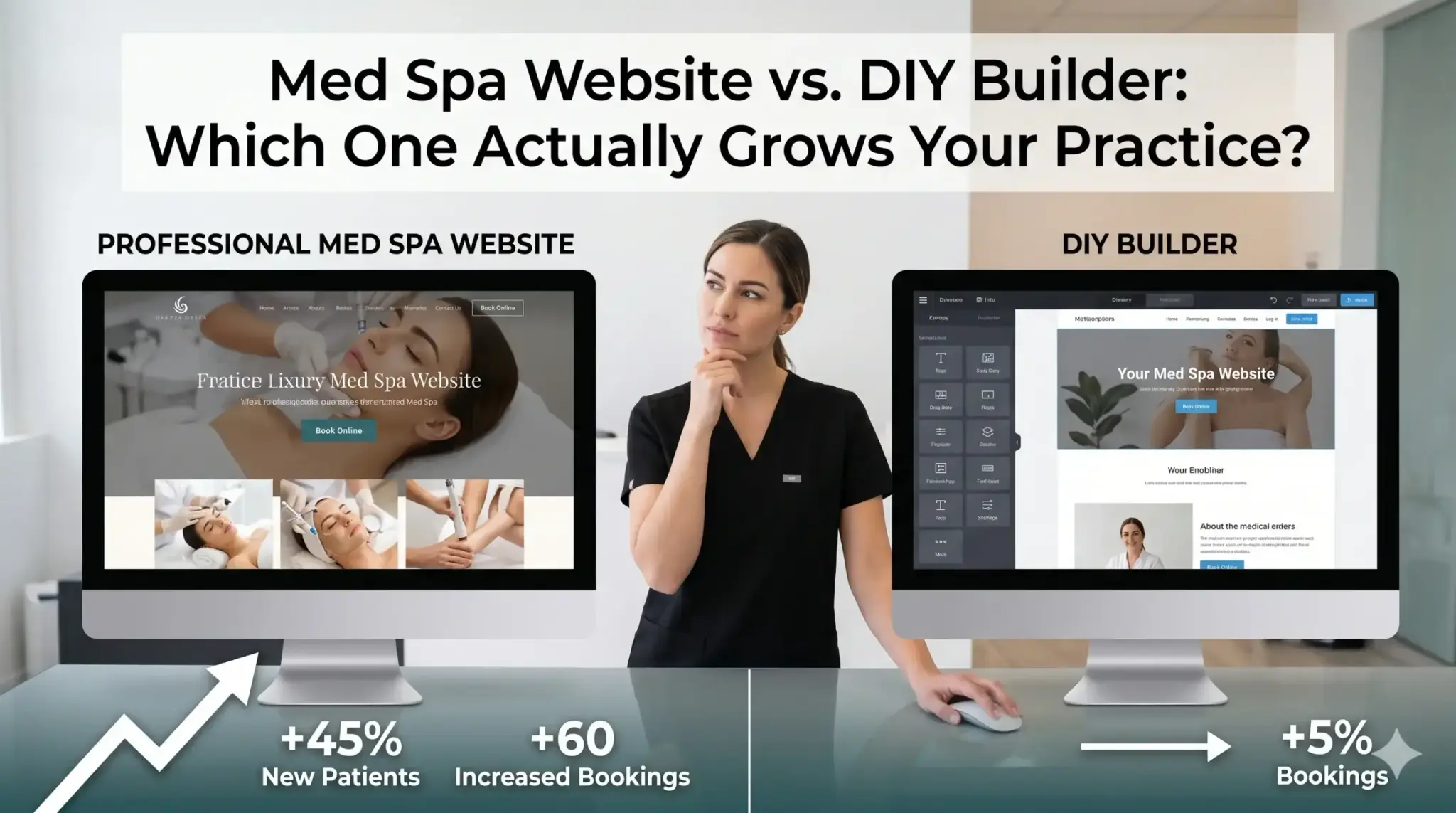
Many MedSpa websites have one generic “Services” page that lists every treatment in a single block of text. This is one of the most common and costly design mistakes in the industry.
When a potential client is researching a specific treatment — say, RF microneedling or lip filler — they want a dedicated page that answers their exact questions: How does it work? Who is it for? What should I expect? What does it cost?
A single catch-all services page can’t do that well. And because Google sees that page as general rather than specific, it won’t rank it for the specific treatment searches your clients are typing.
The fix is a separate page for each core treatment, written for both the client and Google. It takes more time to build, but it drives more qualified traffic — and converts that traffic at a much higher rate.
Real-World Results: What Changes When the Website Actually Works
A MedSpa in the Southeast had been open for three years and was doing solid in-person business, mostly through referrals and loyal returning clients. But their website was almost entirely invisible on Google — and the few visitors who did land on it were bouncing within seconds.
Their site had a common combination of problems: slow load times on mobile, a services page that listed everything in one dense paragraph, no clear call-to-action above the fold, and no location-specific content to signal their area to Google.
After rebuilding the site with dedicated treatment pages, a streamlined consultation form, fast hosting, and a proper local SEO structure, the results shifted noticeably within four months. Organic traffic from Google more than doubled. The consultation request form — previously almost unused — started generating multiple submissions per week. New client bookings from the website alone grew significantly, and for the first time, the site was ranking on page one for their core treatment keywords in their market.
None of it required more ad spend. The site just finally did its job.
Not sure if your MedSpa website has these same issues? Get a free website audit — no obligation, just a clear picture of what’s costing you leads.
Your Path to More Leads: 5 Steps to a MedSpa Website That Actually Converts
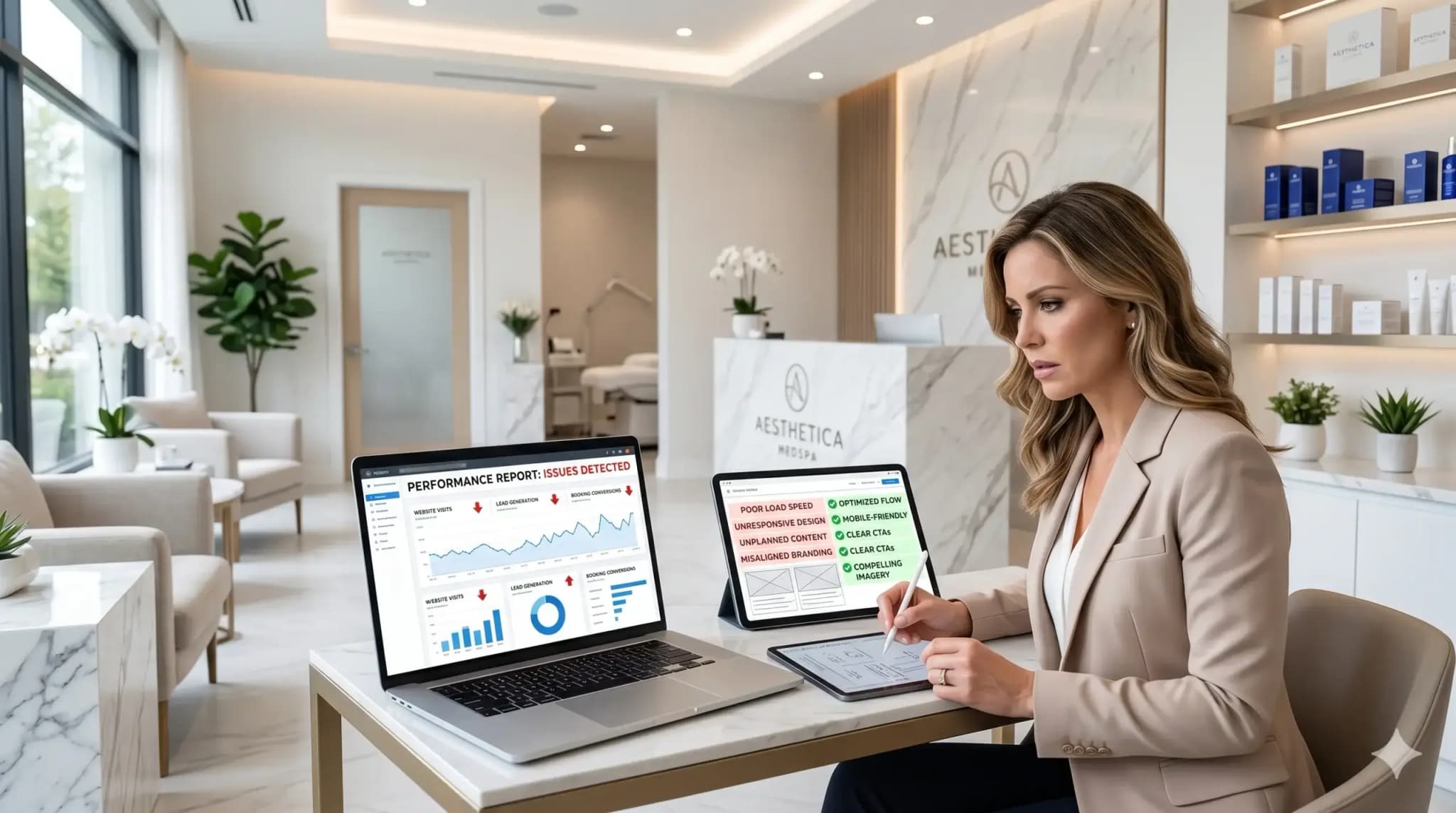
Step 1: Audit what you have. Before fixing anything, understand what’s broken. Look at your load speed, your bounce rate, and how many people actually reach your contact form. If you don’t have access to this data, a website audit can surface it in minutes.
Step 2: Build dedicated pages for your core treatments. Each major treatment you offer deserves its own page — written specifically for the client considering that treatment, and structured clearly for Google.
Step 3: Make the next step impossible to miss. Every page of your site should have one clear call to action. Not five options. One. Usually: “Book a Consultation.” Make it visible without scrolling on both mobile and desktop.
Step 4: Speed up your site. Check your site’s load time on mobile using Google’s PageSpeed Insights. If it’s below a score of 70, you likely have a speed problem that’s costing you both visitors and rankings.
Step 5: Work with a team that understands the MedSpa space. Generic web agencies build generic websites. A team that has built websites for MedSpa businesses understands what clients are looking for, how the search landscape works in aesthetics, and how to turn your site into a real business asset.
Frequently Asked Questions
Why am I not getting calls from my website even though I get some visitors?
Traffic without conversions almost always points to one of three problems: your site doesn’t make it clear what to do next, it doesn’t build enough trust to make someone comfortable calling, or the booking process has too many steps. Getting visitors is only half the job — the site also has to convert them.
How do I know if my MedSpa website is actually working?
A working website generates a steady stream of consultation requests, not just page views. If you’re not getting regular form submissions or click-to-call actions from new visitors, the site isn’t doing its job. A free website audit can show you exactly where visitors are dropping off and what’s stopping them from booking.
How long does it take to see results from a new or redesigned website?
You’ll often see improvements in user behavior — more form submissions, longer time on site — within the first few weeks after launch. Organic search rankings typically improve over two to four months as Google re-indexes and evaluates the new structure. A faster, better-structured site tends to move the needle faster than one that’s been stagnant for years.
What makes a MedSpa website different from a regular business website?
A MedSpa website has to do something most business sites don’t: build enough personal trust that someone is willing to book an aesthetic treatment. That means real photography (not stock images), treatment-specific pages that answer detailed questions, clear credentials, and design that feels as refined as your actual practice. Generic templates don’t get there.
Do I really need a fast website if most of my clients are local and already know me?
Yes — and especially because they’re local. When someone hears about your MedSpa through a referral or sees your social post, the first thing they do is Google you. If your site loads slowly on their phone, looks outdated, or doesn’t answer their questions quickly, you’ve lost them before they ever picked up the phone. Local clients still judge you by your website.
I’ve hired marketing agencies before and didn’t see results. How is this different?
Most agencies focus on driving traffic — ads, social media, SEO volume. The problem is that traffic to a broken website doesn’t book consultations. Digital Trace starts with the website itself: making sure it converts before layering any traffic strategy on top. If the foundation isn’t right, nothing else sticks.
Your MedSpa Deserves a Website That Books Consultations — Not Just Looks Pretty
Every week your current website underperforms is revenue that’s going to a competitor whose site converts better than yours. Not because their treatments are better. Not because their prices are lower. Just because their website does its job.
The good news: this is entirely fixable. A properly built MedSpa website — fast, clear, structured for Google, and designed around conversion — can change the trajectory of your practice.
Digital Trace works specifically with MedSpas across the US to build websites that generate real consultation bookings. Not just impressions. Not just traffic. Actual booked clients.
Get your free website audit — we’ll show you exactly what your site is missing, where you’re losing potential clients, and what it would take to fix it. No sales pitch. No obligation. Just a clear, honest look at what’s costing you leads right now.