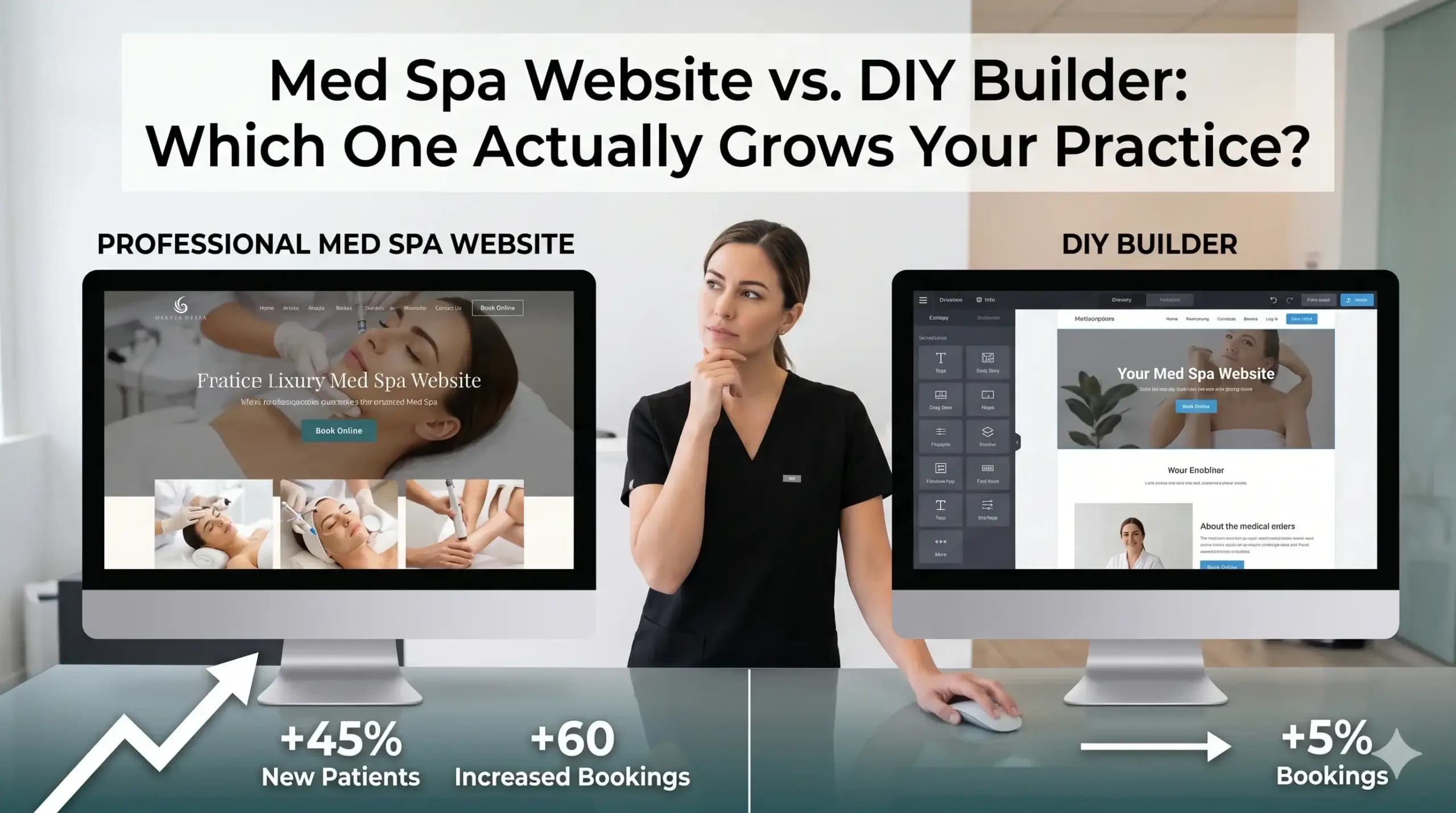
Med Spa Website vs. DIY Builder: Which One Actually Grows Your Practice?
You spent real money on equipment, training, staff, and build-out. Your treatments are excellent and your clients love you. So why is your phone not ringing as much as it should?
For a lot of med spa owners, the answer lives on a webpage they built themselves three years ago — and haven’t touched since.
DIY website builders like Wix, Squarespace, and GoDaddy make it easy to get something online fast. But “something online” and “a website that grows your practice” are two completely different things. One checks a box. The other works for you while you’re in a treatment room.
This post breaks down exactly what’s costing you leads, what the best medspa websites actually do differently, and how to know whether it’s time to stop patching your current site and start building one that pays for itself.
Your Website Is Your Front Desk — And Right Now, It’s Turning Clients Away
Think about what happens when a potential client walks into your med spa for the first time. They’re immediately sizing you up — cleanliness, professionalism, warmth. If the experience feels off, they walk out.
Your website is that first impression for the majority of people who will ever consider booking with you. They Google “botox near me” or “laser skin treatments in [city],” find your site, and form an opinion in about three seconds.
If your site looks dated, loads slowly, or doesn’t answer their basic questions quickly — they close the tab and book with the practice that shows up right below you.
Here’s the real problem: most DIY-built medspa websites fail that three-second test. Not because they’re ugly, but because they weren’t built to convert a skeptical, time-pressed consumer who has five other options a click away.
The Hidden Speed Problem That’s Draining Your Bookings
What you experience: You feel like your website is “fine.” It loads on your laptop at the office, and it looks decent on your phone.
What’s actually happening: Your site is loading in 6, 7, maybe 9 seconds on a mobile connection — and over half of your potential clients are browsing on their phones. Most people leave a site that takes longer than 3 seconds to load. They don’t wait. They don’t come back.
What this costs you: Every slow-loading page is a potential client who never saw your before-and-after photos, never read your treatment menu, never found your phone number. They went to your competitor’s site, which loaded in under 2 seconds, and booked there.
DIY builders are convenient, but they’re packed with bloated code, unnecessary scripts, and shared hosting that can’t handle load. That’s the tradeoff you make for “easy.”
Websites built for medical spa businesses are built lean and fast from the ground up — optimized for mobile speed specifically because that’s where your clients are finding you.
Google Doesn’t Know Your Practice Exists — Here’s Why
What you experience: You search your own business and you show up. So you assume you’re ranking fine.
What’s actually happening: Searching your own business name shows you your own listing. That’s not the same as showing up when someone types “CoolSculpting near me” or “best med spa for microneedling in [your city].”
There’s a difference between being findable and being found by the right people at the right moment.
Most DIY-built medspa websites are missing the technical signals Google uses to understand what a business offers and who it serves — things like properly structured service pages, local SEO signals, and metadata that matches what people are actually searching for. Without those signals, Google won’t confidently show your site to people who don’t already know your name.
The real cost: Your competitor — maybe a bigger chain, maybe just a more digitally-savvy solo practice — is showing up every time your ideal client searches. You’re not even in the conversation.
The best med spa websites aren’t just pretty. They’re architected so Google can read them clearly and rank them confidently for the treatments people are actively searching for.
Your Website Looks Like a Brochure. It Should Work Like a Booking Machine.
Here’s a comparison that hits close to home for most med spa owners:
Imagine you hired a front desk person, but they had no training, no script, and zero authority to book an appointment. A client walks in, asks about your HydraFacial pricing, and the front desk person just shrugs and points to a printed menu on the wall.
That’s what a DIY-built medspa website does. It presents information. It doesn’t guide, reassure, or convert.
The best medspa websites are designed around the psychology of a client who’s on the fence — someone who’s interested but hasn’t committed. They need:
- Social proof (before-and-after photos, testimonials, specific results)
- Reassurance (credentials, safety information, what to expect)
- A clear, frictionless next step (book now, text us, claim a special offer)
- Fast answers to their most common questions
If your current site doesn’t do all four of those things on every page, you’re leaving bookings on the table every single day.
💡 Pro Tip: Your “Book Now” Button Might Be Costing You Clients
A lot of med spa websites have a booking button — but it links to a third-party scheduling tool that opens in a new tab, requires account creation, and takes four steps to complete. On mobile, half of those potential clients drop off before finishing.
The fix isn’t just a button — it’s building a booking flow that feels seamless from click to confirmation. That means fewer steps, mobile-optimized forms, and ideally a click-to-call option for clients who’d rather just speak to someone. This is a small detail that makes a measurable difference in how many inquiries you actually receive.
Before & After: What Happens When a Med Spa Gets the Right Website
The Practice: A laser and injectables med spa in a mid-size market with strong local competition. They had a Squarespace site they’d built themselves when they opened, plus an active Instagram following. Despite solid reviews and a loyal client base, their new client inquiries from the web were inconsistent — maybe 5 to 8 new contact form submissions or calls per month from people who didn’t already know them.
The Problems:
- Site loaded in 7+ seconds on mobile
- No dedicated service pages (everything was on one long scrolling homepage)
- No local SEO signals — they weren’t appearing for treatment-specific searches
- No before-and-after gallery integrated with their service pages
- Booking process required navigating to a third-party tool
What Changed: A full rebuild focused on med spa website design — fast-loading service pages, local SEO structure, an integrated gallery, and a mobile-first booking flow.
The Result: Within 90 days of launch, new client inquiries from organic search went from 5–8 per month to consistently 25–35. The phone rang more. The contact form filled up. And they stopped relying entirely on Instagram to drive new business.
That’s not magic. That’s what happens when your website is actually built to work.
Not sure if your med spa website has these issues? Get a free website audit — no obligation, just a clear picture of what’s costing you leads.
What the Best Med Spa Websites Actually Have in Common
When you look at high-performing medspa websites — the ones that consistently generate inquiries and show up in search — a few patterns emerge:
- Speed. They load fast on mobile, full stop.
- Dedicated service pages. Not one page with a list of treatments — individual pages for each major service, optimized for how people search.
- Local SEO signals. Their structure tells Google exactly where they are, what they do, and who they serve.
- Real social proof. Before-and-afters, specific testimonials, named staff with credentials — not stock photos and generic quotes.
- A clear conversion path. Every page has one obvious next step. Not three. One.
- Trust signals above the fold. Certifications, associations, and experience shown immediately — not buried at the bottom.
DIY builders can produce some of these elements. But replicating all of them, consistently, across a site that’s also fast and technically sound? That requires intentional medical spa web design — not a drag-and-drop template that was built for a yoga studio.
See how Digital Trace builds medical spa websites that check every one of these boxes.
Your Path to More Leads: A Simple 5-Step Reality Check
You don’t need to become a web developer to understand whether your site is working. Here’s a straightforward process:
Step 1: Test your site’s speed on mobile. Go to Google’s PageSpeed Insights (free), type in your URL, and run a mobile test. If your score is below 70 — or your load time is over 3 seconds — you have a real problem that’s costing you clients right now.
Step 2: Search for your own treatments, not your own name. Type “[your city] botox” or “[your city] laser skin treatment” into Google. If you’re not on the first page, your ideal clients aren’t finding you organically.
Step 3: Count your service pages. If all your treatments live on one page, you’re invisible for most of the searches your clients are doing. Each treatment deserves its own page, optimized for how people search.
Step 4: Walk through your booking flow on your phone. Open your site on your personal phone, find a treatment, and try to book. Count every click, every redirect, every form field. If it takes more than 3 steps to connect with you — fix it.
Step 5: Ask an honest question about your site’s first impression. Show your homepage to someone who has never seen it. Ask them: “What does this business do? Would you trust them? Do you know how to book?” If they hesitate on any of those answers, your website is working against you.
FAQ: What Med Spa Owners Actually Ask Before Hiring a Web Agency
Why am I not getting calls from my website even though I have one?
Having a website and having a website that generates calls are two different things. Most med spa websites that don’t convert are missing speed optimization, local SEO structure, or a clear booking path. The site exists — it’s just not doing any of the work.
How do I know if my med spa website is actually working?
If you can’t answer “how many new client inquiries came directly from my website last month,” your site probably isn’t working as hard as it should be. A working website generates a measurable, trackable number of inquiries. If you want to know where yours stands, a free website audit will show you exactly what’s happening under the hood.
How long does it take to see results from a new website?
A new website built with strong local SEO structure typically starts seeing meaningful organic traffic growth within 60–90 days of launch — sometimes faster in lower-competition markets. Results are not instant, but the improvements in speed and user experience often produce quicker wins in conversion rates (more inquiries from existing traffic) even before search rankings fully catch up.
What makes a med spa website different from a regular business website?
Med spa clients are buying trust as much as they’re buying a service. They want to see credentials, real results, and reassurance before they’ll hand over their email — let alone book. A med spa website needs to establish clinical authority and warmth simultaneously, with a booking flow that removes every possible point of friction. That’s a very different design brief than, say, a plumber’s website.
Do I really need a fast website if all my clients are local anyway?
Yes — especially because they’re local. Local searches happen overwhelmingly on mobile, often while someone is out and about and actively ready to book. If your site loads slowly on a mobile connection, you lose that person in real time. Local doesn’t mean low stakes; it means the competition is happening right in your backyard.
I’ve been burned by marketing agencies before. How is this different?
That’s a completely fair concern. The difference is in what’s being measured and delivered. A website audit starts by showing you exactly what’s wrong — in plain English, with no upsell pressure. You’ll see the specific issues, what they’re costing you, and what it would take to fix them. No vague promises, no long retainer before you see anything. Just a clear picture of your current situation.
There’s Real Money Sitting in Your Website Right Now
Every month your med spa website runs slow, ranks invisibly, and fails to convert visitors into calls — that’s real revenue walking out the door. Not theoretical revenue. Actual clients who found you, looked at your site, and chose someone else.
The good news: this is completely fixable. The technical problems that kill most medspa websites are known, solvable, and the results are measurable.
Ready to see exactly what your website is costing you?
Get your free website audit from Digital Trace — no obligation, no sales pitch. Just an honest look at what’s working, what isn’t, and what a better website would actually mean for your practice’s bottom line.