Medical Spa Website Design: 10 Must-Have Features Best MedSpas Use in 2026
You spent serious money on your med spa — the equipment, the training, the build-out. But your website? It’s probably costing you clients every single week without you knowing it.
Most medical spa owners assume their website is “fine.” It loads, it has their phone number, it lists their services. But “fine” isn’t the same as working. When a potential client lands on your site and doesn’t see exactly what they need in the first few seconds, they don’t call — they click away to the competitor down the road who figured this out before you did.
The best medspa websites aren’t just pretty. They’re designed to do one specific job: turn curious visitors into booked consultations. Below are the 10 features that separate high-performing medical spa websites from the ones that quietly bleed leads every month.
1. A Homepage That Speaks to the Right Client in 5 Seconds
Here’s the test: pull up your homepage on your phone and read only the first screen — no scrolling. Does it immediately communicate what you offer, who it’s for, and why someone should choose you over every other option?
If the answer is even slightly “maybe,” you’re losing people.
Visitors make a split-second decision about whether your practice feels right for them. If your headline is something vague like “Welcome to Glow Med Spa,” that decision is often “leave.” The best medical spa websites lead with a specific benefit — something like “Body contouring and skin rejuvenation for [City] residents who want real results, not cookie-cutter treatments.”
What to fix:
- Lead headline states the transformation, not just the service name
- Subheadline addresses the ideal client directly
- Primary call-to-action button is visible without scrolling (on mobile especially)
2. Mobile-First Design That Actually Works on a Phone
Over 70% of people searching for a medical spa are doing it from their phone. If your website was built for a desktop and “adjusted” for mobile, it’s not the same thing — and visitors feel that immediately.
A truly mobile-first medspa website means buttons are easy to tap, text is readable without zooming, images load fast, and your phone number is one tap away. When any of those things break down, the visitor leaves. They don’t send you an email about it. They just go.
What to look for:
- Tap-to-call button prominent at the top of every page
- No pinching or horizontal scrolling required
- Forms are short and easy to complete on a small screen
- Images don’t push content out of the way
3. Page Speed That Doesn’t Kill the Sale Before It Starts
Think of your website like your front desk. If a potential client walks in and has to wait three minutes before anyone acknowledges them, they walk out. That’s exactly what a slow website does — it makes people wait, and most of them won’t.
Studies consistently show that most visitors leave a site that takes more than 3 seconds to load. For a medical spa, where trust and first impressions are everything, that slow load isn’t just annoying — it signals unprofessionalism before the visitor sees a single photo of your work.
The technical fix involves properly compressing images, using fast hosting, and optimizing the code that runs your site. The business result is that more of the people who find you actually stay long enough to book.
💡 Pro Tip: The biggest culprit behind slow medspa websites is usually uncompressed before/after photos. High-resolution images are important for showing results — but they need to be optimized for web. A 4MB photo looks identical to a 200KB version on screen, but the 4MB version can tank your load speed and your Google ranking at the same time. Compress every image before uploading, and your site will feel noticeably faster overnight.
4. Before/After Galleries That Build Trust Without Losing It
Before/after photos are one of the most powerful conversion tools a medical spa has. They’re also one of the most common places where med spa websites go wrong.
The mistake isn’t showing the photos — it’s showing them poorly. Tiny thumbnails, inconsistent lighting, no context about the treatment or the timeline — these don’t build trust, they raise doubts. Potential clients want to see results for someone who looks like them, with a problem they recognize.
What high-converting med spa galleries do differently:
- Organize photos by treatment type so visitors can find what’s relevant to them
- Include brief captions: the treatment, number of sessions, and approximate timeline
- Display images large enough to actually see the difference
- Are optimized so they don’t slow the page to a crawl (see Feature #3)
5. Service Pages That Answer Questions Before They’re Asked
Most med spa service pages do the bare minimum: a paragraph about the treatment, maybe a photo, and a “Book Now” button. That’s not enough for someone deciding whether to spend $800 on a laser package.
A well-built service page walks the visitor through their specific concern, explains the treatment in plain English, addresses common hesitations (does it hurt? how long is recovery? what results can I realistically expect?), and leads them naturally to a consultation. It answers the questions they’d ask your front desk — before they ever pick up the phone.
Websites built for medical spa businesses treat each service page like a quiet sales conversation, not a brochure.
What every service page needs:
- Clear explanation of who the treatment is best for
- Realistic outcome expectations (not just marketing language)
- FAQ section specific to that treatment
- Social proof — a testimonial or result photo tied to that specific service
- One clear next step: book a consultation
6. Online Booking That Doesn’t Require a Phone Call
A significant portion of your potential clients are browsing your website at 10pm. Your front desk isn’t available. If your only option is “call us during business hours,” you’re losing every one of those after-hours visitors to a competitor who has online scheduling.
Online booking doesn’t have to be complicated. Even a simple form that captures a name, contact info, preferred service, and preferred time — and sends an automatic confirmation — is miles better than “we’ll call you back.” The key is that the visitor leaves feeling like they’ve done something, not like they’re waiting for you to respond.
7. Local SEO Signals Baked Into Every Page
When someone searches “CoolSculpting near me” or “Botox [city name],” Google has to make a split-second decision about which medical spas to show. If your website doesn’t give Google the right signals, it doesn’t show your practice confidently — even if you’re the best option in the area.
This goes beyond just having your address on your site. It means your location is woven into your page titles, your service descriptions, and the technical metadata Google reads behind the scenes. It means your site is connected to a well-maintained Google Business Profile. It means you’re consistently mentioned across local directories.
When these signals are all aligned, Google starts showing your practice to people who are actively looking for what you do — in the area you serve.
8. Trust Signals Placed Where Decisions Get Made
A visitor might love your photos and your services — but they still need a reason to trust you with their face or their body. Trust signals are the proof points that tip undecided visitors toward calling.
The mistake most med spa websites make is clustering all their social proof at the bottom of the page, where most visitors never scroll. Reviews, credentials, media features, before/after results — these need to appear throughout the site, especially near call-to-action buttons.
Trust signals that convert for medical spas:
- Google or RealSelf reviews displayed natively (not just a star rating)
- Staff credentials and training listed clearly (not buried in an “About” page)
- Any press, awards, or recognitions
- A real team photo (stock photos undermine trust immediately)
9. A Clear Conversion Path on Every Page
Here’s a question worth sitting with: on every page of your site, is there one obvious next step for the visitor to take?
Many medspa websites are beautiful but directionless. Visitors don’t know whether to call, book, fill out a form, or keep reading. When there are too many options — or none at all — people don’t decide. They leave.
Every page of a high-performing medical spa website points visitors toward a single action: usually booking a consultation or requesting a specific treatment. The path is obvious, the friction is low, and the message around the CTA actually gives the visitor a reason to act now rather than later.
10. Analytics and Tracking That Tell You What’s Actually Working
A website without tracking is like running a front desk with no appointment book. You have no idea who’s coming in, what they’re interested in, or where they’re dropping off.
Proper tracking means knowing which service pages get the most visits, which traffic sources bring people who actually book, and where visitors abandon the booking process. That data is how you stop guessing about your marketing and start making decisions based on what’s actually happening.
How Digital Trace builds medical spa websites includes baseline analytics setup — so from day one, you can see what’s working.
Real-World Results: What Happens When These Features Work Together
A medical spa in Phoenix — a two-provider practice specializing in injectables and laser skin resurfacing — came to Digital Trace with a common problem. Their site was three years old, professionally designed, and generating almost no inbound leads. The owners were relying entirely on repeat clients and word of mouth.
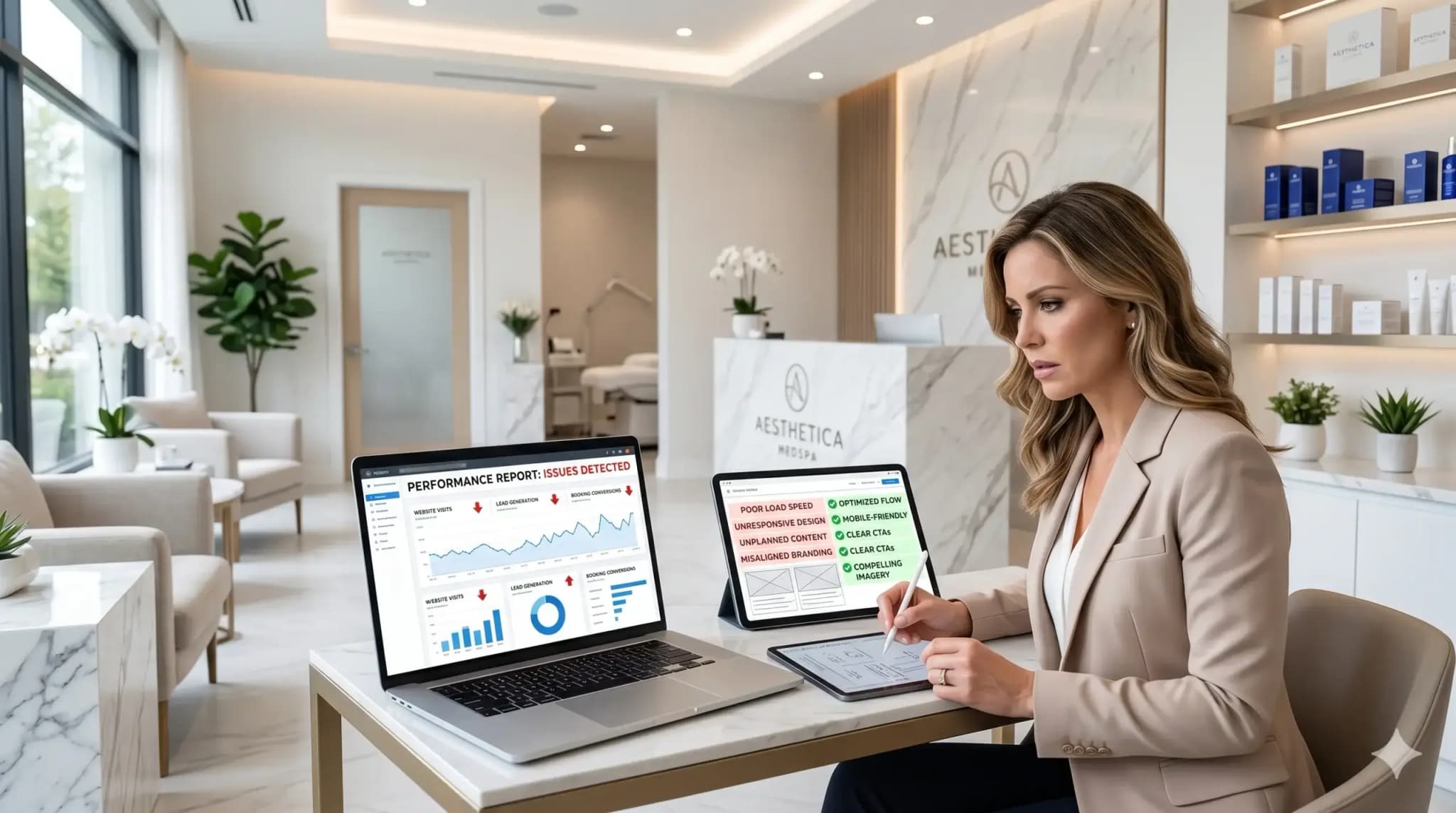
The core issues: the homepage didn’t speak to their ideal client (women 35–55 dealing with sun damage and early aging signs), the before/after gallery was buried and displayed poorly on mobile, there were no local SEO signals connecting them to Phoenix-area searches, and the contact page was a generic form with no incentive to fill it out.
After a full redesign using the features above — with a mobile-first build, restructured service pages, a properly formatted gallery, local SEO integration, and a simplified consultation booking flow — the results over 90 days were measurable: organic search traffic more than doubled, consultation form completions increased by over 180%, and phone inquiries that previously averaged 4–6 per week climbed to 18–22 per week.
The practice didn’t add a single new service. The only thing that changed was how their website communicated with the people already looking for them.
Not sure if your medical spa website has these issues? Get a free website audit — no obligation, just a clear picture of what’s costing you leads.
Your Path to More Leads: 5 Simple Steps
You don’t need to overhaul everything at once. Here’s how to approach this in a way that’s manageable and actually moves the needle:
- Start with an honest mobile check. Pull up your site on your phone. If anything feels clunky, slow, or hard to tap — your visitors are experiencing that too.
- Audit your homepage message. Read only the first screen. Does it clearly say who you help and what makes you different? If not, that’s your highest-priority fix.
- Fix your slowest pages first. Usually your homepage and your top service pages. Faster load times improve both user experience and Google rankings.
- Get your before/after gallery organized and visible. Results are your strongest sales tool. Make sure they’re easy to find, filter, and view on mobile.
- Talk to a web team that knows your industry. A generic web agency treats your medical spa like a plumber’s website. The difference in results is significant.
Frequently Asked Questions
Why am I not getting calls from my website even though people are visiting it?
Traffic without calls usually means your site isn’t giving visitors a clear reason to act, or the path to booking feels uncertain. The most common culprits are a vague homepage message, no trust signals near your call-to-action buttons, and a contact process that feels like too much work. A medical spa website should convert visitors into consultations — not just inform them.
How do I know if my medical spa website is actually working?
If you don’t have Google Analytics or call tracking set up, you genuinely can’t know — and most med spa owners are in this position. The first step is getting proper tracking in place so you can see where visitors come from, which pages they spend time on, and where they drop off before booking. Get a free website audit and we’ll show you exactly what your site is — and isn’t — doing.
What makes a medical spa website different from a regular business website?
Medical spas sit at the intersection of healthcare trust and luxury consumer experience. Your visitors are making decisions about their appearance and sometimes their health — they need to trust you before they book. That requires different design choices, a specific approach to social proof, a more careful tone in copywriting, and a conversion path tailored to consultations rather than immediate purchases.
How long does it take to see results from a new medical spa website?
A well-built site can show improved inquiry volume within the first 30–60 days just from better conversion of existing traffic. SEO improvements — getting you found by people who weren’t finding you before — typically show measurable movement within 60–90 days, with stronger results building over 4–6 months. Anyone promising overnight rankings is overpromising.
Do I really need a fast website if my clients are local and mostly find me through referrals?
Referrals are great — until a referred client Googles you, lands on a slow or outdated site, and second-guesses the recommendation. Your website either reinforces the trust that brought someone to you, or it undermines it. Even if most of your clients come through word of mouth, your website is the first thing they check before they call. A slow, dated site quietly costs you referrals you never knew you were losing.
I’ve worked with web agencies before and felt burned. Why would Digital Trace be any different?
Fair question. The difference is industry focus and outcome orientation. Generic agencies build websites. Digital Trace builds medical spa websites specifically — which means the strategy, the design decisions, and the features we prioritize are all based on what actually converts in your industry. And we don’t disappear after launch: we track results and can tell you in plain numbers what your site is doing for your business.
Your Medical Spa Website Should Be Working as Hard as You Are
You’ve built a practice worth finding. The question is whether the people looking for what you offer can actually find you — and whether your website convinces them to call when they do.
Most medical spa websites fail quietly. No error messages, no obvious problems — just a steady trickle of visitors who leave without ever becoming clients. The 10 features above are what separate the practices that rely on word of mouth from the ones consistently filling their books through their website.
If you want to know exactly where your site stands — what’s working, what’s broken, and what’s costing you leads right now — book a free website audit with Digital Trace. No sales pitch, no obligation. Just a clear, honest picture of your website’s performance and a roadmap for improving it.