Why Your Medical Spa Website Is Losing You Clients (And How to Fix It)
You’re running a busy medical spa. You’re booking appointments, managing staff, ordering supplies, and keeping clients happy — all at once. Your website is the last thing on your mind. And that’s exactly the problem.
Most medical spa owners assume their website is “fine.” It looks decent. It has their services listed. It’s been up for a couple of years. But “fine” is quietly costing you booked appointments every single week.
The truth is, your medical spa website isn’t just a page on the internet — it’s your highest-volume front desk. It works 24/7, handles first impressions, and either earns trust or destroys it in seconds. When it fails, you don’t get a notification. You just stop getting calls. This post breaks down exactly why that happens — and what a website built to actually convert looks like.
Your Website Loads Slowly — And Most People Leave Before They See Your Phone Number
Here’s a scenario most medical spa owners don’t realize is happening: a potential client searches “Botox near me” at 9pm, clicks on your website, and waits. Three seconds. Four. Five. She closes the tab and books with a competitor.
She never called. You never knew she was there.
Slow websites are the single biggest silent killer of medical spa leads. Studies consistently show that most mobile users abandon a site that takes longer than three seconds to load — and the majority of people searching for medical spa services are on their phones.
The technical reason is usually preventable: oversized images, cheap hosting, unoptimized code, or too many plugins stacked on a template that was never built for performance. The fix isn’t complicated, but it requires someone who knows what they’re doing.
At Digital Trace, every medical spa website is built from the ground up for speed — optimized images, lean code, and hosting that can handle traffic spikes. Because the fastest way to lose a lead is to make her wait.
Your Site Looks Generic — And Clients Can Tell the Difference
Think about how a client chooses a medical spa. She’s not shopping for the cheapest price. She’s looking for someone she can trust with her face, her body, and her confidence. Trust is built visually before a single word is read.
If your website looks like a template bought for $49, it signals — unconsciously but immediately — that you’re not the premium provider she was hoping for. Even if your results are exceptional.
The medical spa industry is one of the most visually competitive spaces in local business. Your competitors are investing in photography, clean design, and a brand experience that makes clients feel confident before they even call. If your site hasn’t been updated in three or more years, you’re likely losing high-value clients to spas that look more polished — regardless of who actually delivers better results.
A well-designed medical spa website does three things:
- It communicates expertise and trust through visual consistency
- It makes the path to booking feel effortless and obvious
- It reflects the quality of the experience a client will have in your treatment room
Google Doesn’t Know Enough About Your Business to Show It
You might be doing everything right operationally, but if Google isn’t showing your medical spa when people search for your services, none of that matters. And the reason your competitor shows up on page one while you don’t isn’t always about how long they’ve been around.
It’s often because their website speaks Google’s language — and yours doesn’t.
Here’s what that means in plain terms: Google reads your website to decide what you do, where you operate, and whether you’re trustworthy enough to recommend. If your site is missing key signals — like proper page structure, locally relevant content, and structured data that tells Google you’re a licensed medical spa in your city — Google hedges its bets and shows someone else instead.
A few things that commonly cause this:
- Service pages that are too thin (a paragraph or two isn’t enough for Google to understand what you offer)
- No location-specific content (Google can’t confidently match you to local searches)
- Missing technical signals that confirm your business details
- No internal linking between related services and pages
💡 Pro Tip: One of the most common mistakes we see on medical spa websites is having a single “Services” page that lists everything from Botox to laser treatments in one generic block. Google sees that as one page about many things — not a strong signal for any of them. Breaking each treatment into its own dedicated page, with real detail about what it does, who it’s for, and what results to expect, dramatically increases your chances of ranking for those specific searches. It’s one of the fastest structural fixes that moves the needle.
Your Contact Process Is Killing Conversions
Imagine a client is interested. She’s on your site, she likes what she sees, she’s ready to reach out. Then she hits a form with eight fields asking for her name, phone, email, date of birth, preferred treatment, preferred date, preferred time, and a message. She closes the tab.
Or she finds your “Book Now” button — and it takes her to a third-party booking platform that looks nothing like your website, requires her to create an account, and times out before she finishes.
Friction in the booking process is invisible to you but painfully obvious to your clients. Every unnecessary step between “I’m interested” and “I’m booked” costs you appointments. The bar for what’s acceptable has risen significantly — people expect the same seamless experience they get booking a restaurant or ordering a car.
Your medical spa website’s contact and booking process should be:
- One click away from any page
- Simple — name, phone or email, and preferred service at most
- Visually consistent with the rest of your site
- Confirmed instantly with a clear next step
Before & After: What a Real Fix Looks Like
A day spa and medical aesthetics practice in suburban Atlanta had been operating for six years with a website they’d built themselves on a popular DIY platform. They were busy — but mostly through word of mouth and returning clients. New client acquisition through the web had flatlined.
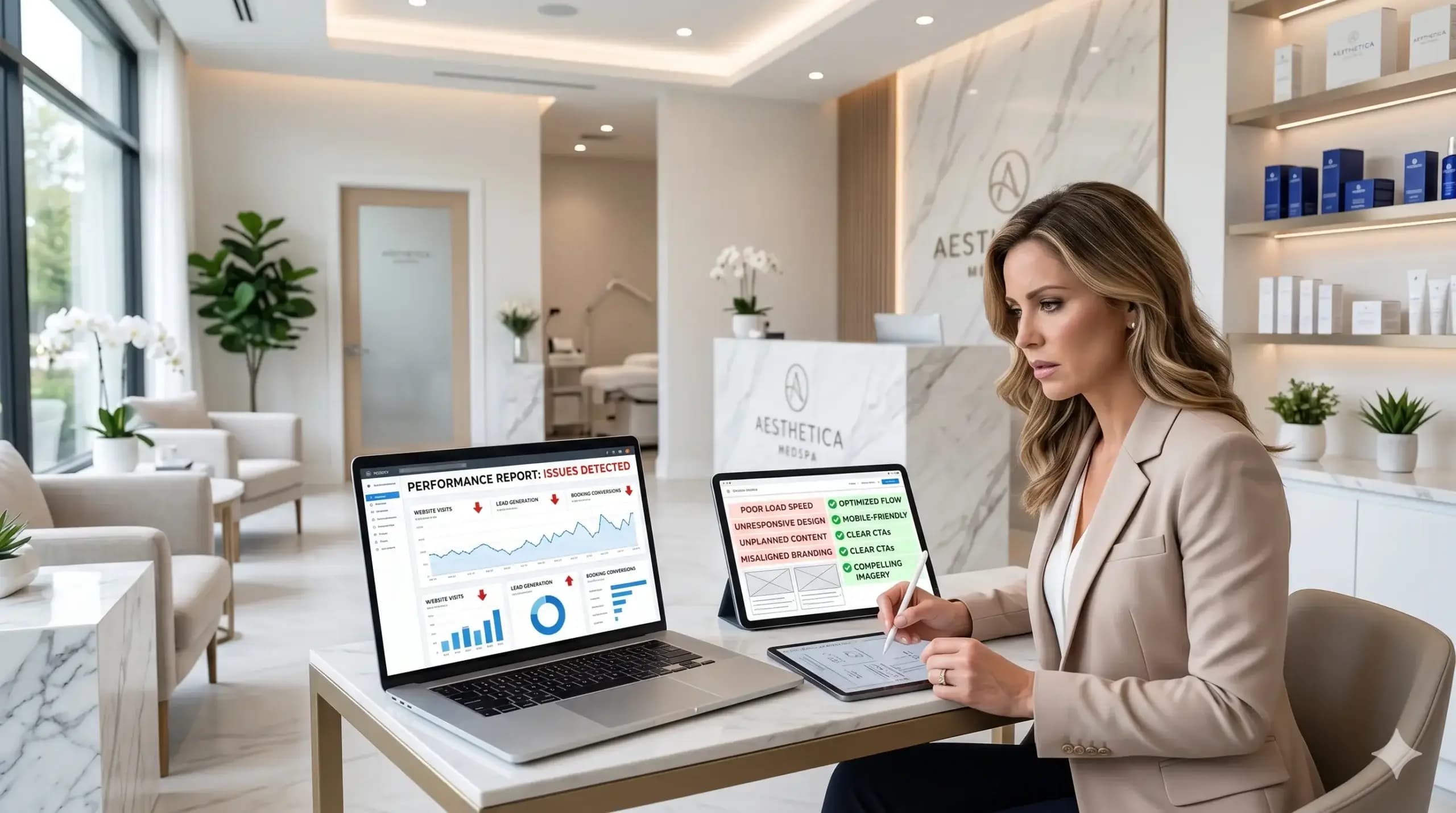
When they came to Digital Trace, the audit revealed three core problems: the site took over seven seconds to load on mobile, they had no individual service pages (everything was on one long scrolling page), and their contact form required nine fields before submission.
Within 90 days of launching a redesigned site — with fast mobile performance, dedicated pages for each service, and a streamlined two-field inquiry form — their website contact requests increased from an average of 4 per month to over 30. New client bookings from online traffic more than doubled. Nothing about their services changed. Only the website did.
Not sure if your medical spa website has these issues? Get a free website audit — no obligation, just a clear picture of what’s costing you leads.
Your Path to More Leads: Where to Start
If you’ve recognized your website in any of the problems above, here’s what the path forward looks like — step by step, in plain terms:
Step 1: Audit what you have. Before changing anything, understand what’s actually broken. Speed, structure, content, and conversion flow all need to be assessed independently. A proper audit surfaces the problems that matter most.
Step 2: Fix speed first. If your site loads slowly on mobile, that’s the first thing to address. Fast load times affect both your Google rankings and whether visitors actually stay long enough to book.
Step 3: Build proper service pages. Each treatment you offer should have its own page — written clearly for both Google and your clients. Think of it as the online version of a thorough consultation.
Step 4: Simplify the path to contact. Reduce your booking form to the bare minimum. Add your phone number to the header of every page. Make it impossible to miss.
Step 5: Make the design match your brand quality. Your website should feel like walking through the front door of your spa — clean, professional, and immediately reassuring. If it doesn’t, it’s working against you.
Frequently Asked Questions
Why am I not getting calls from my website even though people are visiting it?
Traffic without calls almost always means a conversion problem, not a traffic problem. Your site might load slowly, your booking process might have too many steps, or your layout might not make it obvious enough what to do next. A website audit will usually pinpoint the exact drop-off point within a few minutes of analysis.
How do I know if my medical spa website is actually working?
If you’re not tracking it, you genuinely don’t know — and most medical spa owners aren’t. At a minimum, you should know how many people visit your site each month, where they come from, and how many of them reach out. If those numbers aren’t in front of you monthly, your website is running blind. Start with a free audit to get a baseline picture.
How long does it take to see results from a new website?
Speed and conversion improvements can show results within weeks — faster load times and a better booking flow produce measurable changes quickly. Organic search ranking improvements from new content and structure typically take two to four months to gain meaningful traction. Paid traffic results are faster because you control the volume.
What makes a medical spa website different from a regular business website?
Medical spa clients are making decisions about their appearance and wellbeing — which means trust and visual presentation carry more weight than in almost any other local business category. Your website needs to communicate clinical credibility and emotional reassurance at the same time, while also performing technically well for search. That combination requires specific experience with the industry, not a generic web template.
Do I really need a fast website if most of my clients are local?
Yes — especially because they’re local. Local clients search on their phones while they’re out, during lunch breaks, or in the evening at home. Mobile performance is where slow websites hurt most. And Google’s local search rankings factor in page speed directly. A slow website in a competitive local market is handing bookings to your nearest competitor.
I’ve worked with agencies before and didn’t see results. Why would this be different?
Most agencies either over-promise or build websites that look good but aren’t built to convert or rank. The difference is specificity: a website built by someone who understands the medical spa industry — your clients’ decision-making process, your service structure, your compliance considerations — will outperform a generic template every time. The proof is in measurable outcomes: contact form submissions, calls tracked, and new client bookings.
Ready to See What Your Website Is Actually Costing You?
Every week your medical spa website has these issues, you’re losing clients to competitors who look more credible, load faster, and make it easier to book. Those aren’t leads that don’t exist — they’re leads that found someone else.
Digital Trace builds websites designed specifically for medical spa businesses — focused on speed, trust, and converting visitors into booked appointments. We don’t do generic. We work with the specific dynamics of how medical spa clients search, compare, and decide.
The first step costs you nothing. Book your free website audit and get a clear, honest picture of exactly what’s holding your site back — with no sales pressure and no obligation. Just the truth about what your website is doing (and not doing) for your business.