Why Your Competitor Gets More Plumbing Jobs (Hint: Their Website)
You’re a skilled plumber. You show up on time, do clean work, and your existing customers love you. So why does the guy across town — the one whose trucks you keep seeing everywhere — seem to be pulling in more calls than you?
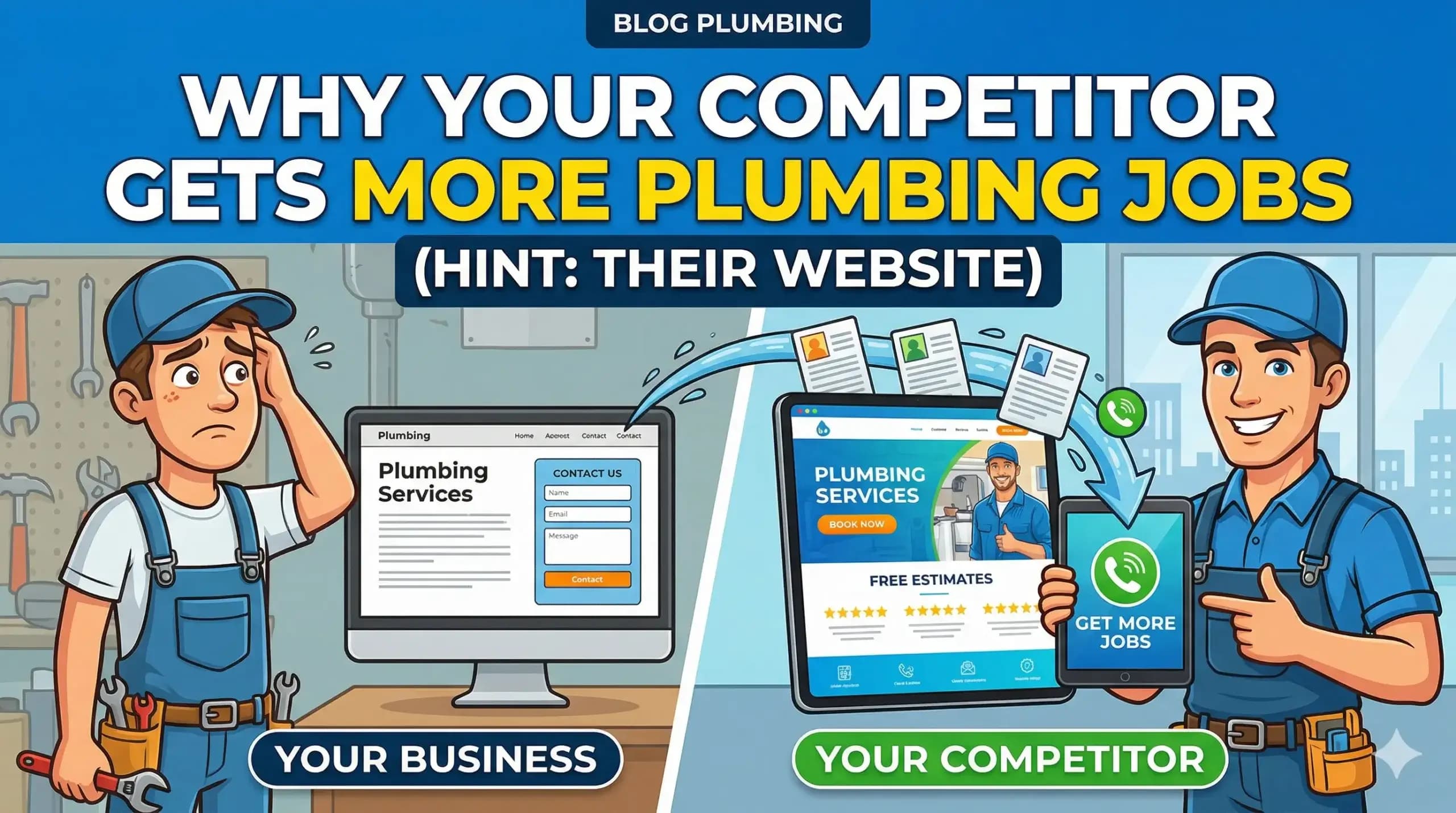
Most plumbers assume it’s word-of-mouth, or that the other guy has been around longer. But here’s what’s actually happening: that competitor has a plumbing website design that works around the clock to bring in leads, while your site quietly turns visitors away.
This isn’t about having a “pretty” website. It’s about the difference between a site that makes your phone ring and one that doesn’t. By the end of this article, you’ll know exactly what separates the two — and what to do about it.
Your Website Is Either a Lead Magnet or a Leaky Pipe — There’s No Middle Ground
Think of your website like a supply line. When it’s working right, jobs flow steadily to your business. When it’s got hidden problems — a slow load here, a broken connection there — pressure drops. Customers don’t make it to the point where they call you. They just disappear upstream to someone else.
Most plumbing business owners don’t realize their website has leaks. The site looks fine to them. But “fine to you” and “converting visitors into paying customers” are two completely different things.
Here’s the hard truth: the majority of people searching for a plumber pick from the first one or two options that load fast, look trustworthy, and make it dead-simple to call. If your site isn’t that — even by a small margin — you’re losing jobs every single day.
The 3-Second Rule That’s Costing You Calls
When someone’s toilet is overflowing or a pipe has burst, they grab their phone and search for a plumber fast. They’re not browsing — they’re deciding in seconds.
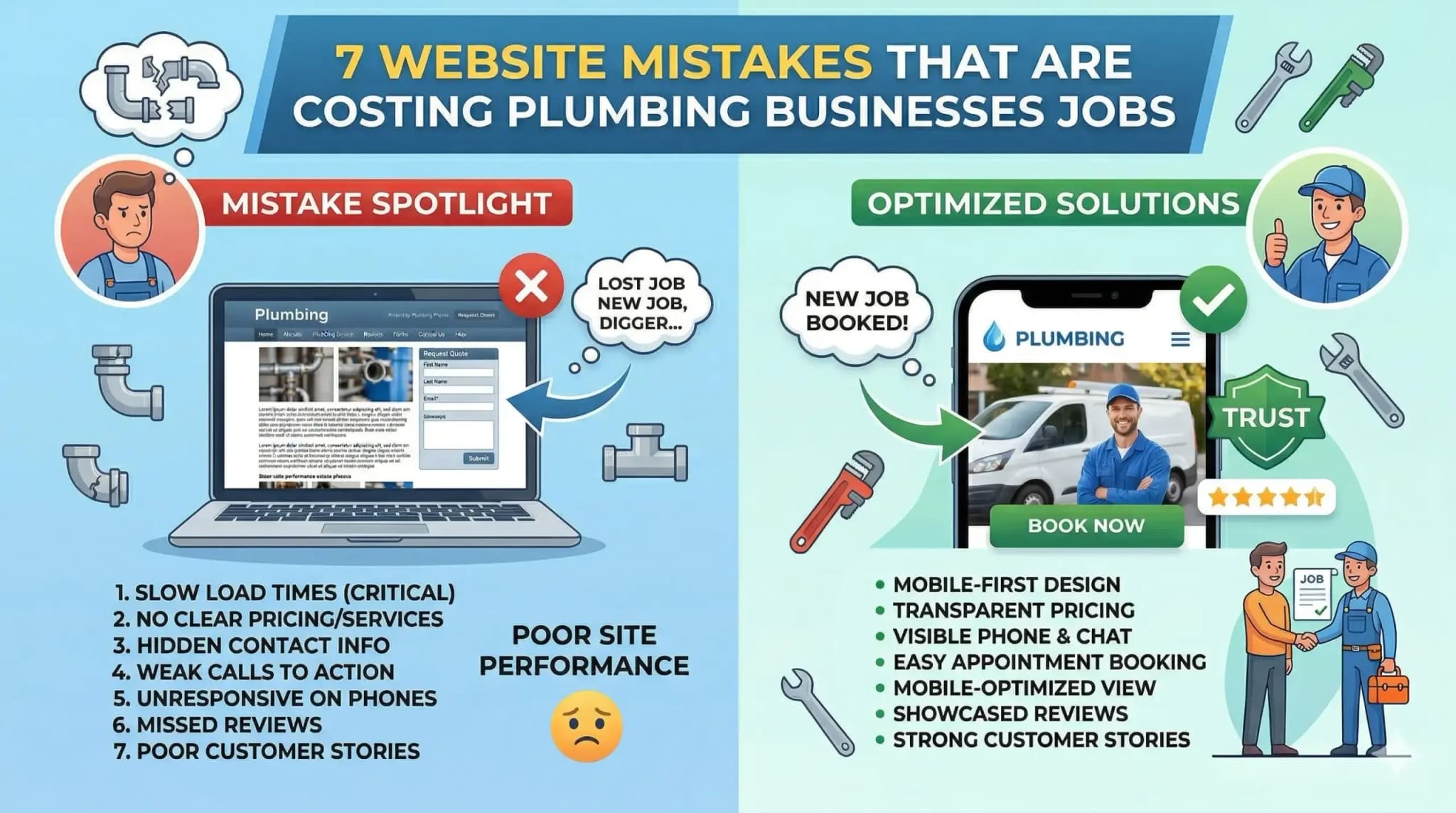
If your website takes more than 3 seconds to load, a large portion of those visitors are already gone before they even see your phone number. They didn’t call your competitor because they were loyal to them. They called because that site was simply faster.
This isn’t a minor issue. Site speed directly affects how many people stay long enough to contact you — and Google factors it in when deciding which plumbing websites to rank higher in search results.
The fix: Properly built websites for plumbers are optimized from the ground up for speed — compressed images, clean code, fast hosting. Not bolted-on tricks, but sites engineered to load instantly on the phone a customer is holding during an emergency.
Google Can’t Find You — Even When You’re Right There
Here’s a scenario that plays out for hundreds of plumbing businesses across the US: a homeowner searches “emergency plumber near me” — and a plumber with half your experience shows up on page one, while your business is buried somewhere customers never scroll.
Why? Google needs clear signals to feel confident showing your business. When your website is missing the right structure — things like clear service pages, location signals, and business information formatted in a way Google understands — it hedges its bets and shows someone else instead.
It’s like having your shop in the right neighborhood but no sign out front. You’re there. Google just isn’t sure enough about what you do or who you serve to point customers your way.
What actually works: A well-structured plumbing company website tells Google exactly what services you offer, which areas you serve, and why you’re the right choice. Digital Trace builds plumbing websites with this architecture baked in — not added as an afterthought.
💡 Pro Tip: Your Homepage Isn’t Doing the Work You Think It Is
Most plumbers send all their traffic to their homepage and wonder why people don’t call. Here’s the issue: a homepage is general. A visitor searching “water heater replacement [city]” lands on your homepage and has to figure out if you even do that — so many just leave.
The fix is dedicated service pages: one for drain cleaning, one for water heater work, one for emergency calls, and so on. Each page talks directly to that customer’s specific problem. Google sees more relevant content and ranks you higher for those searches. Customers feel like you understand their exact situation and are more likely to call. Digital Trace builds out this full page structure for every plumbing client — it’s one of the fastest ways to start capturing leads you’re currently missing.
Your Website Looks Fine on a Computer — But Your Customers Are on Their Phones
Pull up your website right now on your phone. Really look at it. Is the phone number easy to tap? Do you have to pinch and zoom to read anything? Does the page load without things jumping around?
More than 70% of local service searches happen on mobile devices. For plumbing — where someone’s dealing with an active problem and needs help now — that number is even higher. A website that looks decent on a desktop but frustrates mobile users is effectively invisible to a huge portion of your potential customers.
A slow, hard-to-navigate mobile experience sends one clear message: this business isn’t organized. That’s not the first impression you want when someone is deciding who to trust with their home.
The better approach: Every site Digital Trace builds is mobile-first. That means the phone number is always one tap away, the page loads fast on any connection, and the experience feels clean and professional on a 5-inch screen.
What Happens When You Fix These Problems: A Real-World Example
A plumbing company in the midwest — a two-truck operation that had been in business for eight years — was getting almost no calls from their website. They were relying entirely on referrals and had an outdated site a nephew had built years ago. It loaded slowly, wasn’t set up for mobile, and had no individual service pages.
After rebuilding the site with proper structure, mobile optimization, and dedicated pages for their core services (drain cleaning, water heater installation, and emergency calls), the results were significant:
- Organic search traffic increased substantially within 90 days
- They began ranking in the top 3 results locally for emergency plumbing searches
- Inbound calls from new customers more than doubled compared to the same period the prior year
- They hired a third technician within six months to handle the additional volume
The work didn’t change. The truck count barely changed. The website changed — and the business followed.
Not sure if your plumbing website has these issues? Get a free website audit — no obligation, just a clear picture of what’s costing you leads.
Your Path to More Leads: What the Next Steps Look Like
Getting your website working the way it should isn’t complicated. Here’s what the process looks like:
- Find out what’s actually broken. Most plumbers are surprised to discover their site has multiple invisible issues — slow load times, missing service pages, no mobile optimization. A free audit shows you exactly what’s going on.
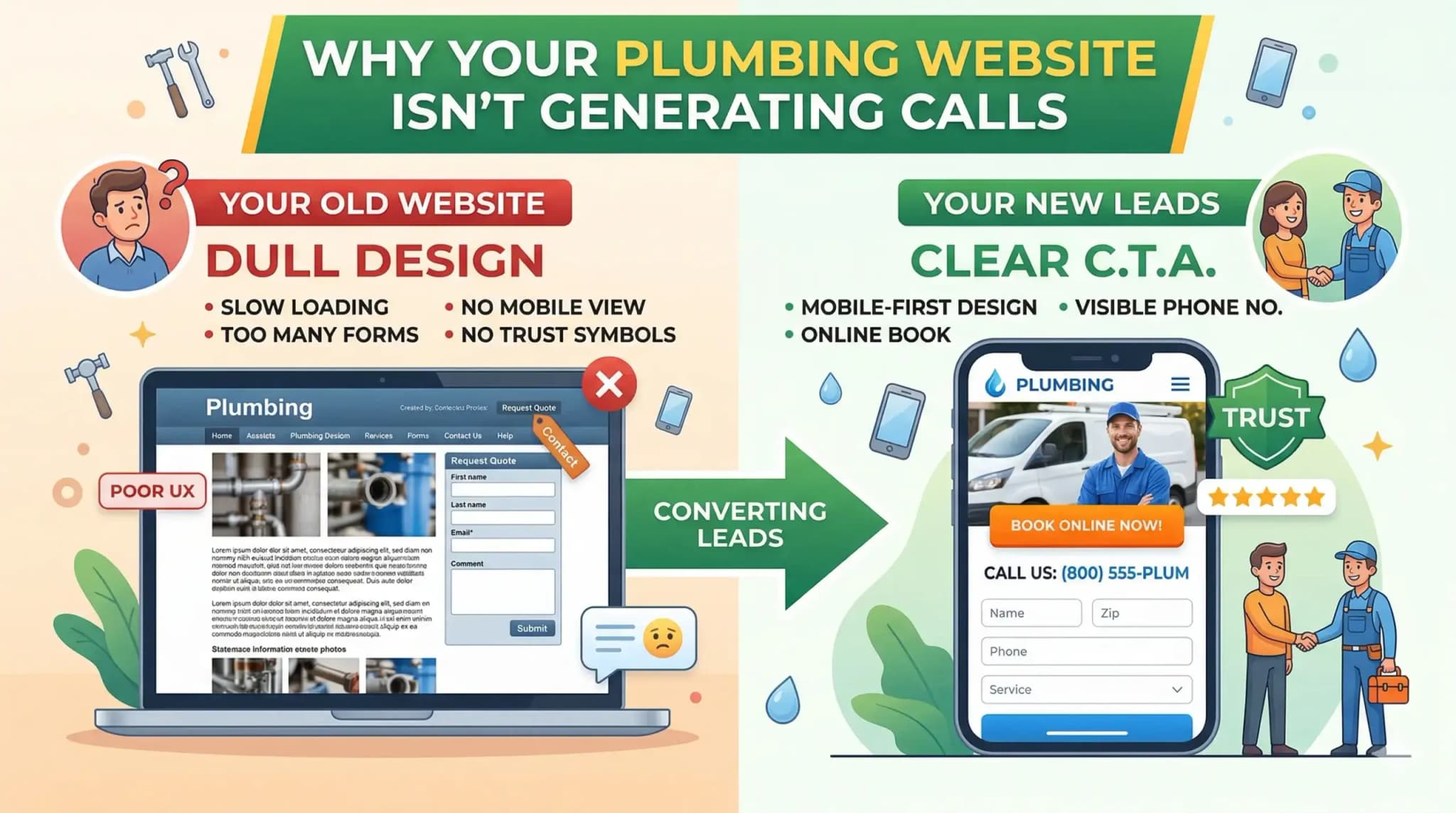
- Get a site that’s built for your business, not just built. A plumbing website should have pages for each of your core services, clear calls to action, and a design that makes it easy for stressed-out customers to call you in seconds.
- Make sure Google knows who you are and where you work. The right structure tells search engines exactly what you do and which areas you serve — so you show up when the right customers are searching.
- Optimize for mobile, because that’s where your customers are. Every element of the site should be easy to use on a phone — especially the phone number.
- Track what’s working. A good website isn’t a one-time thing. Knowing where your leads are coming from lets you double down on what’s working and stop wasting money on what isn’t.
FAQ: What Plumbers Actually Ask Before Rebuilding Their Website
Why am I not getting calls from my website even though I have one?
Having a website and having a website that generates leads are two very different things. The most common culprits are slow load speed, no dedicated service pages, and a site that wasn’t built with local search in mind. If someone can’t find you on Google or your site frustrates them when they do, they’ll just call the next plumber on the list.
How do I know if my plumbing website is actually working?
If you can’t tell where your leads are coming from, that’s already a problem. A working plumbing website should be producing measurable inbound calls and contact form submissions from people who found you through search — not just from people who already knew your name. Get a free website audit and you’ll have a clear answer within days.
How long does it take to see results from a new website?
Most plumbing businesses start seeing meaningful changes in search visibility within 60–90 days of launching a properly built site. Emergency and high-intent searches (like “plumber near me”) often show results faster than broader terms. The key is getting the foundation right from day one.
What makes a plumbing website different from a regular business website?
Plumbing customers are usually dealing with an urgent problem. They need to find you fast, trust you instantly, and contact you in one tap. A generic website template isn’t designed for that. A purpose-built plumbing site has service-specific pages, trust signals (licenses, reviews, service area), a prominently placed phone number, and load speeds optimized for mobile emergency searches.
Do I really need a fast website if my customers are local?
Yes — especially because your customers are local. Local searches on mobile devices are the most time-sensitive searches on the internet. Someone with a burst pipe isn’t going to wait for a slow site to load. Speed is one of the single biggest factors in whether a local visitor calls you or calls someone else.
I’ve paid for a website before and got nothing out of it. Why would this be different?
Most web designers build websites that look good in a portfolio. That’s not the same as building one that generates leads. The difference is in the details: site architecture built for search engines, pages structured around what your customers are actually searching for, and performance optimization that keeps visitors from bouncing. That’s the approach Digital Trace takes specifically for web design for plumbers.
Ready to See What Your Website Is Costing You?
Every week your plumbing website isn’t performing, you’re handing jobs to a competitor — often without realizing it. The problem usually isn’t what you can see. It’s the slow load, the missing service page, the mobile layout that frustrates customers before they ever get to your phone number.
A free audit from Digital Trace will show you exactly where the gaps are — no jargon, no pressure, just a clear breakdown of what’s working and what isn’t.
Book your free website audit today — and find out how many leads your current site is leaving on the table.