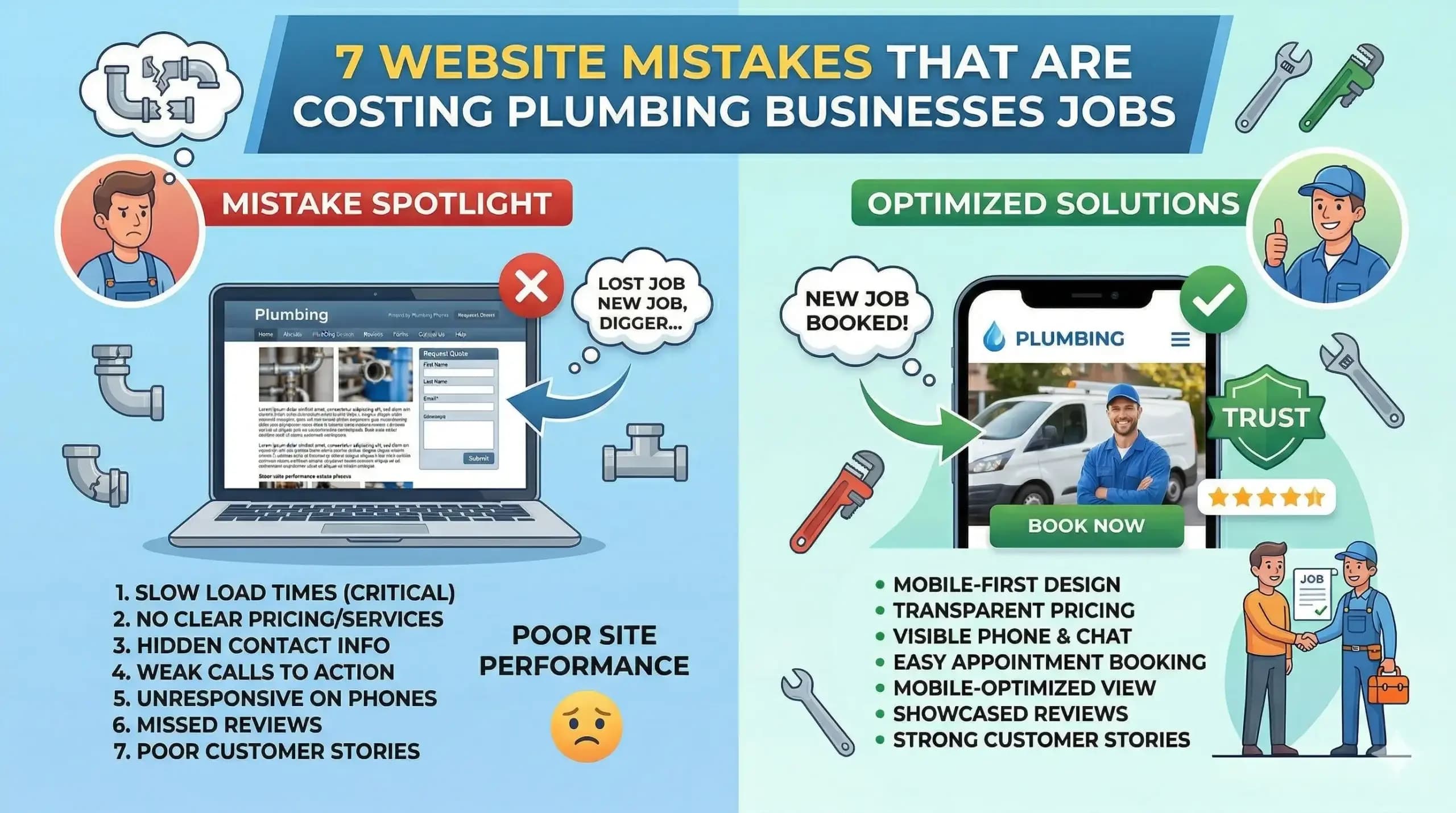
7 Website Mistakes That Are Costing Plumbing Businesses Jobs
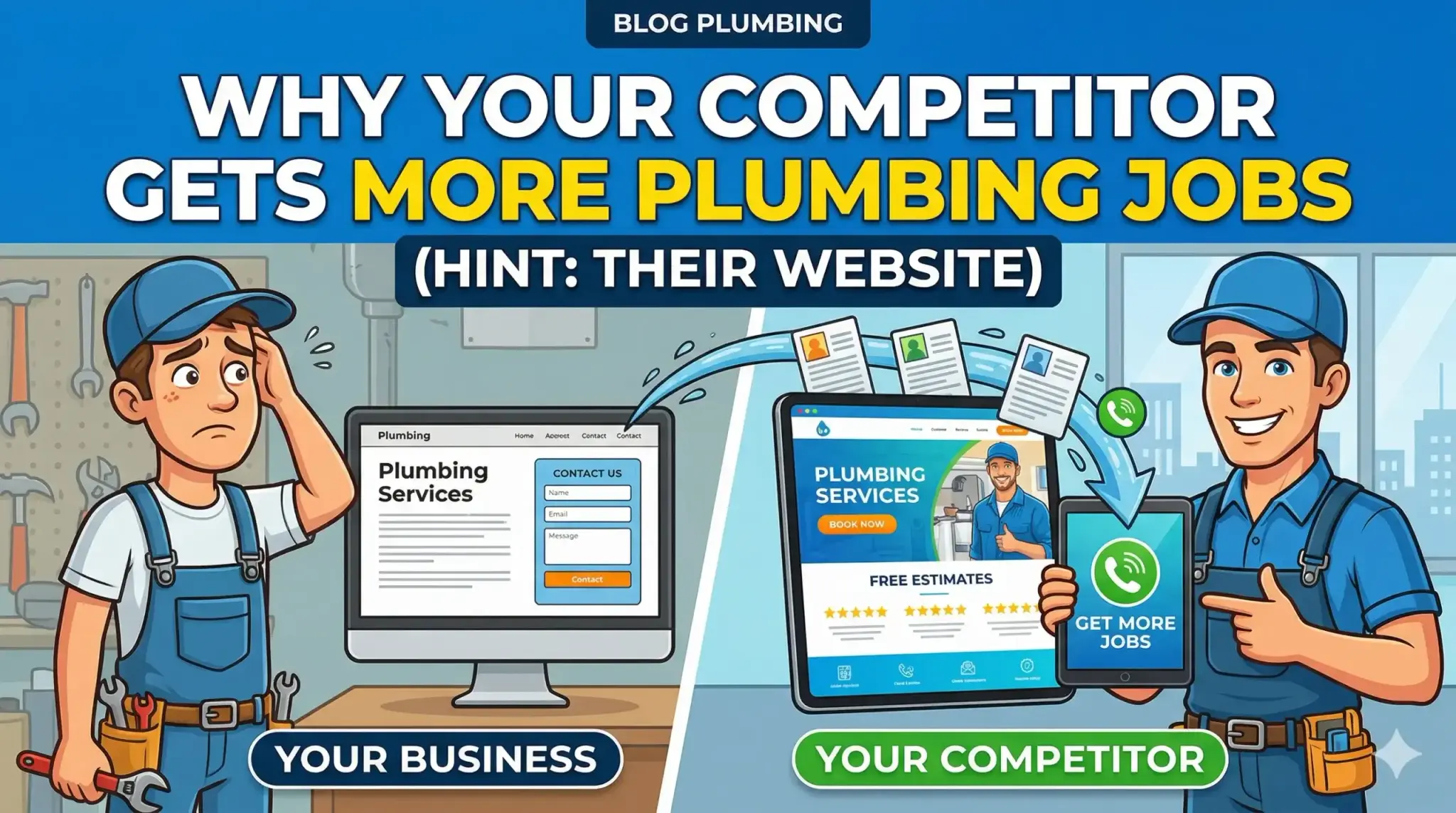
You did everything right. You built your skills, bought the trucks, hired the crew, and showed up for every job. But when someone in your area searches for a plumber online — your competitor’s name appears, not yours. And when someone does land on your website, they click away without calling.
Most plumbing business owners assume the problem is that they need to “do more marketing.” The real problem is almost always the website itself — and it’s usually a handful of fixable mistakes quietly killing your lead flow every single day.
This isn’t about fancy design trends or abstract SEO theory. It’s about the specific things your plumbing company website is probably doing wrong right now, why they cost you jobs, and what a well-built site actually looks like.
Mistake #1: Your Site Takes Too Long to Load — And Nobody Waits
Think of your website like a service call. If your tech shows up 20 minutes late with no call ahead, the homeowner’s already calling someone else. Your website is exactly the same — if it takes more than 3 seconds to load, most visitors are gone before your phone number even appears on screen.
Slow websites usually happen because of oversized images, cheap hosting, or bloated page builders that weren’t built with speed in mind. The site looks fine to you because your browser has cached it — but a first-time visitor on a phone sees a blank screen and a loading spinner.
The business cost is direct: fewer calls, fewer bookings, less revenue. A plumbing website design built for performance loads fast on every device, every time — because slow sites don’t just frustrate visitors, they rank lower on Google too.
Mistake #2: Your Phone Number Is Buried (Or Worse, Not Clickable on Mobile)
This one sounds obvious, but it’s one of the most common mistakes on plumbing websites. Someone has a burst pipe at 9pm. They’re on their phone, stressed, searching fast. They land on your site — and your phone number is tucked at the bottom of the page in small gray text. Or it’s an image, so they can’t tap to call.
That person calls the next plumber who makes it easy.
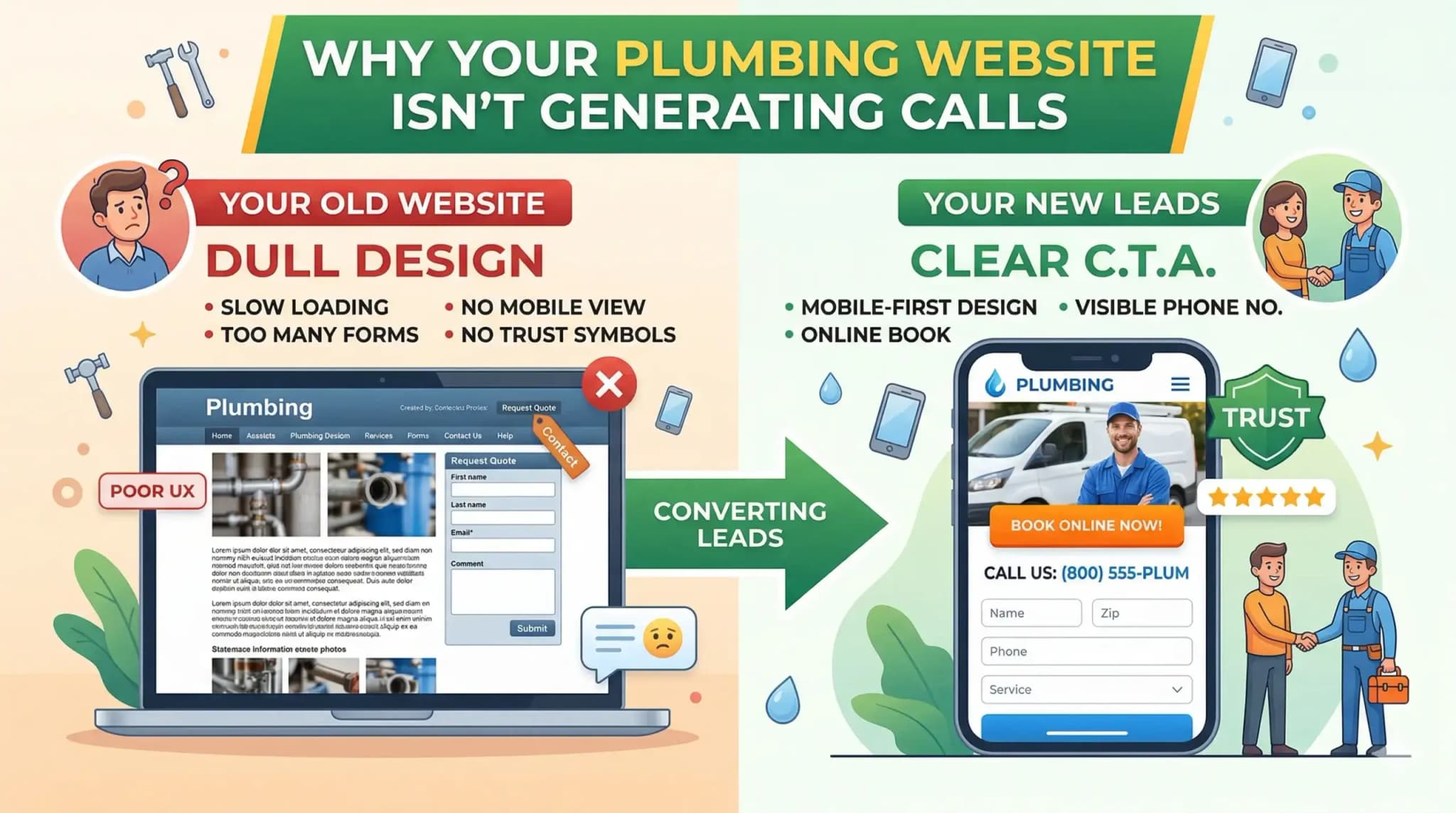
Your phone number should be visible above the fold on every page — meaning they see it without scrolling. On mobile, it must be a clickable tap-to-call link. Every extra step between “found your site” and “calling you” costs you jobs.
Mistake #3: Google Doesn’t Know Enough About Your Business to Trust It
Here’s one that surprises most plumbing business owners: Google doesn’t just crawl your website and automatically understand who you are, what you do, and where you serve. There’s a behind-the-scenes layer of information — called structured data or schema markup — that tells Google: “This is a licensed plumbing company in [city], they do emergency repairs, water heater installs, and drain cleaning.”
Without it, Google treats your site like a stranger at the door — it might let them in, but it won’t recommend them.
The fix isn’t complicated, but it requires someone who knows how to implement it correctly. When done right, your business shows up with richer information in search results — your rating, your service area, your business hours — and Google is far more confident showing you to searchers in your area.
Mistake #4: Your Website Looks the Same on Every Device — And That’s a Problem
Most plumbing leads come from mobile searches. Someone’s got a leak, they pull out their phone, and they search “emergency plumber near me.” If your site wasn’t built to display correctly on a phone screen, you’re invisible to that person — even if you rank on Google.
A site that isn’t truly mobile-optimized will have:
- Buttons too small to tap
- Text that overflows the screen
- Images that stack awkwardly
- Forms that are hard to fill out on a small keyboard
Mobile optimization isn’t just about the site fitting on a smaller screen. It’s about the entire experience being smooth, fast, and conversion-focused on a phone — because that’s where your customers are finding you.
Mistake #5: Your Homepage Talks About You Instead of the Customer’s Problem
Take a look at your homepage right now. Does it open with something like: “Welcome to [Company Name] — serving [city] since 1998. We are a family-owned business committed to excellence…”?
That’s not what a stressed homeowner with a flooding bathroom needs to read.
The best plumbing websites lead with the problem the customer has and the solution you provide. “Got a leak? We’re in [city], available 24/7, and we’ll have someone at your door within the hour.” That’s a homepage that converts. The “about us” story matters — but it belongs lower on the page, after you’ve already addressed why the visitor should call you.
Think of it this way: a good plumber doesn’t show up to a job and spend five minutes telling the homeowner about their certifications before asking what’s wrong. They assess the problem first. Your website should do the same.
Mistake #6: You Have No Reviews or Trust Signals Where It Counts
Online reviews are the word-of-mouth referrals of the internet — and most plumbing websites either hide them or don’t use them strategically. Your Google reviews shouldn’t just live on your Google Business Profile. They should be prominently featured on your website, ideally near the top, near your service pages, and near your contact form or phone number.
Trust signals to include on every plumbing website:
- Google review count and average rating
- Licensing and insurance badges
- Years in business
- Service guarantee or warranty statement
- Photos of your real team and trucks (not stock photos)
When someone lands on your site who has never heard of you, these signals answer the silent question they’re all asking: “Can I trust this company in my home?”
Mistake #7: Your Contact Form Is the Finish Line — Not a Funnel
Most plumbing websites have a contact form. Very few have a contact process that’s designed to actually convert visitors into booked jobs. A form that asks for name, email, message, and nothing else gives you almost no useful information — and gives the visitor no reason to trust that someone will respond quickly.
A conversion-focused contact section for a plumbing website includes:
- A clear headline (“Get a Free Quote — We Respond Within 1 Hour”)
- A short form with the right fields (type of issue, best time to call)
- A phone number visible right next to the form
- An expectation of when they’ll hear back
- Mobile-friendly form fields that don’t require zooming
The goal isn’t just to collect a submission — it’s to give the visitor enough confidence to actually hit send.
💡 Pro Tip: Your Plumbing Service Area Pages Could Be Your Biggest Lead Source — If They Exist
Many plumbing websites have one generic “Services” page that lists everything they do. That’s fine, but it leaves a massive opportunity on the table. If you serve multiple cities or neighborhoods, each one should have its own dedicated page — “Emergency Plumber in [City],” “Water Heater Repair in [City]” — with real, useful content about your service in that area.
Google matches searchers to local results. If you don’t have a page that specifically says you serve a given area, Google has no reason to show you to someone searching there. Individual service-area pages are one of the highest-ROI investments in plumbing website design — and most competitors haven’t done it yet.
Before & After: How One Plumbing Company Went From Invisible to Booked Out
A residential plumbing company in the Midwest — three trucks, mostly referral-based — had a website they’d built themselves using a drag-and-drop builder several years prior. It technically worked: it listed their services, had a contact form, and loaded eventually. But they were getting almost no leads from it and had watched two younger competitors start dominating local search results.
The audit found the core issues: a 9-second load time on mobile, no structured data, a homepage that opened with a company history paragraph, and zero service-area pages for the six suburbs they regularly served.
After rebuilding the site with proper mobile optimization, location-specific service pages, click-to-call functionality, and a conversion-focused homepage, the results shifted within 60 days. Monthly website leads went from 2–3 form submissions to 18–22 per month. Their cost per lead dropped significantly because the traffic they already had was finally converting. Within one quarter, they added a fourth truck.
The traffic hadn’t changed dramatically. The website had.
Not sure if your plumbing website has these issues? Get a free website audit — no obligation, just a clear picture of what’s costing you leads.
Your Path to More Leads: Where to Start
You don’t need to fix everything at once. Here’s a clear sequence that makes sense for most plumbing businesses:
- Test your site speed. Use Google’s free PageSpeed Insights tool (pagespeed.web.dev). If your mobile score is below 70, speed is costing you leads right now.
- Check your phone number. Open your site on your phone. Is your number visible without scrolling? Can you tap it to call? If not, fix this first — it takes hours, not weeks.
- Read your homepage like a stranger. Cover the logo. Does the first sentence speak to a customer’s problem, or your company history?
- Count your trust signals. If a first-time visitor can’t see reviews, credentials, or a guarantee in the first scroll, you’re losing people who were interested.
- Talk to someone who builds plumbing websites specifically. Generic web agencies build generic sites. The difference between a website built specifically for plumbing businesses and a generic template is measurable in calls per week.
FAQ: Real Questions From Plumbing Business Owners
Why am I not getting calls from my website even though I’m getting some traffic?
Traffic without calls usually means the site isn’t set up to convert visitors — not that there’s something wrong with your marketing spend. The most common culprits are a slow load time, a homepage that doesn’t address the customer’s problem immediately, or a phone number that isn’t visible or tappable on mobile. Getting people to your site is half the job. Getting them to call is the other half.
How do I know if my plumbing website is actually working or just sitting there?
If you don’t have Google Analytics or Search Console set up, you genuinely don’t know. A working plumbing website shows measurable data: how many people visited, how many clicked your phone number, how many filled out your form, and where they came from. If you can’t answer those questions, your site is a black box — and you can’t improve what you can’t measure. A free audit will show you exactly where your site stands.
How long does it take to see results after fixing or rebuilding a plumbing website?
Conversion improvements (speed, mobile usability, clearer CTAs) can show results within weeks because they affect visitors who are already finding you. SEO improvements — like service-area pages and structured data — typically take 60–90 days to show meaningful changes in rankings. The two work together: a faster, better-converting site also tends to rank higher because Google measures how people behave on your site.
What makes a plumbing website different from just a regular small business website?
A plumbing website needs to convert people who are in an urgent, stressful situation — often on a phone, often outside of business hours. That means 24/7 visibility, immediate trust signals, lightning-fast load times, and a contact experience that feels frictionless. It also needs service-area targeting built into the structure, because local search is where most plumbing leads start. A generic website doesn’t account for any of that.
Do I really need a fast website if most of my customers are local and already know me?
Referral customers who already know you will call you regardless of your website. But those customers won’t grow your business — new customers will. And new customers in your area are searching Google right now. When they find your site on a phone and it takes 8 seconds to load, they’re gone before they ever see your name. Speed isn’t a technical nicety — it’s the first impression you make on every stranger who could become a long-term customer.
I’ve worked with a web agency before and didn’t see results. Why would this be different?
Most web agencies build websites that look good in a browser on a desktop. They don’t specialize in the plumbing industry, don’t optimize for local search conversion, and don’t track whether the site is actually generating calls. The difference is in the specifics: industry-relevant structure, mobile-first performance, structured data for local businesses, and a design process that starts with “what makes this visitor call” — not “what looks nice.”
Your Website Should Be Working as Hard as You Do
Every day your plumbing website has these issues is another day your competitor is getting calls that could have been yours. The jobs are out there — people in your area are searching for a plumber right now. The only question is whether your website gives them a reason to call you or keep scrolling.
A free website audit from Digital Trace takes the guesswork out of it. We’ll look at your site through the eyes of a homeowner with a problem, identify exactly what’s costing you leads, and give you a clear picture of what needs to change — with no obligation and no sales pressure.