How to Get More Plumbing Leads Without Paying for Ads
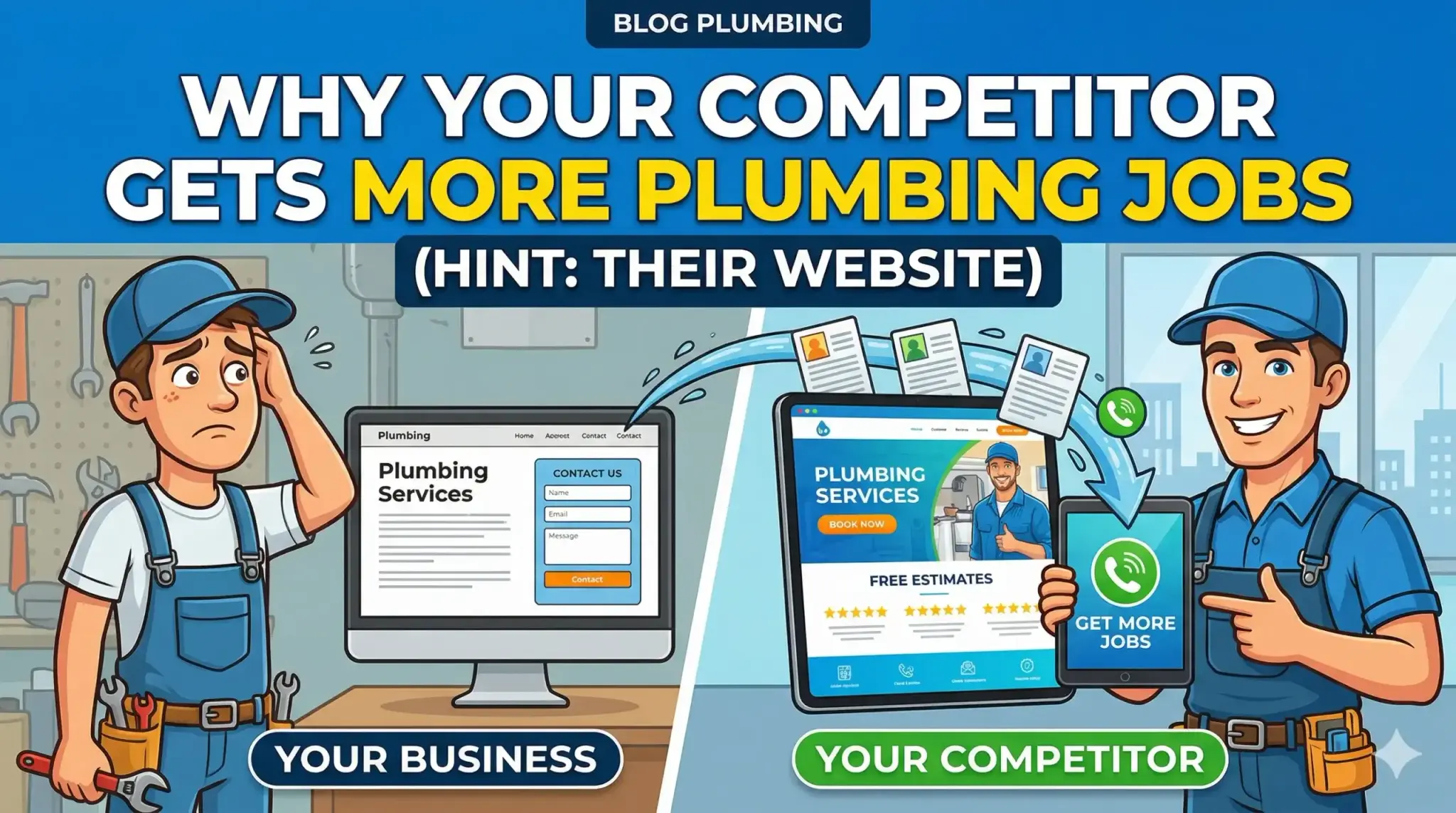
You’ve got a website. Maybe it cost you a few hundred bucks, maybe a few thousand. You figured having something online was enough — and yet the phone isn’t ringing the way it should. Meanwhile, you know your competitor two towns over stays booked out two weeks in advance, and you can’t figure out why.
Here’s what most plumbing business owners get wrong: they think having a website is the finish line. It’s not. A website that doesn’t work is like a service van with no signage — it exists, but it’s not doing anything for your business.
The good news? You don’t need to throw money at Google Ads to fix this. The real problem — and the real solution — lives in your plumbing website design. Get that right, and your website becomes your best salesperson, running 24 hours a day without commission.
This guide breaks down exactly what’s costing you leads right now, and what a properly built plumbing company website actually looks like.
Your Website Loads Too Slowly — And You’ve Already Lost the Customer
Picture this: a homeowner’s pipe bursts at 7pm. They grab their phone, search “plumber near me,” and your site comes up. They tap it. It takes five seconds to load. They hit the back button and call your competitor.
That’s not a hypothetical. That’s happening to plumbing businesses with slow websites every single day.
Most people will leave a website if it doesn’t load within three seconds on mobile. They’re not being impatient — they’re just stressed and in a hurry, which is exactly the mindset of someone who needs a plumber.
The technical reason is usually oversized images, bloated code, or cheap hosting that can’t keep up. The fix isn’t glamorous, but it’s critical: fast hosting, compressed images, and clean code.
Websites built for plumbing businesses by Digital Trace are built for speed from day one — because a half-second improvement in load time can be the difference between a new customer and a missed call.
Your Site Looks Fine on a Computer — But Your Customers Are on Their Phones
More than 70% of local service searches happen on mobile. When someone needs a plumber, they’re not sitting at a desk — they’re standing in a wet basement, reaching under a leaking sink, or on the phone with their landlord.
If your website doesn’t work perfectly on a phone, you’re invisible to most of your potential customers.
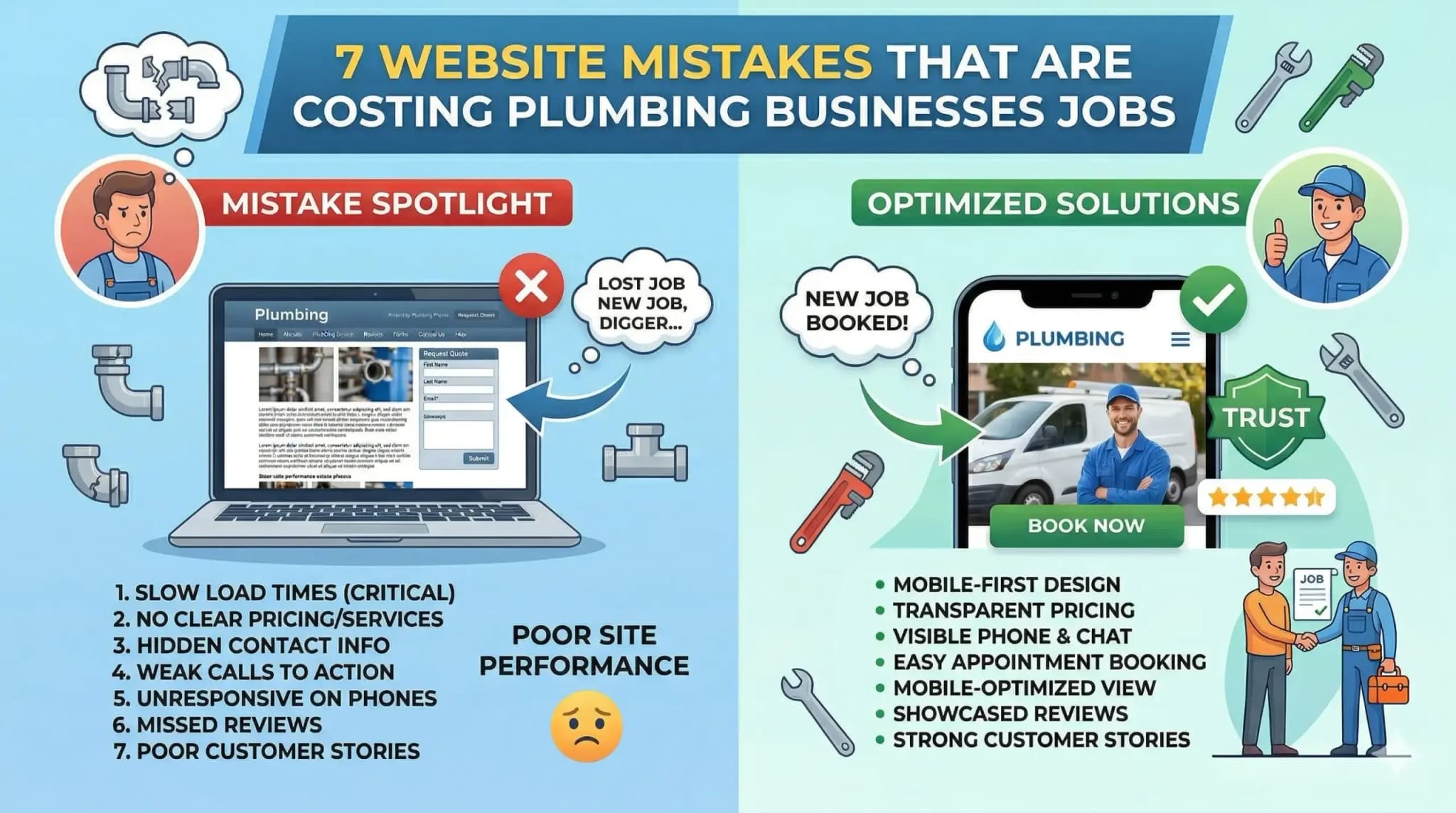
Bad mobile experience looks like:
- Text too small to read without zooming
- Buttons that are hard to tap
- Phone numbers that aren’t clickable (so customers have to manually dial)
- Forms that don’t fit the screen
A proper mobile-first plumbing website makes it effortless to call you in one tap, request a quote in under a minute, and find your service area instantly — even on a 4G connection in a basement.
Google Doesn’t Know Enough About Your Business to Recommend It
When someone searches “emergency plumber in [your city],” Google is making a split-second decision about which businesses to show. If your site doesn’t give Google clear, structured signals about who you are, what you do, and where you serve, Google defaults to showing someone else.
This isn’t about keyword-stuffing your homepage. It’s about giving Google the specific information it needs:
- What services you offer (drain cleaning, water heater repair, pipe replacement, etc.)
- What areas you serve — by city, zip code, or neighborhood
- How long you’ve been in business
- That you’re a legitimate, trusted local business
There’s a technical layer here called schema markup — essentially a set of invisible tags on your website that tell Google “this is a plumbing business, this is their service area, this is their phone number.” Without it, Google is guessing. With it, Google gets confident and starts recommending you.
This is one of the most commonly missed fixes on plumbing sites, and one of the first things checked in a Digital Trace website audit.
💡 Pro Tip: Your Homepage Might Be Talking to Everyone — Which Means It’s Convincing Nobody
A common mistake plumbing businesses make is building one generic homepage that tries to cover everything: residential, commercial, emergency, installation, repair. The result is a page that’s vague, unfocused, and doesn’t rank well for any specific search.
The fix? Dedicated pages for your most important services. A separate page for water heater repair, one for drain cleaning, one for emergency plumbing. Each page speaks directly to a customer with that specific problem, and each page has a real shot at ranking on Google for that specific search.
You’re Not Showing Up When It Matters Most — Emergency Searches
“Emergency plumber open now.” “Plumber near me tonight.” These are the searches where someone is ready to hire right now — no shopping around, no waiting. They want the first credible option they see.
Ranking for emergency and after-hours searches isn’t luck. It comes down to a few things your website needs to get right:
- Clear messaging that you offer emergency or same-day service (above the fold, not buried)
- A click-to-call phone number visible on every page
- Local SEO signals that tell Google you serve specific neighborhoods or cities
- Fast load times (see above — emergencies don’t wait for a slow website)
If your site buries your phone number or makes people scroll to find out if you’re available after 5pm, you’re losing those high-intent jobs to someone else.
The Real Cost of a Website That “Just Exists”
Here’s a realistic scenario that plays out across the US every day.
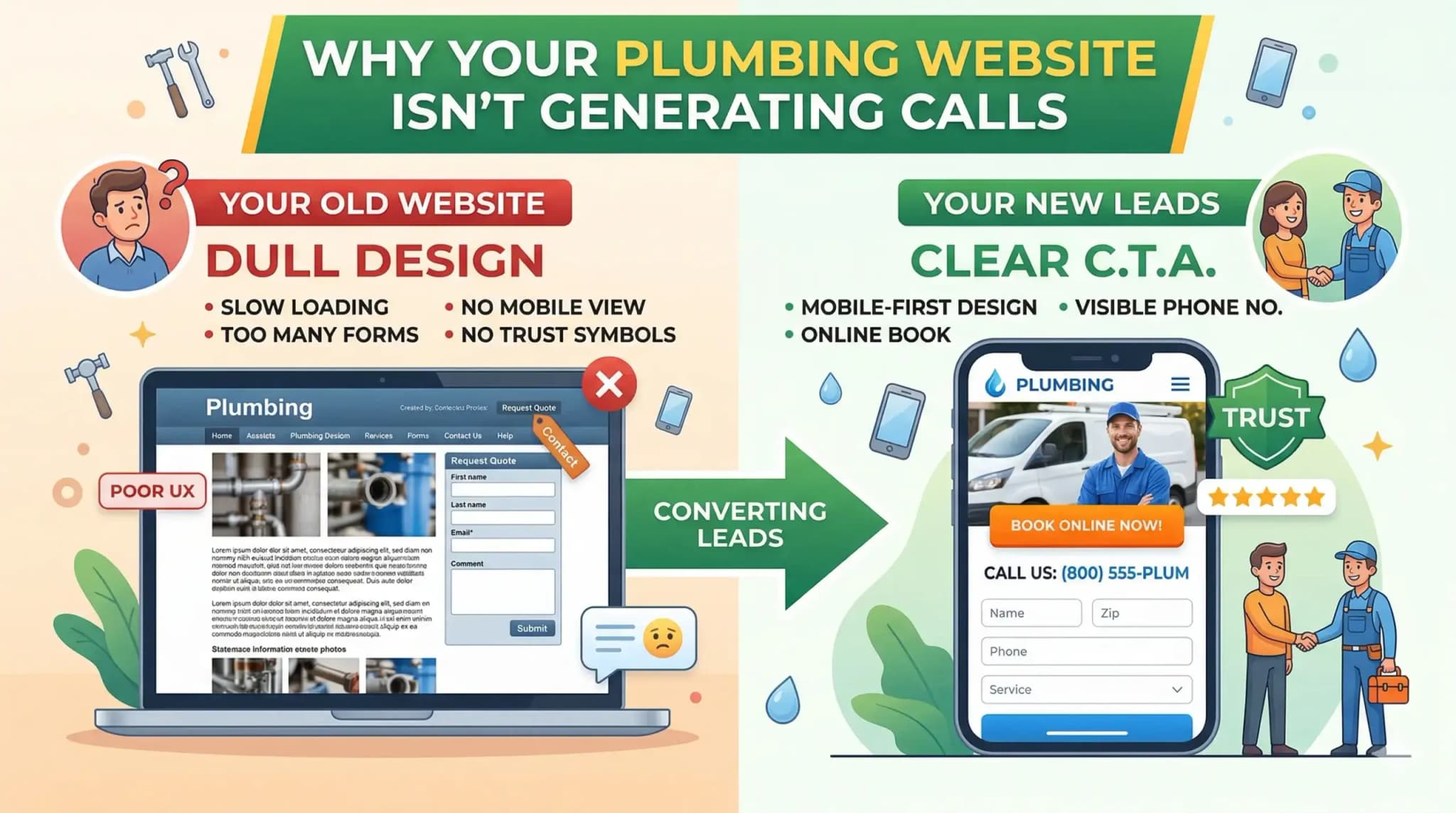
Before: A family-owned plumbing company in Ohio had a website built five years ago. It looked decent on desktop, but the owner never knew it was nearly unusable on mobile. The site took 6+ seconds to load on a phone, the “Contact Us” button was buried at the bottom, and the site had no individual pages for services like water heater replacement or sewer line repair. They were running Facebook Ads just to stay busy — spending around $1,200/month just to keep the phone ringing.
After: After rebuilding with a mobile-first design, clean service pages, and proper local SEO structure, the same company started showing up in the top three results for “water heater repair [city]” and “emergency plumber [city]” without paying for clicks. Within four months, they had cut their ad spend in half and were generating more calls than before — from organic traffic alone. The biggest change? A click-to-call button at the top of every page. Simple, but it doubled contact form submissions and calls from mobile users.
Not sure if your plumbing website has these issues? Get a free website audit — no obligation, just a clear picture of what’s costing you leads.
Your Path to More Leads: What to Do Next
You don’t need to overhaul everything overnight. Here’s what actually moves the needle, in order:
- Test your site on mobile. Pull it up on your own phone right now. Can you tap the phone number to call? Does it load in under 3 seconds? If not, that’s your first fix.
- Make your phone number impossible to miss. It should be at the top of every page, clickable on mobile. Not in the footer. Not hidden. Right there.
- Create a page for each of your main services. Don’t lump drain cleaning, water heater repair, and emergency plumbing all on one page. Give each one its own URL, its own content, its own chance to rank.
- Claim and optimize your Google Business Profile. Make sure your hours, service area, and services are up to date. Add photos. Respond to reviews. This is free and directly tied to how often you show up in local searches.
- Get a professional audit of what’s actually broken. Most plumbing business owners don’t know what’s costing them leads — because the issues are invisible until you know where to look.
Learn how Digital Trace builds websites for plumbing companies built to rank, convert, and grow — without paid ads as a crutch.
FAQ: Real Questions from Plumbing Business Owners
Why am I not getting calls from my website?
Usually it comes down to one of three things: the site loads too slowly and people leave before they see your number, your site doesn’t rank for the searches your customers are actually typing, or your contact options aren’t obvious enough on mobile. Most of the time it’s a combination of all three.
How do I know if my plumbing website is actually working?
If you can’t answer “how many calls or form submissions did my website generate last month,” your site probably isn’t working. A website that’s doing its job will have clear tracking in place and will consistently drive inbound contacts — not just sit there looking professional.
How long does it take to see results from a new website?
For local SEO, most plumbing businesses start seeing meaningful movement within 60 to 90 days of launching a properly optimized site. Emergency and high-intent keywords can move faster. Paid ads are faster than organic, but a well-built site compounds over time — you keep getting leads without paying per click.
What makes a plumbing website different from a regular business website?
Plumbing customers are often in a hurry, stressed, and searching on mobile. Your website needs to be built for that specific behavior: fast loading, clear emergency availability messaging, service-specific pages, and a frictionless way to contact you in one tap. A generic business template doesn’t account for any of that.
Do I really need a fast website if my customers are local?
Yes — especially because your customers are local. Local searches almost always happen on mobile, often in urgent situations. Google also uses page speed as a ranking factor for local results. A slow website doesn’t just frustrate visitors; it actively hurts where you show up in search.
How do I know if I need a new website or just some fixes?
That depends on what’s under the hood. Some sites just need targeted improvements — faster hosting, better service pages, improved mobile layout. Others have issues deep enough that starting fresh is actually more efficient. The fastest way to find out is a proper audit. Request your free website audit here and get a clear picture of where you stand.
Ready to Find Out What Your Website Is Really Costing You?
Most plumbing businesses have no idea how many leads they’re losing every week — because the problem is invisible. No error message, no alert. Customers just silently leave and call someone else.
A free website audit from Digital Trace shows you exactly what’s happening: where visitors are dropping off, why Google isn’t ranking your site, and what it would take to turn your website into a consistent source of inbound calls.
There’s no obligation. No sales pressure. Just a clear, honest look at what’s working and what isn’t.
Get your free plumbing website audit →
No risk. No fluff. Just answers.