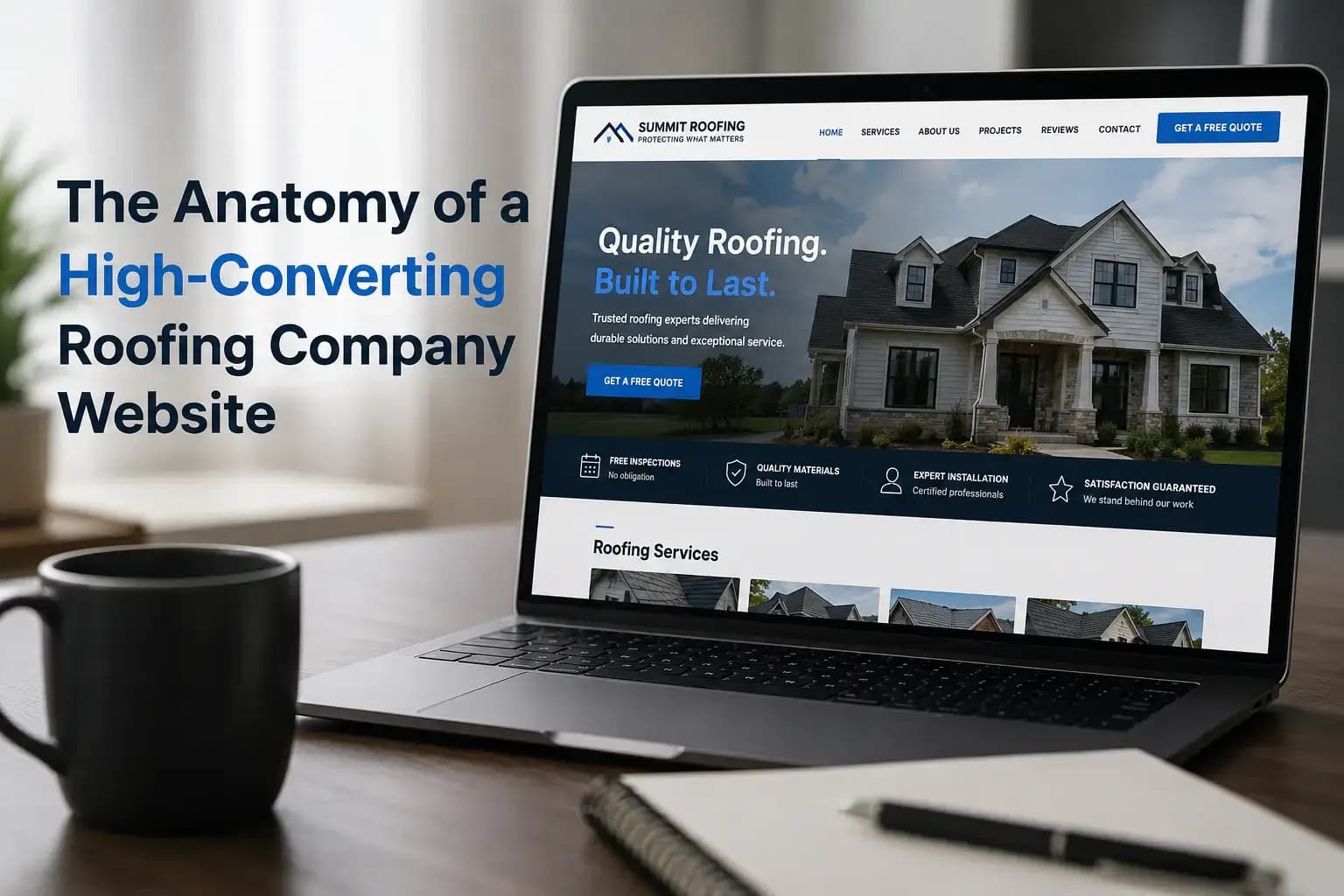
The Anatomy of a High-Converting Roofing Company Website
Your roofing crews show up on time. Your work is solid. You have reviews that back it up. So why is your phone quiet while another roofing company in your area stays booked three weeks out?
The answer is almost never your reputation — it’s your website. Most roofing business owners think of their website as a digital business card: something that just sits there looking decent. But the highest-performing roofing websites work like a tireless salesperson, fielding calls at 2 a.m. and turning strangers into paying customers before you even pick up the phone.
This guide breaks down — piece by piece — what separates a roofing website that generates leads from one that quietly bleeds revenue every single day. If you work with a skilled roofing website design agency, these are the exact elements they’ll build into your site from day one.
The First 5 Seconds Decide Everything
When a homeowner finds your site after a storm or a leak, they’re anxious and making a fast decision. If your site takes more than three seconds to load, most of them are already gone — they’ve tapped the back button and called your competitor.
This isn’t theory. It’s how people actually behave on mobile phones, which is where the majority of roofing searches now happen. A slow site isn’t a tech problem; it’s a missed call.
The technical reason this happens: most roofing websites are built on bloated templates loaded with unnecessary code, oversized images, and plugins that fight each other for processing time. A properly built roofing website strips all that out, compresses every image, and loads the most important content — your phone number, your headline, your call-to-action — within the first second.
What a high-converting roofing website does instead:
- Loads the core content in under 2 seconds on a mobile connection
- Places the phone number in the very first visible block — no scrolling required
- Uses a single, clear headline that tells visitors exactly who you serve and where
Your Homepage Is Failing to Answer One Question
Every visitor who lands on your roofing website is asking themselves a single, silent question: “Is this company right for me?” If your homepage doesn’t answer that in about four seconds, they assume the answer is no.
Think of it like a roof estimate. If a homeowner calls and your crew shows up with no business cards, no truck branding, no uniform — they’re going to feel uneasy before you even get on the ladder. Your website is that first impression before the estimate.
Most roofing websites pile on generic language: “Quality you can trust.” “Professional roofers.” “Serving your community.” This means nothing to someone who just had a branch punch through their shingles. What they want to see is: what you fix, where you work, and what makes you different from the three other roofing companies in the next tab over.
A homepage that converts should make three things instantly clear:
- What you do (residential repair, commercial roofing, storm damage, full replacements — be specific)
- Where you do it (your actual service cities or counties, not just “local area”)
- Why you over the next guy (licensed, insured, specific experience, real reviews with names and photos)
Missing Trust Signals Are Costing You Calls You Never Knew You Lost
Here’s something most roofing business owners don’t realize: people don’t call roofing companies they don’t trust. And trust on a website is built through very specific signals — most of which are missing from the average roofing site.
A homeowner handing over thousands of dollars for a new roof is taking a real risk. They’ve heard the horror stories — deposits taken, work left unfinished, fly-by-night contractors. Your website has about thirty seconds to convince them you’re not that.
Trust signals aren’t complicated, but they have to be visible without scrolling. Buried reviews and certifications in the footer don’t build confidence — they’re invisible.
Trust signals that actually move the needle for roofing businesses:
- Google reviews displayed directly on the site (not just a link to your Google profile)
- Photos of your actual crews and completed jobs — not stock photography
- Visible license numbers and insurance badges for every state you operate in
- A physical address (even a service area map builds credibility)
- Before-and-after job photos with brief captions about the specific problem solved
💡 Pro Tip
One of the most common mistakes roofing websites make is using stock photos of smiling homeowners or generic rooftops. Homeowners can spot these instantly, and they quietly signal that you’re hiding something. Replace every stock image with a real photo from a real job — even a smartphone photo of a finished ridge line tells more truth than a staged studio shot. Real photos build the kind of trust no template can manufacture.
Why Your Roofing Website Doesn’t Show Up When People Search
You can have the best-designed roofing website in your city, and it still won’t ring your phone if Google doesn’t know you exist. This is where roofing SEO comes in — and where most roofing business owners have been burned by agencies who promised rankings and delivered nothing.
Here’s the honest version: Google decides which roofing companies to show based on dozens of signals. Location. Reviews. How fast your site loads. Whether the words on your site match what people are actually searching for. Whether other websites link to yours. If any of those signals are weak, a competitor with a worse website can outrank you just because their digital foundation is stronger.
The most common SEO problem for roofing websites is this: the site uses the same vague language for every city. A page titled “Roofing Services” with no mention of your specific service area tells Google almost nothing. Compare that to a page specifically built around “roof replacement in [City, State]” that answers exactly the questions homeowners in that city are typing — that page wins.
What effective search engine optimization for roofing companies actually involves:
- Separate, well-written pages for each major service city (not just a list of cities in your footer)
- Your business name, address, and phone number consistent across your site and every online directory
- Optimized Google Business Profile that matches your website’s service areas exactly
- Clear page titles that include what you do and where — not just your company name
A Real Roofing Business, Before and After
Before: A family-owned roofing company operating in the Dallas-Fort Worth area had been in business for eleven years. Their website was built by a friend’s nephew in 2019. It loaded slowly, used the same generic headline as every other roofing site, and wasn’t showing up in local searches at all. The owner knew his reviews were good, but he couldn’t figure out why new customers said they’d “heard about him through a friend” — never from a Google search. He was running a six-person crew entirely on referrals, with zero leads coming in online.
After: The site was rebuilt from scratch with fast load times, city-specific service pages for every major metro area they covered, real job photos throughout, and trust signals placed above the fold. Within ninety days of the new site going live, organic search traffic was climbing. Within five months, the phone was ringing from Google searches — something that had never happened in eleven years. The owner added two new crews to handle the volume.
This isn’t a miracle. It’s what happens when a roofing website is built to actually work.
Not sure if your roofing website has these issues?
Get a free website audit — see exactly what’s costing you leads →
Your Path to More Leads
Getting your roofing website right doesn’t require a massive overhaul overnight. It requires hitting the right elements in the right order.
Step 1: Audit what you have. Before spending a dollar, find out what’s actually broken. Speed, trust signals, SEO — most roofing websites have problems in all three areas, but some are worse than others. Fix the most damaging ones first.
Step 2: Fix your mobile experience. More than half of roofing searches happen on a phone. If your site is hard to navigate on a small screen, hard to read, or forces someone to pinch-zoom to find your phone number, you’re losing jobs before they even call.
Step 3: Build pages for every city you actually want to work in. If you want jobs in five cities, you need at least five pages that specifically talk about roofing in those cities. Generic “service area” pages don’t rank. Specific, well-written city pages do.
Step 4: Put real proof front and center. Move your best reviews, your best job photos, and your credentials above the fold. Stop hiding them at the bottom of the page where no one scrolls.
Step 5: Make it easy to contact you in every possible way. Phone number at the top. A contact form that actually works. A “Request a Free Estimate” button that’s visible on every page. The fewer clicks between interest and contact, the more leads you capture.
Frequently Asked Questions
Why am I not getting calls from my website even though it looks fine?
Looking fine and performing well are two completely different things. A website can look polished and still load slowly, rank nowhere in Google, and fail to give visitors a reason to trust you over a competitor. The most common culprit is a combination of slow load speed and missing SEO — both invisible to the business owner but obvious to Google and to impatient homeowners.
How do I know if my roofing website is actually working?
The simplest test: search for “roofing company [your city]” on your phone — not while logged into Google — and see if your site appears in the first five results. Then visit your own site on mobile and time how long it takes to load. If you can’t find yourself in search results and your site takes longer than three seconds, you’re losing leads daily. A free website audit will give you a complete picture without the guesswork.
How long does it take to see results after a new roofing website launches?
It depends on how competitive your market is, but most roofing businesses see meaningful movement in organic search within sixty to ninety days of launching a properly built site with solid SEO. Some see calls within the first month. The key is launching with everything in place — fast load times, city-specific pages, optimized Google Business Profile — rather than making changes piecemeal.
What makes a roofing website different from a regular small business website?
Roofing is a high-trust, high-ticket, often-urgent purchase. A homeowner dealing with storm damage isn’t browsing casually — they’re panicked, comparing three companies at once, and ready to call the first one that feels credible and local. Roofing websites need trust signals that other small businesses can get away without: license badges, real job photos, visible reviews, and hyper-local content that shows you actually know their neighborhood.
Do I really need a fast website if most of my customers are local?
Yes — especially because they’re local. Local customers search on their phones, often in the moment a problem happens. If your site loads in five or six seconds, they’re already looking at your competitor’s site. Google also uses page speed as a ranking factor, which means a slow site doesn’t just frustrate visitors — it actively prevents you from showing up in the searches that would bring them to you in the first place.
How much does a roofing website actually cost, and is it worth it?
A properly built roofing website — fast, SEO-optimized, conversion-focused — is an investment, not an expense. The right question isn’t what it costs; it’s what a single roofing job is worth to you. If one new roof replacement is worth $8,000 to $15,000, and a well-built website generates two or three of those per month from organic search alone, the math answers itself. The websites that don’t pay off are the ones built cheap, with no SEO, and no strategy behind them.
Ready to Stop Guessing and Start Growing?
Your roofing business does great work. The problem is that nobody searching for a roofer online can tell that from your current website.
A high-converting roofing website isn’t about having a site that looks impressive — it’s about having one that loads fast, shows up in search, earns trust in seconds, and gives people a clear reason to call you instead of the next name on the list.
If you’re not sure whether your site is working or quietly losing you business, the first step is finding out for free.
Ready to find out what’s costing your roofing business leads?