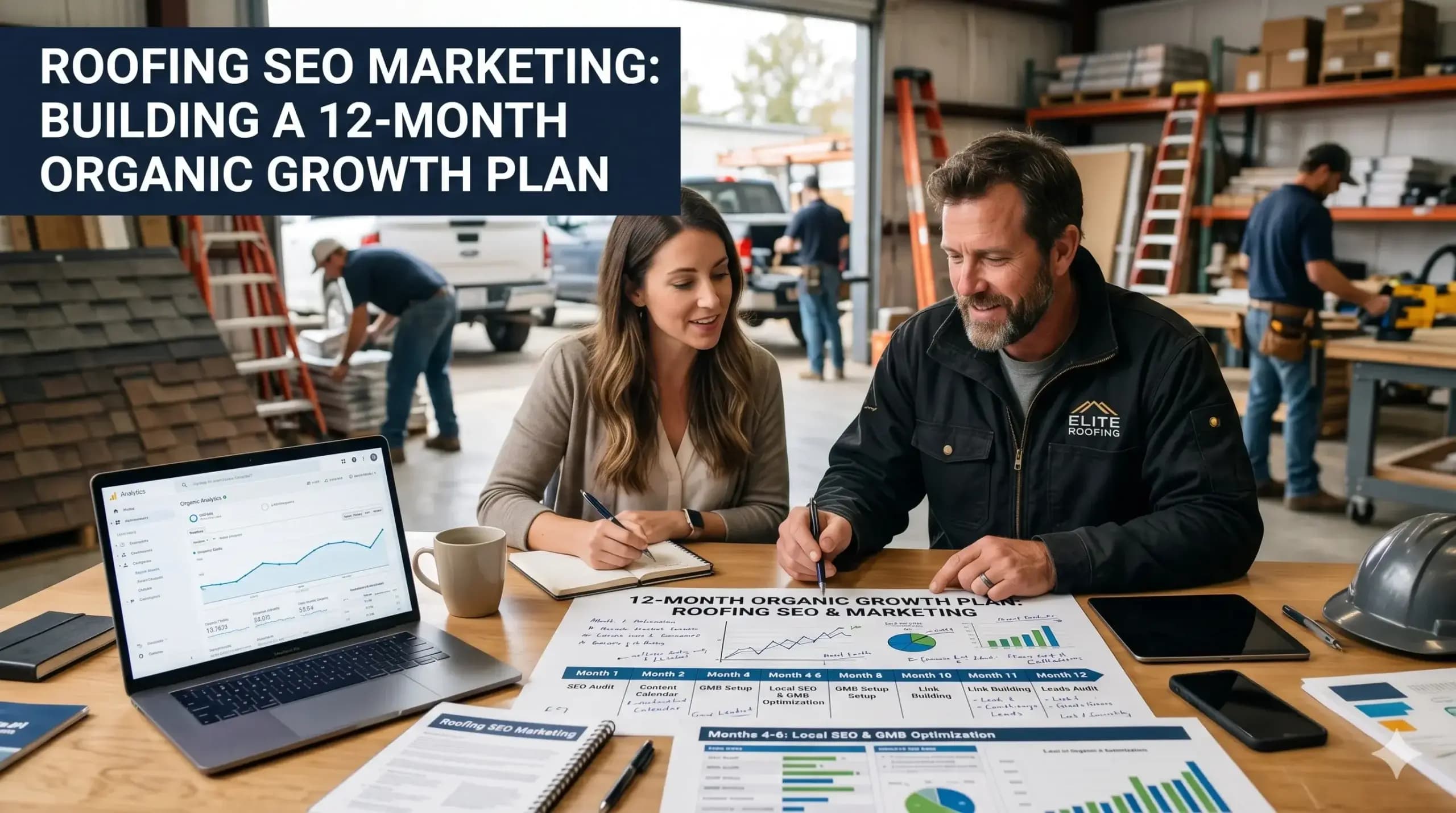
Roofing SEO Marketing: Building a 12-Month Organic Growth Plan
Your truck is wrapped. Your work is good. Your customers refer you. So why does your competitor — the one you know does mediocre work — keep showing up on Google while you don’t?
Most roofing business owners assume it’s about spending more on ads. But the real problem is usually something quieter: your website isn’t built to earn trust from Google, and it isn’t built to convert the homeowners who do find it.
Roofing SEO isn’t about gaming an algorithm. It’s about making sure that when a homeowner in your service area types “roof repair near me” at 7pm after a hailstorm, your name is the one they see — and your website is the one that makes them pick up the phone.
This guide lays out a realistic, 12-month approach to organic growth that roofing companies across the US can follow — step by step, no technical degree required.
Why Your Phone Isn’t Ringing (Even When You’re “On Google”)
A lot of roofers have a Google Business Profile. Some even have a website. But showing up somewhere on page two for your town’s name isn’t the same as being found.
Here’s the reality: most homeowners never scroll past the first three results. If you’re not in that pack — or in the map results above it — you’re invisible to the people who are ready to buy right now.
The gap between “being on Google” and “getting calls from Google” comes down to how well your entire digital presence is optimized — your website speed, your local signals, your content, and your reputation online. Most roofing websites are missing at least two or three of these.
Month 1–2: Your Website Is Either a Sales Tool or a Dead End
Think of your website like a roofing estimate. A homeowner gets three quotes. Two contractors show up with a clean proposal, clear pricing breakdown, photos of past work, and a professional vibe. The third hands over a wrinkled piece of paper with a number on it.
Your website is that estimate. First impressions happen in under three seconds.
If your site takes more than three seconds to load, most visitors leave before they ever see your phone number. This isn’t a design opinion — it’s how people actually behave on mobile, where most roofing searches happen.
What a high-converting roofing website needs:
- A phone number visible above the fold on every page, especially on mobile
- Clear service areas listed (not just your city — surrounding towns too)
- Before/after project photos that load quickly and look professional
- A simple contact form that works on every device
- A page for each major service (roof replacement, storm damage, gutters, etc.)
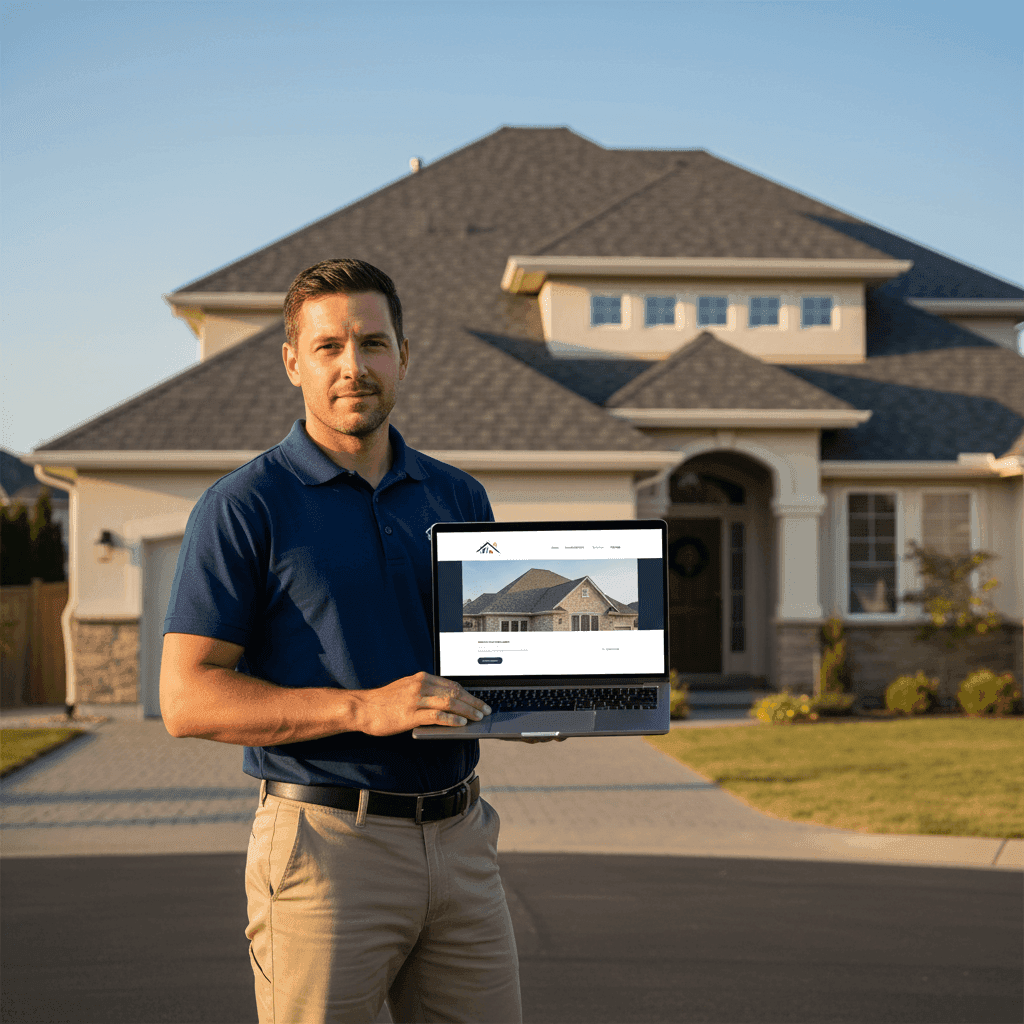
At Digital Trace, websites built for roofing businesses are built around these conversion principles from the ground up — not as an afterthought.
Month 2–4: Google Needs to Know Exactly Where You Work
Google is essentially a matchmaker. It wants to connect homeowners with the best local roofer for their specific area. But if your website only mentions your city name once — buried in the footer — Google isn’t confident enough in the match to show you prominently.
This is where local SEO comes in, and it’s one of the highest-leverage things a roofing company can fix.
The foundation of local roofing SEO:
- A fully completed Google Business Profile with real photos, updated hours, and accurate service areas
- Your business name, address, and phone number matching exactly across your website, Google, Yelp, HomeAdvisor, and every other directory
- Dedicated pages on your website for each town or county you serve — not just one generic “service area” page
- Consistent reviews coming in over time (not a one-time surge)
The reason your competitor shows up ahead of you isn’t always because they have a better website. Often it’s because their local signals are cleaner and more complete than yours.
💡 Pro Tip
One of the most common mistakes roofing companies make is inconsistent business information across the web. If your address is listed as “Suite 100” on your website but “Ste. 100” on Yelp and missing entirely on HomeAdvisor, Google sees three different businesses — and trusts none of them fully. A quick audit of your directory listings can uncover this invisible problem and fix it fast.
Month 4–6: Content That Answers What Homeowners Are Actually Asking
Homeowners don’t search “roofing SEO.” They search “how long does a roof replacement take” or “does homeowner’s insurance cover storm damage repair” or “best roofing company in [their town].”
If your website has no answers to these questions, you have no reason to show up when they ask.
Creating content isn’t about blogging for the sake of it. Every page or article you publish is a chance to appear in front of a homeowner at the exact moment they need a roofer.
High-value content topics for roofing companies:
- “How to file a roof damage claim after a storm” (high intent, high trust)
- “Signs you need a full roof replacement vs. a repair”
- “What to expect during a roof inspection”
- “How long does a new roof install take?”
Each of these pulls in homeowners who are actively researching — which means they’re close to hiring someone. Being the company that answered their question builds trust before they even call you.
Month 6–9: What Google Sees That You Don’t
There are signals Google uses to rank websites that you’d never notice just by looking at a page. These are behind-the-scenes factors that, when missing, quietly cost you position after position in the rankings.
Two of the most common ones for roofing sites:
Your site isn’t telling Google enough about your business. There’s a simple piece of structured data (called schema markup) that you can add to your site which tells Google that you’re a local roofing business, where you’re located, what your hours are, and what services you offer. Without it, Google is guessing. With it, you often see star ratings, phone numbers, and business hours appear directly in search results — which dramatically increases clicks.
Your site isn’t earning trust from other websites. When reputable local sites — the Chamber of Commerce, local news outlets, supplier directories — link to your website, Google counts those as votes of confidence. Most roofing websites have almost none. Building even a handful of quality local links can move the needle significantly over six to nine months.
Month 9–12: Reviews, Reputation, and Ranking Together
Reviews aren’t just social proof for homeowners. They’re a ranking signal for Google.
A roofing company with 85 reviews and a 4.8 average will outrank a competitor with 12 reviews — even if the competitor’s website is technically better. Google treats review volume and recency as a signal that a business is active and trusted by real customers.
The mistake most roofing companies make is hoping reviews happen on their own. They don’t — at least not consistently enough to build momentum.
A simple review system that works:
- Ask every customer for a review immediately after job completion, while satisfaction is highest
- Send a direct link to your Google Business Profile review page via text (not email — open rates are much higher)
- Respond to every review, positive or negative — this signals to Google that you’re active and engaged
A roofing company with a growing stream of real reviews is building a compounding asset. Every new review makes the next lead a little more likely to call.
A Before/After: What This Looks Like in the Real World
A mid-size roofing company based in the Dallas-Fort Worth area came to Digital Trace with a familiar problem. They’d been in business for nine years, had great word-of-mouth, and a website they’d paid $1,500 for back in 2018. Their Google Business Profile existed but hadn’t been updated in two years.
They were generating most of their leads through referrals and a few expensive paid ads — but organic traffic was essentially zero.
Within the first 90 days, Digital Trace rebuilt their site with fast load times, clear service pages for each of their six service counties, and a mobile-first design built around conversion. Their Google Business Profile was fully built out, directory listings were cleaned up, and five new service area pages went live.
By month six, they were ranking in the local map pack for eleven target keywords across three counties. By month nine, inbound calls from organic search had gone from near zero to roughly 25–35 per month — without any paid ads running.
The referrals kept coming. But now organic search was working alongside them.
Not sure if your roofing website has these issues? Get a free website audit — no obligation, just a clear picture of what’s costing you leads.
Your Path to More Roofing Leads: 5 Steps That Actually Move the Needle
Step 1: Fix your website’s foundation. Speed, mobile usability, and a visible phone number aren’t optional — they’re the baseline. If your site is slow or hard to navigate on a phone, no amount of SEO will save it.
Step 2: Lock down your local presence. Clean up your Google Business Profile, make sure your information is consistent across every directory, and start asking every happy customer for a review.
Step 3: Create a page for every service area you work in. One city page isn’t enough. Every town you serve regularly deserves its own page with localized content.
Step 4: Publish content that answers real homeowner questions. You don’t need to blog every week. Even four to six well-written pages per year targeting common questions can generate consistent traffic over time.
Step 5: Track what’s working and double down. Use Google Search Console (it’s free) to see which searches are bringing people to your site. Double down on what’s gaining traction and keep building from there.
Frequently Asked Questions
Why am I not getting calls from my website even though I get some traffic?
Traffic and calls are two completely different things. A site can get visitors and still fail to convert them if the phone number isn’t prominent, the page loads slowly, or the site doesn’t clearly communicate what you do and where you work. The goal isn’t more traffic — it’s more qualified visitors who take action when they land.
How do I know if my roofing website is actually working for me?
If you don’t know where your last ten leads came from, your website isn’t being tracked properly. At minimum, you should have Google Analytics and Google Search Console set up so you can see how many people are finding your site, what they searched, and what they do when they arrive. Get a free website audit and we’ll show you exactly where your site stands.
How long does it take to see results from roofing SEO?
Honestly — it depends on where you’re starting. If your site is new and your local presence is thin, expect three to six months before you see meaningful movement. If your foundation is solid and you’re in a mid-size market, some wins can come faster. The key is that roofing SEO compounds over time. Month twelve looks very different from month one.
What makes a roofing website different from a regular business website?
Roofing is a local, high-trust purchase. Homeowners are making a $10,000–$20,000 decision after a stressful event like storm damage. Your website needs to communicate credibility fast — licenses, insurance, service areas, real project photos, and reviews. A generic template built for “small businesses” doesn’t account for any of that.
Do I really need fast website speeds if my customers are mostly local?
Yes — more than most industries. Over 70% of roofing searches happen on mobile, often right after a weather event when homeowners are stressed and moving fast. If your site takes five seconds to load on a phone, most people bounce before they see a single word. Speed isn’t a technical luxury; it’s directly tied to how many calls you get.
I’ve hired agencies before and nothing happened. Why would this be different?
That’s a fair question, and a common experience. Most agencies sell SEO as a generic service — the same playbook for a dentist, a plumber, and a roofer. How Digital Trace builds roofing websites is different because we work exclusively in the home services space and understand what drives calls for roofing companies specifically. The audit we offer isn’t a sales pitch — it’s a real look at what’s working, what isn’t, and what we’d do about it.
Ready to Find Out What’s Costing You Leads?
Most roofing companies have at least two or three fixable problems that are quietly draining calls every week — a slow site, inconsistent local listings, missing service area pages, or reviews that stopped coming in six months ago.
The audit is free. The call is short. And you’ll walk away with a clear picture of where your biggest opportunities are — no obligation to do anything about it.
See what’s costing you leads — and let’s build something that actually works for your roofing business.