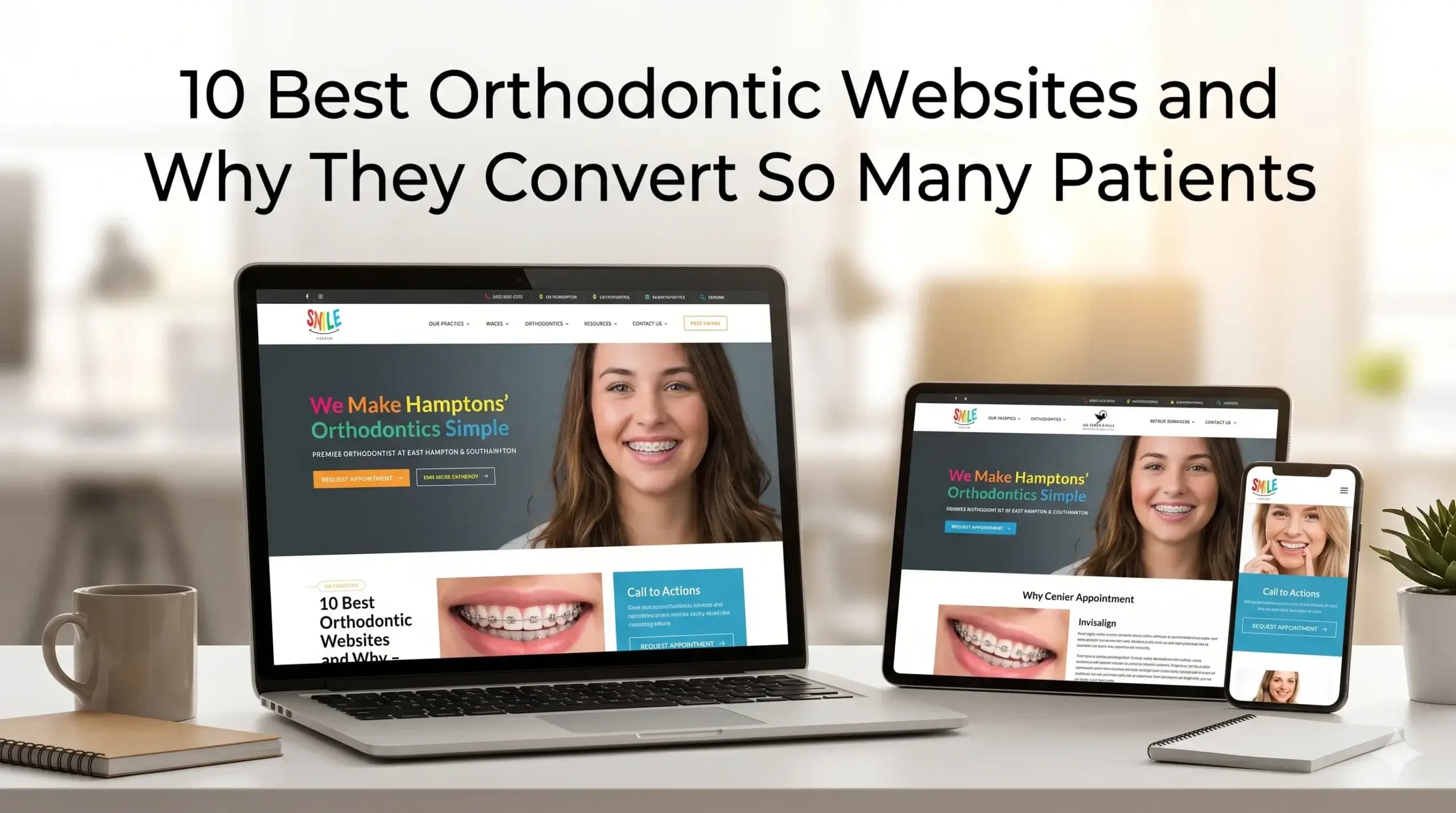
10 Best Orthodontic Websites and Why They Convert So Many Patients
Your waiting room is full on Tuesdays, but empty on Fridays. Your front desk tells you calls have been slow. You’ve spent money on a website — maybe even redesigned it in the last few years — but you still can’t tell if it’s actually bringing in new patients or just sitting there looking nice.
Most orthodontists assume their website is “fine.” The truth is, a site that looks fine and a site that actively books consultations are two completely different things. The gap between them is costing you real patients every single month.
This article breaks down what the best orthodontic websites actually do differently — and more importantly, what your site might be doing wrong that’s quietly draining your new-patient pipeline.
What Separates a Great Orthodontic Website From One That Just Exists
Think of your website like your front desk receptionist. A great one greets every visitor with confidence, answers their questions before they even ask, and walks them toward booking. A mediocre one just stares at them blankly until they leave.
Most orthodontic websites are the mediocre receptionist.
Here’s what the best ones do instead:
- They load fast — before the visitor’s patience runs out (usually within 3 seconds)
- They speak directly to the patient’s concern, not just the practice’s credentials
- They make the next step — booking, calling, requesting info — completely obvious
- They look and feel trustworthy on a phone screen, where most patients are browsing
The best orthodontic website design isn’t about flashy animations or trendy fonts. It’s about removing every possible obstacle between a nervous first-time visitor and a booked consultation.
The 10 Website Elements Top Orthodontic Practices Get Right
1. A Clear, Patient-Focused Headline Above the Fold
Most orthodontic websites open with something like “Welcome to Smith Orthodontics — Serving Families Since 2003.” That’s not what a nervous parent searching “braces for my teen” needs to see.
The best sites open with something that speaks directly to the patient: “Straighter Smiles, Faster Than You Think — Book a Free Consultation Today.” It tells the visitor they’re in the right place and what to do next — in one line.
What to check: Can a first-time visitor understand what you do, who you help, and what to do next within 5 seconds of landing on your page? If not, they’re leaving.
2. Mobile Design That Actually Works
More than 60% of people searching for an orthodontist are doing it from their phone. Yet most orthodontic websites are built for a desktop and then squeezed onto mobile as an afterthought.
The result: tiny buttons, text that runs off the screen, and a phone number that isn’t clickable. Every one of those friction points is a lost call.
The top orthodontic websites treat mobile as the primary experience — big tap targets, click-to-call buttons front and center, and forms that don’t require a stylus to fill out.
3. Speed That Doesn’t Test a Parent’s Patience
Your site loads too slowly — and most people leave in the first 3 seconds before they even see your phone number. This isn’t an exaggeration. Google’s own data consistently shows that conversion rates drop sharply with every additional second of load time.
Slow sites are usually caused by uncompressed images, cheap hosting, or outdated page builders. These are fixable. But most practices don’t realize it’s happening because the site loads fine on their office desktop — connected to fast Wi-Fi.
Test your site on a mobile connection. If it takes more than 3 seconds, you’re losing patients before they’ve read a single word.
4. Before-and-After Photo Galleries Done Right
Orthodontics is a visual specialty. Parents and teens want to see results. The best orthodontic websites feature real, high-quality before-and-after photos organized by treatment type — Invisalign, metal braces, ceramic braces.
What most practices do instead: a tiny gallery buried three clicks deep, or stock photos that don’t show real patient outcomes.
Your results are your best sales tool. If visitors have to hunt for them, they’ll go to a competitor whose results are front and center.
5. Offers That Reduce the Risk of Saying Yes
One of the biggest barriers a new patient faces is the fear of commitment. Orthodontic treatment is a significant investment. The best websites acknowledge this directly by leading with a low-risk first step: a free consultation, a complimentary records review, or a same-week exam.
Practices that bury their offer — or don’t have one at all — ask visitors to make a big decision with very little reassurance. The best orthodontic sites remove that hesitation with a clear, low-pressure invite.
6. Reviews and Social Proof Where Patients Can Actually See Them
Google reviews matter — but only if people see them. The best orthodontic websites don’t just hope patients will check Google before calling. They pull real reviews directly onto the homepage, near the booking button.
A nervous parent reading “My daughter loved her Invisalign experience — the team was so patient with her” right before clicking “Book Now” is far more likely to follow through than one who has to go searching for reassurance.
Pro tip: Don’t just show a star rating. Show the actual review text, with a real first name. Specificity builds trust.
7. Clear, Specific Service Pages for Each Treatment
When someone searches “Invisalign provider near me,” they don’t want to land on your generic “Services” page and hunt around. They want a dedicated Invisalign page that tells them: how it works, how long it takes, how much it costs (even a range), and what to do next.
The best orthodontic websites have individual, detailed pages for every major treatment. These pages rank better on Google, answer patient questions faster, and convert at a much higher rate than a catch-all services page.
8. A Booking System That Works at 11 PM
A busy mom doesn’t have time to call during office hours. She’s researching orthodontists after her kids are in bed. If your website doesn’t let her request an appointment online — or at least submit a form — you lose her to the practice that does.
The top orthodontic websites integrate with scheduling tools or offer a simple, fast contact form with same-day follow-up promises. The best ones confirm the request instantly with an automated response so she knows her inquiry was received.
9. Local SEO Signals Baked Into the Site
Google doesn’t know enough about your orthodontic practice to show it confidently in local search results — there’s a simple fix for that. It’s called structured data (or schema markup), and it tells Google exactly who you are, where you are, what you offer, and what your patients say about you.
Without it, your site is speaking to Google in a foreign language. With it, Google can surface your practice for “orthodontist near me” and specific treatment searches in your area with much more confidence.
This is one of the most consistently overlooked elements in orthodontic website design — and one of the highest-impact fixes available.
10. A Team Page That Shows Real People
Orthodontic care is personal. Patients — especially teens — want to know who’s going to be working on their teeth. The practices with the best-converting websites don’t hide their team behind stock photography or a generic paragraph.
They show real photos, real names, short bios that include personality, and sometimes a video introduction. It sounds simple. It works.
💡 Pro Tip: The One Page Most Orthodontic Websites Get Wrong
Nearly every orthodontic website has a homepage, a services page, and a contact page. Almost none of them have a well-optimized page for each specific treatment targeting their local area — like “Invisalign in [City]” or “Teen Braces [City].”
These local treatment pages are some of the highest-converting pages an orthodontic website can have, because they match exactly what a patient is searching for. Building them isn’t complicated, but it does require knowing how to structure them so Google reads them correctly and ranks them. This is a core part of how Digital Trace builds websites for orthodontic practices.
A Real-World Before-and-After: What a Better Website Actually Changes
Consider a two-doctor orthodontic practice in the Midwest — established for over a decade, strong word-of-mouth, but struggling to grow through digital channels. They had a website that had been built about six years prior. It looked acceptable on desktop, loaded slowly on mobile, had no online booking, and their team page featured photos that were nearly a decade old.
Their front desk was answering calls, but the practice owner noticed that new-patient call volume had plateaued despite more people in the area searching for orthodontists. They weren’t showing up in local searches for “Invisalign near me” or “braces for teens” — their two highest-margin services.
After a full redesign focused on speed, mobile experience, local treatment pages, and integrated scheduling:
- Mobile load time dropped from 8.4 seconds to under 2 seconds
- Online appointment requests went from near-zero to 20–30 per month within the first quarter
- Calls from new patients increased noticeably within 60 days of launch
- Their Invisalign page began ranking on the first page of Google for local searches within 90 days
The practice didn’t change their pricing, their team, or their marketing spend. They changed their website — and it started doing the work their old site never did.
Not sure if your orthodontic website has these issues? Get a free website audit — no obligation, just a clear picture of what’s costing you new patients.
Your Path to More New Patients: 5 Practical Steps
You don’t need to overhaul everything at once. Here’s where to start:
- Test your site on your phone, on mobile data. Not your office Wi-Fi. If it’s slow or hard to use, your patients are experiencing the same thing.
- Check if you can book online. If someone lands on your site at 10 PM on a Sunday, can they request an appointment? If the answer is no, you’re sending patients to whoever says yes.
- Find your reviews — and put them front and center. Don’t rely on patients to go looking for reassurance. Bring it to them, on the page where they make the decision to call.
- Search your own treatments locally. Type “Invisalign [your city]” and “braces [your city]” into Google. If your practice isn’t showing up, your site likely doesn’t have the pages or the signals Google needs to rank you.
- Talk to a web team that knows your industry. Orthodontic website design isn’t the same as building a restaurant site or a law firm site. The questions patients ask, the barriers they face, and the conversion paths that work are specific to your specialty.
Frequently Asked Questions
Why am I not getting calls even though I have a website?
Having a website and having a website that works are different things. Most orthodontic sites are built to look good — not to guide a visitor toward booking. If your site loads slowly, doesn’t work well on mobile, or doesn’t make the next step obvious, visitors leave without calling. A free audit can show you exactly where the drop-off is happening.
How do I know if my orthodontic website is actually bringing in patients?
If you can’t tell — that’s already a problem. Your website should be trackable. You should know how many people visit, where they come from, which pages they view, and how many contact you. If you’re not looking at this data monthly, you’re flying blind on one of your biggest marketing assets.
How long does it take to see results from a new orthodontic website?
Most practices start seeing improvements in inquiry volume within 60–90 days of launching a properly built site. Local SEO results — ranking for searches in your area — typically build over 3–6 months. The important thing is that every month you delay, you’re losing patients to practices whose sites are already doing this right.
What makes an orthodontic website different from a regular business website?
Orthodontic patients have specific concerns: cost, time commitment, how treatment will look, whether their teen will cooperate. A great orthodontic website addresses these directly, with treatment-specific pages, real before-and-after results, financing information, and a booking process that reduces friction. A generic website template doesn’t do any of this well.
Do I really need a fast website if most of my patients are local?
Yes — especially because they’re local. Local searches on Google heavily favor sites that load fast and work well on mobile. Google’s ranking algorithm penalizes slow sites. And local patients browsing on their phones will leave just as fast as anyone else if your site takes 8 seconds to load. Speed isn’t a luxury; it’s a ranking and conversion factor.
How do I get started if I’m not sure what my site needs?
The easiest first step is a free audit. Book a free website audit with Digital Trace — it takes just a few minutes to request, and you’ll get a clear picture of what’s working, what isn’t, and what’s actually costing you new patients. No sales pressure, no obligation.
Ready to Find Out What Your Website Is Costing You?
Every week your orthodontic website underperforms is a week you’re handing new patients to competitors whose sites do the job yours doesn’t.
Digital Trace specializes in orthodontist website design — not generic web design, not sites built from templates that could belong to any practice in any city. We build fast, conversion-focused websites specifically for orthodontic practices across the US, backed by local SEO strategy that actually gets you found.
The first step is free, and it’s specific to your practice.
No obligation. No jargon. Just a clear, honest look at what your site is doing — and what it’s leaving on the table.