How Much Does Orthodontist Website Design Cost in 2026? (Complete Pricing Guide)
You invested years in your training, built a practice you’re proud of, and put up a website — and yet the phone isn’t ringing the way it should. Patients are out there searching for an orthodontist, but they’re booking with someone else.
Most orthodontists assume this is a budget problem. “We just need to run more ads.” But in the majority of cases, the problem is the website itself — not traffic, not marketing spend, not word-of-mouth. The website is either invisible to Google, confusing to visitors, or too slow to hold anyone’s attention long enough to call.
This guide breaks down exactly what orthodontic website design costs in 2026, what separates a site that generates patients from one that just exists, and how to know which category yours falls into. By the end, you’ll know what to spend, what to expect, and what questions to ask before hiring anyone.
Why Most Orthodontist Websites Don’t Actually Work
Think of your website the way you think about a patient’s first consultation. If the consult room is hard to find, the front desk seems confused, and the patient can’t figure out next steps — they leave. They don’t book. They go somewhere else.
Your website is that consultation experience, happening silently, 24/7, without you in the room.
A website that “doesn’t work” isn’t always one that looks bad. It’s one where:
- It takes more than 3 seconds to load on a phone (most patients are on mobile)
- The homepage doesn’t immediately answer “Do you treat adults/kids/teens?” and “How do I get started?”
- Google can’t confidently determine what you offer, where you are, or who you serve
- There’s no clear path from “landing on the page” to “booking a consultation”
The result? Visitors leave. Google stops ranking you. Your competitor — who may be a less experienced orthodontist — gets the call instead.
What Orthodontist Website Design Actually Costs in 2026
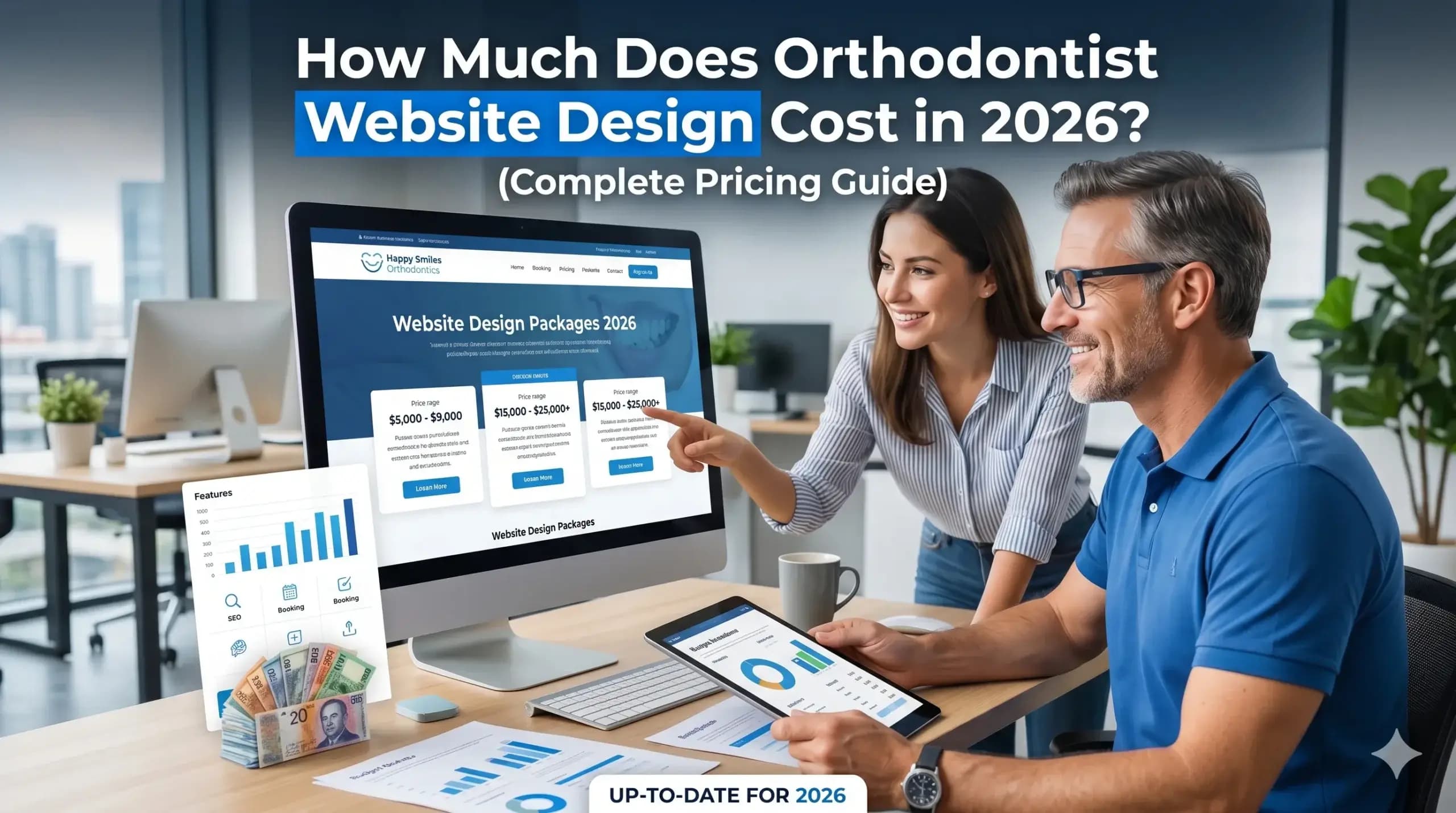
Pricing in this space ranges enormously, from a few hundred dollars to $20,000+. Here’s what those tiers actually deliver.
Tier 1: $500–$2,500 — Template Sites and DIY Builders
This is the Wix, Squarespace, or freelancer-on-a-budget range. You get a site that looks presentable on a desktop but typically:
- Loads slowly on mobile (where 70%+ of your patients are searching)
- Uses a generic template that looks identical to dozens of other practices
- Has no SEO strategy, no local optimization, no conversion structure
- Offers no ongoing support when something breaks or needs updating
For a practice doing $500K+ per year, this is the equivalent of printing your braces ad on napkins. It exists, technically.
Tier 2: $2,500–$7,500 — Mid-Range Custom or Semi-Custom Design
This is the most common range for small and mid-size orthodontic practices. At this level, you should expect:
- A custom design built around your brand and patient demographics
- Mobile-first build (designed for phones, not retrofitted)
- Basic local SEO setup — Google Business integration, location pages, correct contact structure
- Clear calls-to-action: “Book a Consultation,” “See Financing Options,” “Invisalign vs. Braces” comparison pages
- Integration with your scheduling platform
Quality varies significantly at this tier. The difference between a $3,000 site and a $7,000 site is often the depth of conversion strategy and the SEO architecture built in from day one — not just how it looks.
Tier 3: $8,000–$20,000+ — Fully Custom, Performance-Optimized Orthodontic Sites
At the top end, you’re investing in a site that’s engineered to generate patients, not just describe your practice.
This includes:
- Custom development with performance optimization (sub-2-second load times)
- Full local SEO buildout across all service areas
- Schema markup so Google understands and confidently displays your practice
- Content strategy targeting the specific searches your patients use (“affordable braces near me,” “Invisalign for adults,” “orthodontist that accepts Medicaid”)
- Conversion-focused design with A/B tested layouts
- Ongoing optimization, not a one-time handoff
Practices in competitive metro areas — Dallas, Chicago, Phoenix, Miami — often need this tier to rank and convert reliably.
The Real Difference Between a “Pretty” Site and One That Books Patients
Here’s a question worth sitting with: Is your website designed to impress other dentists, or to book patients?
Most orthodontic websites are built to look professional in a portfolio. The agency takes a screenshot, posts it to their Instagram, and moves on. Whether the site actually converts patients is rarely measured.
A site built to book patients works differently:
Speed first. If your site takes more than 3 seconds to load on a phone, more than half your visitors are already gone — before they’ve seen your name. This isn’t theoretical; it’s what Google’s own data shows repeatedly. Fast sites rank better and convert better.
Trust signals, immediately. New patients are anxious. They want to know: Do you treat kids? Do you offer payment plans? Are you taking new patients? Are you near me? These answers should appear above the fold — within the first screenful — without requiring anyone to scroll or click.
One clear next step. A confused visitor does nothing. Every page of your site should have one obvious action: “Book Your Free Consultation.” Not three options. Not a contact form buried in the footer. One button, one purpose.
See how Digital Trace builds websites built for orthodontist businesses →
What Most Orthodontic Website Agencies Don’t Tell You
Here’s where orthodontists commonly get burned.
You paid for design. You didn’t pay for results.
Many agencies deliver a beautiful website, hand over the keys, and disappear. The site may look excellent in a browser on a 27-inch monitor. But if it wasn’t built with SEO structure, mobile performance, and conversion logic from the start — it’s a brochure, not a patient-generation machine.
A design agency’s job ends at launch. A results-focused orthodontic web agency’s job starts there.
Your old site is costing you money right now.
A slow, poorly structured, or non-mobile-optimized website doesn’t just fail to bring in new patients — it actively costs you patients who found you and then left. If your site has a 70% bounce rate (most do), that means 7 out of 10 visitors are leaving without calling. On even 300 visitors a month, that’s 210 potential patients walking out the door each month.
Google needs to understand your practice before it will rank it.
There’s a common technical gap on most orthodontic websites called schema markup — essentially a set of invisible labels that tell Google what your business is, what it offers, where it’s located, and what hours it keeps. Without it, Google makes its best guess. With it, you appear with rich results: star ratings, hours, address — the kind of search result that gets clicked.
💡 Pro Tip: The #1 Mistake Orthodontists Make with Their Websites
Most orthodontists have one location page — if that. But patients search the way they think: “orthodontist in [neighborhood],” “braces near [zip code],” “Invisalign in [suburb].” If your website only targets your city name, you’re invisible to patients three miles away searching in their specific area. The fix is building dedicated location or neighborhood pages targeting the specific communities your practice serves. It’s one of the fastest ways to expand your local search footprint without spending more on ads.
Real-World Scenario: What a Better Site Actually Changes
Dr. Martinez runs a two-location orthodontic practice in the suburbs of Atlanta. Her practice had been open for eight years — great reputation, strong word-of-mouth, good reviews — but her website was built in 2019 and hadn’t been touched since.
The problems weren’t obvious from the outside. The site looked fine. But it loaded in 6.8 seconds on mobile, had no separate pages for her Marietta and Smyrna locations, and her Invisalign page was a single paragraph with no keyword structure.
After a redesign focused on performance, local SEO, and conversion:
- Mobile load time dropped to under 2 seconds
- Two location-specific pages were built targeting each service area
- Organic search traffic from “orthodontist Marietta” and “Invisalign Smyrna” moved from page 3 to page 1 within 4 months
- New patient consultation requests from the website increased from roughly 8 per month to 31 per month
The practice didn’t change. The word-of-mouth didn’t change. The ad spend didn’t change. The website did.
Not sure if your site has these issues? Get a free website audit — no obligation, just a clear picture of what’s costing you leads.
Your Path to More Patients: 5 Steps That Actually Work
Step 1: Audit what you have. Before spending anything, understand what’s broken. Speed, mobile experience, SEO structure, and conversion flow should all be evaluated. (This is exactly what the free audit covers.)
Step 2: Prioritize mobile performance. If your site loads in more than 3 seconds on a phone, that’s the first fix. Everything else is secondary.
Step 3: Build your local SEO foundation. Make sure Google knows exactly what you offer, where you are, and who you serve. This means properly structured location pages, accurate schema markup, and a Google Business profile that’s connected and optimized.
Step 4: Design around the patient decision — not the practice profile. Your homepage should answer the four questions every new patient has before they’ll call: What do you offer? Do you serve people like me? How do I get started? Can I afford this?
Step 5: Choose an agency that measures outcomes. Ask any agency you’re considering: “How will you measure whether this site is generating more patients?” If the answer involves traffic reports and rankings only — not consultation bookings — that’s a red flag. Results mean patients in chairs.
Learn more about how Digital Trace builds websites for orthodontist practices →
Frequently Asked Questions
Why am I not getting calls from my website even though it looks good?
Looking good and performing well are two different things. Most underperforming orthodontic websites have the same three problems: they load too slowly on phones (killing the user experience before it starts), they don’t clearly guide visitors to take action, and Google doesn’t rank them well because the SEO structure is missing or weak. A visual redesign without fixing these underlying issues won’t change your results.
How do I know if my orthodontist website is actually working?
If you don’t know how many consultation requests came from your website last month, your website isn’t being treated as a business tool — it’s being treated as wallpaper. A working site has measurable outcomes: form submissions, phone call tracking, and lead attribution. If your current agency can’t tell you those numbers, that’s a problem worth solving. A free website audit can show you exactly where patients are dropping off.
How long does it take to see results from a new orthodontic website?
Conversion improvements — more people calling from the same traffic — can happen within days of a better site launching. SEO results, meaning more people finding your site through Google, typically take 60–120 days to show meaningful movement, and 4–6 months to solidify rankings for competitive terms. Practices that combine a performance-optimized site with a strong local SEO strategy consistently see significant gains within the first two quarters.
What makes an orthodontist website different from a regular business website?
Orthodontic patients have specific anxieties: cost, treatment time, pain, whether their insurance is accepted, and whether the orthodontist specializes in their situation (kids vs. adults vs. complex cases). A website built specifically for orthodontic practices addresses these concerns directly — through treatment comparison pages, financing information, before/after galleries, and patient journey content — in a way a generic template never would. The conversion flow for an orthodontic practice is also different, because the goal is always a consultation booking, not an immediate purchase.
Do I really need a fast website if most of my patients are local and referred by word-of-mouth?
Yes — because even referred patients Google you before they call. A referral is not a guarantee. If someone’s friend recommends you and they pull up your website on their phone and it’s slow, cluttered, or hard to navigate, a meaningful percentage of them will quietly look at another practice instead. A slow website is a trust problem, not just a technical one.
What should I ask a web design agency before hiring them for my orthodontic site?
Ask three things: “Can you show me orthodontic websites you’ve built that rank on page one for local searches?” “How do you measure success after the site launches?” and “What happens when I need updates or something breaks — am I on my own?” Agencies that can’t answer these confidently have built sites, not results. The right partner treats your website as an ongoing asset, not a one-time project.
Ready to See What Your Website Is Costing You?
Your website is running right now — either working for you or working against you, around the clock. Most orthodontists are surprised to discover just how many leads their current site is quietly losing each month.
A free website audit from Digital Trace takes a clear-eyed look at your speed, local SEO, mobile experience, and conversion structure — and shows you exactly where the gaps are. No jargon, no sales pitch. Just a concrete picture of what’s holding your practice back online.
Get your free orthodontist website audit →
There’s no cost, no obligation, and no commitment. Just real answers about what your website is — and isn’t — doing for your practice.