Best Solar Website Design Practices to Get More Leads in 2026
You’ve spent money on panels, trucks, training, and a crew — and yet your website sits there like a brochure no one picks up. Homeowners searching “solar installation near me” are finding your competitors, getting quotes, and signing contracts. Not because your competitors do better work. Because their websites do a better job of converting curious visitors into paying customers.
Most solar business owners assume they just need more traffic. More ads. More posts. But the real problem is usually the website itself — slow pages, confusing layouts, missing trust signals, and calls-to-action buried so deep no one ever sees them. This article breaks down exactly what’s holding your solar website back and what a high-performing solar website design actually looks like in 2026.
Why Most Solar Websites Drive Visitors Away Instead of Calling You
Think of your website like a solar consultant walking into a homeowner’s living room. If that consultant mumbles, fumbles through papers, and can’t answer a simple question in under 30 seconds — the homeowner checks out. Your website works the same way.
When a homeowner lands on your site, they make a snap judgment in about 3 seconds. If the page is cluttered, takes forever to load, or doesn’t immediately answer “Can you help me save money on electricity?” — they hit the back button. They don’t give second chances.
Here’s what usually drives them away:
- A homepage that talks about the company instead of the customer’s problem
- Generic stock photos of solar panels with no local credibility markers
- No clear answer to: “How do I get a quote?”
- A phone number buried at the bottom of the page
The fix isn’t a total rebuild — but it does require rethinking what your homepage is actually supposed to do.
Your Website Speed Is Costing You Customers Right Now
Here’s something most solar business owners don’t realize: if your website takes more than 3 seconds to load, a large share of visitors leave before they’ve even seen your phone number. This isn’t theory — it’s well-documented user behavior that Google tracks and uses in rankings.
Why it happens: Images from your gallery, heavy video backgrounds, or outdated hosting can quietly bloat your site’s load time. On mobile (where most homeowners search), this gets even worse.
What it costs you: A homeowner searching on their phone after work, comparing three local solar companies, will simply call the one whose site loads first. They don’t wait. They don’t refresh. They move on.
What Digital Trace does instead: Every website built for solar businesses by Digital Trace goes through a performance audit — images are compressed, code is cleaned up, and hosting is configured to serve pages fast. Speed is a lead-generation tool, not just a technical checkbox.
Your Site Looks Fine on a Desktop. It’s a Mess on Mobile.
Over 60% of homeowners searching for solar services do it on a smartphone. If your site was designed five years ago, or designed by someone who only previewed it on a laptop, your mobile visitors are likely seeing broken layouts, tiny text, and buttons that are nearly impossible to tap.
The technical reason: Many older websites weren’t built “mobile-first.” The desktop version was designed first, then awkwardly scaled down for phones. That creates layouts where text overlaps, images cut off, and the quote form is basically unusable.
The real cost: A homeowner trying to fill out your contact form on their phone — and giving up — is a lost lead you never knew you had. There’s no notification that says “someone tried and failed.” They just vanish.
The better approach: Mobile-first design means your site works perfectly on a 6-inch screen before anything else. Tappable buttons, readable text without zooming, and a contact form that takes 30 seconds to complete — not 5 minutes of frustration.
💡 Pro Tip: Google Can’t Show Your Business Confidently — And There’s a Simple Fix
Many solar websites are missing what’s called “local structured data” — a small piece of code that tells Google your exact business name, service areas, phone number, and what you do. Without it, Google doesn’t fully understand your business, which makes it less likely to show you in local results when homeowners are searching.
The fix is a schema markup addition that doesn’t change how your site looks to visitors — but signals to Google that your solar business is legitimate, local, and worth showing. Most solar website owners don’t know this exists. Most of their competitors don’t either, which is exactly why fixing it can move the needle fast.
Why Your Competitor Shows Up on Google and You Don’t
You might have a better installation crew, better panels, and better reviews — but if your competitor’s site is better optimized for search, they win the click. Every time.
Google’s local results — the map listings and the top organic results — favor websites that have a few non-negotiable ingredients:
- Clear, location-specific pages: A page that says “Solar Panel Installation in [Your City]” outranks a generic homepage every time for local searches.
- Fast load times: (Covered above — but it’s also a ranking factor, not just a user experience issue.)
- Consistent business information: Your name, address, and phone number need to match exactly across your website, Google Business Profile, and any directories.
- Reviews woven into the site: Not just on Google — having testimonials and star ratings visible on your actual web pages builds trust with both visitors and search engines.
Solar business owners often say “We tried SEO and it didn’t work.” In most cases, what they tried was adding a few keywords to their homepage — without the structural groundwork that makes rankings stick.
Trust Signals: The Thing Between a Visitor and a Phone Call
A homeowner considering solar is making a big financial decision — $15,000 to $30,000 or more. They’re not just looking for the cheapest option. They’re looking for the safest one. Your website needs to answer the question: “Can I trust these people in my home?”
Most solar websites fail at this. Here’s what’s usually missing:
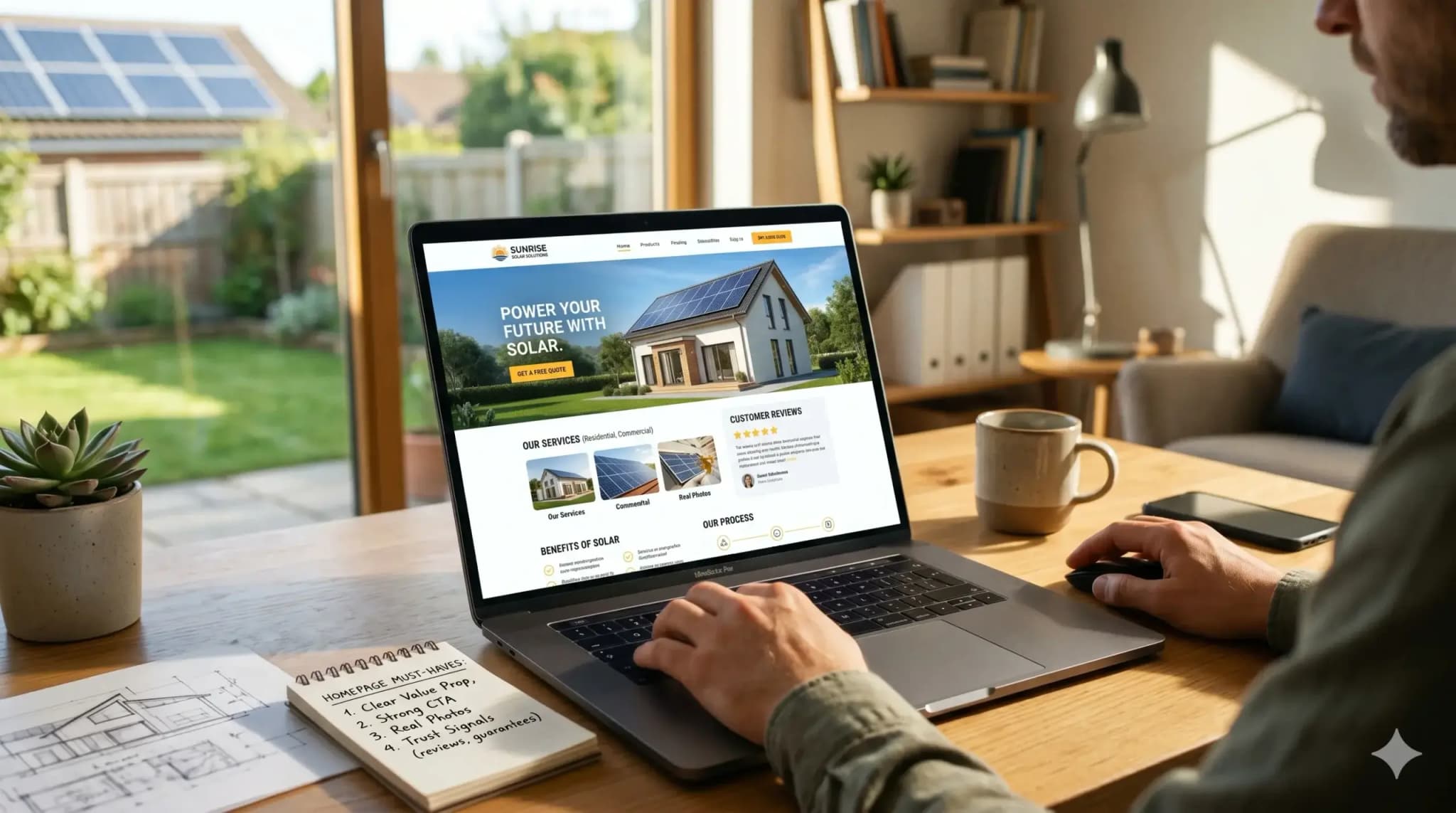
- Real photos of your team and actual completed installations — not stock images
- Specific reviews: “Great company” means nothing. “They saved us $180 a month starting in month two” is a reason to call
- Credentials and certifications: NABCEP certification, manufacturer partnerships, state licensing — these belong front and center, not buried on an About page
- A clear warranty explanation: Homeowners are worried about what happens if something breaks in year 5. Answer that question before they have to ask.
Every one of these elements is a reason for a visitor to stay — or leave. Adding them doesn’t require a redesign. It requires knowing what a solar buyer actually needs to see before they pick up the phone.
Before & After: What Happens When a Solar Website Actually Works
The situation: A residential solar installer in Texas was running Google Ads and getting decent traffic — around 800 visitors a month. But they were averaging only 3–4 inquiry form submissions per month. Their cost per lead was approaching $400, which made their ad spend barely worth it.
The problem: Their homepage had a 6-second load time on mobile, their contact form was on a separate page with no strong call-to-action pointing to it, and their site had no location-specific pages — just one generic homepage serving the entire metro area.
What changed: A performance overhaul cut mobile load time to under 2 seconds. Individual city pages were created for their three main service areas. Testimonials with real savings numbers were added to the homepage. The quote form was moved above the fold with a clear headline: “Find Out How Much You’ll Save — Free 20-Minute Assessment.”
The result: Within 90 days, monthly inquiries climbed from 4 to 22. Cost per lead dropped significantly. The same ad spend that was barely breaking even started producing a consistent pipeline of qualified homeowner leads.
The traffic didn’t change much. The website started doing its job.
Not sure if your solar website has these issues? Get a free website audit — no obligation, just a clear picture of what’s costing you leads.
Your Path to More Leads: 5 Practical Steps
You don’t need to do everything at once. Here’s where to start:
- Test your mobile experience right now. Pull up your own website on your phone and try to submit a contact form. Time yourself. If it takes more than 60 seconds or anything feels broken — that’s a problem to fix immediately.
- Make your phone number impossible to miss. It should be in the top-right corner of every page, clickable on mobile, and repeated near every call-to-action.
- Add one real customer story with real numbers. Not a generic “Great service!” quote — one specific story that shows a homeowner what their outcome could look like.
- Create a page for each city or metro area you serve. One generic homepage trying to serve three counties will rank for none of them. Specific pages rank for specific places.
- Book a free audit with Digital Trace. Before you invest in ads, content, or a full rebuild, know exactly what’s working and what isn’t. A free website audit from Digital Trace will show you the specific issues costing your solar business leads — and what to fix first.
Frequently Asked Questions
Why am I not getting calls from my website even though I get some traffic?
Traffic without calls usually means one of a few things: your site loads too slowly and people leave before they see anything, your call-to-action isn’t clear enough, or your site isn’t building enough trust for homeowners to take the next step. Getting visitors to your site is only half the job — converting them is the other half, and most solar websites are set up only for the first part.
How do I know if my solar website is actually working?
A working solar website converts visitors into inquiries. If you’re getting 500 visitors a month and fewer than 10–15 contact form submissions or calls, something is broken in the experience. Tracking where visitors drop off — and fixing those friction points — is what separates a website that generates leads from one that just exists online.
How long does it take to see results from a new or improved website?
Performance improvements like speed and mobile fixes can start impacting bounce rates within days. SEO improvements — like location-specific pages and structured data — typically take 60 to 90 days to show meaningful ranking movement. The combination of both is what delivers sustainable results, not just a short-term spike. Get a free website audit to understand your specific timeline based on where you’re starting.
What makes a solar website different from a regular business website?
Solar buyers are making a 15- to 30-year decision about their home. They need to see financial outcomes (savings, payback periods, incentives), trust markers (licenses, certifications, warranties), and social proof from real local homeowners — not just a pretty design. A generic website template doesn’t address any of that. A solar-specific site is built around the specific fears and questions a homeowner has before they’re ready to get a quote.
Do I really need a fast website if my customers are local?
Yes — especially if your customers are local. Local homeowners search on their phones while they’re thinking about it, often in the evening or weekend. If your site loads slowly on a mobile connection, they move to the next result before they’ve seen a single thing about your business. Speed is even more important for local businesses competing for the same searches in the same area.
I’ve been burned by agencies before. How is this different?
That’s a fair concern — and it’s worth asking directly. Digital Trace specializes specifically in solar website design, not generic web design for any business that walks in. That focus means the work is grounded in what actually drives solar leads, not just what looks good in a portfolio. The free audit is a no-pressure way to see exactly what’s holding your site back before committing to anything.
Ready to Stop Losing Leads You Don’t Know About?
Every day your solar website has a slow load time, a broken mobile experience, or missing trust signals — you’re handing potential customers to your competitors. Most of those leads never tell you they visited. They just leave.
A free website audit from Digital Trace shows you exactly where your solar website is losing leads, what it’s costing you in real revenue, and what to prioritize first. No jargon, no sales pitch — just a clear, honest picture of what’s working and what isn’t.
See what’s costing you leads — get your free audit today
There’s no obligation and no commitment. Just answers.