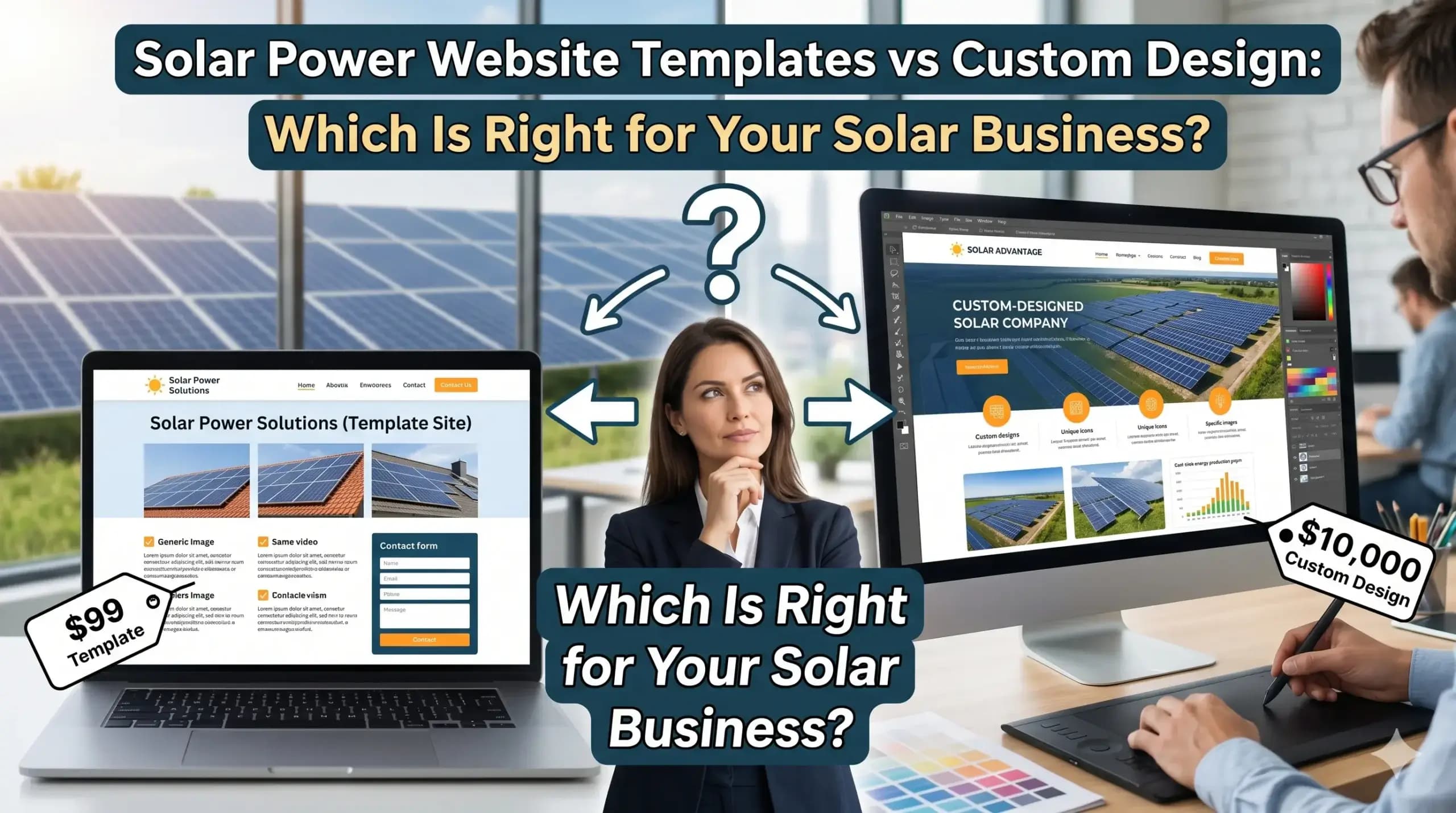
Solar Power Website Templates vs Custom Design: Which Is Right for Your Solar Business?
You spent good money on your solar business — panels, equipment, crews, certifications. But when a homeowner searches “solar installation near me” and finds your website, they’re gone in seconds. Not because your business isn’t great. Because your website isn’t doing its job.
Most solar companies fall into one of two camps: they grabbed a cheap template to “get something up,” or they paid a web agency a lot of money and still wonder why the phone isn’t ringing. Neither option is automatically right. The real question is: what does your solar website actually need to do — and is it doing it?
This guide breaks down exactly what separates a solar website that generates steady quote requests from one that just sits there. By the end, you’ll know which direction is right for your business and what to look for.
The Hidden Cost of “Good Enough” Solar Websites
You might think your website looks fine. It has your phone number, some photos of installs, maybe a contact form. That’s not the problem.
The problem is what happens before a visitor ever decides to call you.
A homeowner looking for solar installation is shopping. They’re comparing three or four companies in the same afternoon. Your website has roughly 5–7 seconds to answer the one question every prospect is silently asking: “Can I trust these people with a $25,000 purchase?”
A generic template with stock photos of solar panels and boilerplate text doesn’t answer that question. It raises doubt. And doubt means they click back and call your competitor instead.
This isn’t about aesthetics. It’s about conversion — turning visitors into calls, calls into consultations, consultations into signed contracts.
What Solar Power Website Templates Actually Give You
Templates have their place. If you’re a brand-new operation with zero budget and zero online presence, a template beats nothing. But here’s what you’re working with:
- The same design your competitor might be using. Many solar businesses use the same Squarespace, Wix, or WordPress themes. Prospects notice sameness — even subconsciously.
- Generic messaging baked in. Templates are built for no one in particular, which means they speak to everyone and convert almost no one.
- Speed and mobile issues out of the box. Templates are loaded with code for features you’ll never use. That extra weight slows your site down — and slow sites lose visitors before they even see your offer.
- No local SEO muscle. Templates don’t come pre-built to rank in your specific market. Getting found in Google requires structure that most templates skip entirely.
Templates are like buying a stock service van off a lot — it drives, but it’s not set up for your routes, your tools, or your crew.
What Custom Solar Website Design Actually Means (And Costs)
“Custom design” can mean anything from a $500 Fiverr job to a $50,000 agency retainer. The price tag alone tells you nothing.
What actually matters in a custom solar website design:
Speed built in from the start. A custom-built site is trimmed down to only what it needs. That means faster load times — which keeps visitors on the page long enough to read your offer and pick up the phone.
Messaging written for your specific customer. A homeowner in the Southeast worried about hurricane season has different concerns than a homeowner in Arizona focused on summer energy bills. Custom sites can speak directly to your market’s real objections.
Lead flow built around how solar buyers actually decide. Solar purchases aren’t impulse decisions. A good solar website design walks prospects through the trust-building steps they need — proof of work, financing options, local reviews, clear next steps — before asking them to commit.
Search visibility that compounds over time. A properly built site is structured so Google understands exactly what you do, where you do it, and why you’re worth showing to searchers. That structure is hard to retrofit onto a template.
The difference isn’t just what your site looks like on day one. It’s how much business it generates over the next two to three years.
The 4 Things Every Solar Website Needs to Convert Visitors into Leads
Whether you go template or custom, these four elements determine whether your solar website design actually works:
1. Speed — or visitors leave before they see your number. If your site takes more than 3 seconds to load on mobile, a significant portion of your visitors are already gone. Most solar buyers are researching on their phones. A slow site doesn’t just frustrate people — it signals that your business isn’t buttoned up.
2. A clear, compelling offer above the fold. The first thing a visitor sees — before they scroll — should answer: What do you do, who is it for, and why should I trust you? Most solar websites bury this. The result is confused visitors who bounce.
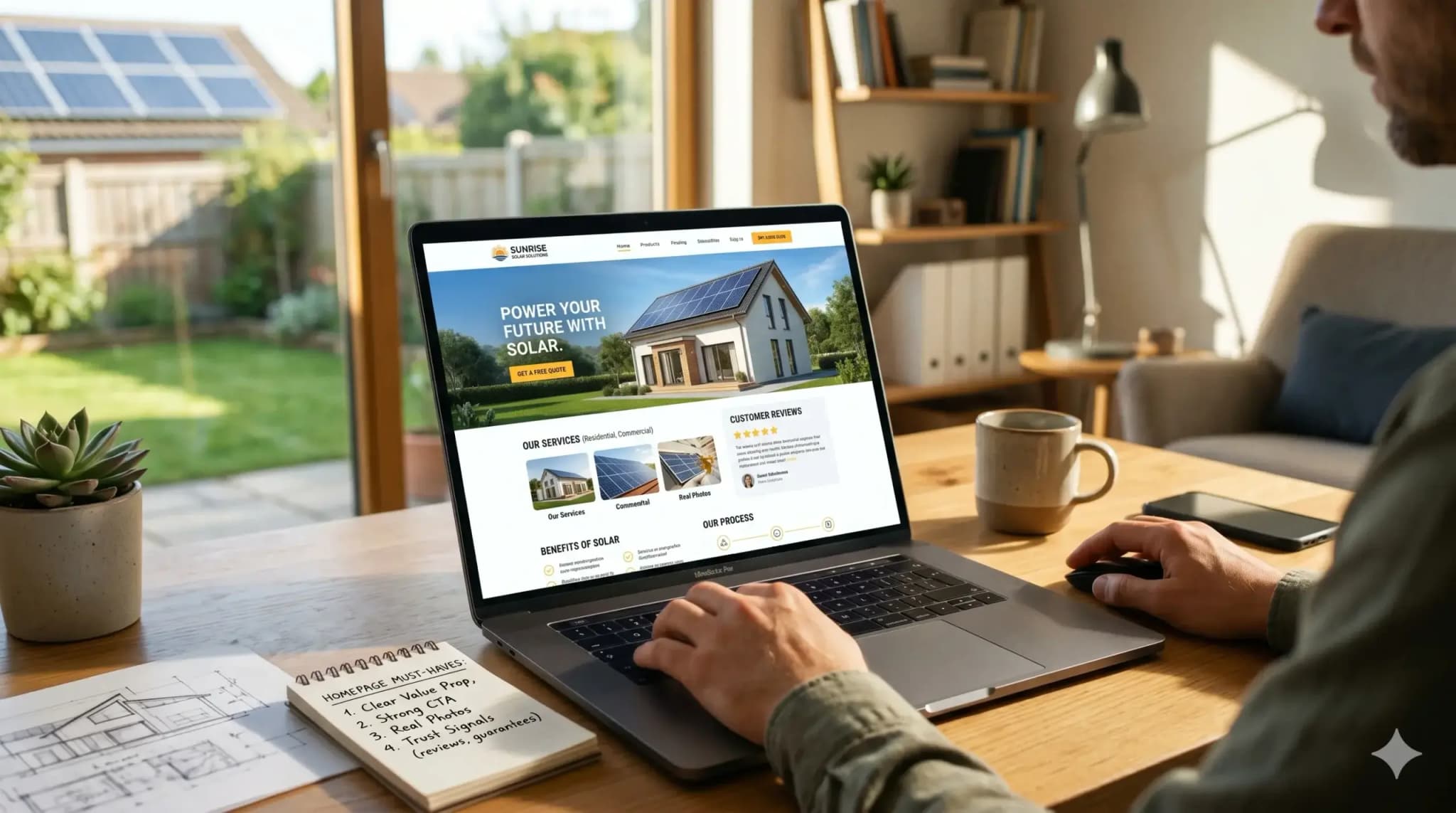
3. Proof that you do the work well. Real photos of your installs. Real reviews from local homeowners. Real numbers — panels installed, years in business, energy savings achieved. Stock imagery and vague testimonials don’t build trust with a prospect about to spend five figures.
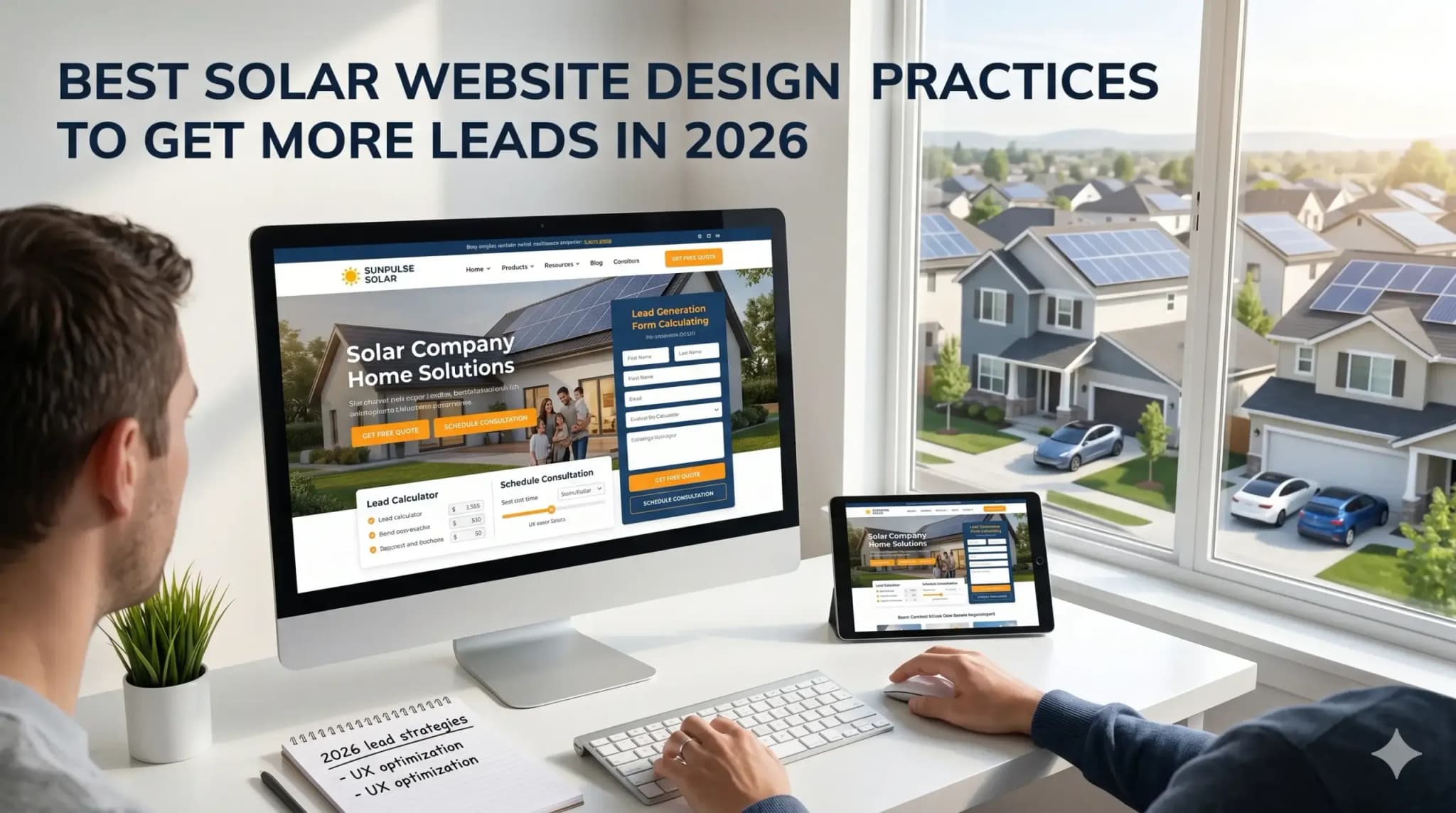
4. A low-friction next step. “Request a free quote” converts better than “Contact us.” A scheduler that lets prospects book a consultation in 60 seconds converts better than a form that says “we’ll get back to you in 2–3 business days.” Make it easy to say yes.
💡 Pro Tip: Your Homepage Might Be Talking to the Wrong Person
One of the most common mistakes in solar web design: the homepage is written for anyone who might be curious about solar — instead of the person who is ready to get a quote.
If your messaging starts with “Solar energy is the future of clean power…” you’re writing an educational brochure, not a lead generation page.
The fix: lead with the customer outcome. “Get a free quote and see how much you could save on your energy bill — most homeowners are surprised by the number.” That one shift in messaging angle can meaningfully change how many visitors actually reach out.
Before & After: What a Real Solar Website Redesign Can Do
The situation: A residential solar installer in the Carolinas had been in business for six years. Solid reputation, consistent referrals, decent reviews on Google. But their website — a WordPress template they’d set up themselves — was generating almost no inbound leads. They were relying almost entirely on referrals and door-to-door canvassing to fill their pipeline.
The problem: The site loaded slowly on mobile (over 6 seconds). The homepage featured a stock photo of a generic rooftop and a headline that read “Affordable Solar Solutions.” There was no mention of their service area, no real project photos, no financing information, and no clear reason to choose them over a national installer.
What changed: The site was rebuilt from scratch with a focus on local search visibility, mobile speed, and conversion. Real project photos from local installs replaced stock images. The homepage messaging was rewritten around the specific concerns of Carolina homeowners — including utility rate increases and storm resiliency. A simple quote request form replaced a generic contact page.
The result: Within 90 days of launch, inbound quote requests climbed from near-zero to a consistent 15–20 per month. The team went from relying on referrals to having a full pipeline — without increasing their ad spend. Within six months, the site was ranking on the first page of Google for their primary local search terms.
That’s the difference between a website that exists and a solar website design built to generate leads.
Not sure if your solar website has these issues? Get a free website audit — no obligation, just a clear picture of what’s costing you leads.
Templates vs Custom: How to Actually Decide
Here’s the honest breakdown:
A template might work for you if:
- You’re brand new and need something up immediately
- You’re running it as a temporary placeholder while you build budget
- You have someone in-house who can customize it meaningfully
Custom solar website design is the right call if:
- Your current site isn’t generating consistent inbound leads
- You’re competing in a market with established solar companies
- You’re spending money on Google Ads and the traffic isn’t converting
- Your business depends on a steady pipeline — not just referrals
The hard truth: most solar businesses that are stuck at the referral-only stage have a website problem. The website isn’t converting the people who find it. Fixing that is almost always higher ROI than buying more ads.
Your Path to More Leads: 5 Steps That Actually Work
Step 1: Audit what you have. Before spending anything, find out what’s actually wrong. Speed, messaging, structure, local SEO — each issue has a different fix. See what’s costing you leads with a free audit before you commit to anything.
Step 2: Prioritize mobile speed. More than half of solar research happens on phones. If your site loads slowly on mobile, fix that first — it affects everything downstream: your Google ranking, your bounce rate, your conversion rate.
Step 3: Rewrite your homepage for the buyer who’s ready to decide. Stop educating. Start converting. Lead with outcome, trust signals, and a clear next step.
Step 4: Build local SEO into the structure. Make sure Google knows your service areas, your business category, and exactly what you do. This isn’t just a Google Business Profile task — it’s built into how the site is coded and structured.
Step 5: Track what’s actually happening. Set up call tracking and form tracking. You can’t improve what you can’t measure. Know which pages are converting, which are leaking visitors, and where your leads are actually coming from.
Frequently Asked Questions
Why am I not getting calls from my solar website?
The most common reasons: your site loads too slowly for mobile visitors, your messaging doesn’t address the specific concerns of a buyer ready to get a quote, or Google isn’t surfacing your site for the searches your customers are actually typing. In most cases, it’s a combination of all three. A quick audit can pinpoint exactly which issue is doing the most damage.
How do I know if my solar website is actually working?
If you can’t answer “how many inbound leads did my website generate last month?” — that’s your answer. A working solar website has call tracking, form tracking, and analytics set up so you know your numbers. If you’re flying blind, you’re likely leaving leads on the table. Get a free website audit to see what your site is actually doing (or not doing).
How long does it take to see results from a new solar website?
You’ll typically see improvements in conversion rate and lead volume within the first 30–60 days of a properly built site launch. Organic search rankings take longer — usually 3–6 months to see meaningful movement for competitive local terms. That’s why the site needs to convert paid and referral traffic immediately while the SEO compounds in the background.
What makes a solar website different from a regular business website?
Solar is a high-consideration purchase. Homeowners don’t buy on impulse — they research, compare, and look for trust signals before ever picking up the phone. A solar website needs to do more trust-building work than a typical service business site. That means real project proof, clear financing messaging, local reviews, and a consultation process that feels low-pressure. Generic business website templates aren’t built for that sales cycle.
Do I really need a fast website if my customers are local?
Yes — especially if your customers are local. Local solar buyers are almost always researching on their phones, often while they’re at work or between errands. If your site takes 5+ seconds to load, they’re already looking at your competitor’s site. Google also uses site speed as a ranking signal, which affects whether local customers find you in the first place. Speed isn’t a luxury — it’s table stakes.
Should I use the same web agency that built my competitor’s site?
Only if your competitor’s site is generating strong, consistent leads. Most agency-built solar sites look polished but weren’t built with conversion and local SEO as the actual priority. Before hiring any agency, ask to see the lead generation results from sites they’ve built — not just the designs. Digital Trace’s solar website work is built around one metric: how many qualified leads your site generates.
Stop Leaving Leads on the Table
Your solar business earns every installation. Your website should be doing the same work.
If you’ve been getting by on referrals and wondering why your site isn’t pulling its weight — or if you’ve already invested in a website that still isn’t generating calls — the problem is almost always fixable. But you need to know exactly where the breakdown is happening before you can fix it.
Digital Trace offers a free, no-obligation website audit for solar businesses across the US. You’ll get a clear picture of what’s working, what’s costing you leads, and what the fastest path to improvement looks like.
Claim your free solar website audit →
No pitch. No pressure. Just a straight answer about what your solar website is actually doing — and what it should be doing instead.