How to Choose the Best Solar Website Design for Your Solar Business
You’ve invested in your solar business — the equipment, the crew, the licensing. But when a homeowner Googles “solar installation near me,” your competitor’s name shows up and yours doesn’t. Or worse: they find your site, spend ten seconds on it, and call someone else.
That’s not a lead problem. That’s a website problem.
Most solar business owners assume their site is “fine” because it looks decent. But there’s a big difference between a website that looks good and one that actually generates calls. The gap between the two is where most solar companies are silently losing thousands of dollars every month — without ever knowing why.
This guide breaks down exactly what separates a high-performing solar website from one that’s just taking up space on the internet. By the end, you’ll know what to look for, what to fix, and how to turn your website into your best salesperson.
Why Your Solar Website Isn’t Bringing in Calls
Think of your website like a sales rep who never sleeps. If that rep shows up to appointments looking disheveled, can’t answer basic questions, and takes forever to get to the point — homeowners walk out. That’s what a poorly designed solar website does, 24 hours a day.
The three biggest reasons solar websites fail to convert visitors into leads:
- They load too slowly. If your site takes more than 3 seconds to load, more than half your visitors are already gone — before they ever see your phone number.
- They don’t speak to local homeowners. Generic content about “clean energy” doesn’t make someone in Phoenix feel like you’re the right company for their home.
- They make people work too hard to take action. If your phone number isn’t visible immediately, if your contact form has six fields, or if there’s no clear reason to call you — visitors bounce.
These aren’t design opinions. They’re the difference between a website that rings your phone and one that sits quietly while your competitors collect the leads.
The Hidden Speed Problem Costing You Leads
Your site might load fine on your office computer with fast Wi-Fi. But most homeowners searching for solar are doing it on a phone, on the go, sometimes on a weak connection.
When your site is slow on mobile — and most solar websites are — Google notices. It actively ranks faster sites above yours. So even if everything else is perfect, a slow site means you’re invisible to the homeowners most likely to convert.
What makes a solar website slow?
- Oversized images that weren’t compressed for web
- Cheap or shared hosting that can’t handle real traffic
- Bloated website builders with code that loads dozens of unnecessary scripts
- No caching or content delivery network (CDN) in place
A properly built solar website loads in under 2 seconds on mobile. That alone can separate you from 80% of your local competition.
At Digital Trace, every solar website we build is tested for mobile speed before it ever goes live — because a slow website isn’t just frustrating, it’s expensive.
Your Website Isn’t Telling Google Enough About Your Business
Here’s something most solar business owners don’t realize: Google doesn’t automatically understand what your business does, where you serve, or who you work with. You have to tell it — explicitly — through the way your site is structured.
When your site is missing the right signals, Google doesn’t confidently show it in search results. That means homeowners in your exact service area who are actively searching for solar are finding your competitors instead of you.
What Google needs to rank your solar site:
- Pages dedicated to your specific service areas (not just one generic “Service Area” page)
- Content that directly answers the questions homeowners are searching for
- Structured data markup that tells Google you’re a local solar business with reviews, hours, and a service area
- A Google Business Profile that’s tightly connected to your website
This isn’t about gaming the system. It’s about giving Google the information it needs to confidently recommend you — the same way a trusted neighbor would.
💡 Pro Tip: One Page Does Not Fit All
One of the most common (and costly) mistakes solar businesses make is using a single page to target every city they serve. It feels efficient, but it signals to Google that you’re not actually local anywhere.
The fix: create a dedicated landing page for each city or county you serve — with content that speaks to homeowners in that specific area. A solar company serving Austin, Round Rock, and Cedar Park should have three separate pages, not one page with all three city names crammed in. This alone can dramatically improve how often your site shows up for local searches.
What “Best Solar Website Design” Actually Means
There’s a lot of noise about what makes a website look good. Clean design, nice photos, a logo that pops. That stuff matters — but it’s the floor, not the ceiling.
The best solar website designs do three things that most don’t:
1. They build trust fast. Homeowners making a decision about a $20,000–$40,000 solar installation are not going to call the company with a generic website and no social proof. Real photos of your team, your actual installs, verified reviews, and certifications all tell a homeowner: these people are real, and they do good work.
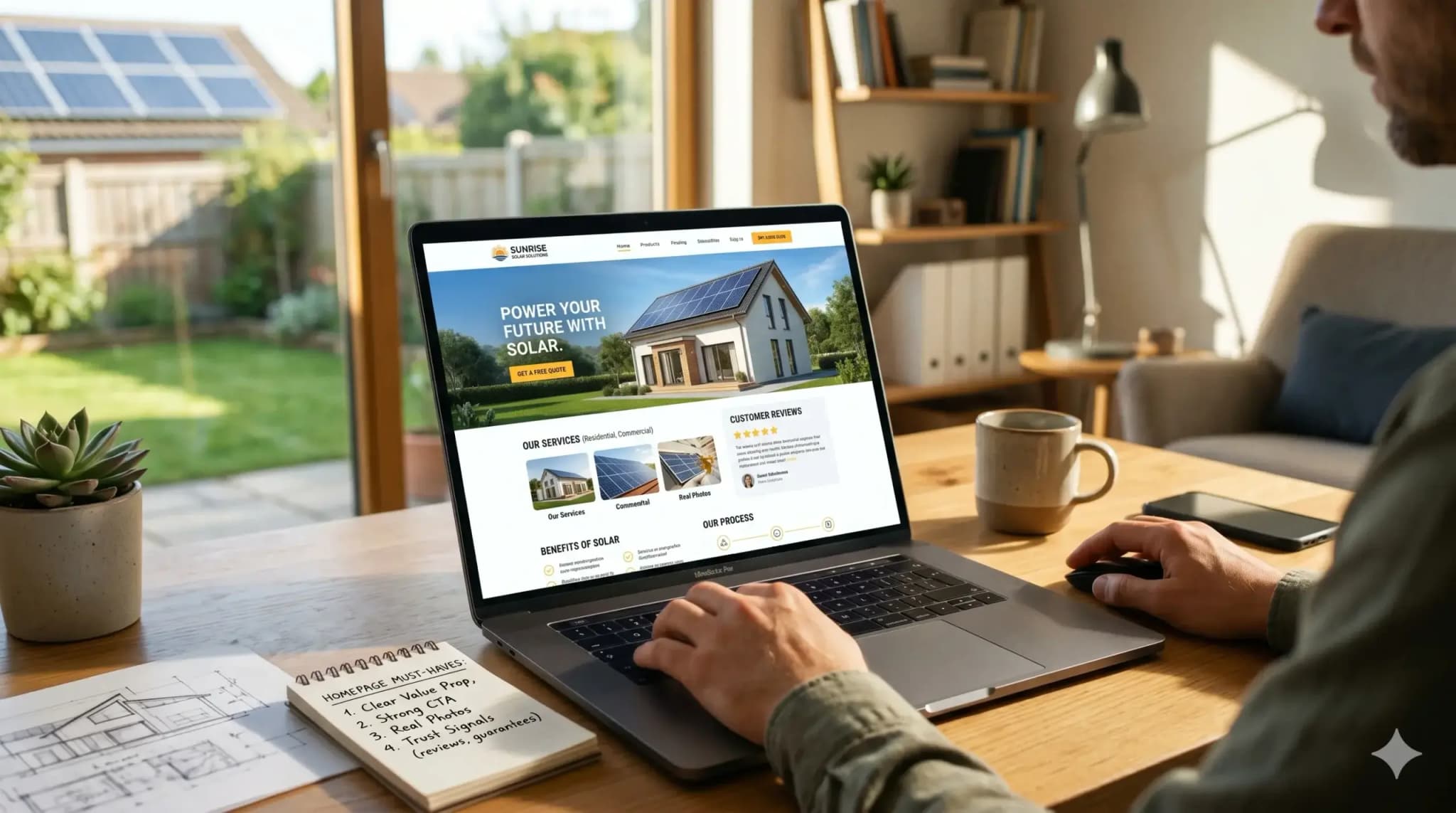
2. They make the next step obvious. A visitor shouldn’t have to search for how to contact you. Your phone number should be visible at the top of every page. Your CTA (whether it’s “Get a Free Quote” or “Schedule a Consultation”) should appear multiple times — not just buried at the bottom.
3. They’re built for conversion, not just looks. A beautiful website that doesn’t convert is just an expensive brochure. The layout, the copy, the button placement, the page flow — all of it should guide a visitor toward one action: contacting you.
This is what separates websites built specifically for solar businesses from generic templates that any contractor might use.
Before & After: What a Real Solar Website Overhaul Looks Like
SunPath Solar — Phoenix, AZ
SunPath Solar had been in business for six years with a solid reputation built almost entirely on referrals. Their website was a template from a general website builder — functional but forgettable. It loaded slowly on mobile, had no city-specific pages, and their contact form was buried on page three.
On average, they were getting fewer than 10 online inquiries per month. Most of their calls came from past customers or people who’d seen their yard signs.
After a full website redesign focused on solar web design best practices — fast mobile load times, dedicated pages for each of their 8 service cities, clear trust signals, and a click-to-call button pinned to the top of every page — the results shifted within 90 days:
- Online inquiries jumped from 8–10/month to 34–40/month
- Their Google search visibility in Phoenix and surrounding cities increased significantly
- Their close rate improved because incoming leads were already pre-sold on the company before they even called
The website didn’t change what SunPath Solar did. It just made sure the right homeowners could find them — and trusted them enough to reach out.
Not sure if your solar website has these issues? Get a free website audit — no obligation, just a clear picture of what’s costing you leads.
Your Path to More Solar Leads: 5 Steps That Actually Work
You don’t need to overhaul everything overnight. Here’s the clearest path from where you are to a website that works as hard as you do:
- Test your site on mobile — right now. Pull out your phone, go to your website, and time how long it takes to load. If it’s more than 3 seconds, that’s your first problem to fix.
- Check what a homeowner sees first. When someone lands on your homepage, is your phone number visible without scrolling? Is there a clear reason to call you over anyone else? If not, your layout is working against you.
- Look at what cities you serve — and whether each has its own page. If you’re targeting more than one city with a single page, you’re leaving local search visibility on the table.
- Make sure your reviews are showing up. Your Google Business Profile should be active, up to date, and linked to your website. Reviews aren’t just trust signals for homeowners — they influence how Google ranks you.
- Get a professional audit. You can fix the easy stuff on your own. But the hidden issues — technical speed problems, missing structured data, pages that should be ranking but aren’t — those require a set of expert eyes.
FAQ: What Solar Business Owners Actually Ask
Why am I not getting calls from my website even though I get some traffic?
Traffic and leads are two different things. A site can attract visitors who are just browsing, doing research, or not in your service area. What converts visitors into callers is a combination of clear trust signals, fast load speed, an obvious path to contact you, and content that speaks directly to what they’re looking for. If any one of those is missing, people leave without calling.
How do I know if my solar website is actually working for me?
Look at two numbers: how many people visit your site each month, and how many of those submit a form or call you. If you’re getting hundreds of visitors but fewer than 10–15 inquiries, something’s broken in between. A free audit can show you exactly where the drop-off is happening. Book a free review here and get a clear answer in days, not weeks.
How long does it take to see results from a new solar website?
A properly built site with strong local SEO can start showing ranking improvements within 60–90 days. Lead volume typically follows within the same window, though it compounds over time. The businesses that see the fastest results are usually the ones that had the biggest technical gaps to close — because fixing those gaps has immediate impact.
What makes a solar website different from a regular contractor website?
Solar purchases are high-ticket and high-consideration. Homeowners spend weeks or months researching before they call. Your website needs to do more than list your services — it needs to answer financing questions, showcase real installs, address common objections, and build enough trust that a stranger is willing to invite you to their home for a $30,000+ purchase. A generic contractor template wasn’t built for that sales cycle.
Do I really need a fast website if my customers are mostly local referrals?
Referrals are great — until the neighbor passes along your name and the homeowner Googles you. If what they find is a slow, outdated, or thin website, you’ve just lost a warm lead. Your website is your credibility check. Even referral-based businesses lose deals when their site doesn’t match the quality of work being recommended.
Should I use a solar website template or get a custom design?
Templates can work if they’re fast, mobile-optimized, and built with conversions in mind. Most aren’t. The bigger issue is that a template doesn’t adapt to your specific service area, your team, or your differentiators — and Google rewards specificity. A custom-built site that speaks directly to homeowners in your market will almost always outperform a template over time.
Ready to Find Out What’s Costing You Leads?
If you’ve made it this far, you already know your website could be doing more. The question is how much more — and what exactly is standing in the way.
Digital Trace specializes in solar website design that ranks on Google, loads fast on mobile, and converts visitors into qualified leads. We work exclusively with solar businesses, so we’re not guessing at what works in your industry.
Get your free website audit today — no sales pressure, no obligation. Just a detailed look at what’s working, what isn’t, and what to fix first. Most solar business owners are surprised by what they find.
Your competitors aren’t waiting. Neither should you.