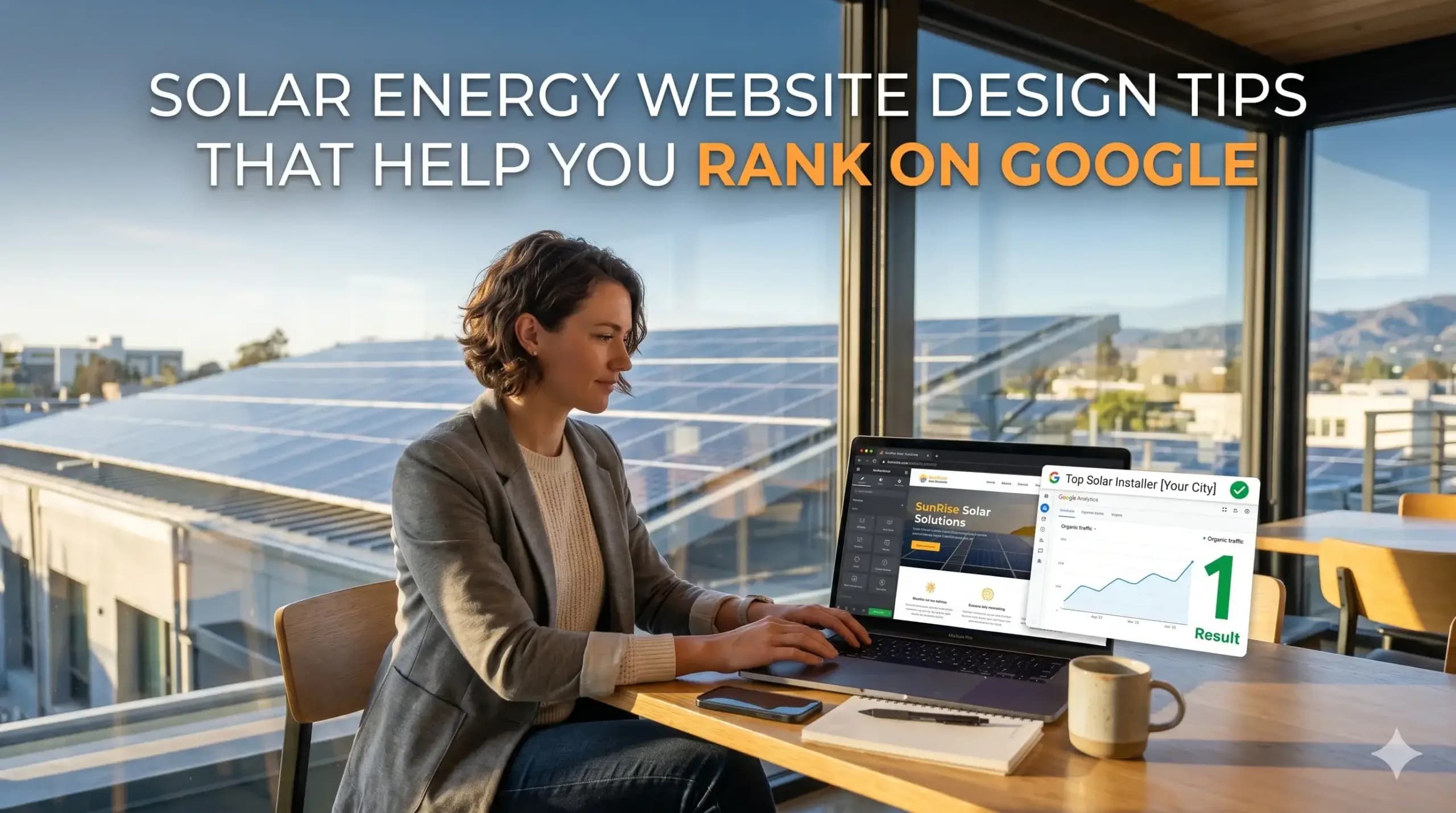
Solar Energy Website Design Tips That Help You Rank on Google
You spent money on a website. You’re doing some marketing. But the phone still isn’t ringing the way it should — and you’re not sure why.
Here’s what most solar business owners get wrong: they think a website is just a place to put their logo and services. But your competitors who are winning jobs aren’t just online — they’re ranking on Google, loading fast on every device, and turning visitors into calls before doubt has a chance to creep in.
Your website isn’t a pamphlet. It’s your best salesperson — and right now, it might be giving up before the pitch even starts.
This guide breaks down exactly what separates a solar website that sits there from one that consistently generates qualified leads. Every tip is written in plain English, with zero jargon. By the end, you’ll know what to look for, what to fix, and where to start.
Why Your Solar Competitors Show Up on Google and You Don’t
When someone types “solar installation near me” into Google, they’re ready to buy. That search happens thousands of times a day across the US. The question is whether your business shows up — or your competitor’s does.
Most solar websites miss Google’s ranking signals in ways that are completely invisible to the owner. It’s not that your work is worse. It’s that Google doesn’t have enough clear signals to trust your site over someone else’s.
Three of the most common reasons solar websites don’t rank:
- The site doesn’t clearly say where you serve — city names, counties, and regional terms need to appear naturally in your content
- The pages are thin on information, which tells Google there’s nothing worth showing
- The site isn’t earning any credibility signals, like backlinks or reviews baked into the page
Websites built for solar businesses are built differently from generic sites. They’re structured from day one around the keywords your customers are actually searching — not what you think sounds good.
Your Website Loads Too Slowly — And You’re Losing Leads Because of It
Think about the last time you visited a slow website on your phone. You probably left before it finished loading. Your potential customers do the same thing — and they don’t come back.
Most people decide whether to stay on a page within the first three seconds. If your solar site is still loading at second four, that visitor is already on your competitor’s site. You never even got a chance.
The technical reason is usually image sizes, bloated code, or cheap hosting — but the business impact is simple: you’re paying for traffic that never converts.
Signs your site is too slow:
- Pages take more than three seconds to load on a mobile phone
- Images look fuzzy or take a moment to “snap” into focus
- You’ve never had your site’s speed tested
Speed isn’t a nice-to-have anymore. Google uses page speed as a ranking factor — meaning a slow site doesn’t just lose visitors, it also drops in search results. You lose twice.
💡 Pro Tip: Your Site Isn’t Just Slow on Desktop
Most solar business owners test their website on a desktop computer and assume it looks fine. But more than 60% of local searches happen on a mobile phone — and desktop and mobile load very differently.
A site that appears fine on your laptop may be loading slowly, cutting off text, or hiding your phone number behind a hard-to-tap button on Android and iPhone screens.
The fix: Run your site through Google’s free PageSpeed Insights tool (search it — takes 60 seconds) and look at your mobile score specifically. Anything below 70 is costing you leads. A well-built solar website should score 85 or higher on mobile.
Google Doesn’t Know Enough About Your Business to Show It Confidently
There’s a simple piece of code — called schema markup — that tells Google exactly what your business is, where you operate, what services you offer, and how customers can contact you. Most solar websites don’t have it.
Without it, Google has to guess. And when Google guesses, it tends to show the businesses it’s more confident about — which are usually your competitors who’ve got their technical setup right.
The business cost is invisible but real. You might be doing everything else correctly and still lose ranking spots to a competitor with a weaker reputation, simply because their site speaks Google’s language more clearly.
This is one of the first things Digital Trace checks during a site audit — and it’s one of the quickest wins to put in place.
Visitors Land on Your Site and Leave Without Calling — Here’s Why
Getting someone to your website is only half the battle. The other half is making sure they call or fill out a form before they talk themselves out of it.
Most solar websites bury the contact information, use vague calls to action like “Learn More,” or don’t address the questions a prospect is asking in their head: How long does installation take? Are there financing options? Do you handle the permits?
When those questions go unanswered, the visitor doesn’t call to ask — they leave and find a competitor whose site answered their questions.
What a high-converting solar website does differently:
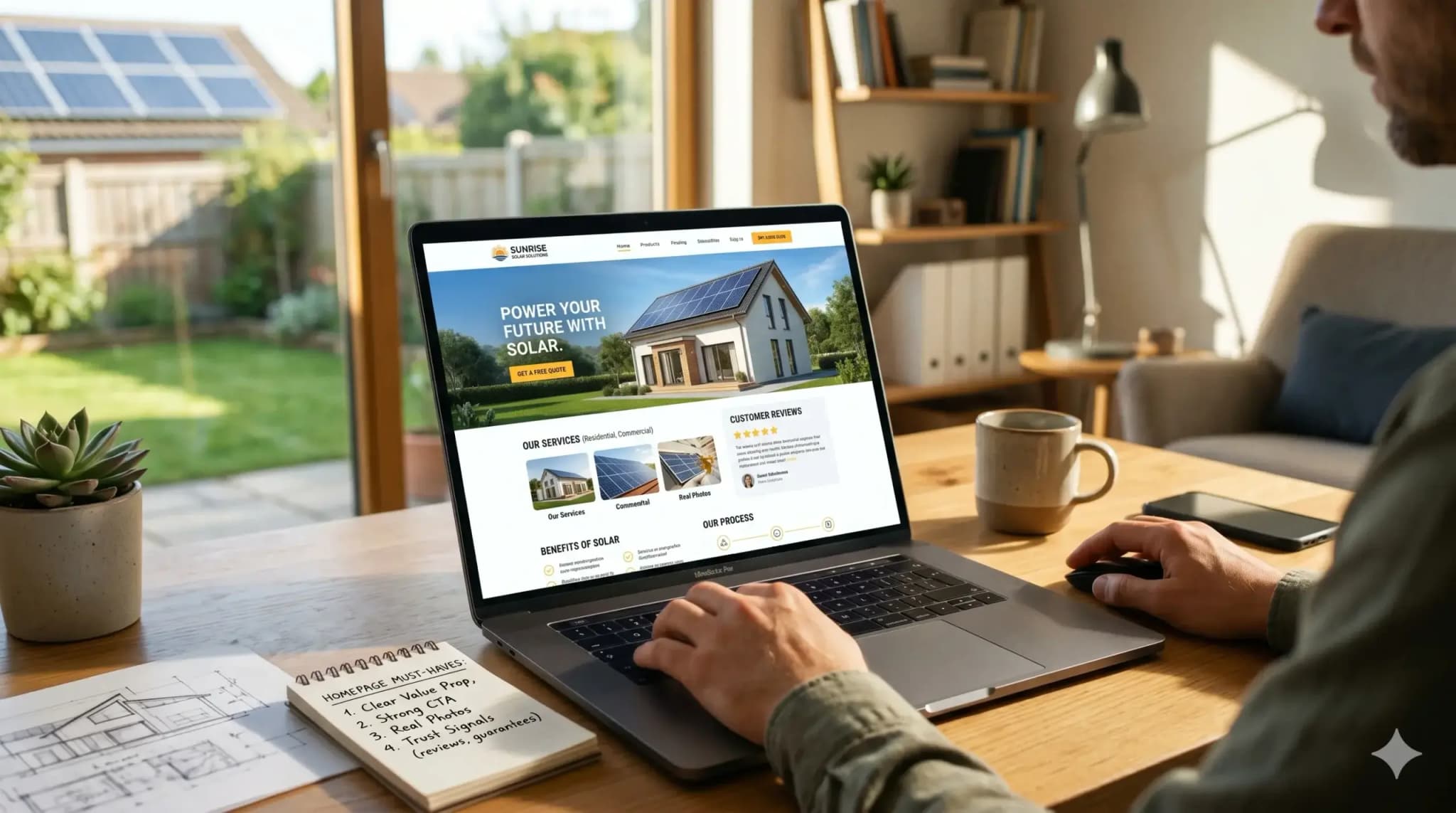
- Shows the phone number prominently at the top of every page — especially on mobile
- Uses specific calls to action like “Get Your Free Solar Quote” instead of generic buttons
- Includes a short FAQ or “what to expect” section that addresses common objections
- Features real photos of your team and completed installations — stock photos kill trust
Think of it this way: your website is like a solar consultation. If the homeowner feels informed and at ease, they move forward. If they leave with unanswered questions, they shop around.
The Real Cost of a Website That “Just Exists”
Here’s a realistic scenario that plays out across the solar industry every month.
Before: A solar installation company in the Southwest had a website they’d built themselves years ago. It looked professional enough — but it was loading slowly on mobile, had no schema markup, and the service pages were nearly identical, with barely a paragraph of content each. They were spending money on Google Ads to get traffic, but their conversion rate was under 1%. Most visitors bounced in under 20 seconds.
After: After rebuilding the site with a focus on speed, mobile experience, local keyword targeting, and clear calls to action, their organic traffic grew by over 180% within six months. Their paid ad conversion rate climbed from under 1% to just over 4%. The phone started ringing from people who found them organically — without paying per click.
The difference wasn’t magic. It was fixing the things that were quietly sending qualified buyers to competitors.
Not sure if your solar website has these issues? Get a free website audit — no obligation, just a clear picture of what’s costing you leads.
Your Path to More Solar Leads Starts Here
You don’t need to understand code or SEO to take the right steps. Here’s what the process looks like when it’s done right:
Step 1 — Audit what you have. Find out where your current site is losing people. Speed, mobile experience, keyword gaps, and missing trust signals are usually the first culprits.
Step 2 — Fix the foundation. Before adding more marketing, the site needs to be fast, mobile-friendly, and technically set up for Google to understand it.
Step 3 — Build pages that match what your customers are searching. Generic service pages don’t rank. Your site needs content that answers real questions your customers are typing into Google.
Step 4 — Make it easy to call or convert. Every page should have a clear next step — a phone number, a form, or a low-friction offer like a free quote or consultation.
Step 5 — Let it compound over time. Unlike paid ads that stop the moment you stop paying, a well-built solar website builds authority month over month. The longer it’s in good shape, the stronger it gets.
See how Digital Trace builds solar websites designed around these principles from the ground up.
Frequently Asked Questions
Why am I not getting calls from my solar website even though I get some traffic?
Traffic without calls usually means one of a few things: visitors can’t find your contact information easily, the site doesn’t answer their questions, or it doesn’t look trustworthy enough to take the next step. Getting people to your site is only half the job — the design and content need to close the gap between “browsing” and “calling.”
How do I know if my solar website is actually working?
If you can’t answer how many phone calls or form fills came from your website last month, it’s not being tracked properly — and you’re flying blind. A working solar website has clear conversion tracking set up and shows steady organic traffic growth month over month. Get a free website audit to find out exactly where yours stands.
How long does it take to see results from a new solar website?
Most solar businesses start seeing measurable improvements in organic traffic within 90 to 120 days of launching a properly optimized site. Significant ranking gains typically build over six to twelve months. It’s slower than paid ads but compounds — meaning you’re not paying per click every time someone finds you.
What makes a solar website different from a regular business website?
Solar customers do a lot of research before committing to a purchase that costs tens of thousands of dollars. A solar website needs to build trust faster, answer more technical questions, address financing concerns, and be optimized for local search terms that reflect how homeowners actually look for solar installers. A generic template won’t do that effectively.
Do I really need a fast website if my customers are mostly local homeowners?
Yes — especially because most local searches happen on mobile phones. A homeowner searching “solar installation in [your city]” is probably on their phone, and if your site takes four or five seconds to load, they’ll hit the back button and call whoever comes up next. Local buyers are not more patient than anyone else on the internet.
I’ve already paid an agency for a website. Why isn’t it ranking?
Most web design agencies build sites that look good — but looking good and ranking on Google are two different skills. SEO requires keyword research, technical setup, page structure, and content strategy baked in from the start. If your agency handed you a beautiful site without those elements, you’ve got a great-looking problem.
Ready to Find Out What Your Solar Website Is Really Costing You?
Most solar business owners have no idea how many leads their website quietly loses every week — not because the business isn’t good, but because the site isn’t set up to compete.
A free audit from Digital Trace gives you a clear, honest look at what’s working, what isn’t, and what’s costing you the most. No sales pitch. No obligation. Just a real picture of where you stand.