Solar Panel Website Design: What Every Solar Company Needs on Their Homepage
You spent real money building your solar website. Maybe you hired someone, bought a template, or had a nephew put it together. Either way, the phone isn’t ringing the way it should — and you’re not sure why.
Here’s what most solar companies don’t realize: a website that looks professional and a website that generates leads are two very different things. Most solar websites fall into the first category. They show up online, they have photos of panels and a contact form — and they quietly lose dozens of potential customers every single month.
This guide breaks down exactly what your solar homepage needs to convert visitors into calls, quotes, and signed contracts. No fluff. No jargon. Just the specific things that separate a solar website that works from one that doesn’t.
Why Most Solar Websites Lose Leads Before Anyone Picks Up the Phone
Think about what happens when a homeowner starts researching solar. They Google something like “solar installation near me,” skim a few results, and click on two or three sites. Within about 10 seconds, they’ve already formed an opinion.
If your site loads slowly, looks cluttered, or doesn’t immediately answer their biggest questions — they’re gone. They’re on your competitor’s site.
That’s not a traffic problem. That’s a conversion problem. And it starts on your homepage.
The solar industry has a higher purchase hesitation rate than almost any other home improvement sector. Customers are spending $20,000–$40,000+ on a system they can’t fully see before it’s installed. That means your website has to do a lot of heavy lifting — building trust, answering objections, and making it easy to take the next step.
Most solar sites aren’t built to do any of that.
The 6 Things Every Solar Homepage Actually Needs
1. A Headline That Speaks to the Customer’s Situation — Not Your Company
Most solar homepages open with something like: “Powering Homes Across [State] Since 2015” or “Your Trusted Solar Partner.”
That means nothing to a homeowner who just got a $280 electric bill and wants to know if solar is worth it.
Your headline should speak directly to where they are right now. Something like: “Cut Your Electric Bill by Up to 80% — See If Your Home Qualifies” or “Solar Installation for [City] Homeowners — Get Your Custom Savings Estimate.”
The difference is massive. One headline talks about you. The other talks about them. Visitors stay on pages that feel relevant to their situation.
2. A Fast, Mobile-First Design (This Is Where Most Solar Sites Quietly Bleed Leads)
More than 60% of homeowners researching solar are doing it on their phones — often after seeing an ad, a neighbor’s install, or their latest utility bill.
If your site takes more than 3 seconds to load on a phone, most of those visitors are already gone before your phone number even appears on screen.
This isn’t about looking pretty on mobile. It’s about the site loading fast enough that people actually stay. A slow site is like a sales rep who shows up 20 minutes late to an appointment — by the time they arrive, the homeowner has already moved on.
The websites built for solar businesses at Digital Trace are built speed-first, on lean, optimized code — not bloated page builders that add load time with every feature.
3. Trust Signals That Appear Before the Scroll
Here’s a real pattern: a homeowner lands on your homepage. They’re skeptical. Solar has a reputation for pushy salespeople and confusing contracts. Within the first few seconds, their guard is up.
What they’re looking for — before they read a single word of your pitch — is evidence that you’re a real, credible business.
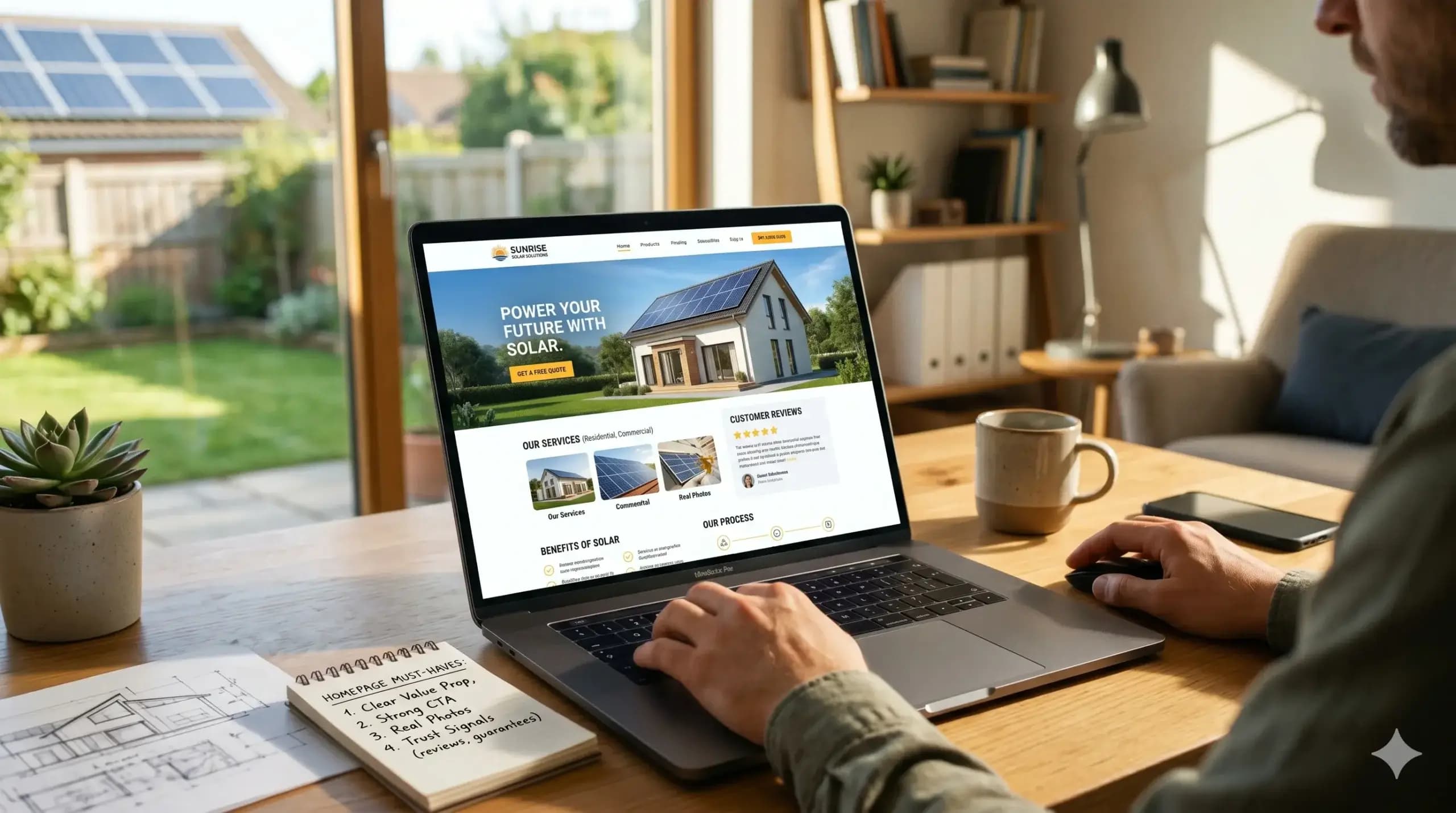
That means your homepage needs to show, above the fold (before any scrolling), at least three of these:
- Google review rating and count (e.g., “4.9 stars — 183 reviews”)
- Years in business or installs completed (“500+ homes installed across Texas”)
- Certifications and licenses (NABCEP, state licenses, manufacturer partnerships)
- Real photos of your team and local installs — not stock imagery
- Financing badge or partner logos (Sunrun, GoodLeap, etc.)
Generic solar sites skip most of these. That’s a lead walking out the door.
4. One Clear, Obvious Next Step
This is the most common mistake on solar websites: too many CTAs, none of them compelling.
“Get a Quote,” “Learn More,” “Contact Us,” “Request an Estimate,” “Schedule a Consultation” — all of them competing for attention on the same page.
When everything is a CTA, nothing is a CTA.
Your homepage should have one primary action you want visitors to take, and it should appear in at least three places: the top of the page, after your trust section, and at the bottom. Make the button specific:
- ❌ “Get a Quote” (vague, commitment-heavy)
- ✅ “See How Much You Could Save” (benefit-focused, low friction)
- ✅ “Check Your Home’s Solar Potential” (interactive, curiosity-driven)
The goal is to get them to click — not to make them feel like they’re signing a contract before they’ve even talked to you.
5. An Answer to the Question They’re All Thinking: “Is Solar Worth It for Me?”
Every person landing on your site has the same internal question: “Will this actually save me money? Is my house even a good fit?”
If your homepage doesn’t address this, they’ll either stay stuck or find a competitor who does.
A simple section that walks them through what makes a home a good solar candidate — roof age, utility rates, sun exposure, available incentives — builds trust and positions you as the expert before you ever get on a call.
This doesn’t need to be complicated. A short FAQ, a 3-step explainer, or a savings calculator widget all work. The point is: answer their real question before they have to ask it.
6. Local Signals That Prove You’re Not a National Middleman
The solar lead generation space is full of companies that collect homeowner info and sell it to multiple installers. Homeowners know this, and they’re suspicious of it.
Your homepage needs to make it immediately obvious you’re a real, local company — not a lead-gen operation.
That means:
- A physical address (or service area map)
- Local project photos with city names
- Reviews from local homeowners (not just a generic rating)
- A local phone number — not an 800 number
These signals are small, but they do a lot of work. They answer the unspoken question: “Are these people actually going to show up?”
💡 Pro Tip: Your Contact Form Is Probably Losing You Leads
Most solar contact forms ask for too much upfront: name, email, phone, address, roof type, monthly bill, and more. That’s a lot of friction before a homeowner has any reason to trust you.
The fix is simple: use a two-step form. Step one asks only one question — something like “How much is your average monthly electric bill?” Step two collects their contact info. This approach reduces drop-off dramatically because the first question feels easy, not like a commitment. Once they’ve answered it, they’re already engaged — and much more likely to complete the form.
Before & After: What Happens When a Solar Website Is Built Right
The Situation: A residential solar installation company in the Southwest had been running Google Ads for 18 months with mediocre results. Their homepage had good traffic — around 800–1,000 visitors per month — but was only converting at about 0.8%. That meant roughly 6–8 form submissions per month for a significant monthly ad spend.
The Problem: Their homepage opened with a full-width video (slow to load), had no reviews above the fold, used a 6-field contact form, and the main CTA said “Request a Free Quote” — which felt like a big commitment to someone still in research mode.
What Changed: The homepage was rebuilt with a clear savings-focused headline, a 2-step micro-form (“What’s your average monthly electric bill?”), Google review stars in the header, local project photos, and a mobile load time cut from 6.2 seconds to under 2.
The Result: Within 90 days, conversion rate climbed from 0.8% to 3.1% — nearly 4x as many leads from the same traffic. Monthly form submissions went from 6–8 to 25–30. Ad spend stayed the same. The phone started ringing.
That’s the difference between a solar website that exists and a solar website that works.
Not sure if your solar website has these issues? Get a free website audit — no obligation, just a clear picture of what’s costing you leads.
Your Path to More Solar Leads: What to Do Next
If you’re reading this and recognizing your own site in some of these problems, here’s where to start:
- Pull up your homepage on your phone. Count how long it takes to load, and look at it like a first-time visitor would. What’s the first thing you see? Is it clear what you do and who you do it for?
- Check if your reviews are visible. If a homeowner lands on your site and can’t see a review rating without scrolling, that’s trust you’re not building.
- Find your main CTA and test it. Click the button yourself. Does it feel like a big commitment or a small, easy step? If it feels big, rewrite it around the benefit — not the action.
- Look at your contact form. Count the number of fields. If there are more than three, you’re probably losing leads before they finish.
- Talk to a team that builds solar websites specifically. Not a generalist agency that’s done everything from dentist offices to food trucks. Solar buyers are unique — their hesitation, their decision timeline, and their objections are specific to this industry. You want a website built by people who understand that. See how Digital Trace builds solar websites that are designed to convert from the ground up.
Frequently Asked Questions
Why is my solar website getting traffic but no calls?
Traffic without calls usually means one of three things: the wrong visitors are finding your site, the page loads too slowly for them to stay, or the site doesn’t give them a clear, low-friction next step. Often it’s a combination. A site audit can pinpoint exactly where visitors are dropping off.
How do I know if my solar website is actually working?
If you can’t answer “how many leads did my website generate this month,” your site isn’t working — or at least you have no way of knowing. A properly set up solar website tracks form submissions, phone call clicks, and where visitors come from. You should know your conversion rate (leads ÷ visitors) every month. Anything below 2% usually means there’s a conversion problem worth fixing.
What makes a solar website different from a regular business website?
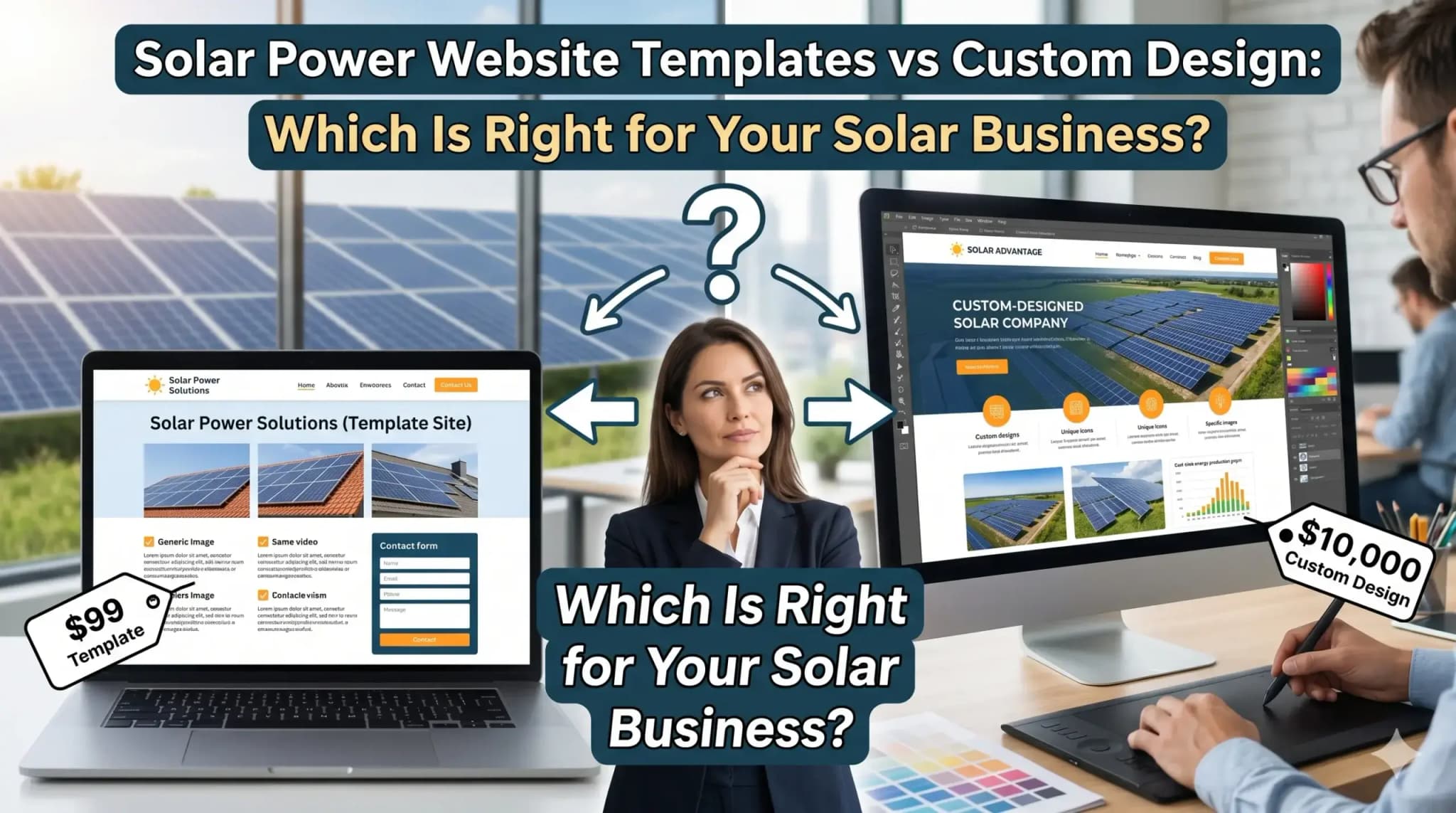
Solar is a considered purchase with a long decision cycle and a lot of buyer hesitation. A solar homepage needs to do specific things a regular business site doesn’t: pre-handle financing objections, showcase local credibility, answer the “is my home a good fit?” question, and move people toward a low-commitment first step rather than an immediate quote request. Generic templates don’t account for any of this.
How long does it take to see results from a rebuilt solar website?
Most solar businesses start seeing measurable conversion improvements within 60–90 days of launching a properly optimized site, assuming they already have consistent traffic. If organic SEO improvements are also part of the rebuild, those typically compound over 3–6 months. The conversion gains — more leads from your existing traffic — show up fastest.
Do I really need a fast website if most of my customers are local?
Yes — especially if they’re local. Local homeowners are searching on their phones, often in the middle of the day between tasks. If your site doesn’t load quickly, they’ll click back and call your competitor before you even know they were there. Speed isn’t a tech luxury; it’s a basic expectation that every visitor has whether they know it or not.
How do I know if my solar website has hidden problems costing me leads?
The fastest way is a professional audit that looks at load speed, mobile performance, conversion flow, local SEO signals, and trust elements. Get a free website audit from Digital Trace — there’s no obligation, and you’ll walk away with a clear picture of what’s working, what isn’t, and what it’s costing you.
Your Solar Website Should Be Working as Hard as You Do
Every month your homepage isn’t converting is a month of leads going to a competitor who built a better site. That’s not an exaggeration — it’s just what the numbers show.
The good news: the fixes aren’t complicated. A clearer headline, a faster load time, visible trust signals, and a contact form that doesn’t feel like a commitment. These are the things that move the needle.
If you want to know exactly where your site stands, book a free website review with Digital Trace. We’ll look at your homepage the way a potential customer would — and show you, specifically, what’s costing you leads. No pitch. No obligation. Just a clear, honest assessment from a team that builds solar websites that convert.