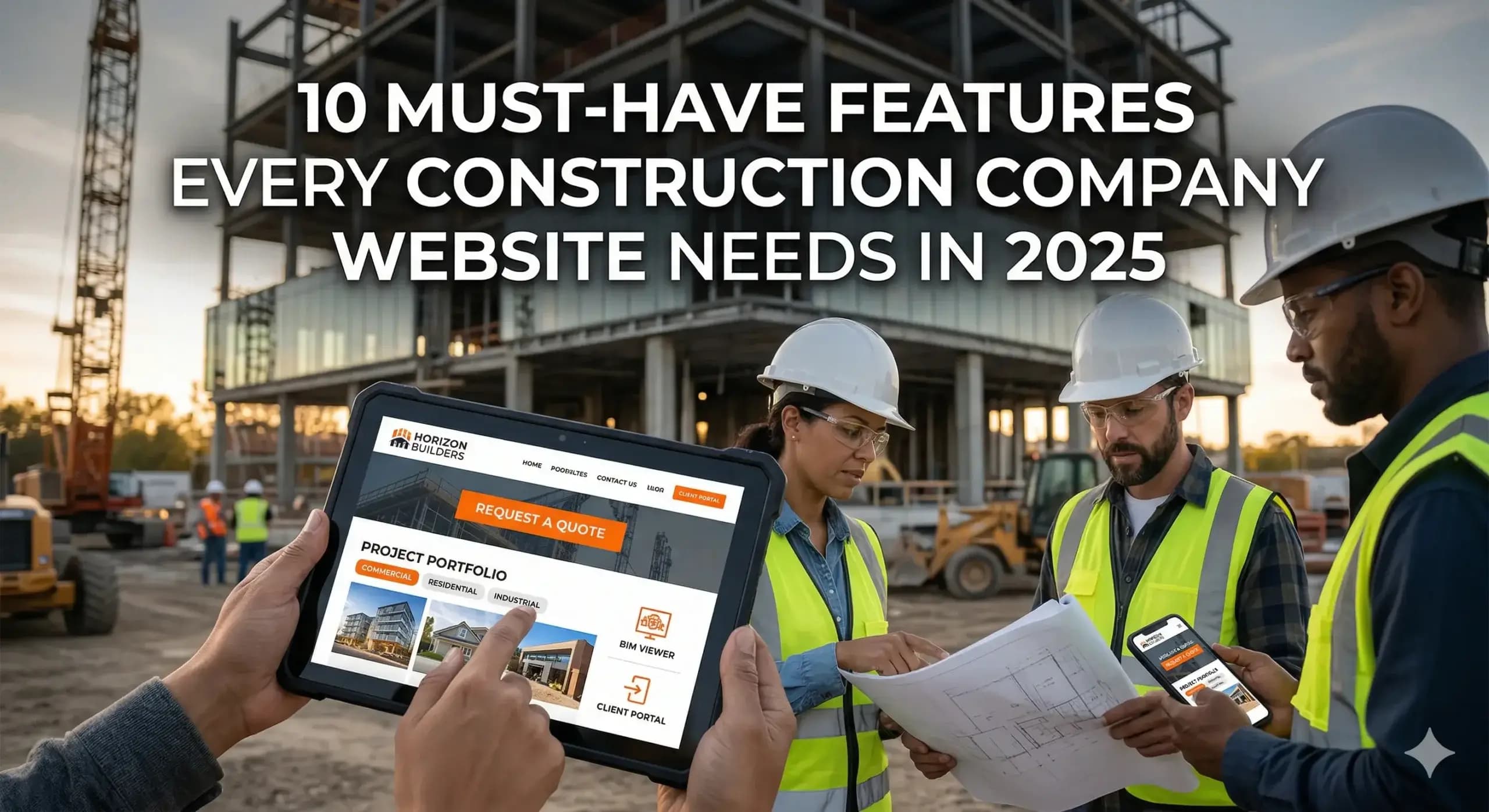
10 Must-Have Features Every Construction Company Website Needs in 2025
Your crew shows up on time. Your bids are solid. Your past projects speak for themselves. But your phone isn’t ringing the way it should — and if you’re honest, you already suspect your website might have something to do with it.
Most construction company owners treat their website like a business card: something you print once, hand out, and forget about. The problem is, your website isn’t a business card. It’s your best salesperson — or your worst one. It’s working 24 hours a day, either convincing potential clients to call you, or quietly sending them to your competitor down the road.
The difference between a website that sits there and one that actually generates leads comes down to a handful of specific features. Not flashy gimmicks. Not expensive redesigns for redesign’s sake. Specific things that make a visitor trust you, understand what you do, and pick up the phone.
Here are the 10 features every construction company website needs in 2026 — and why missing even a few of them is costing you real jobs.
1. A Load Speed That Doesn’t Drive Prospects Away
Think about the last time you drove past a job site where the equipment was broken down and nothing was moving. That’s what a slow website feels like to a potential client. They pulled up, saw nothing happening, and left.
If your construction firm website takes more than 3 seconds to load, most visitors are gone before they ever see your phone number. Google’s own research shows that mobile bounce rates spike dramatically as page load time increases — and most people searching for a contractor are on their phone, probably standing in their driveway.
Slow sites usually happen because of uncompressed images, outdated hosting, or code that wasn’t built with performance in mind. It’s invisible to you but very visible to every visitor.
What it costs you: A contractor in Phoenix recently discovered his site was averaging 8-second load times on mobile. He was spending $600/month on Google Ads, but most of that traffic was bouncing before the page finished loading. Fixing the speed issue alone cut his bounce rate significantly and more than doubled his lead conversions.
Websites built for construction businesses are built performance-first — optimized images, fast hosting, lean code — because a slow site is a lead-killing site.
2. A Phone Number You Can See Immediately — On Every Page
This sounds obvious. You’d be surprised how many construction company websites bury the phone number at the bottom of a “Contact” page that requires three clicks to find.
On mobile, your phone number should be tappable — a click-to-call link at the very top of the screen, on every single page. If someone is searching for a roofer or a general contractor at 7pm after getting a water damage estimate, they’re ready to call. The moment they have to hunt for your number, you’ve already lost half of them.
The fix is simple: your number goes in the header, in the footer, and on a sticky bar that follows the visitor as they scroll. Make it effortless. Make it impossible to miss.
3. Project Photos That Actually Show What You Can Do
A construction website without strong project photos is like a contractor who shows up to bid a job without a portfolio. You might be the best in the business — but if you can’t show it, you’re just another name on a list.
Real photos of your actual work build trust faster than any headline you could write. Before-and-after shots of remodels, structural builds in progress, finished commercial spaces — these tell the story of what it’s like to hire you.
Stock photos of hard hats and power tools do the opposite. Visitors can spot them instantly, and they signal that you don’t have enough confidence in your own work to show it.
- Use real job site photography when possible
- Include captions with project type, location, and scope
- Organize by project category so visitors can find relevant work fast
4. Local SEO Signals That Help Google Find You
Here’s the plain-English version of something most agencies overcomplicate: Google needs to understand where you work and what you do before it shows your business to anyone searching for it.
If your website doesn’t clearly name the cities and regions you serve — in the content, in the page titles, in the site structure — Google genuinely doesn’t know where to rank you. Your competitor who built their site with local SEO in mind will show up every time someone in your area searches “general contractor near me.” You won’t.
This isn’t about stuffing city names into every paragraph. It’s about building your site the right way from the start — with location-specific service pages, proper title tags, and a Google Business Profile that connects back to your site correctly.
💡 Pro Tip: One of the most common mistakes construction businesses make is having only one generic “Services” page on their entire site. If you do roofing, framing, commercial fit-outs, and renovations, each of those should be its own page — with its own content, targeting its own search terms. A single page trying to cover everything ends up ranking for nothing. Google rewards specificity, and so do clients who want to know you specialize in exactly what they need.
5. Trust Signals That Do the Selling Before You Pick Up the Phone
A homeowner or project manager evaluating contractors is asking themselves one question: “Can I trust this company with my money and my property?”
Your website needs to answer that question before they ever have to ask. Trust signals are the elements that do the convincing while you’re out on a job site:
- Google reviews — displayed prominently, not hidden in a footer
- Licenses and certifications — BBB accreditation, contractor license numbers, insurance badges
- Named testimonials — real names, real projects, real results (not anonymous quotes)
- Years in business — if you’ve been around a long time, say it clearly
- Any press, awards, or recognitions — even local newspaper coverage counts
The more a visitor can verify about you without having to ask, the more likely they are to call.
6. A Clear, Specific “What We Do” Section
Vague websites lose business. If someone lands on your homepage and can’t figure out within 10 seconds whether you do residential or commercial work, new construction or remodels, local or regional — they leave.
Your construction firm website needs to be specific about who you serve and what you do. Not in a long block of text. In clear, scannable sections that answer the visitor’s real question: “Is this the right contractor for my project?”
Think of it this way: a general contractor’s website that clearly says “We specialize in commercial tenant improvements in the Dallas-Fort Worth metro” will get fewer total visitors than a generic site — but the visitors it gets are the right ones, and the conversion rate will be dramatically higher.
Proof: What Happens When You Fix These Things
Before: A mid-size residential remodeling company in Atlanta had a website built in 2019. It looked fine on a desktop but was nearly unusable on mobile. Load times were slow, there were no project photos (just stock images), and the phone number was only on the contact page. The owner was getting maybe 2–3 web leads per month, most of them low-quality inquiries.
After: A rebuilt construction company website with mobile-first design, real project photography, a click-to-call header, and local SEO pages for each service category in their target suburbs. Within 90 days of launch, inbound web leads climbed to 12–15 per month. More importantly, the quality improved — visitors were arriving pre-sold on the company’s work and calling with specific, serious projects.
The revenue difference: At an average job value of $18,000, going from 2 web leads to 12 per month — even at the same close rate — represents a significant business transformation.
Not sure if your construction website has these issues? Get a free website audit — no obligation, just a clear picture of what’s costing you leads.
7. Mobile-First Design (Not “Mobile-Friendly” — Mobile-First)
There’s a difference between a site that technically works on mobile and one that was actually built for it. “Mobile-friendly” often means a desktop site that shrinks down — menus get tiny, text runs together, buttons are too small to tap.
Mobile-first means the entire experience was designed for the phone first, then expanded for desktop. That means large tap targets, readable fonts without zooming, fast-loading images, and a layout that guides a mobile visitor directly to calling you.
More than 60% of local service searches happen on mobile devices. If your site wasn’t designed with that in mind, you’re delivering a frustrating experience to the majority of your potential clients.
8. A Contact Form That Asks the Right Questions
A generic “Name, Email, Message” form isn’t enough for a construction business. It invites tire-kickers and leaves you with vague inquiries that waste your time.
A well-designed contact form for a construction website should pre-qualify the lead a little:
- What type of project are you looking to complete?
- What’s your approximate timeline?
- What’s the address or city of the project?
- How did you find us?
These questions don’t scare away serious buyers — they actually make serious buyers more confident that you’re a professional operation. And they save you from spending 30 minutes on a phone call with someone who has a $2,000 budget for a $40,000 project.
9. An SSL Certificate and a Secure, Professional Domain
This one is non-negotiable and surprisingly easy to overlook. If your website shows “Not Secure” in the browser bar, you’ve already lost a portion of visitors — especially business owners and property managers who take cybersecurity seriously.
An SSL certificate (the “https://” in your web address) is a basic trust signal. It’s also a Google ranking factor. Sites without it are actively penalized in search results.
Beyond SSL, your domain matters too. A construction company still running on a free website builder subdomain (like yourcompany.wix.com) is signaling, whether you intend to or not, that you’re not fully established. A clean, professional domain tied to your business name costs almost nothing and makes a meaningful first impression.
10. Google Analytics and Conversion Tracking (So You Know What’s Working)
Most construction business owners have no idea how many people visit their website each month, where they came from, or whether any of those visitors called them. That’s like running job sites without tracking your labor hours or materials — you have no idea what’s profitable and what isn’t.
Google Analytics, combined with call tracking software, tells you:
- How many people visited your site this month
- What pages they looked at
- Whether they came from Google search, Google Maps, a referral, or an ad
- How many called you directly from the website
This data lets you make decisions. It tells you which service pages are pulling in traffic and which ones need work. It shows you whether your SEO is improving month over month. And when you’re ready to run paid ads, it ensures you’re not flying blind.
How Digital Trace builds construction websites includes conversion tracking set up from day one — so you always know exactly what your site is doing for your business.
Your Path to More Leads: 3 Steps to Start Today
Step 1: Audit your current site honestly. Pull it up on your phone (not your desktop). Time how long it takes to load. Count how many clicks it takes to find your phone number. Look at it like a stranger would — someone who found you on Google and knows nothing about your company.
Step 2: Identify your top 2–3 services and make sure each one has its own dedicated page with a clear description, a photo or two, and a call-to-action. If they don’t exist, that’s the first thing to build.
Step 3: Get a professional set of eyes on it. A free audit from a team that builds construction websites specifically will find issues you can’t see yourself — and prioritize what to fix first based on actual business impact, not technical checklists.
Frequently Asked Questions
Why am I not getting calls from my construction website?
The most common reasons are a slow load time, poor mobile experience, no local SEO, or a lack of trust signals like reviews and project photos. Visitors are landing on your site but leaving before they decide to call. A free audit can pinpoint exactly which of these is happening on your specific site — book one here at no cost.
How do I know if my construction website is actually working?
If you don’t have Google Analytics and call tracking set up, you genuinely don’t know. A working construction website should show you steady monthly traffic from local search terms, a low bounce rate (meaning visitors are staying and looking around), and a measurable number of inbound calls or form submissions tied directly to website visits.
How long does it take to see results from a new website?
A newly built site with proper local SEO in place typically starts seeing meaningful search traffic within 60–90 days. Lead volume usually follows within the first 3–4 months, assuming the site is built correctly from the start. Quick wins like Google Maps optimization can drive results even faster.
What makes a construction website different from a regular business website?
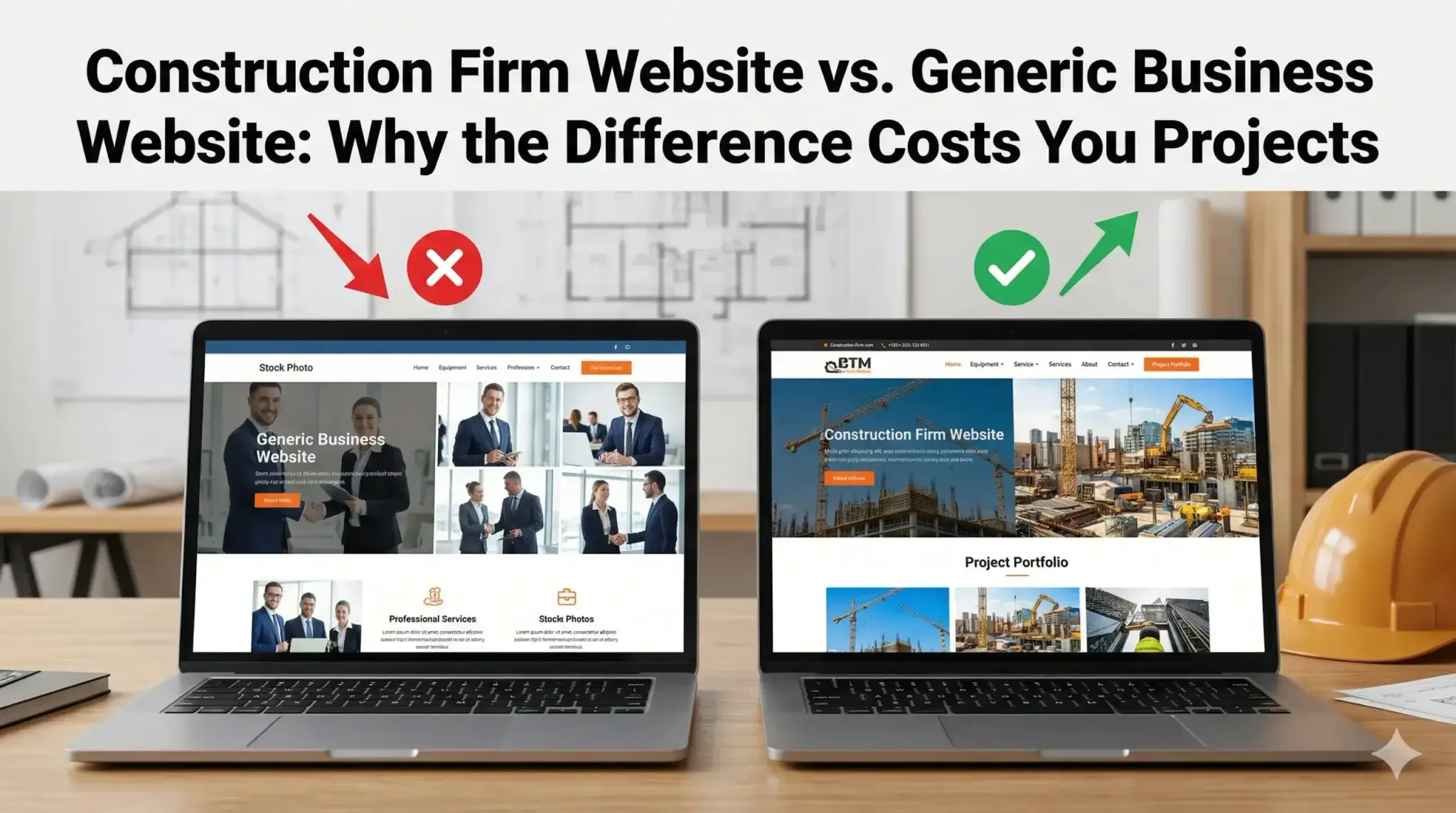
Construction buyers need to see proof before they commit — project photos, licenses, reviews, and specific service descriptions. They’re also highly local, which means local SEO structure matters far more than it would for an e-commerce brand. A good construction firm website is built around trust, proof, and frictionless contact — not generic templates designed for retail or services businesses.
Do I really need a fast website if my customers are mostly local?
Yes — especially if your customers are local. Local buyers searching on mobile expect fast results. Google also uses page speed as a ranking factor for local search, meaning a slow site can push you down in results for searches in your own backyard. The contractor who shows up first and loads fast wins the click, even over the one with a better reputation.
I’ve been burned by agencies before. How is this different?
That’s a fair concern, and it’s exactly why Digital Trace offers a free audit with no strings attached. You get a clear, honest assessment of what’s actually costing you leads — no pressure, no commitment. If you find it useful, great. If it’s not the right fit, you’ve lost nothing. Start with the free audit and judge from there.
Ready to Find Out What Your Website Is Really Costing You?
Every month your construction company website underperforms is a month your competitor answers the phone call you should have gotten. The jobs are out there. The searches are happening. The question is whether your website is capturing them or letting them walk.
Digital Trace builds high-converting websites specifically for construction businesses across the US — sites that load fast, rank locally, and turn visitors into real leads.
No obligation. No sales pitch. Just a clear, honest look at what’s working, what isn’t, and what it would take to start generating more leads from your website this year.