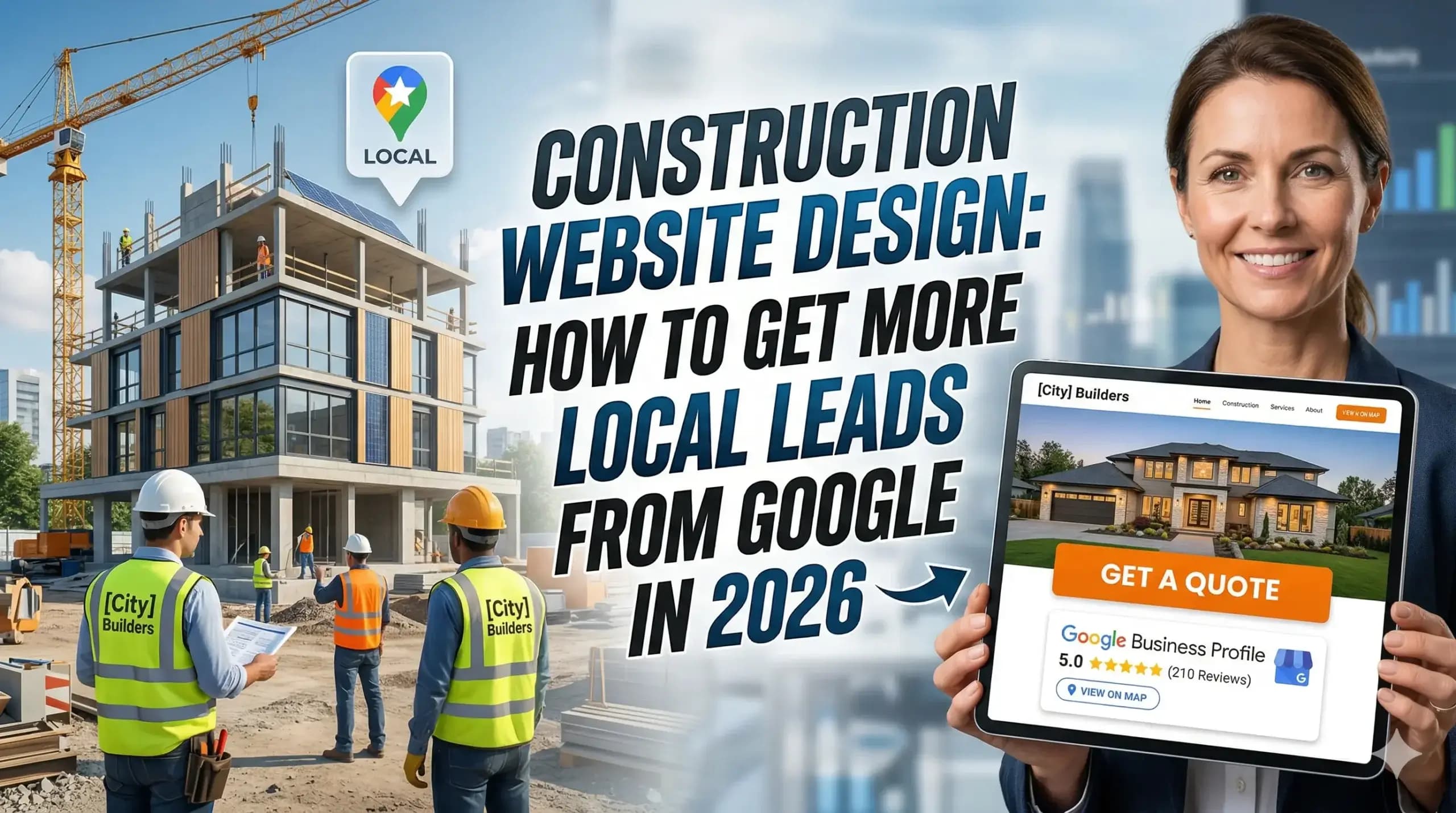
Construction Website Design: How to Get More Local Leads From Google in 2026
You’re busy running a construction business — managing crews, juggling bids, keeping projects on schedule. The last thing you have time to worry about is your website. But here’s the problem: your website is out there right now, either sending you leads or turning them away. And most construction company websites are doing the latter.
The frustrating part? The owners don’t even know it.
Most contractors assume a website just needs to exist — a few photos, a phone number, maybe a list of services. But that’s not how it works in 2026. When a homeowner or general contractor searches “roofing contractor near me” or “commercial builder in [city],” Google decides in milliseconds which businesses to show. And the companies showing up aren’t just the ones with the best crews — they’re the ones with websites built to earn Google’s trust and convert visitors into calls.
This guide breaks down exactly why your construction website might be silently costing you jobs, and what a well-built construction website actually looks like when it’s working hard for your business.
Why Your Construction Phone Isn’t Ringing (And Your Website Is the Reason)
Picture this: you hand a potential client a business card that’s bent, has a typo on it, and directs them to a voicemail that’s full. That’s essentially what a slow, outdated, or poorly structured construction website does every single day.
When someone lands on your site and it takes more than three seconds to load, most people leave — without ever seeing your services, your photos, or your phone number. They don’t call. They don’t come back. They go straight to your competitor.
The technical term is “page load speed,” but the business impact is simple: every second of delay costs you real inquiries. A site built for construction needs fast hosting, optimized images, and lean code — things most generic website builders don’t prioritize.
Your Site Looks Fine on a Desktop — But Your Customers Are on Their Phones
Here’s something worth checking right now: pull up your website on your phone. Is the text tiny? Do you have to zoom in to find the phone number? Is the “Request a Quote” button buried at the bottom?
Nearly 70% of people searching for local contractors do it on their phone. If your site doesn’t load cleanly, display your phone number prominently, and let someone tap-to-call in under five seconds — you’re losing leads on every single mobile visit.
This isn’t just a design preference. Google penalizes sites that don’t perform well on mobile. That means a poor mobile experience doesn’t just frustrate visitors — it also pushes you lower in search results, making it harder for anyone to find you in the first place.
The fix isn’t just making your text bigger. A properly built construction company website is designed mobile-first, meaning the phone experience is the priority, not an afterthought.
Google Doesn’t Know Enough About Your Business to Trust It
Think of Google like a new subcontractor you’re vetting before a big project. You want references, proof of work, credentials, and a clear scope of what they do. If the information is vague or missing, you move on to someone else.
That’s exactly how Google treats your website. If your site doesn’t clearly tell Google:
- Where you operate (specific cities and service areas)
- What you do (general contracting, commercial builds, residential remodels — all clearly stated)
- Who you are (your business name, address, phone number — consistent everywhere online)
- What others say about you (reviews, trust signals, certifications)
…then Google won’t feel confident showing your business to searchers. There’s a technical layer here called structured data (or schema markup) — basically a way of labeling your website’s content so Google can read it clearly. Without it, your construction firm website is speaking a language Google only half-understands.
The result? You rank lower than competitors who have the same quality of work but a better-structured website.
💡 Pro Tip: Your “Services” Page Is Probably Hurting You
One of the most common mistakes construction company websites make is cramming every service onto a single page — roofing, siding, decks, additions, commercial work — all in one long list.
Here’s the problem: if a homeowner searches “deck builder in [city]” and lands on a page that also talks about commercial roofing and foundation work, Google doesn’t see a focused, relevant match. It sees a general page that sort of applies.
The fix is straightforward: create a dedicated page for each core service, written specifically for that service and that type of customer. A deck page for deck customers. A commercial page for commercial clients. Each one gives Google a clear, confident signal — and gives your visitor exactly what they came for. This single change often produces a meaningful lift in both rankings and conversions.
What Happens When Everything Goes Wrong: A Before-and-After
The situation: A mid-sized general contracting company in the Southeast — six full-time employees, strong reputation locally, good reviews on Google, and a website that had been built by a cousin seven years ago. The owner was running paid ads and getting some calls, but the cost per lead was high and organic search was essentially zero.
The problems: The site took over eight seconds to load on mobile. The homepage mentioned the company name and city once, buried in the footer. There were no individual service pages — just a general “What We Do” section. The Google Business Profile had different contact info than the website. And there was no clear call-to-action above the fold on any page.
What changed: A full rebuild focused on construction web design that matched how local customers actually search. Service-specific pages for residential renovations, commercial build-outs, and custom additions. Mobile load times cut to under two seconds. Consistent NAP (name, address, phone) data across the site, Google Business Profile, and key directories. A clear “Get a Free Estimate” button visible the moment someone lands on any page.
The result: Within 90 days, the site was generating consistent organic inquiries without paid ads. The owner estimated they recovered at least three to five jobs per month that had previously been going to competitors — jobs that were there for the taking, just not visible.
Not sure if your construction website has these problems? Get a free website audit — no pressure, just a clear, honest picture of what’s costing you leads right now.
What a High-Converting Construction Website Actually Has
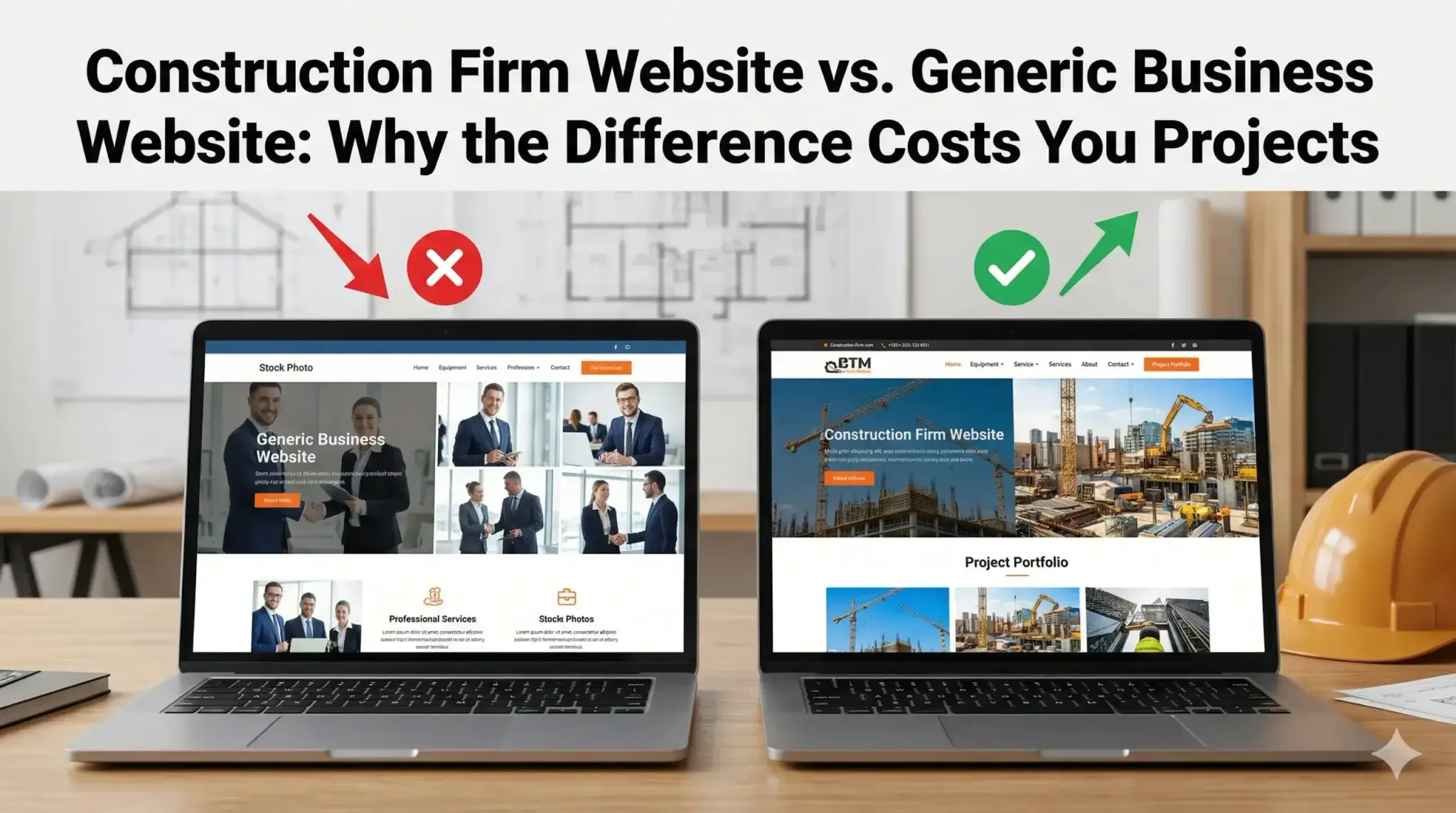
A website built specifically for construction isn’t the same as a generic small business site with a hard-hat photo slapped on the banner. Here’s what separates a site that generates leads from one that just takes up space online:
- Speed under two seconds on mobile — because that’s when most people decide to stay or leave
- A tap-to-call phone number visible without scrolling — no one should have to search for how to reach you
- Dedicated service pages — one page per core service, written for the customer searching for that specific thing
- Real photos of your work — stock photos kill trust; your actual projects build it
- Clear geographic signals — your city, your service areas, stated plainly and repeatedly
- A simple, low-friction lead form — asking for name, phone, and project type is enough; a 10-field form gets abandoned
- Social proof above the fold — star rating, number of reviews, or a short testimonial from a real client
This is what Digital Trace builds for construction businesses — websites designed around the specific way people search for and hire contractors.
Your Path to More Leads: 5 Steps That Actually Move the Needle
You don’t need to become a digital marketing expert. You just need a clear picture of where the gaps are and someone who knows how to close them.
Step 1: Audit what you have. Before changing anything, understand what’s working and what isn’t. Page speed, mobile experience, keyword visibility, and conversion paths — these all need to be assessed before you build or rebuild.
Step 2: Fix your mobile experience. If your site is hard to use on a phone, everything else is secondary. This is where most construction websites lose the most leads — silently, every day.
Step 3: Build service-specific pages. Stop sending every visitor to one generic page. Each core service deserves its own page, written for the specific customer who’s searching for it.
Step 4: Make your local presence clear. Your city and service areas should be stated clearly across your site — in headings, in your content, and in your page metadata. Google needs to see it. So do your customers.
Step 5: Make it easy to contact you. A visible phone number, a simple form, and a single strong call-to-action on every page. Remove every barrier between a visitor and a conversation with your business.
FAQ: What Construction Business Owners Actually Ask Before Hiring a Web Agency
Why am I not getting calls from my website?
Usually it comes down to three things: people can’t find your site (you’re not ranking), people visit but leave before they call (bad mobile experience or slow load times), or people don’t trust what they see (weak social proof, no clear service focus). Most construction websites have at least two of these problems at once.
How do I know if my construction website is actually working?
If your site isn’t generating at least a few genuine inquiries per month from organic search — without paid ads — it probably isn’t pulling its weight. A good place to start is checking how many calls or form fills are coming from your website directly, not from your Google Business Profile or referrals. A free website audit can show you exactly where visitors are dropping off and what’s fixable.
How long does it take to see results from a new website?
A rebuilt site that’s properly optimized typically starts showing traction within 60 to 90 days — sometimes faster if the previous site was severely underperforming. You won’t dominate every keyword overnight, but consistent improvement in organic visibility and lead quality is realistic within the first quarter.
What makes a construction website different from a regular business website?
Construction customers search very differently from retail or service customers. They’re often looking for specific work types, in specific cities, sometimes on a tight timeline. A construction company website needs to match those search patterns precisely — with service-specific content, strong local signals, and a design that builds immediate trust (portfolio, reviews, credentials) since the jobs involved are high-stakes purchases.
Do I really need a fast website if my customers are local?
Yes — especially because your customers are local. When someone searches for a contractor in your city and your site loads slowly, Google notices that people leave and factors it into where you rank. Local competition is often intense, and a one-second advantage in load time can be the difference between showing on page one or page two. Most people never scroll to page two.
I’ve hired agencies before and seen nothing. Why would this be different?
That’s a fair and common frustration. The difference usually comes down to whether the agency builds a generic website or one built specifically for how your industry and your customers work. Construction web design isn’t a template job — it requires understanding how contractors get hired, what local search actually looks like for your services, and how to turn a website visit into an estimate request. Results should be measurable, and a good agency will show you exactly what’s changing and why.
Ready to See What Your Website Is Actually Costing You?
Most construction business owners are surprised to learn how much revenue their current website is leaving behind — not because their work isn’t good, but because their site isn’t built to compete.
There’s no obligation and no sales pitch. Digital Trace will take a clear look at your website, show you exactly what’s working against you, and give you a straight answer about what it would take to fix it.
If your competitors are showing up on Google and you’re not, the gap almost always starts with the website. Let’s find out what’s behind it — and close it.