How to Choose the Right Construction Web Design Agency (Without Getting Burned)
You’ve spent years building a reputation in construction — delivering projects on time, keeping crews accountable, and earning referrals the hard way. Then you hired a web agency, paid a few thousand dollars, and… nothing changed. The phone didn’t ring more. The website looked fine but produced nothing.
That’s not bad luck. That’s what happens when a general web agency builds a site without understanding how construction customers actually search, think, and decide who to call.
Most construction business owners assume their website problem is about design. It’s usually not. The real problem is that your site was built to look good — not to rank on Google, load fast on a job-site phone signal, or convert a skeptical homeowner or project manager into a call.
This guide breaks down exactly what to look for when choosing a construction web design agency — and what warning signs mean you’re about to get burned again.
Your Website Is Like Your Work Truck — If It Can’t Perform, It’s Costing You Money
Think of your website the way you think about your work truck. Nobody hires a contractor who shows up in a rusted-out, unreliable vehicle with no lettering on the side. First impressions matter. But more than looks, the truck has to actually run — it has to show up on time, carry the load, and get you to the job.
A construction website works the same way. It has to show up (rank on Google), load fast (even on a phone with two bars of LTE), and carry a potential customer all the way from “I found this company” to “I’m calling them right now.”
Most agencies build you a nice-looking truck that breaks down in the driveway.
Here’s what actually matters — and how to tell the difference before you sign a contract.
Red Flag #1: They’ve Never Built a Site for a Construction Company
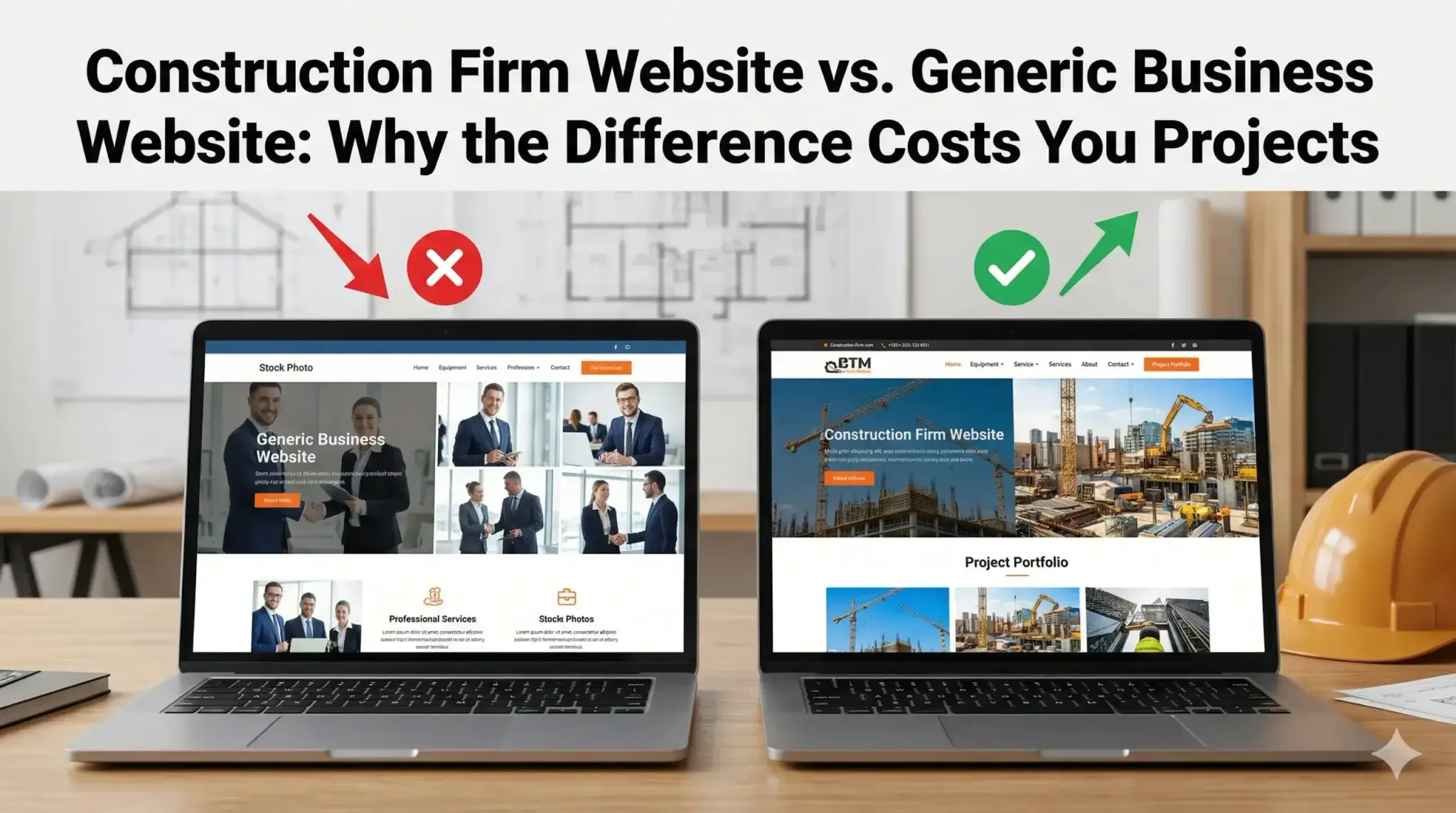
Generic web agencies build websites. That’s it. They’ll take your logo, write some copy about “quality craftsmanship and customer satisfaction,” throw in a stock photo of a hard hat, and call it done.
The problem is they don’t know how construction customers actually find contractors. They don’t know that someone searching “commercial concrete contractor near me” is ready to hire — right now — while someone searching “what does a foundation repair cost” is still in research mode. Those two visitors need completely different pages.
They don’t know that most of your traffic will come from mobile, often from someone standing in a parking lot or on a job site. They don’t know that your service area matters as much as your services. And they almost certainly don’t know how Google evaluates a construction business’s website differently than a restaurant or a law firm.
Before you sign with any agency, ask them: Can you show me construction websites you’ve built? What happened to their leads after launch? If they fumble that answer, keep walking.
Red Flag #2: They’re Selling You a Website — Not a Lead System
A website that doesn’t generate calls is just an expensive business card.
The agencies that get construction businesses real results understand that a website is a system, not a project. It has moving parts that all have to work together:
- Speed: If your site takes more than 3 seconds to load, more than half your visitors leave before they see a single word. Not because they don’t need a contractor — because they moved on to the next result.
- Mobile experience: Most people searching for a contractor are on their phone. If your site is hard to navigate on a phone screen, you’re losing those leads.
- Clear calls to action: Every page needs to answer the question “what do I do next?” — with a phone number, a contact form, or a request-a-quote button that’s easy to find.
- Local SEO: Google needs to understand exactly where you work and what you do. Without the right setup, your site might rank for your company name but not for “roofing contractor in [your city]” — which is what your customers are actually searching.
A good construction web design agency builds all of this in from day one, not as add-ons you pay for later.
Red Flag #3: Your Site Is Invisible on Google — and No One Told You
Here’s a problem that’s more common than most construction owners realize: your website exists, but Google isn’t showing it to anyone who actually needs your services.
Why does this happen? A few reasons.
First, your pages may not be targeting the right phrases. There’s a big difference between having a page that mentions “we do roofing” and having a page built to rank for “metal roofing contractor [city].” Google reads your pages like a blueprint — if the blueprint isn’t specific, it doesn’t know what to build.
Second, Google may not have enough information about your business to trust it. There’s a technical setup (called schema markup) that tells Google: “This is a licensed general contractor. They serve these zip codes. Here’s their phone number. Here’s what they specialize in.” Without it, Google treats your site like an unmarked truck — it doesn’t confidently recommend you.
Third, if your site loads slowly or isn’t mobile-friendly, Google quietly pushes it down in rankings. You’ll never get a notification. You just stop showing up.
💡 Pro Tip: Check How Your Site Loads on a Phone Before Anything Else
Most construction business owners check their website on a desktop computer in the office. Their customers are checking it on a phone, standing in a parking lot, often on a weak signal.
Pull out your phone right now and open your website on cellular data (turn off Wi-Fi). Time how long it takes to load. Then ask yourself: is your phone number visible without scrolling? Can someone tap to call you in under 10 seconds?
If the answer to either question is no, you’re losing real leads every single day. A good web design agency will fix this before anything else — because no amount of design work matters if people leave before the page finishes loading.
What a Real Before/After Looks Like
Garcia & Sons Concrete — Dallas, TX
Garcia & Sons had been in business for 11 years. Solid reputation, strong referral base, real project photos. Their website had been built by a local graphic designer five years earlier and hadn’t been touched since.
The problem: they were getting fewer than 10 website visitors a week and almost no inbound calls from people who didn’t already know them. They were invisible on Google for nearly every search that mattered — “commercial concrete contractor Dallas,” “flatwork and slab installation,” “concrete driveway replacement near me.”
The site also loaded in over 7 seconds on mobile, had no Google Business Profile integration, and was missing basic local SEO signals entirely.
After rebuilding the site with construction-specific SEO, fast mobile performance, dedicated service area pages, and clear lead capture on every page, results shifted significantly within 90 days:
- Organic website traffic increased by over 300%
- Inbound calls from the website went from near-zero to 18–24 per month
- The contact form was generating 6–10 qualified project inquiries per month
None of their services changed. Their prices didn’t change. The only thing that changed was that the right people could finally find them — and when they landed on the site, it was built to make them call.
Not sure if your construction website has these issues? Get a free website audit — no obligation, just a clear picture of what’s costing you leads.
What to Actually Look for in a Construction Web Design Agency
Now that you know what the wrong agency looks like, here’s what the right one does differently.
They ask about your business before they talk about design. A good agency wants to know: What services make you the most money? What areas do you serve? Who are your best customers — homeowners, property managers, general contractors? The website strategy flows from those answers.
They show you the plan, not just the portfolio. Any agency can show you screenshots. The right agency explains how the site will rank, what pages they’ll build, how they’ll handle your service areas, and what the lead flow will look like after launch.
They build for performance, not just aesthetics. Fast load times, clean mobile experience, click-to-call buttons, real photos from your projects, and content that matches how your customers actually search — all of that has to be built in, not bolted on.
They understand construction-specific SEO. Websites built for construction businesses need service-specific pages, location targeting, and Google Business Profile alignment. Without all three working together, you’ll rank for your company name and almost nothing else.
Your Path to More Leads: 5 Steps That Actually Work
Here’s a simple framework to go from invisible to consistently generating inbound construction leads:
- Audit what you have. Before spending money, know exactly what’s broken. Speed, mobile experience, SEO basics, and lead capture are the four areas that matter most.
- Build service-specific pages. Don’t put everything on one page. If you do residential roofing, commercial roofing, and storm damage repair — those are three different pages targeting three different searches.
- Fix your mobile experience. Your phone number should be tap-to-call, visible at the top of every page, on every device. No exceptions.
- Target your actual service area. If you work in 8 cities, you need content built around each of those cities — not just your headquarters location.
- Track what’s actually driving calls. A good agency sets up call tracking and form tracking from day one, so you’re not guessing whether the website is working.
Frequently Asked Questions
Why isn’t my construction website getting me any calls?
Usually it’s one of three things: your site isn’t ranking for the searches your customers actually use, it loads too slowly on mobile so people leave before they see your number, or your pages don’t make it obvious what to do next. Most construction sites have all three problems at once. A quick audit will tell you exactly which one is costing you the most.
How do I know if my construction website is actually working?
If you can’t answer “how many calls came from the website this month?” — your website isn’t being tracked properly. A working construction website should have call tracking, form submission tracking, and Google Search Console set up so you can see which searches are bringing people to your site and which pages they’re landing on.
How long does it take to see results from a new construction website?
For most construction businesses, well-built sites start seeing measurable organic traffic growth within 60–90 days. Lead volume from the site typically builds over 3–6 months. Paid advertising can drive leads faster while organic rankings build. Either way, the results compound — the longer the site runs, the better it performs.
What makes a construction website different from a regular business website?
Construction customers search differently. They search by service type, location, and project type — often from a phone, often in a hurry. They want to see real photos of real work, clear service explanations, and an easy way to get a quote fast. A generic website template doesn’t account for any of that. Construction web design has to be built around how contractors actually win jobs.
Do I really need a fast website if my customers are local?
Yes — especially because they’re local. Local searches happen on phones. Someone searching for a contractor while standing at their property or sitting in their car needs your site to load fast and make it easy to call you immediately. A site that takes 6 seconds to load on mobile will lose that customer to the competitor who loads in 2 seconds, every single time.
How do I know if an agency actually understands construction?
Ask them: What service pages would you build for a general contractor? and How do you handle local SEO for businesses that serve multiple cities? If they can’t answer those specifically — or if they give you a generic answer about “SEO best practices” — they don’t have real experience in the construction industry. You want an agency that’s done this before and can show you the results. Get a free website audit to see exactly where your current site stands before talking to anyone.
Stop Letting Your Website Cost You Jobs
Every week your website isn’t ranking, loading fast, and converting visitors — you’re handing jobs to competitors who figured this out before you did.
The construction businesses winning online aren’t the biggest or the oldest. They’re the ones whose websites show up when someone searches, load fast when someone clicks, and make it easy to call when someone’s ready to hire.
If you’re not sure where your site stands, the fastest way to find out is to have someone who knows construction websites actually look at it.
Get a free website audit from Digital Trace — no sales pitch, no pressure. Just an honest look at what’s working, what’s broken, and exactly what it would take to turn your website into a lead source you can count on.