Construction Firm Website vs. Generic Business Website: Why the Difference Costs You Projects
You built your construction business with skilled labor, good work, and word of mouth. Now you’ve got a website — and you’re still not getting the calls you expected. Meanwhile, a competitor across town (who you know does the same work, maybe worse) keeps showing up in Google and landing jobs.
The frustrating truth? It probably isn’t your reputation, your pricing, or your portfolio. It’s your website — specifically, what kind of website it is.
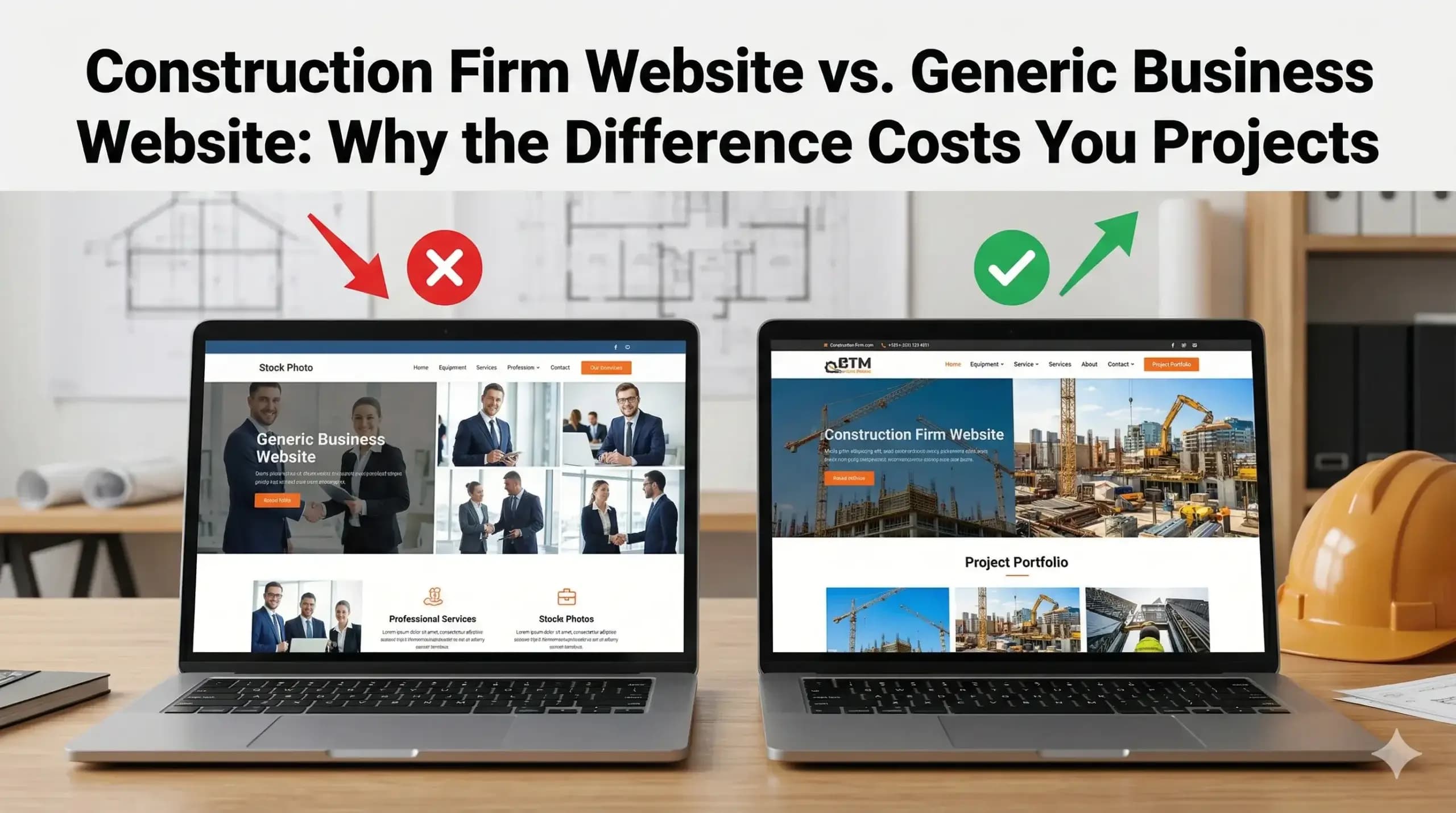
Most construction firms are running on generic websites built for businesses-in-general. These sites look fine enough. They have your logo, your phone number, maybe some photos. But they’re not built for the way people search for construction companies, evaluate contractors, or decide who to call when a project is on the line.
This article breaks down exactly what a construction firm website needs to do differently — and why the gap between “a website” and the right website is where your projects are being lost.
Your Website Is Competing in a High-Stakes Market — and It Doesn’t Know It
Think about what happens when a property manager, general contractor, or homeowner needs a construction firm. They don’t flip through a binder. They go to Google, type in something like “commercial construction company near me” or “foundation contractor [city],” scan the first few results, click one or two, and make a judgment call inside of 30 seconds.
That 30-second window is where your business is won or lost — and a generic website is built to fail it.
Here’s what a generic site does during those 30 seconds:
- Loads slowly, causing the visitor to click away before your phone number even appears
- Shows vague language like “quality service” and “customer satisfaction” — the same words every other site uses
- Offers no clear reason why your firm is the right choice for this specific type of project
- Has no visible trust signals — no licenses, no certifications, no completed project photos with context
A construction firm website built correctly does the opposite. It loads fast, immediately communicates what kind of work you do, shows proof, and makes it dead simple to call or request a quote.
The “Cheap Blueprint” Problem: Why Generic Websites Don’t Convert Construction Leads
Here’s a useful way to think about it. Imagine showing up to bid a complex commercial job with a generic proposal template you pulled off the internet — one that wasn’t adjusted for the project scope, the client’s industry, or the local code requirements. You’d probably lose that bid to someone who showed up with specifics.
That’s exactly what a generic website does for your construction business every single day.
Generic website templates are designed to work for anyone — a bakery, a law firm, a plumber. That flexibility is exactly why they fail for construction. The way people search for and evaluate a construction firm is completely different from how they choose a restaurant or a retail store.
A few things generic sites consistently get wrong for construction businesses:
- No project-type targeting. When someone searches “tilt-up warehouse contractor” or “historical renovation firm,” a generic site has no content that matches that intent. Google doesn’t show it. The visitor doesn’t find you.
- No trust-building structure. Construction clients are making big financial decisions. They need to see licenses, insurance info, project timelines, and real completed work — not stock photos and boilerplate copy.
- No local signal strength. Google ranks local contractors based on specific signals. A generic site often skips the geographic markers that tell Google where you work and what you do there.
This is what websites built for construction businesses are designed to fix at every level — not just visually, but structurally and technically.
Speed Is a Sales Problem, Not a Tech Problem
Here’s a number worth knowing: most people decide whether to stay on a website or leave within the first three seconds. On mobile, it’s even less forgiving.
When a potential client clicks your site and it takes five or six seconds to load — which is common with poorly optimized generic templates — most of them are already gone. They’ve hit the back button and clicked your competitor.
This isn’t a technology problem. It’s a revenue problem.
Construction clients are often busy people — project managers, property owners, GCs — who are doing quick research between meetings or on the job site from their phones. A slow, bloated website tells them nothing good about your operation.
What causes this? Usually a combination of oversized images, unoptimized code, and cheap hosting. The fix isn’t glamorous, but it’s straightforward when someone who knows what they’re doing handles it.
A properly built construction firm website loads fast on mobile, looks clean on any screen size, and gets the visitor to your phone number or contact form before they have time to second-guess clicking away.
💡 Pro Tip: Your Homepage Is Probably Talking to the Wrong Person
One of the most common mistakes in construction websites is writing homepage copy that describes the company instead of speaking to the client’s problem.
Most homepages start with something like: “We are a full-service construction firm with 20 years of experience serving the greater [City] area.”
That’s all about you. The visitor’s first thought is: “Okay, but can you solve my problem?”
The fix is to lead with what the client needs. Something like: “Need a reliable contractor for your commercial build-out? We deliver on schedule, on spec, and on budget — every time.”
This small shift in framing changes how visitors respond. It also helps with SEO, because search engines reward content that directly addresses what searchers are looking for.
Why Your Competitor Shows Up on Google and You Don’t
Local search rankings for construction companies aren’t random. Google uses specific signals to decide which firms to show and in what order.
Generic websites often miss several of these signals entirely:
- No location-specific content. If your site doesn’t mention the cities and regions you serve throughout the content, Google won’t confidently connect you to searches in those areas.
- Missing structured data. Google uses behind-the-scenes code tags to understand what your business does, where you’re located, and what kind of services you offer. Most generic templates don’t include these, which means Google has to guess — and often guesses wrong.
- Weak or nonexistent service pages. A single “Services” page with a bulleted list is not enough. Contractors who rank well typically have dedicated pages for each service type — commercial construction, tenant improvements, ground-up builds, etc.
The result is a site that exists but isn’t found. Your firm is invisible to the people actively searching for exactly what you offer.
Seeing how Digital Trace builds construction websites makes it clear how differently this can be approached — structuring each page to target specific search terms while building in all the trust signals that convert visits into calls.
Real-World Example: Regain Construction, Denver, CO
A realistic before/after scenario based on common construction firm challenges.
Regain Commercial Builders had been in business for 14 years, doing mostly light commercial and industrial work in the Denver metro. They had a website — built by a cousin about five years earlier using a generic small business template. It had their logo, a few project photos, and a contact form.
The problem: they were getting almost no inbound leads from their site. Every new job came from referrals. When they asked existing clients to check them out online, most reported the site looked outdated and didn’t load well on phones.
Here’s what was wrong:
- The site took 8+ seconds to load on mobile
- There were no dedicated pages for their core services (tenant improvements, warehouse builds, ground-up commercial)
- The homepage copy was generic, with no mention of the specific industries they served
- Google couldn’t confirm their service area or specialties
After a full rebuild — fast-loading, mobile-first, with dedicated service and location pages and proper structured data — results shifted measurably within 90 days:
- Organic search traffic increased by roughly 3x
- Inbound calls from the website went from near-zero to 8–12 per month
- Two of those calls converted to project contracts within the first 90 days
The work didn’t change. The team didn’t change. The website changed.
Not sure if your construction website has these issues? Get a free website audit — no obligation, just a clear picture of what’s costing you leads.
Your Path to More Leads: 5 Steps to a Construction Website That Actually Works
Getting more calls from your website isn’t complicated — but it does require the right structure. Here’s what the path looks like:
- Audit what you have. Before anything else, understand where your current site is falling short. Speed, content gaps, missing trust signals, and local SEO issues are the most common culprits.
- Identify your highest-value services and build pages around them. Each major service you offer — new construction, renovations, tenant improvements, specialty work — deserves its own page with specific language and search targeting.
- Make mobile performance non-negotiable. Most of your potential clients are checking you out on their phones. If your site doesn’t load fast and look clean on mobile, you’re losing them before you even get a chance.
- Build in trust from the first scroll. Licenses, insurance, project photos with context, client types served, and years in business should all be visible without digging. Clients need to feel confident before they call.
- Turn your site into a lead capture machine. Phone numbers should be clickable. Contact forms should be simple. Every page should have a clear next step. Don’t make visitors work to reach you.
FAQ: Real Questions from Construction Business Owners
Why am I not getting calls from my website?
The most common reasons are slow load times, no visibility in local search, or a site that doesn’t answer the questions prospects have when they land on it. Visitors decide in seconds whether to stay or leave — if your site doesn’t immediately communicate who you serve and why you’re the right choice, most people leave without calling. A proper free website audit can identify exactly where your site is losing people.
How do I know if my construction website is actually working?
If your website is working, you’ll know — because you’ll be getting regular inbound calls and form submissions from people who found you through Google. If every job still comes from referrals and your website hasn’t produced a qualified lead in months, it’s not working. The site might look fine, but looking fine and performing are two different things.
What makes a construction website different from a regular business website?
Construction clients evaluate contractors very differently from how people choose a restaurant or service shop. They’re making large financial decisions and need to see proof — project photos with context, licensing info, service-area specifics, and relevant experience. A generic business template isn’t structured for that decision-making process. A construction firm website is built to match how construction clients actually think and search.
Do I really need a fast website if my customers are local?
Yes — probably more so. Local clients are often searching on their phones while on the job site or between meetings. Google also factors site speed directly into local search rankings. A slow site hurts you twice: visitors leave before they see your number, and Google ranks you lower because of it.
How long does it take to see results from a new website?
Realistically, meaningful improvements in search visibility and inbound leads typically show up within 60–90 days of launching a properly built site. The speed and lead conversion improvements are often immediate — from the moment the new site goes live. SEO results build over time as Google recognizes the improved signals and begins ranking you for the terms your clients are searching.
I’ve been burned by marketing agencies before — how is this different?
That’s a fair concern, and it’s worth asking directly. The difference is in what’s being built and why. Generic web agencies build websites. Construction-focused web work is about building something that gets you projects — designed around how construction clients search, evaluate, and decide. The results should be measurable: more calls, more quote requests, more jobs. If an agency can’t tell you how they’ll measure success, that’s a warning sign.
Stop Leaving Projects on the Table
Every month your construction firm runs a generic website is a month competitors with better-built sites are picking up the calls that should be going to you.
The fix isn’t complicated or expensive — but it does require someone who understands how construction clients search, how Google ranks local contractors, and how to turn website visits into phone calls.
Get a free website audit from Digital Trace — no pitch, no pressure, just a clear breakdown of what your current site is costing you in leads, and what it would take to fix it. For construction firms serious about growing through better online visibility, it’s the fastest way to know exactly where to start.