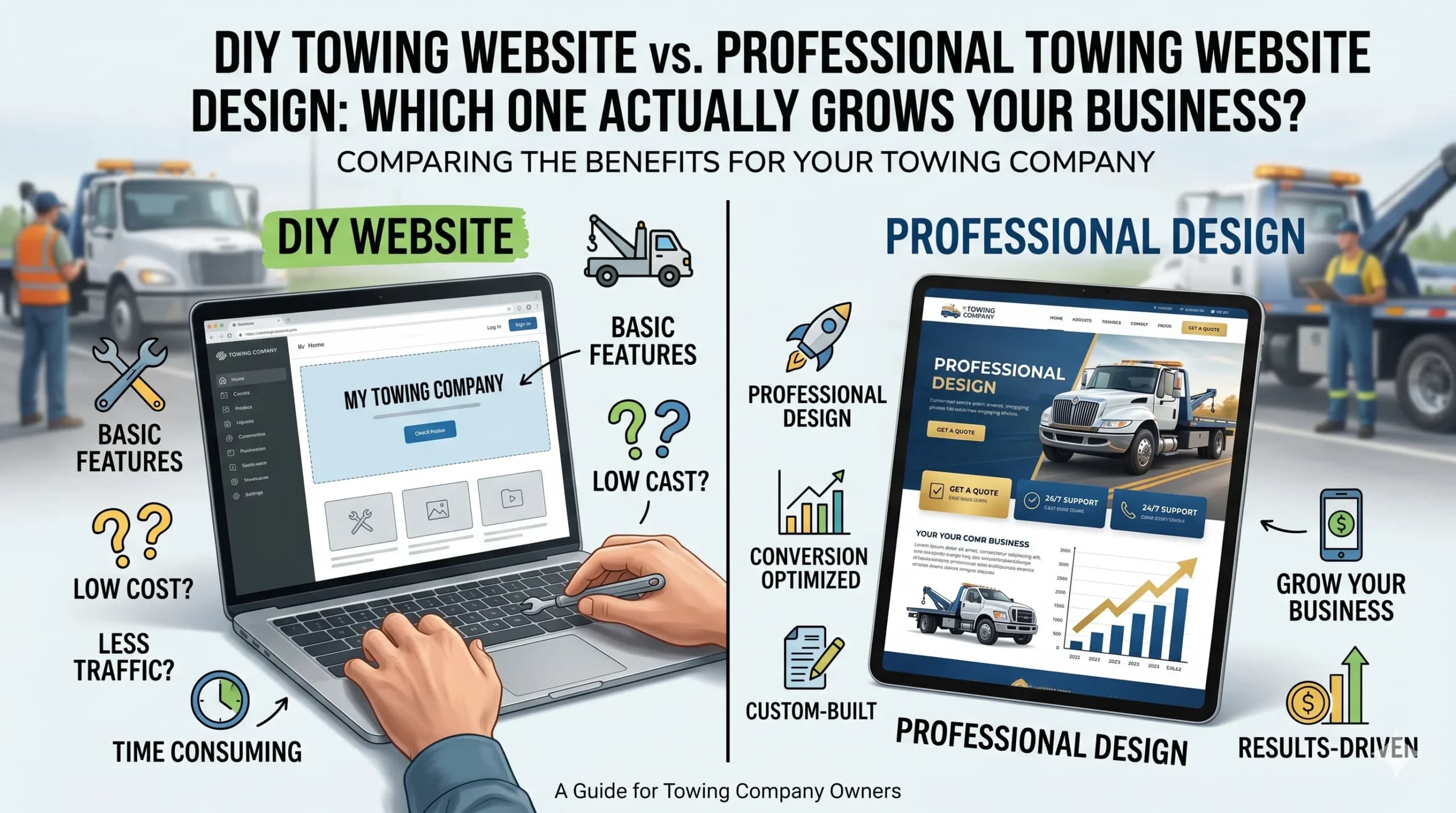
DIY Towing Website vs. Professional Towing Website Design: Which One Actually Grows Your Business?
You’ve got a towing business to run — dispatch calls coming in, trucks on the road, drivers to manage. So when it came time to build a website, you handled it yourself (or had a nephew do it), got something live, and moved on.
But here’s the problem: the phone isn’t ringing from it.
You’re not alone. Most towing company owners assume that having any website is good enough. The truth is, there’s a massive difference between a website that just exists and a towing website design that actually converts visitors into paying customers. One is a digital placeholder. The other is your best salesperson — working 24/7, capturing calls at 2am when someone’s car breaks down on the highway.
By the end of this article, you’ll know exactly why your website might be failing you, what a professionally built towing service website actually does differently, and how to find out what it’s costing you right now.
Why Your Towing Website Isn’t Bringing In Calls
Think about the moment someone needs a tow. Their car just died on the side of the road. They’re stressed, maybe in the dark, and they pull out their phone. They type “tow truck near me” or “towing service [city name]” — and they call the first company that looks trustworthy.
If your website isn’t showing up in that search, or if it shows up but looks outdated or loads slowly, that customer calls your competitor. Not because they preferred them — just because your site didn’t show up or didn’t pass the split-second trust test.
That’s not a traffic problem. That’s a towing website design problem.
The DIY Website Trap: What It Costs You Without You Knowing
A DIY site built on Wix, Squarespace, or a free WordPress template might look fine on your laptop. But “looks fine” and “performs” are two completely different things for a towing service website.
Here’s what’s typically broken under the hood:
- It loads too slowly. Most people searching for a tow truck are on their phones, often with spotty signal. If your site takes more than 3 seconds to load, the majority of visitors leave before they ever see your phone number. That’s not an exaggeration — it’s a consistent pattern across local service websites.
- Google can’t figure out what you do or where you do it. Without the right technical setup (called local schema markup), Google doesn’t have the structured information it needs to confidently recommend your business in local searches. The fix isn’t complicated, but most DIY builders skip it entirely.
- Your phone number isn’t click-to-call. On a phone, a number that isn’t tappable means the customer has to memorize it, switch apps, and dial manually. Most don’t bother.
- You’re invisible in the city areas you actually serve. DIY sites rarely have the location-specific pages that tell Google “this towing company serves [city], [city], and [city].” Without those, you show up for almost nothing.
What a Professional Towing Website Design Actually Does Differently
Here’s the analogy that makes this click for most towing operators: imagine you’ve got a great truck, but the radio doesn’t work, the GPS is broken, and it doesn’t show up in dispatch. It can still tow — but you’d never get a call for it.
That’s a DIY website. A professional towing website design is the fully operational truck: it shows up when someone needs help, it looks reliable, and it makes it effortless to call.
Specifically, a professionally built towing company website does these things:
- Loads in under 2 seconds — so customers on the side of the road aren’t waiting and bouncing
- Has a prominent, click-to-call phone number visible above the fold on every page
- Targets the specific cities and service areas where you actually want to win work
- Is structured so Google understands your services — roadside assistance, flatbed towing, long-distance towing, whatever you offer
- Builds immediate trust with real photos, clear service descriptions, and visible reviews
💡 Pro Tip: Your Homepage Might Be Turning Customers Away in the First 5 Seconds
Most DIY towing websites make the same mistake: they open with a generic tagline like “Reliable Towing Services” and a stock photo of a highway. There’s no immediate answer to what the customer is thinking: “Can you tow me right now, in my city, and how much will it cost?”
A professional tow truck website answers those three questions before the visitor even scrolls. That means city-specific language, a visible service list, and a clear call button — all in the first screen they see. This single change alone can dramatically increase the number of people who actually pick up the phone.
Real-World Example: What Changed When One Towing Company Got Serious About Their Website
Take a roadside and recovery operation based in the Dallas–Fort Worth area — a 4-truck operation with solid word-of-mouth, but a website that had been cobbled together years ago and never updated.
The problems: The site took nearly 7 seconds to load on mobile. The phone number wasn’t clickable. There were no city-specific pages, so the company only appeared in search results for their home city — missing out on five surrounding suburbs they regularly served. Google Business Profile existed but wasn’t connected properly to the site.
What changed: A rebuilt towing service website design — mobile-first, fast-loading, with dedicated service area pages for each city they covered. The phone number moved to a sticky header visible on every page. Local schema markup was added so Google could fully understand the business. Reviews were integrated from their existing Google profile.
The result: Within 90 days, organic calls from the website more than doubled. They started appearing in local pack results for three cities they’d been invisible in. The owner reported that he stopped relying entirely on referrals to keep his trucks busy during slow weeks — the website was now pulling its weight.
Not sure if your towing website has these issues? Get a free website audit — no obligation, just a clear picture of what’s costing you leads.
Your Path to More Leads: 5 Steps That Actually Move the Needle
You don’t need to understand web development to know what a better website should do. Here’s what the path forward looks like in plain terms:
- Find out what’s broken first. Before spending anything, get a clear diagnosis. A free audit will show you exactly what’s costing you calls right now — slow load times, missing city pages, broken click-to-call, and more.
- Fix the mobile experience. The majority of towing searches happen on phones. If your site isn’t built for mobile, you’re losing customers every single day.
- Build pages for every city you serve. Each city you want work from needs its own page. This is how you show up in searches beyond your home city.
- Make calling effortless. One tap to call. That’s the only goal of every page on a towing website.
- Work with someone who knows the towing industry. Generic web agencies build generic websites. A team that has built websites for towing businesses knows which pages to build, which cities to target, and which trust signals actually convert a stressed-out driver into a call.
Frequently Asked Questions
Why am I not getting calls from my towing website?
The most common reasons are slow load speed (people leave before the page opens), no click-to-call number, and missing local SEO — meaning your site doesn’t appear in searches for the cities you actually serve. Any one of these alone can kill your incoming calls. Together, they mean your website is essentially invisible to the customers who need you most.
How do I know if my towing website is actually working?
If you can’t point to a specific number of calls or form submissions that came directly from your website each month, it’s probably not working. A properly set up site will have call tracking and Google Analytics showing you exactly how many people found you online and what they did next. A free audit can show you the baseline — and what you’re currently missing.
How long does it take to see results from a new towing website?
For local SEO results, most towing businesses see meaningful movement within 60–90 days of launching a properly optimized site. Some improvements — like click-to-call rates and mobile conversions — happen immediately on launch day because the experience is simply better for the visitor.
What makes a towing website different from a regular business website?
Towing customers are almost always in an urgent situation. They’re not browsing — they need help right now. That means a towing service website has one job above all others: get the visitor to call in under 10 seconds. The design, the structure, and the content all have to support that single goal. Generic websites are built to inform. A towing website is built to convert under pressure.
Do I really need a fast website if my customers are local?
Especially if your customers are local. Local customers are searching on their phones, often outdoors with inconsistent signal. A slow site doesn’t just frustrate them — it gets abandoned. And Google’s ranking algorithm specifically penalizes slow mobile sites, meaning your slower competitor with a faster website will outrank you even if your business is better.
I’ve been burned by a web agency before. How is this different?
That’s a fair concern, and it’s one we hear often. The difference is specificity. Agencies that build generic websites can’t explain why a towing website needs different city pages than a plumber’s. They can’t tell you which trust signals matter most to someone on the side of the road at midnight. Digital Trace works specifically with towing and roadside businesses — so the strategy isn’t guesswork, it’s built on what actually works in your industry.
There Are Calls You’re Missing Right Now — Let’s Find Them
Every day your current website sits there underperforming, someone types “towing service near me,” finds a competitor, and calls them instead. That’s real revenue walking out the door — and most towing operators don’t even know it’s happening because they have no way to measure what they’re missing.
A free website audit changes that. You’ll get a clear, honest look at exactly what’s broken on your current towing website, which cities you’re invisible in, and what it would take to fix it. No pressure, no complicated jargon — just a straightforward picture of what’s costing you leads.