How a Professional Tow Truck Website Pays for Itself in 30 Days
Your truck is ready. Your crew is ready. But your phone isn’t ringing — at least not the way it should be.
Most towing business owners assume the problem is competition. There are just too many other companies out there, right? Maybe. But here’s what’s actually happening: customers are searching for a tow truck right now, in your area, and your website is quietly losing them before they ever pick up the phone.
The average person in a roadside emergency makes a decision in under 10 seconds. They land on a site, scan it fast, and either call or go back to Google to find someone else. If your site loads slowly, looks outdated, or doesn’t immediately show them a phone number and a reason to trust you — they’re gone. And you never even knew they were there.
This article breaks down exactly why that happens, what it’s costing you in real dollars, and how the right towing website design changes that equation — fast.
Your Website Is Your Dispatcher. Is It Doing Its Job?
Think about your best dispatcher. They answer fast, give callers confidence, and get the job booked before anyone hangs up. Now imagine your dispatcher taking 8 seconds to pick up the phone, speaking quietly, and forgetting to mention your service area.
That’s what a slow, poorly built towing website does every single day.
When someone searches “tow truck near me” at 11pm on the side of a highway, they are ready to hire. They’re not browsing — they need help now. Your website either closes that call or hands it to your competitor in the next Google result.
The problem isn’t that you don’t have a website. The problem is that your website isn’t working fast enough, clearly enough, or confidently enough to win that customer in the moment they need you most.
Why Your Towing Website Isn’t Generating Calls
It Loads Too Slowly — and Customers Don’t Wait
Most visitors decide whether to stay or leave within 3 seconds of landing on a page. If your site takes 6, 7, or 8 seconds to load on a phone, the majority of your visitors are already gone — without ever seeing your phone number.
This isn’t just an inconvenience. Google also tracks how fast your site loads and uses it as a ranking signal. A slow site doesn’t just lose visitors; it gets buried lower in search results, meaning fewer people find you in the first place.
The fix isn’t glamorous, but it’s powerful: properly compressed images, clean code, and fast hosting can cut load time dramatically. Websites built for towing services businesses by Digital Trace are built with speed as a foundation — not an afterthought.
Your Phone Number Isn’t Obvious Enough
This sounds too simple to matter. It isn’t.
On mobile — where the majority of towing customers are searching — your phone number needs to be visible immediately, tappable with one finger, and present on every page. If a visitor has to scroll, zoom, or hunt for your number, most won’t bother. They’ll go back to Google and call whoever has it front and center.
Check your own site right now on your phone. How many taps does it take to call you?
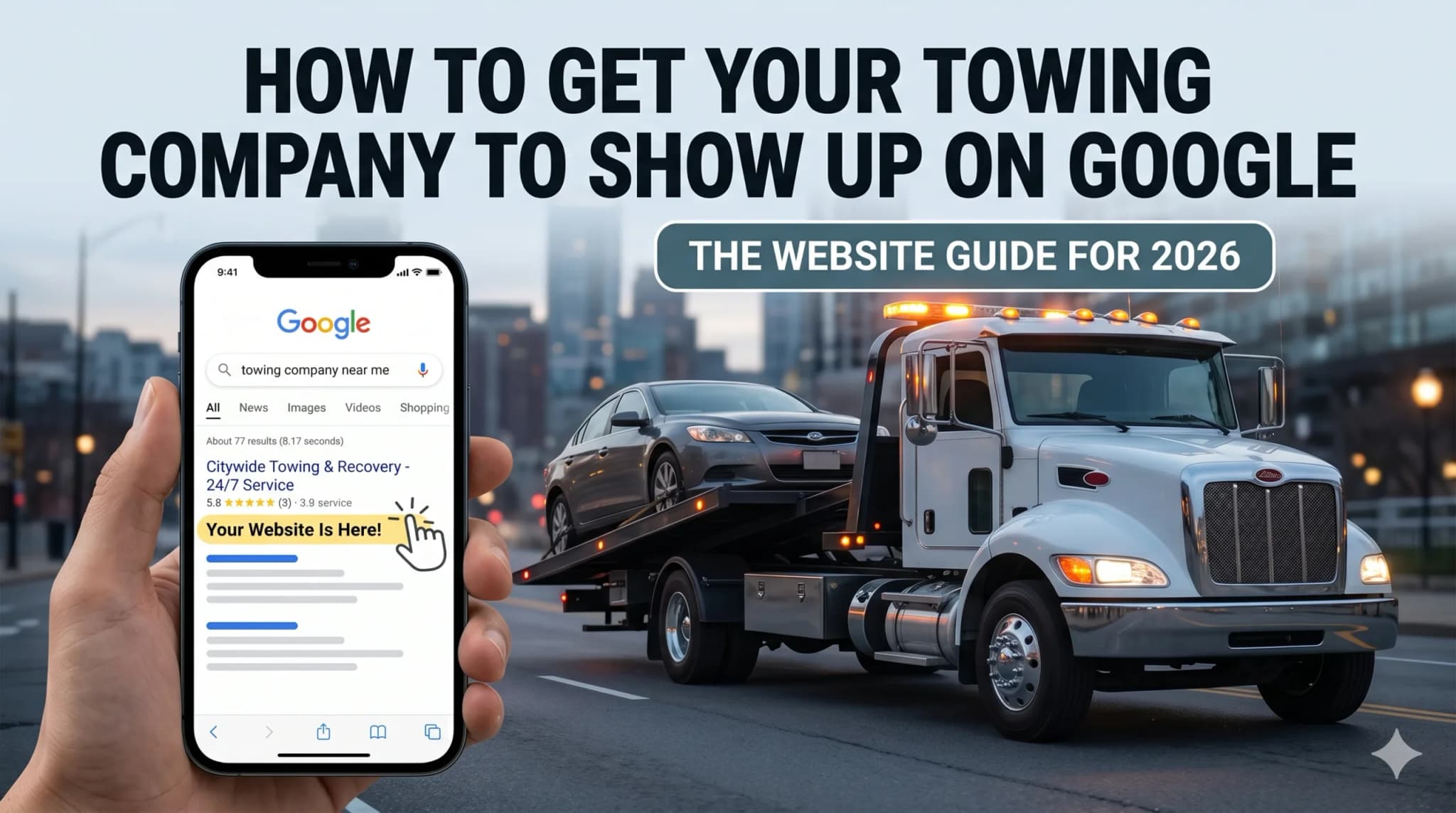
Google Doesn’t Know Enough About Your Business to Recommend You
There’s a behind-the-scenes layer of information that helps Google understand your business — things like your service area, your business category, your hours, and the specific services you offer. When that information is missing or incomplete, Google becomes less confident showing your site to searchers.
This doesn’t mean you’re penalized. It means you’re invisible in moments where you should be the obvious answer. A properly structured towing website tells Google exactly who you are, where you serve, and what you do — so it shows your site to the right people at the right time.
The Design Problem Nobody Talks About: Trust Signals
Picture this: you’re stranded at midnight and you find two towing companies online. One has a clean site, real photos of their trucks, visible reviews, a clear service list, and a phone number at the top. The other has a cluttered layout, stock photos, no reviews, and it’s hard to tell what cities they even cover.
Who do you call?
Your website either builds trust instantly or raises doubt. And doubt, in a high-stress roadside situation, always loses.
Trust signals that actually move the needle for towing businesses:
- Real photos of your actual trucks and crew (not stock images)
- Visible customer reviews — ideally pulled in from Google
- A clear list of services with cities or counties covered
- Licensing, insurance, or certifications mentioned prominently
- Response time or availability (“24/7 Dispatch — We Answer Every Call”)
Most towing websites are missing three or more of these. That’s not a branding problem — it’s a revenue problem.
💡 Pro Tip: Your Homepage Is Probably Costing You Jobs
Here’s a common mistake in the towing industry: business owners build a homepage that talks about their company — years in business, family-owned, proud to serve — but buries the things customers actually need in an emergency. Customers in roadside situations don’t care about your history in the first 5 seconds. They need to know: Can you come to me? How fast? What’s the number? Put your service area, response time, and phone number above the fold on your homepage — meaning visible without any scrolling. Everything else can come after. This one change alone can meaningfully increase the number of calls you get from people who land on your site.
Real Story: From Ghost Town to Booked Solid
A towing company in the Dallas-Fort Worth area had been in business for 11 years. They had a website — had for years — but most of their work still came from word of mouth and one referral relationship with a local auto shop. Their site was pulling in some organic traffic, but the phone rarely rang from it.
Here’s what the audit found:
- Site loaded in 7.4 seconds on mobile
- No click-to-call button visible on mobile homepage
- Phone number only appeared in the footer
- Service area pages existed but weren’t optimized for local searches
- No customer reviews visible on the site
After a full redesign focused on speed, mobile usability, local SEO structure, and trust signals, the results shifted quickly:
- Mobile load time dropped to under 2 seconds
- Inbound calls from organic search increased by roughly 3x within the first 30 days
- Within 60 days, they had reduced their reliance on the referral relationship because online leads were consistent enough to fill the schedule
The investment in a proper towing website design paid for itself within the first month — not because of magic, but because the site finally started doing what it was supposed to do: convert searching customers into booked calls.
Not sure if your website has these same issues? Get a free website audit — no obligation, just a clear picture of what’s costing you leads.
What Makes a Towing Website Different From a Generic Business Website
A plumber, a restaurant, and a towing company all need websites. But the urgency and decision-making speed of a towing customer is entirely different.
When someone searches for a tow truck, they are almost always in a high-stress, time-sensitive situation. They’re not comparing five options over two days. They’re picking from the top two or three results and calling immediately.
That means your site needs to be engineered for speed of decision — not depth of browsing. Every design choice, from where the phone number lives to how fast the page loads to whether reviews are visible, should be made with one goal in mind: get this customer to call in under 10 seconds.
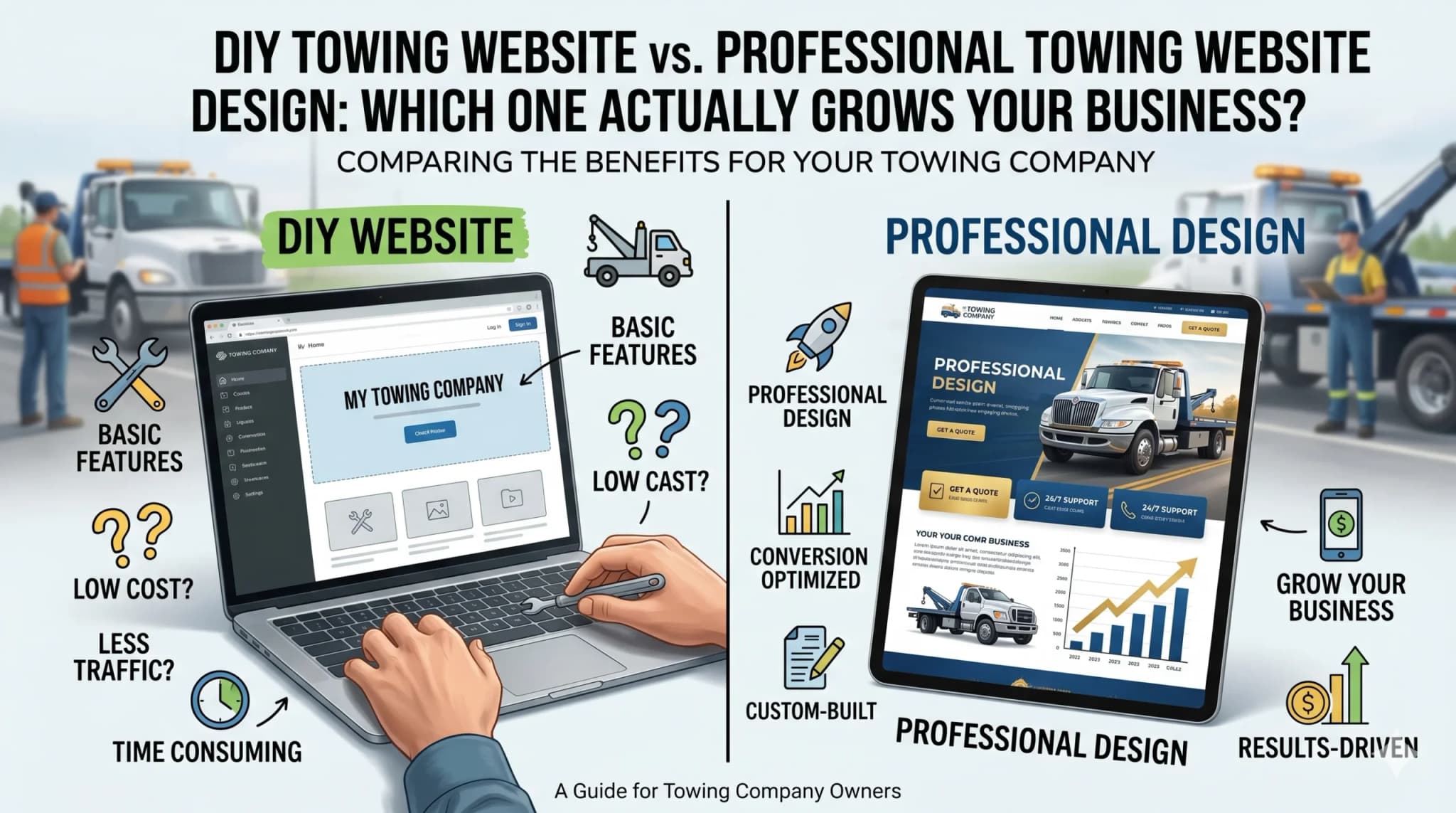
Generic website builders and templates aren’t designed with that in mind. They’re designed to look clean and check a box. A towing-specific build considers your emergency customer’s psychology, your local competition, and your specific service areas from the ground up.
Your Path to More Leads: What the Next 30 Days Can Look Like
Here’s what it looks like when a towing company gets serious about their website:
Step 1: Audit what’s actually happening. Before changing anything, understand what your current site is doing and where it’s falling short. A good audit covers speed, mobile usability, local SEO structure, and conversion elements.
Step 2: Fix the fast stuff first. Speed and mobile phone number visibility can often be addressed quickly — and they have an immediate impact on calls.
Step 3: Build out your local presence. Service area pages, Google Business Profile alignment, and local keyword targeting make sure you show up when someone nearby searches for what you do.
Step 4: Add trust signals. Real photos, visible reviews, and clear service information turn visitors into callers. These aren’t decorative — they’re functional.
Step 5: Track what changes. After a professional towing website design build, you should be able to see changes in call volume, form submissions, and search rankings within 30 to 60 days. If you can’t measure it, you can’t improve it.
Frequently Asked Questions
Why am I not getting calls from my towing website?
Usually it’s one of three things: your site loads too slowly on mobile, your phone number isn’t immediately visible and tappable, or your site isn’t showing up high enough in local search results for people to find you. Often it’s all three. A quick audit will tell you exactly which problems are actually costing you calls.
How do I know if my towing website is actually working?
If you can’t answer “how many calls did my website generate last month,” your site isn’t working. A properly built site is connected to call tracking and analytics so you can see exactly what’s happening. If your current site has no tracking in place, you’re flying blind.
How long does it take to see results from a new website?
For towing companies, improvements in mobile conversions and call volume typically show up within the first 30 days of a properly built site going live. Local SEO improvements — ranking higher in your service areas — generally take 60 to 90 days to fully take hold. The fastest wins come from speed improvements and better mobile usability.
What makes a towing website different from a regular business website?
Towing customers are almost always in emergency situations. They’re not browsing — they’re deciding in seconds. A towing website needs to be built for fast decisions: immediate phone number visibility, clear service area information, trust signals up front, and fast mobile load times. A generic template or builder doesn’t account for any of that.
Do I really need a fast website if my customers are local?
Yes — especially because your customers are local. Local searches happen overwhelmingly on mobile, and mobile users are the least patient. If your site takes more than 3 seconds to load on a phone, you’re losing a significant percentage of visitors before they ever see your number. Speed matters more for local emergency services than almost any other type of business. Get a free audit to see exactly how your site performs right now.
I’ve paid for a website before and it didn’t help. How is this different?
Most websites are built to look good — not to generate leads. The difference is in the strategy behind the build: local SEO structure, mobile conversion optimization, trust signal placement, and speed. Digital Trace builds towing websites specifically to drive inbound calls, not just to exist online.
Stop Losing Jobs to a Website That Isn’t Working
Every day your website loads slowly, hides your phone number, or fails to show up in local searches is a day you’re handing jobs to competitors — without knowing it.
The good news: these problems are fixable, and the impact shows up fast when they’re fixed correctly.
Digital Trace specializes in towing website design that’s built from the ground up to drive calls — not just look good. If you’re not sure what your site is actually costing you, find out now.
Book your free website audit — no pitch, no pressure. Just a straight answer on what’s working, what isn’t, and what it would take to turn your website into your best salesperson.