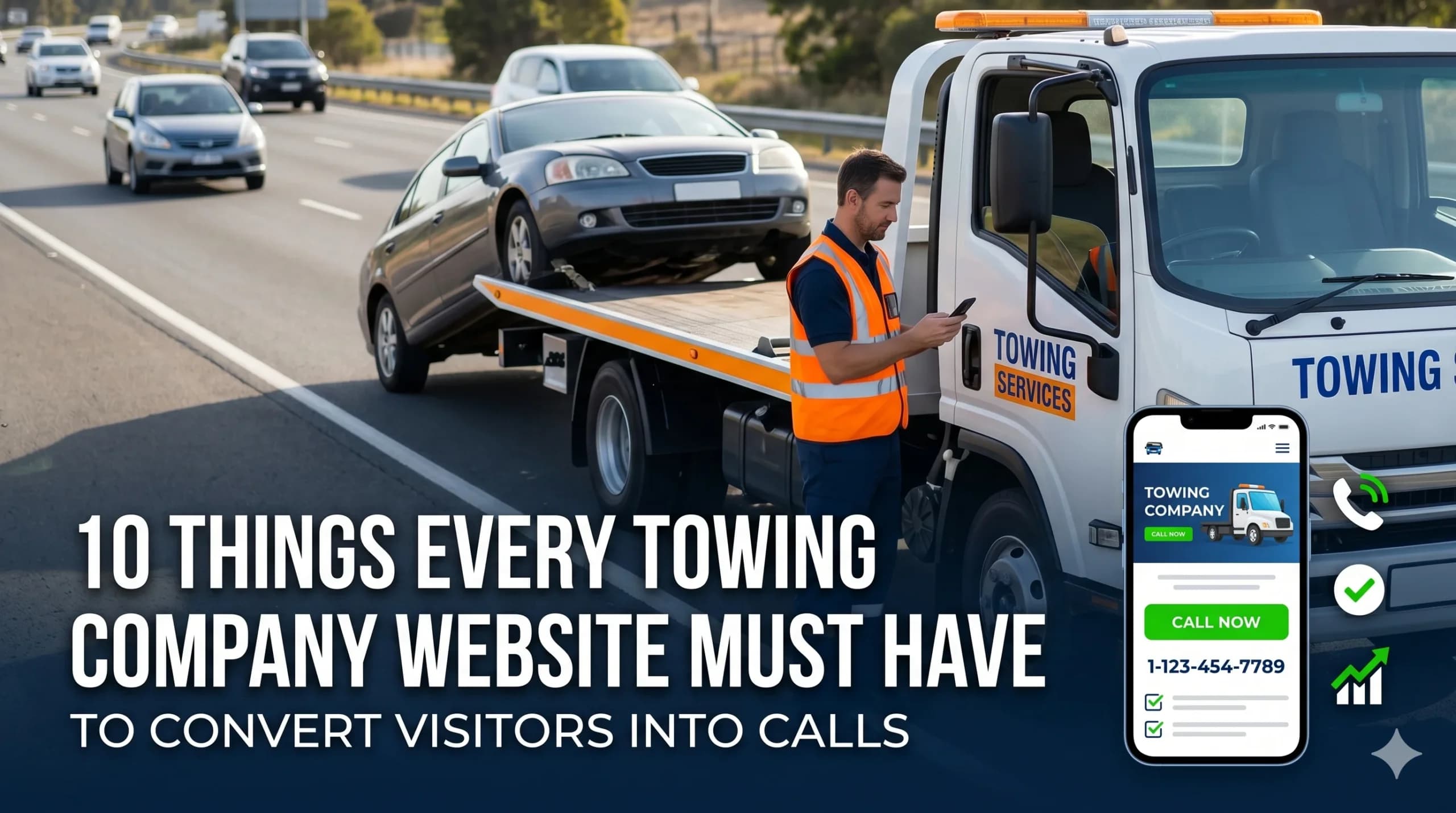
10 Things Every Towing Company Website Must Have to Convert Visitors Into Calls
Someone’s car just broke down on the side of I-95. They grab their phone, search “towing near me,” and your website comes up. They tap the link — and wait. And wait. The page loads slowly, your phone number is buried, and the site looks like it was built in 2014. They hit the back button and call your competitor instead.
That call should have been yours.
Most towing company owners assume their website is “fine” because it exists. But there’s a massive difference between a website that exists and a website that works — one that loads in under two seconds, earns trust instantly, and makes it dead simple for a stressed driver to call you right now. Bad towing website design doesn’t just look unprofessional. It actively costs you real money, every single day.
Here are the 10 things your towing website absolutely must have — and why missing even a few of them is likely killing your inbound calls.
1. Your Phone Number Front and Center — Above Everything Else
A person searching for a tow truck is never relaxed. They’re stranded, stressed, possibly in a dangerous spot. The last thing they want to do is scroll, hunt, or figure out your website.
Your phone number needs to be visible immediately — at the top of the page, large, and ideally a tap-to-call button on mobile. If someone has to look for it, you’ve already lost them.
Most towing websites bury the number in a footer or a “Contact Us” page. That single mistake turns a hot lead into a call for your competitor. Put the number at the top of every single page.
2. A Website That Loads in Under 3 Seconds
Think of your website like a tow truck that takes 45 minutes to show up — nobody’s going to wait. They’re calling someone else.
Most people will leave a website that takes more than three seconds to load. On mobile, that number is even less forgiving. Slow websites lose customers before those customers ever see what you offer.
Slow loading usually comes from uncompressed images, cheap hosting, or bloated code that was never cleaned up. Websites built for towing services businesses are built lean and fast from the start — because in this industry, speed isn’t a luxury, it’s a requirement.
3. Mobile-First Design — Because That’s Where Your Customers Are
Nearly every towing call starts on a smartphone. A driver on the side of the road isn’t opening a laptop — they’re on their phone, thumb-scrolling, looking for the fastest solution.
If your website isn’t built for mobile first, it’s broken for your most important visitors. Text that’s too small to read, buttons that are too close together to tap, images that don’t scale — these all send the message: call someone else.
Your mobile site should feel like an app, not a shrunken desktop page. Big tap targets, readable text, fast loading, and that phone number always visible.
4. Service Area Pages That Tell Google Exactly Where You Work
Here’s a frustrating reality: you could be the best towing company in your city, but if Google doesn’t know exactly which towns and zip codes you serve, it won’t show you to the right people.
A single generic homepage isn’t enough. You need individual pages — or at minimum, clear content — that names the cities, counties, and areas you serve. When someone types “towing in [their town],” Google needs a strong signal that you’re the answer.
Without this, you’re invisible to the searches that matter most. You’re not competing for calls — you’re just hoping for them.
💡 Pro Tip: Your Google Business Profile and Website Must Match
One of the most common silent killers for towing companies: your Google Business Profile lists your address and service areas, but your website never mentions those same locations. Google sees the mismatch and gets confused — so it shows you less.
Make sure your business name, address, phone number, and service areas are consistent across your website and your Google listing. This single fix can meaningfully improve how often you appear in local search results.
5. A Clear, Trust-Building Homepage — Not a Wall of Text
When a potential customer lands on your homepage, they’re asking one question in the first five seconds: “Can I trust these people to help me right now?”
A homepage that answers that question looks like this: your logo, your service area, your phone number, a simple headline that says what you do and where, and a few trust signals — years in business, reviews, licensing, 24/7 availability. That’s it.
What it does not look like: three paragraphs about your “commitment to excellence,” a slideshow of stock photos, and a form asking for someone’s name, address, and vehicle year just to get a quote.
6. Real Customer Reviews Displayed Prominently
Reviews are your most powerful sales tool — and most towing websites either hide them or don’t use them at all.
A five-star rating from a real local customer does more to earn trust than anything you could write about yourself. Someone stranded at 2 AM reads “Showed up in 20 minutes, professional and fair price — highly recommend” and thinks: that’s who I’m calling.
Display your Google reviews directly on your homepage. Show your star rating. If you have testimonials, put them where people can see them without scrolling to the bottom of the page.
7. 24/7 Availability Stated Clearly — If You Offer It
Towing is an emergency service. A huge portion of calls happen at night, on weekends, and during bad weather. If you’re available around the clock, your website needs to say so — loudly and clearly.
“Available 24/7 — Call Now” is one of the highest-converting phrases a towing website can display. It removes a major objection immediately: will anyone even answer?
If it’s not visible above the fold, you’re losing calls to competitors whose websites make that promise clearly.
8. A Simple, Specific List of Your Services
People don’t always need a full tow. They might need a jump start, a tire change, a lockout service, or a long-distance haul. If your website doesn’t clearly list what you offer, those customers assume you don’t do it — and they search elsewhere.
List your services clearly. Use plain language:
- Emergency towing
- Roadside assistance (jump starts, flat tires, lockouts)
- Long-distance towing
- Accident recovery
- Motorcycle towing
- Heavy-duty towing
Each service is a reason for someone to call you. Make sure every one of them is visible.
Before & After: What a Real Fix Looks Like
The situation: A two-truck towing operation in the Dallas–Fort Worth area had been in business for six years. The owner had built a basic website years earlier — it had his phone number, a photo of his truck, and a short paragraph about his services. He was getting some calls but knew he was missing out.
The problems: His site took over eight seconds to load on mobile. His phone number wasn’t clickable. He had no service area pages, so Google wasn’t ranking him for any specific cities. His homepage had no reviews, no trust signals, and no clear call-to-action.
What changed: His website was rebuilt with a mobile-first design, a tap-to-call button in the header, service area pages for nine cities in the DFW metro, and his Google reviews embedded on the homepage. Load time dropped to under two seconds.
The result: Within 90 days, his inbound calls from the website more than doubled. His Google Maps ranking improved for several target cities. The same owner who felt like his website was “fine” was now treating it as his best salesperson.
Not sure if your towing website has these issues? Get a free website audit — no obligation, just a clear picture of what’s costing you leads.
9. Schema Markup — The Invisible Code That Helps Google Trust You
You’ll never see schema markup on your website — it lives in the background code. But it makes a real difference in whether Google shows your business confidently in local search results.
Think of it this way: without schema, Google is guessing what your business does, where it operates, and when it’s open. With schema, you’re handing Google a fact sheet. It knows you’re a towing company, your service area, your hours, and your phone number — so it shows you with more confidence.
Most towing websites have none of this in place. It’s a straightforward fix that gives you a competitive edge in local search.
10. A Strong, Visible Call-to-Action on Every Page
Every page of your towing website should answer one question for the visitor: what do I do next?
The answer is almost always: call us. But if your website doesn’t remind people to do that — repeatedly, visibly, on every page — many of them won’t. They’ll read, they’ll scroll, and they’ll leave.
Every page needs a visible phone number, a “Call Now” button on mobile, and a clear prompt. Don’t make people think. The easier you make it to call, the more calls you get.
Your Path to More Calls: 5 Simple Steps
If you’re looking at this list and realizing your website is missing several of these elements, here’s where to start:
- Check your mobile load speed — use Google’s free PageSpeed Insights tool. If you’re scoring below 70 on mobile, your site is losing you calls.
- Make your phone number a tap-to-call link — every phone number on your site should open the dialer automatically on mobile.
- Add your service cities to your homepage and create basic location pages — even simple pages for your top five cities can make a measurable difference.
- Embed your Google reviews on your homepage — this is one of the fastest trust-builders available to any local business.
- Get a professional audit — before spending money on ads or SEO, understand exactly what your current website is and isn’t doing for you.
Frequently Asked Questions
Why am I not getting calls from my website?
The most common reasons are slow load speed, a phone number that isn’t clickable on mobile, and no clear call-to-action. If someone lands on your site and has to work to figure out how to call you, most of them won’t bother — they’ll call a competitor whose website made it easier.
How do I know if my towing website is actually working?
If you’re not tracking calls from your website separately from other sources, you honestly don’t know. At a minimum, check your Google Analytics to see how many people visit your site and how quickly they leave. High “bounce rates” — people leaving immediately — usually point to slow load speed or a homepage that doesn’t answer the visitor’s question fast enough.
How long does it take to see results from a new towing website?
Most towing companies start seeing measurable improvements in local rankings and call volume within 60–90 days of launching a properly built website. The timeline depends on how competitive your market is and how much content your site has — but the foundation (speed, mobile design, local pages) starts working from day one.
What makes a towing website different from a regular business website?
Towing is an emergency service, which means your website has to perform under pressure — on a cracked phone screen, on a slow mobile connection, for someone who’s stressed and needs a fast answer. A standard business website optimized for browsing and comparison doesn’t serve that moment well. Your site needs to load instantly, show your phone number immediately, and communicate trust in under five seconds.
Do I really need a fast website if my customers are local?
Yes — especially because they’re local and on mobile. Local customers searching for a tow truck are almost always on their phones. If your site takes more than three seconds to load on a mobile connection, a large percentage will leave before it finishes loading. Speed matters more for local emergency services than almost any other business category.
How do I know what my website is costing me in lost leads?
That’s exactly what a free audit reveals. Book a free website review and you’ll get a clear breakdown of what’s working, what’s not, and what specific fixes would have the most impact on your inbound call volume — no jargon, no sales pitch, just straight answers.
Stop Letting Your Website Cost You Calls
Every day your towing website is missing these elements, calls are going to competitors. Not because those companies are better than you — but because their websites make it easier for customers to choose them in a split second of stress and urgency.
The good news: most of these problems have clear, fixable solutions. You don’t need a complete redesign every time — but you do need a website that was built with one goal in mind: getting your phone to ring.
How Digital Trace builds towing service websites is different from a generic web agency. Every site is built around conversion — fast, mobile-first, and optimized for local search from day one.
Ready to find out exactly what your current website is costing you? Get your free towing website audit — no obligation, no hard sell. Just a clear, honest picture of what’s standing between your website and more calls.