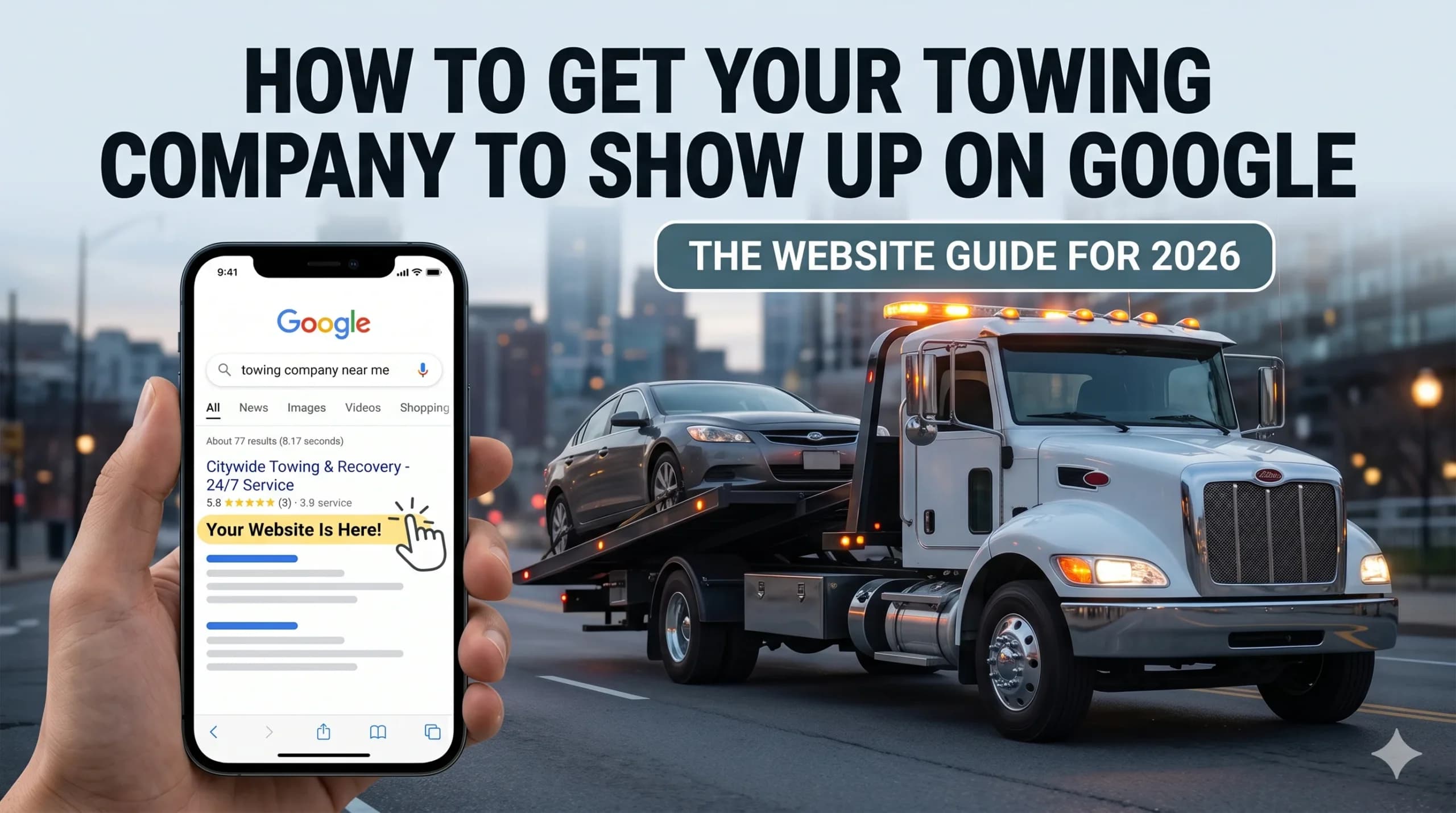
How to Get Your Towing Company to Show Up on Google: The Website Guide for 2026
Your tow truck is ready. Your drivers are ready. But when someone types “towing near me” into their phone at 11pm on the side of the highway — your company doesn’t show up.
That’s not a luck problem. That’s a website problem.
Most towing company owners assume Google just “figures it out” over time. It doesn’t. Google needs very specific signals from your website to trust it enough to show it to customers in your area. Without those signals, you stay invisible — while your competitor two towns over picks up every call.
This guide breaks down exactly what’s holding your towing website back, what fixes actually move the needle, and what a properly built towing website looks like in 2026.
Your Website Loads Slow — And You’re Losing Customers in the First 3 Seconds
Think about what happens when someone calls for a tow. They’re stressed, stuck, and searching from their phone. If your website takes more than 3 seconds to load, most of them hit the back button before they ever see your phone number.
The technical term is “page speed” — but the business reality is simpler: a slow site means a ringing phone for your competitor instead of you.
Most towing websites are slow because they’re loaded with oversized images, outdated plugins, or cheap hosting that can’t keep up. None of that is visible to you as the owner — but Google sees all of it, and it penalizes slow sites by pushing them down in search results.
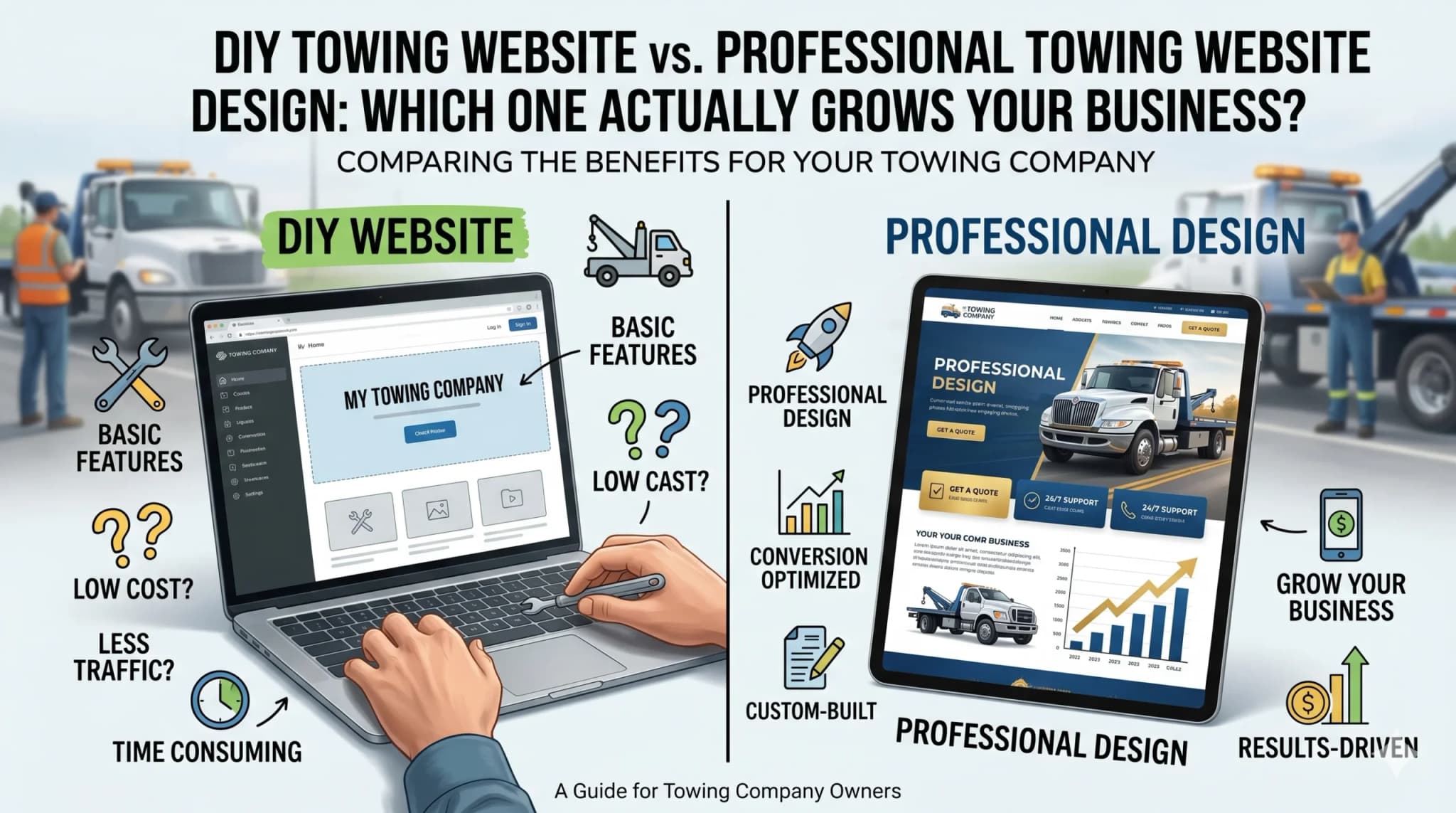
The fix isn’t just compressing a few images. It means rebuilding the site with speed as a priority from the ground up — the way websites built for towing businesses should be from day one.
Google Can’t Find Your Location — So It Doesn’t Show You
Here’s something that surprises most towing company owners: having a website doesn’t automatically tell Google where you operate.
If your site doesn’t clearly signal your city, service area, and business category in the right places, Google treats you like a ghost. It has no confidence in where you are or who you serve — so it doesn’t put you in front of local searchers.
This is where “local SEO” actually lives. It’s not magic — it’s making sure your city and service area appear in your page titles, headings, and behind-the-scenes tags that Google reads. It also means your website needs to be consistent with your Google Business Profile.
When these pieces are missing or mismatched, your site gets buried. When they’re done right, your business shows up in the map pack — those top 3 results that get the bulk of local calls.
Your Homepage Doesn’t Answer the One Question Visitors Are Asking
When someone lands on your towing website, they have one question: “Can this company help me, right now, where I am?”
If your homepage takes more than a few seconds to answer that — with a visible phone number, your service area, and what you do — they’re gone. They’re not reading paragraphs about your company history. They’re in crisis mode, and they need certainty fast.
Think of your homepage like the first 10 seconds of a dispatcher call. You answer fast, state your coverage area, and give the customer confidence. A homepage that buries the phone number, uses a slideshow, or leads with generic phrases like “Welcome to our company” fails that test every time.
A high-converting towing website leads with:
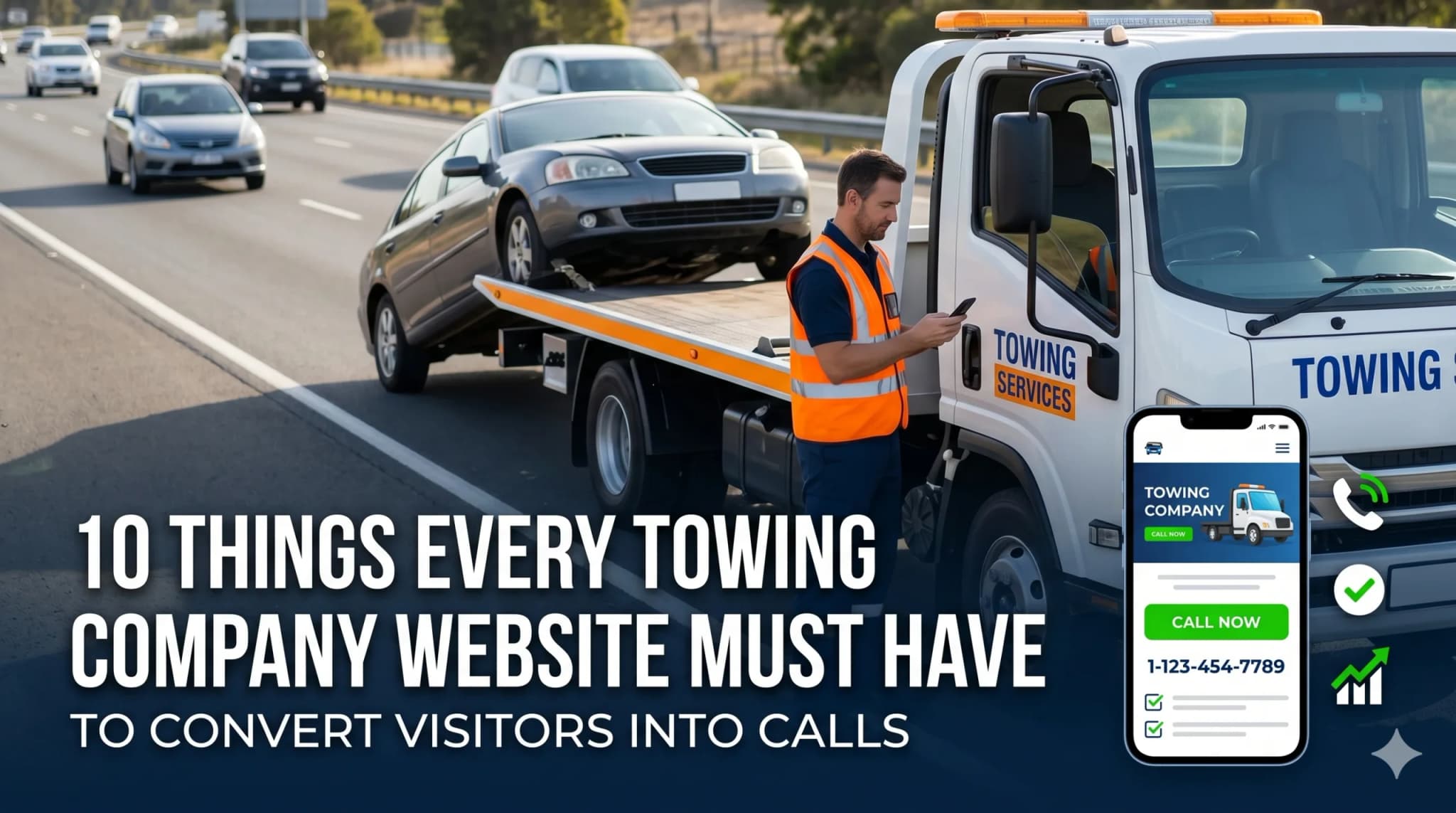
- A large, tappable phone number at the top of every page
- Your service area stated clearly above the fold
- One clear action for the visitor to take (call now or request a tow)
- Trust signals: years in business, 24/7 availability, reviews
💡 Pro Tip
The biggest mistake towing websites make: only having one phone number buried in the footer.
On mobile — where the majority of towing searches happen — your phone number needs to be a tappable button at the top of every single page. If a user has to scroll or search for it, you’ve already lost them. The technical fix is a sticky header with a click-to-call button that follows the user as they scroll. Simple change. Significant impact.
Google Doesn’t Know Enough About Your Business to Trust It
Even if your site loads fast and your phone number is visible, there’s one more layer Google is looking for: structured data that confirms who you are.
Without getting into code, here’s what it means in practice: Google likes to see your business name, address, phone number, and service category written in a specific format in the background of your website. It’s called schema markup. Without it, Google is guessing at what your business does — and guessers don’t rank confidently.
There’s also the matter of your Google Business Profile. If the details there don’t match your website exactly — down to your address format — Google treats that as a red flag. Inconsistency equals distrust.
Fixing this isn’t something you need to manage manually. It’s built into the foundation of a properly designed towing service website — and it’s one of the fastest ways to start climbing in local search.
What Happens When You Get It Right: A Real-World Example
Consider a towing company operating out of a mid-sized city in the Southeast. They had a website — built years ago by a friend — with no mobile-friendly layout, a phone number only in the footer, and no local keywords anywhere on the page. Their Google Business Profile listed a slightly different address than the website. They were getting maybe 3–4 calls a week from online searches.
After a full rebuild — fast-loading mobile-first design, proper local SEO structure, click-to-call button, and schema markup — the results shifted within about 60 days. They went from page 3 on Google to the local map pack for their primary city. Weekly calls from online search went from 4 to roughly 22. Same trucks. Same drivers. Same service area. Just a website that actually worked.
That’s not a miracle — it’s what happens when a towing company website is built to perform, not just to exist.
Not sure if your towing website has these issues? Get a free website audit — no obligation, just a clear picture of what’s costing you leads.
Your Path to More Calls: 5 Steps That Actually Work
You don’t need to become a web expert. You just need to make sure these five things are handled — either by you or by someone who knows what they’re doing.
- Speed check your site. Go to Google’s PageSpeed Insights and type in your URL. If your mobile score is below 70, you have a problem that’s costing you calls every day.
- Audit your phone number placement. Open your website on your phone. Is your number visible without scrolling? Is it tappable? If not, fix that first.
- Check your Google Business Profile. Make sure your name, address, and phone number match your website exactly — same format, same abbreviations.
- Add your service area to your homepage. Your city and surrounding areas should appear in your page title, your main heading, and naturally in your content.
- Have your site reviewed by someone who builds towing company websites. A general web designer won’t know what towing customers search for. Industry-specific experience matters.
If steps 1–4 reveal real problems, step 5 is where Digital Trace builds towing service websites that address all of it — from performance to local SEO to conversion — in one build.
Frequently Asked Questions
Why am I not getting calls from my website?
The most common reasons are: your site doesn’t rank locally because it lacks proper SEO structure, your phone number isn’t easy to find on mobile, or your page loads too slowly and visitors leave before they see anything. Any one of these alone can kill your lead flow — and most towing websites have all three.
How do I know if my towing website is actually working?
If you’re not tracking where your calls come from, you’re flying blind. A working website should show up in Google’s local map pack for your city and service keywords, load in under 3 seconds on mobile, and have a measurable call volume tied to online searches. If you can’t answer any of those, a free audit is the fastest way to find out what’s happening.
How long does it take to see results from a new website?
Most towing businesses start seeing movement in Google rankings within 45–90 days of launching a properly optimized site. The improvements to your conversion rate — more visitors calling — happen immediately once the site is live. SEO takes a little longer, but the foundation needs to be right from day one.
What makes a towing website different from a regular business website?
Towing customers are almost always searching from a phone, under stress, needing an immediate response. That means your site needs to prioritize mobile speed, a visible phone number, clear service area messaging, and 24/7 availability — not general business information or flashy design. A generic web template built for a retail store won’t convert towing customers the same way.
Do I really need a fast website if my customers are local?
Yes — especially because they’re local. Local searches happen almost entirely on mobile, often in low-signal areas. A slow site in that context doesn’t just frustrate visitors; it ranks lower in Google’s local results to begin with. Google officially uses page speed as a ranking factor for mobile search, which is exactly where your customers are finding you.
How much does a towing company website cost, and is it worth it?
Cost varies depending on what’s built and what’s needed. But the better question is: what’s it costing you to have a website that doesn’t work? If your site brings in even two or three more calls per week, it pays for itself quickly in most markets. The goal isn’t to spend money on a website — it’s to build something that generates a return.
Ready to Find Out What’s Holding Your Website Back?
Most towing company owners don’t know their website has problems until they have someone look at it. The slow load time, the buried phone number, the missing local signals — it all adds up to leads going to a competitor instead of you.
A free audit takes minutes and shows you exactly what’s costing you calls. No sales pressure. No commitment. Just a clear, honest look at your website from people who specialize in towing website design.