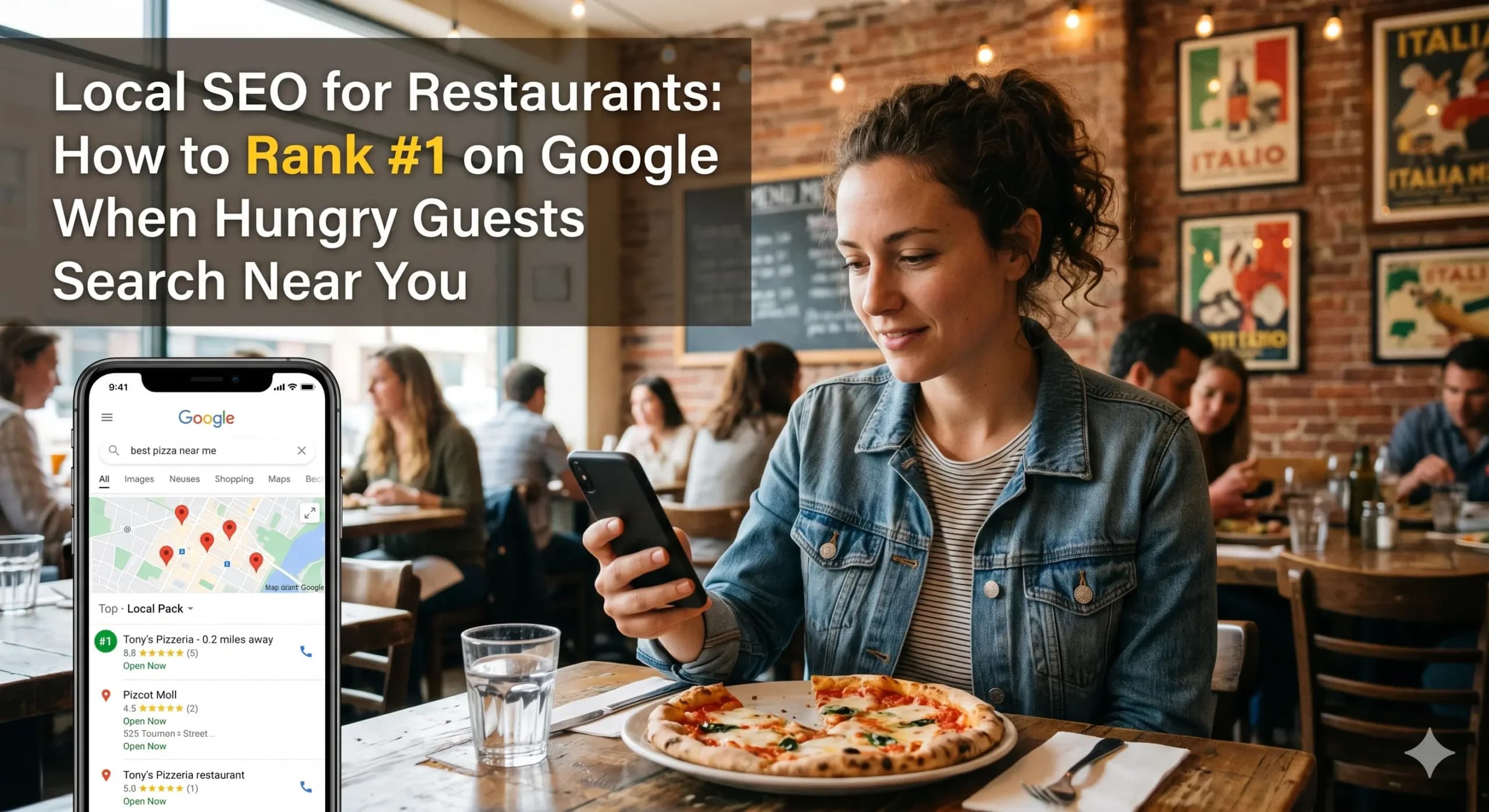
Local SEO for Restaurants: How to Rank #1 on Google When Hungry Guests Search Near You
Picture this: someone is sitting two blocks from your restaurant, phone in hand, hungry, typing “best Italian near me.” Your competitor shows up. You don’t.
That’s not a marketing problem. That’s a website problem.
Most restaurant owners assume Google ignores them because they’re small, or because they don’t run ads. The real reason is quieter — and more fixable. Your restaurant site design is either helping Google trust your business enough to show it, or it’s giving Google reasons to skip you entirely.
This guide breaks down exactly what’s happening behind the scenes, what it’s costing you in empty tables and missed phone calls, and what a properly built restaurant website actually looks like.
Why Google Doesn’t Show Your Restaurant (Even to People Nearby)
Google’s job is to answer a hungry person’s question with confidence. When it looks at your website, it’s asking: Can I trust this place is real, open, and worth recommending?
If your site is slow, hard to navigate on a phone, or missing basic information, Google hedges its bet — and shows a competitor instead. That competitor probably isn’t better than you. They just have a website that gives Google fewer reasons to doubt them.
The fix isn’t magic. It’s web design for restaurants done with Google’s expectations in mind, not just what looks pretty on a desktop screen.
Your Website Is Like Your Host Stand — First Impressions Are Everything
Think about the last time you walked into a restaurant and the host stand was empty, the menu was water-stained, and nobody acknowledged you for two minutes. You probably considered leaving.
That’s what a bad restaurant website does to a visitor — except online, they actually do leave. Usually within three seconds.
When someone finds your site from Google:
- If it loads slowly, they hit the back button before they see your phone number
- If it isn’t mobile-friendly, your menu looks like a tangled mess on their screen
- If your hours aren’t front and center, they assume you might be closed and call someone else
The best restaurant web designers build sites where a guest can find your address, view your menu, and make a reservation within ten seconds — on their phone, in poor cell signal, at 7 PM on a Friday.
The Hidden Reasons Your Phone Isn’t Ringing
Your Site Loads Too Slowly
Most restaurant websites carry way too many large images. Beautiful food photography matters — but when those images aren’t optimized, your site takes five or more seconds to load. Most visitors are gone by second three.
Google also measures load speed and uses it as a ranking signal. A slow site gets buried — not because your food isn’t great, but because your restaurant web page design is technically weighing itself down.
A properly built site compresses images without losing quality, loads the most important content first (your name, phone number, and CTA), and performs fast on mobile networks — not just your office WiFi.
Google Doesn’t Know Enough About Your Business
There’s a layer of invisible information websites can include that tells Google exactly what type of business you are, where you’re located, what hours you keep, and what cuisine you serve. It’s called structured data.
Without it, Google has to guess — and when Google isn’t sure, it doesn’t take the risk of showing you. Adding this information to your restaurant homepage design is one of the fastest ways to improve your visibility in local search results.
Your Menu Isn’t Readable by Google
Here’s one most restaurant owners never hear: if your menu is a PDF, an image, or embedded from a third-party service, Google can’t read it. That means every search like “restaurants with wood-fired pizza near me” — where your menu is the proof — won’t surface your site.
A proper restaurant menu design website has menu items in actual text on your pages, so Google can match your food to what people are searching for. That’s free, perpetual discoverability that most restaurants are leaving on the table.
💡 Pro Tip
One of the most common mistakes restaurant owners make is linking their menu as a PDF download. It feels professional — but Google can’t index a PDF the way it indexes a webpage. Every item on that PDF is invisible to search. Move your menu into an actual webpage with text, organized by category, and you’ll start showing up in searches you never appeared in before. A good restaurant website designer will handle this automatically.
What a High-Performing Restaurant Website Actually Does
The difference between a restaurant site that generates reservations and one that just “exists” comes down to a few specific decisions:
- Mobile-first design — over 80% of local searches happen on a phone. If your site isn’t built for mobile, it’s built for no one.
- Click-to-call phone numbers — your number should be tappable from every page, without the visitor having to find it
- Fast-loading food photography — visual and appealing, without slowing the page down
- Google Business Profile integration — your website and your Google listing should reinforce each other
- Location-specific pages — if you have multiple locations, each one needs its own page with its own address, hours, and content
This is what Digital Trace builds for restaurant businesses. Not sites that look good in a portfolio screenshot — sites that show up in search and turn visitors into guests.
Before & After: What a Real Turnaround Looks Like
The situation: A family-owned Italian restaurant in Austin, Texas had been in business for eleven years. Great food, loyal regulars — but their website hadn’t been updated since 2017. It loaded in seven seconds on mobile. Their menu was a PDF. Their Google Business Profile pointed to a website that didn’t mention their hours or their new outdoor patio.
What changed: Their site was rebuilt with a mobile-first layout, an optimized text-based menu organized by course, click-to-call buttons on every page, and proper structured data added behind the scenes. Their Google Business Profile was synced with the new site’s content.
The result: Within 60 days, they were ranking in the top three results for four high-intent local searches. Online reservation requests increased by roughly 65%. The owner’s words: “I thought people just weren’t searching for us. Turns out they were — we just weren’t showing up.”
Not sure if your restaurant website has these issues? Get a free website audit — no obligation, just a clear picture of what’s costing you reservations and calls.
Your Path to More Reservations: 5 Steps That Actually Work
1. Check your site on your phone — right now. Open your restaurant’s website on your personal phone using cellular data (not WiFi). Count how long it takes to load. If it’s more than three seconds, customers are leaving before they see your menu.
2. Find out if your menu is visible to Google. Copy a specific dish name from your menu and search it on Google along with your city. If your site doesn’t appear, your menu may be locked in a PDF or image that Google can’t read.
3. Confirm your Name, Address, and Phone number are consistent everywhere. Your website, Google Business Profile, Yelp listing, and Facebook page should all show identical information. Even small differences (St. vs Street) can confuse Google and hurt your local ranking.
4. Add a clear call to action above the fold. The first thing someone sees on your site — before they scroll — should be your phone number, your hours, and a button that says “Make a Reservation” or “Order Online.” Don’t make them dig for it.
5. Work with a restaurant web design agency that understands local SEO. A site that looks great but doesn’t rank is just an expensive brochure. The right restaurant website development company builds both at once — design that converts and structure that ranks.
Frequently Asked Questions
Why am I not getting calls from my website even though I have one?
Having a website and having a website that works are two different things. Most restaurant sites have at least one silent problem — slow loading, a PDF menu, missing location data — that stops Google from showing them to local searchers. A free audit will usually surface the issue in minutes.
How do I know if my restaurant website is actually working?
The honest answer: if you’re not getting regular inquiries, reservation requests, or direction clicks from your site, it probably isn’t working. A properly optimized site should be your most consistent source of new customer inquiries — not an afterthought.
How long does it take to see results from a redesigned restaurant website?
Most restaurants see measurable improvement in local search rankings within 30 to 60 days of launching a properly built site. The technical improvements — speed, structured data, mobile performance — take effect quickly. Content-driven results build over time but compound.
What makes a restaurant website different from a regular business website?
Restaurants have specific needs that generic websites don’t address: a readable, indexable menu, reservation and ordering integrations, location-specific pages for multi-location businesses, and mobile-first design for on-the-go searchers. A restaurant web design agency that has built sites specifically in the food and hospitality space will know these requirements without you having to explain them.
Do I really need a fast website if my customers are mostly local?
Local customers are more reliant on mobile browsing — they’re searching while they’re out, often in areas with variable cell coverage. A slow site hurts you more with local searchers, not less. Google also factors page speed directly into local rankings.
How do I know if my restaurant website has these specific problems?
The fastest way is to get a free website audit from Digital Trace. The audit looks at your site’s speed, mobile experience, menu visibility, local SEO signals, and conversion setup — and gives you a plain-English summary of what’s costing you leads, with no obligation to do anything with it.
Ready to Stop Losing Reservations to a Broken Website?
Every day your restaurant site isn’t built for local search is a day you’re handing customers to whoever shows up in that top spot instead of you.
Digital Trace specializes in building and optimizing restaurant websites across the US — sites that load fast, rank well, and turn hungry searchers into paying guests. There’s no guesswork, no generic templates, and no vague promises about “increasing your visibility.”
Find out exactly what’s costing you reservations, calls, and revenue — and what it would take to fix it. No sales pressure. Just a clear, honest look at your site from people who build restaurant websites for a living.