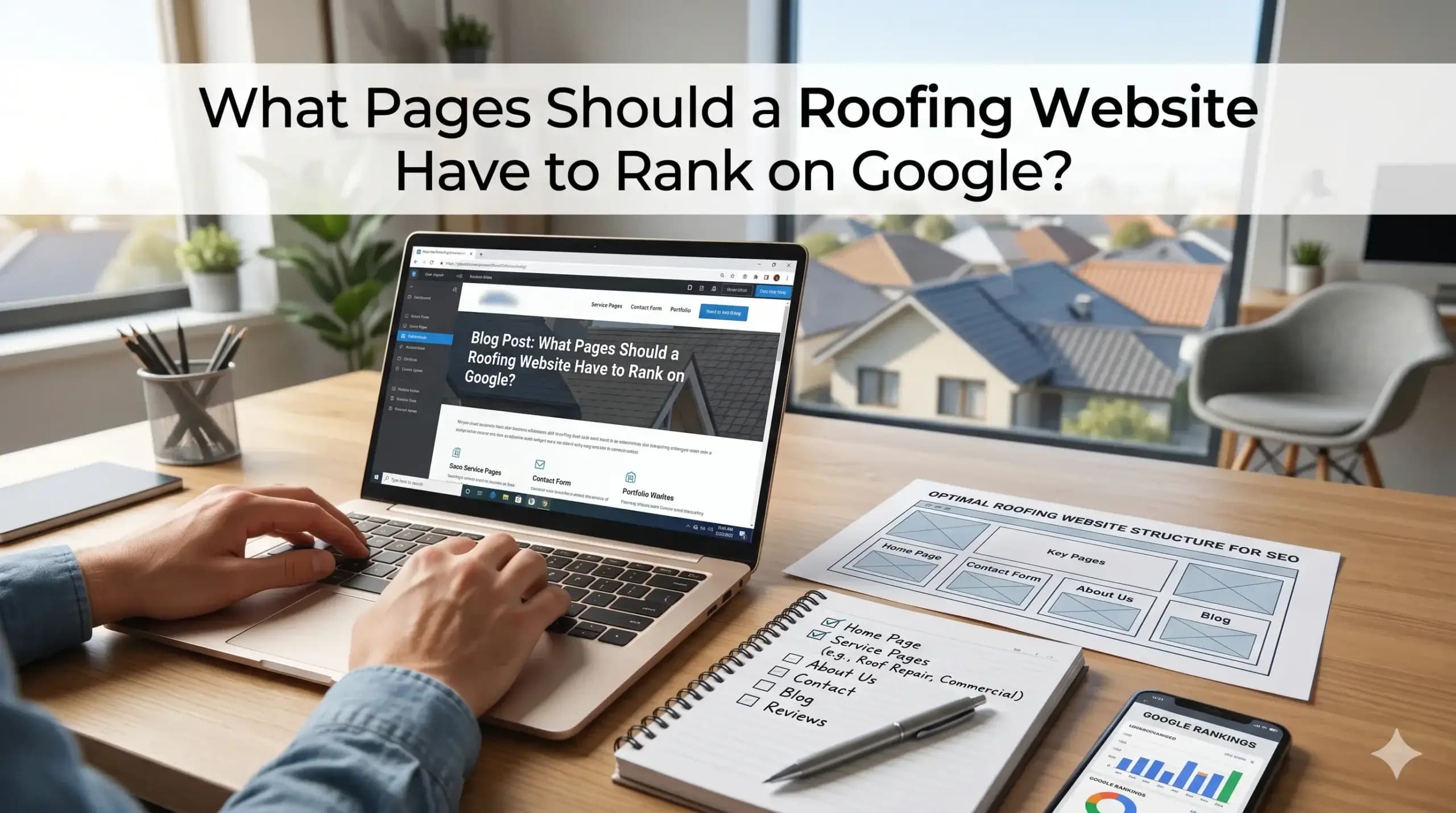
What Pages Should a Roofing Website Have to Rank on Google?
Most roofing websites have a homepage, a contact form, and maybe a gallery. That’s not a website that ranks — that’s a digital business card. The difference between a roofing contractor who gets 30 inbound calls a month from Google and one who gets three usually comes down to page structure, not ad spend. Here’s exactly what pages your site needs, why they matter, and how to build them right.
Your Homepage Is Not Your Ranking Strategy
Your homepage should convert — not rank. Trying to target every keyword from your homepage (“asphalt shingle roofing, metal roofing, flat roof repair, storm damage, emergency tarping…”) dilutes everything and ranks for nothing. Google rewards pages that are about one thing.
Your homepage should clearly state what you do, where you do it, and who you are. A GAF Master Elite certification badge, an Owens Corning Preferred Contractor logo, or a BBB accreditation seal should be visible above the fold. These aren’t just trust signals for visitors — they’re relevance signals for Google.
What your homepage shouldn’t do: try to rank for “roofing contractor [city].” That’s what your location page is for.
Every Service Needs Its Own Dedicated Page
The most common structural mistake roofing websites make is listing all services on one page. Asphalt shingle replacement, TPO flat roofing, metal roofing installation, storm damage repair, and emergency tarping are not the same service — and Google doesn’t treat them as such.
A dedicated page for each service lets you:
- Target the specific search terms homeowners use (“TPO flat roof replacement” vs. “asphalt roof repair”)
- Include relevant content about that service — material options, typical costs, what the process looks like
- Capture different intent stages (someone searching “how long does a metal roof last” is earlier in the buying process than someone searching “metal roof installation quote”)
A roofing company in Columbus, Ohio — call them Ridge Line Roofing — built individual pages for asphalt shingles, metal roofing, and TPO commercial flat roofing. Within four months, their TPO page was ranking on page one for “commercial flat roof replacement Columbus” — a search their homepage had never appeared in. That page alone brought in two commercial jobs in one quarter.
Each service page should be 500–800 words. It should include the service process, materials, typical project scenarios, and one or two trust signals relevant to that service.
Do You Have a Page for Every City or Town You Serve?
The short answer is: yes — and it’s the highest-leverage SEO move most roofers aren’t making.
Google’s local search algorithm heavily weights geographic relevance. A single “Service Areas” page that lists 12 cities doesn’t rank for any of them. A dedicated page for each location — “Roofing Contractor in Westerville, OH,” “Roofing Services in Dublin, OH” — gives Google a page to associate with that specific geography.
Each location page needs to be genuinely unique. Thin pages that just swap out the city name get filtered out of rankings. What makes a location page rank:
- A unique opening that references something real about that area (hailstorm history, common roof types in the neighborhood, proximity to your shop)
- A list of services you offer in that location
- At least one local trust element (a review from someone in that town, a project photo from a job in that area)
- A clear call to action with a local phone number if possible
Sites with dedicated service area pages rank in 2.3x more local searches than those relying on a single combined page, according to aggregated data from local SEO studies across contractor industries. For a roofing company serving 10 towns, that means 10 chances to appear on page one — instead of one.
A Storm Damage and Insurance Claim Page Is Not Optional
After a significant hailstorm or wind event, homeowners don’t search for “roofing contractor.” They search for “storm damage roof repair,” “hail damage roof insurance claim,” and “does my insurance cover roof replacement.” These are high-intent searches — people who are actively trying to solve a problem right now.
If your site doesn’t have a page dedicated to storm damage and insurance claims, you are invisible during the most profitable window of the year.
This page should cover:
- What roof storm damage looks like (granule loss, dents in flashing, cracked shingles)
- How the insurance claims process works, step by step
- What your role is as the contractor — documentation, adjuster meetings, supplement requests
- Why working with a local, licensed and insured contractor matters for claims
This is also the page where your certifications matter most. An Owens Corning Preferred Contractor or GAF Master Elite designation carries real weight with homeowners navigating a stressful insurance process for the first time.
A Comparison Table: Pages That Drive Leads vs. Pages That Don’t
| Page Type | Ranking Potential | Lead Generation | Required? |
|---|---|---|---|
| Homepage | Low — too broad | High (converts traffic) | Yes |
| Individual service pages | High — specific intent | High | Yes |
| Location/city pages | Very high — local search | High | Yes |
| Storm damage / insurance | High — seasonal surge | Very high | Yes |
| Gallery / project photos | Low | Medium (trust signal) | Recommended |
| About page | Low | Medium (trust signal) | Yes |
| Blog / resource articles | Medium — informational | Low-medium | Optional |
| Generic “Services” page | Very low | Low | No — replace with individual pages |
What an About Page Actually Does for Your Rankings
About pages don’t rank for high-value terms. That’s not why you need one. You need it because Google’s E-E-A-T framework (Experience, Expertise, Authoritativeness, Trustworthiness) evaluates the people behind a business.
A strong About page for a roofing contractor includes:
- How long you’ve been in business and roughly how many roofs you’ve replaced
- Certifications and manufacturer credentials (these should link to the actual manufacturer certification pages — those are quality backlinks in reverse)
- Real photos of the owner, crew, and trucks — not stock photography
- A short story about why you started the company or what separates you from larger crews
This content doesn’t move rankings directly, but it reduces bounce rates, increases time on site, and signals legitimacy to both visitors and Google’s quality raters.
Frequently Asked Questions
How many pages does a roofing website need to rank on Google? There’s no magic number, but a roofing site with fewer than 10–15 pages is almost certainly leaving local search traffic on the table. The minimum effective structure is: homepage, one page per major service (typically 4–6 pages), one page per service area (at least 3–5 for most contractors), a storm damage page, an about page, and a contact page. That gets you to 15–20 pages, which is enough to build real topical authority in a local market.
Does a roofing website need a blog to rank on Google? Not necessarily. Blogs help with informational searches (“how much does a new roof cost,” “how long does a metal roof last”) but the highest-value local SEO ranking comes from service pages and location pages — not blog posts. If you have limited time, build out your core service and location pages first. Add a blog only when those are solid.
What’s the difference between a service page and a location page for roofing SEO? A service page targets a roofing type or job category — “TPO Flat Roof Installation” or “Storm Damage Roof Repair.” A location page targets a geography — “Roofing Contractor in Naperville, IL.” You need both. A location page with no services doesn’t convert; a service page with no geography doesn’t rank locally. The most effective structure combines them: a primary service page plus location-specific variants that mention that service in the context of each city.
Should every roofing service have its own page, even if the services are similar? Yes. Even closely related services benefit from separation. “Asphalt shingle repair” and “asphalt shingle replacement” attract different searchers with different intentions and budgets. A homeowner with a few missing shingles after a windstorm searches differently than someone whose roof is 22 years old and failing. Separate pages let you address each scenario specifically — and give Google two pages to rank instead of one.
The One Thing to Take Away
Page structure is your roofing website’s foundation. A well-designed site with the wrong page structure will still underperform a plain-looking site that has a dedicated page for every service, every city, and every high-intent moment like storm season. Build the structure first. Everything else — design, photos, reviews — amplifies it.
If you want to see how your current site’s structure compares to what’s actually driving leads in your market, Digital Trace Agency builds websites exclusively for roofing contractors — or start by running your numbers through the free Roofing Lead Loss Calculator to see what your site might be costing you.